Montgeon and the northern parks form Le Havre's green lung, a vast stretch of urban woodland perched above the city where forest trails, family adventure courses, and quiet picnic clearings offer a complete change of pace from the concrete geometry of the UNESCO-listed centre below. Free to enter every day, the Parc Forestier de Montgeon is Le Havre's largest urban forest park and the place where Le Havre residents genuinely go to breathe.
Perched on the plateau above Le Havre's rebuilt city centre, the Parc Forestier de Montgeon is 270 hectares of genuine urban woodland, a former historic forest that now serves as the city's primary green escape. This is where the city unwinds: joggers on forest tracks at dawn, families picnicking under the canopy on weekends, teenagers queuing for the zip lines of the adventure park tucked into the trees.
Orientation: Where Montgeon Sits in Le Havre
Le Havre is divided, broadly, into a lower city and an upper city. The lower city is the famous UNESCO-listed grid of Auguste Perret's post-war reconstruction, running from the central railway station down to the seafront. The upper city, reached by climbing the steep plateau edge, is a different world: residential, quieter, and defined largely by its green space. Montgeon is the dominant feature of this northern plateau.
The park's main entrance and address sits on Avenue Jacques Anquetil, and its postal district is 76610 Le Havre. In practical terms, the forest occupies the northern arc of the city, forming a green boundary between the dense urban fabric of the inner northern districts and the open plateau beyond. Walking south from the park's edge, you descend towards the city centre in about 20 to 30 minutes on foot. The park connects eastward to the broader network of northern green spaces, including the Parc de Rouelles, the other anchor of Le Havre's northern green belt.
Together, Montgeon and Rouelles account for a significant portion of Le Havre's green space. For visitors building a mental map: the UNESCO-listed city centre is directly to the south, the seafront curves away to the west, and the northern residential plateau, with Montgeon at its heart, rises above everything. The forest is accessible by tram from the centre, making it more reachable than its size might suggest.
Character & Atmosphere
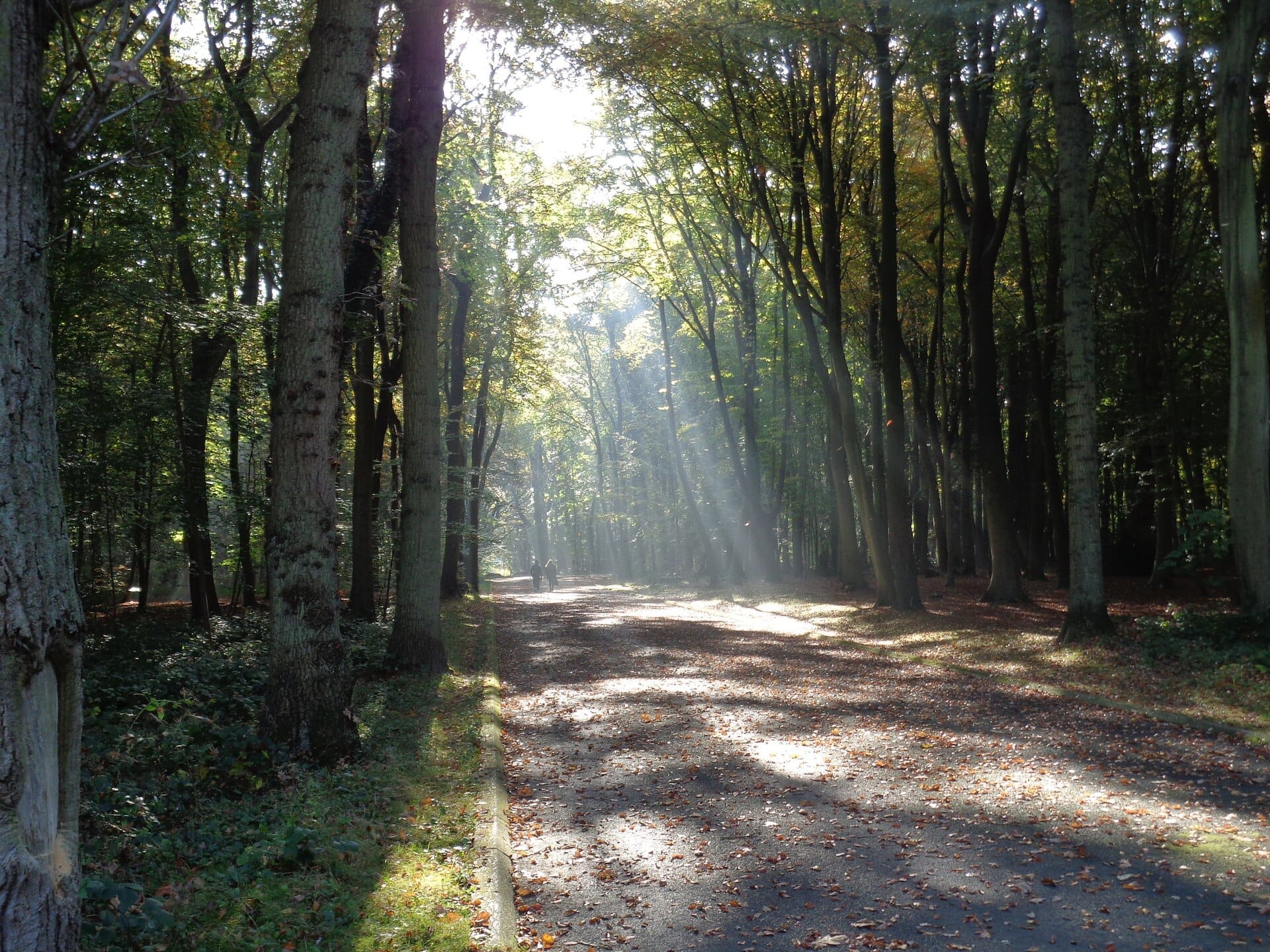
What strikes you first about Montgeon is the silence. Not countryside silence, exactly, but the particular quiet of a large urban forest: the hum of the city is still audible on the periphery, but inside the canopy it fades behind birdsong and the creak of branches. The forest originated as part of the historic Hallates woodland and was formally shaped into a 270-hectare recreational park by landscape architect René-Edouard André in 1910, which explains why it has the feel of a designed landscape, with proper paths and clearings, rather than raw scrubland.
Early mornings here belong to joggers and dog walkers. The light filters through the tree cover in long pale columns, and the tracks are almost empty. By mid-morning on weekends, families start arriving in earnest, spreading blankets in the clearings nearest the car parks and the playground areas. Summer afternoons are when the adventure park draws its biggest crowds, the zip lines cutting through the trees to the sound of shouts from above. Late afternoons, the park empties gradually, and the golden hour light turns the forest floor amber in a way that feels very different from the hard coastal light down on the seafront.
This is not a neighborhood in the conventional sense of cafés on every corner and shop fronts at street level. There are no restaurants inside the forest and very little commercial infrastructure in the immediate surroundings. The character here is entirely defined by the green space itself. Local residents from the surrounding northern districts use it daily, but it draws very few tourists, which means you are almost always sharing it with people who actually live in Le Havre rather than visitors passing through.
ℹ️ Good to know
Admission to the Parc Forestier de Montgeon is free every day of the year. LH Aventure Parc inside operates seasonally and charges separately for its tree-climbing and zip-line courses.
What to See & Do
The forest is the main event, and it rewards simple exploration. The network of marked trails runs through mixed woodland, with enough variation in terrain and tree cover to hold interest for a two-hour walk without doubling back. Paths are generally well-maintained, and some sections are suitable for trail running and cycling, making it popular with the local sports community throughout the week.
LH Aventures Parc is the park's most structured attraction, an adventure course built into the forest canopy with multiple circuits of varying difficulty, including giant zip lines that cross above the treeline. It caters to children from around age three upward, as well as adults looking for more of a challenge on the higher circuits. If you are visiting Le Havre with children, this is likely the single most effective way to spend a forest morning. Check seasonal opening dates before visiting, as the park does not operate year-round.
Forest walking and trail running on marked paths through the 270-hectare woodland
LH Aventures Parc: multi-level tree-climbing circuits and zip lines (seasonal, paid entry)
Picnic areas and clearings throughout the park, free to use
Children's playgrounds near the main access points
Informal cycling on forest tracks (mountain bikes are well suited to the terrain)
Beyond the forest itself, the northern parks zone connects to Parc de Rouelles, a complementary green space to the east with its own distinct character. Together they form a continuous corridor of green that can occupy a full day if you move between them. For visitors who prefer structured cultural itineraries, Montgeon works best as a half-day counterpoint to a morning in the city centre, giving the afternoon a completely different texture.
Montgeon should also be understood in the context of Le Havre's broader outdoors offer. The city is more outdoor-focused than many French urban centres, with the seafront promenade to the south and the clifftop heights of Sainte-Adresse to the west. Montgeon is the inland green counterpart to that coastal offer, and the combination of forest, beach, and coastal cliffs is one of the underappreciated qualities of Le Havre as a destination.
Eating & Drinking
There is no food scene inside Montgeon forest itself. The park has no cafés, restaurants, or kiosks within its boundaries, so if you are planning a morning or afternoon here, the practical approach is to pick up provisions before you arrive. The residential streets surrounding the park have local bakeries and small grocery shops serving the neighbourhood, but these are everyday local amenities rather than destinations in their own right.
For a proper meal before or after a forest visit, the most sensible option is to head back toward the city centre, which takes about 15 to 20 minutes by tram. The central covered market, the Halles Centrales, is the best place in the city to pick up prepared food, charcuterie, cheese, and bread for a forest picnic.
The Halles Centrales is worth knowing about if you are planning a Montgeon picnic: it sits in the city centre and stocks everything you need for a proper outdoor lunch. Buy your supplies there, take the tram north, and eat under the trees. This is exactly how many Le Havre families spend a warm weekend morning.
💡 Local tip
Pack food and water before entering the forest. There are no shops or cafés inside the park, and the nearest reliable food options are in the surrounding residential streets or back in the city centre.
Getting There & Around
The most practical way to reach Montgeon from the city centre is by Le Havre's tramway network, operated by LiA (Le Havre Agglomération). Tram stops serve the northern districts, and the LH Aventures Parc and the main park access are reachable from the tram network. The journey from the central station takes around 15 to 20 minutes. Check the LiA website or app for current timetables and the most relevant stop for your intended park entrance.
By car, the park is accessed via Avenue Jacques Anquetil, and there are parking areas near the main entrance. The reference access point called 'porte des paons' is noted in local directions and is useful as a landmark when navigating. Parking inside or adjacent to the forest is free, which makes the car a convenient option for families with young children or large groups.
On foot from the city centre, the walk up to Montgeon involves climbing the plateau escarpment, which is steep in places. It is a worthwhile urban walk if you are interested in seeing how the lower and upper cities connect, but most visitors will find the tram more comfortable, especially on the return leg when legs are tired from the forest trails.
Cycling is a reasonable option for the fit, particularly given Le Havre's network of cycle paths and the long-distance Vélomaritime and Seine à Vélo routes that pass through the city. Inside the forest, unpaved tracks are manageable on a mountain bike. If you are exploring Le Havre more broadly on two wheels, a forest loop through Montgeon pairs well with the Le Havre walking tour route down in the city centre.
💡 Local tip
Verify current tram stop names and routes on the LiA network before your visit, as stop configurations can change. The LiA website (transports-lia.fr) has a journey planner in French and English.
Where to Stay
There are no hotels inside or immediately adjacent to Montgeon forest. Accommodation in the immediate northern residential districts is limited and geared entirely toward local rental. This is not a neighborhood where visitors stay; it is one they visit from a base elsewhere in the city.
For visitors to Le Havre, the logical base is either the UNESCO city centre or the seafront area, both of which offer good hotel selection and easy tram access to Montgeon. The Le Havre accommodation guide covers the options across the main districts. From the city centre, Montgeon is a 20-minute tram ride, which makes it a perfectly manageable half-day excursion rather than a reason to seek out nearby lodging.
Honest Assessment: Is Montgeon Worth Your Time?
Montgeon is not for every visitor to Le Havre. If your priority is the UNESCO architecture, the Impressionist art heritage, or the coastal scenery, the forest park sits outside those itineraries and requires a deliberate detour north. It rewards visitors who want to see Le Havre as a functioning city rather than a museum piece, or who need a half-day of open air after the concrete corridors of the Perret grid.
For families, it is arguably the most useful green space in the city. LH Aventures Parc alone can occupy children for a full morning, and the picnic infrastructure means a low-cost, low-stress family day out. For walkers and trail runners, the scale of the forest, 270 hectares of continuous woodland, is genuinely impressive for an urban park. And for anyone on a longer visit to Le Havre who wants to understand the city beyond its famous rebuilt centre, Montgeon reveals a side of the city that the standard Le Havre itinerary rarely reaches.
The park's main limitation is its lack of supporting infrastructure. No cafés, no restaurants, no visitor services inside the boundary. On a cold, wet Normandy day, a forest walk loses much of its appeal. But on a clear morning in spring or summer, with the light breaking through the canopy and the city invisible below the treeline, Montgeon is one of the more genuinely peaceful places in northern France.
⚠️ What to skip
Montgeon is a full-sun, open-air destination. In Normandy's frequently grey and wet autumn and winter months, the forest tracks can be muddy and the atmosphere considerably less inviting. Sturdy footwear is advisable any time outside peak summer.
TL;DR
Montgeon is Le Havre's largest urban forest park, 270 hectares of free-access woodland on the northern plateau above the city centre, reachable by tram in about 20 minutes.
Best suited to families (especially with LH Aventures Parc's adventure courses and zip lines), walkers, joggers, and visitors who want a green counterpoint to Le Havre's architectural city centre.
No food or drink options inside the park: bring provisions from the Halles Centrales or local bakeries before you arrive.
Not an accommodation base: stay in the city centre or seafront and visit Montgeon as a half-day excursion.
Works best in spring and summer; muddy tracks and grey skies reduce the appeal significantly in autumn and winter, so factor in the weather before making it a priority.
Le Havre rewards the traveler who looks past the port cranes. This two-day itinerary moves through the UNESCO-listed Perret city centre, France's second-largest Impressionist collection, a shingle beach 500 metres from downtown, and one of Normandy's most dramatic coastlines — all without wasting a morning on the wrong museum on its closing day.
Le Havre has an oceanic climate that keeps things cool and changeable year-round. This guide cuts through the vague advice to tell you exactly when to go, what to expect each season, and who should consider visiting in winter instead of summer.
Le Havre sits at the heart of one of France's richest travel regions. Whether you're docked on a cruise or basing yourself in the city, these are the most rewarding day trips within reach, with honest breakdowns of transport, costs, and what to expect on the ground.
Le Havre divides opinion. Some dismiss it as an industrial port stop; others leave genuinely impressed by its UNESCO-listed architecture, world-class Impressionist museum, and dramatic seafront. This guide gives you the full picture so you can decide for yourself.
Le Havre is one of northern France's most significant cruise ports, serving as the gateway to Normandy, Paris, and a UNESCO-listed city centre that most passengers overlook entirely. This guide covers terminal logistics, honest excursion options, transport costs, and how to make the most of your time ashore.
Le Havre is where Impressionism got its name. In 1872, Claude Monet painted 'Impression, Sunrise' from the harbor quays here, launching one of art history's most consequential movements. This guide covers every key painting location, the MuMa art museum, coastal trail logistics, and what most visitors get wrong about the city's artistic legacy.
Le Havre transforms in summer, with a city-wide contemporary art season, an urban pebble beach on the English Channel, action sports events, and free outdoor installations across its UNESCO-listed centre. This guide covers everything from the Un Été au Havre festival to getting there from Paris or the UK.
Le Havre rewards walkers like few other French cities. Its UNESCO-listed city centre is a coherent open-air museum of post-war modernist architecture, compact enough to cover in a half-day on foot. This guide gives you everything you need to plan your own route, from key stops and timing to costs and seasonal tips.
Le Havre is a strong family destination. From a long pebble beach accessible by tram to a UNESCO-listed city centre full of surprising museums, this Normandy port city offers genuinely varied days out for children of all ages. This guide covers the best activities, honest seasonal advice, and practical logistics so you can plan without guesswork.
In September 1944, Allied bombing reduced Le Havre's city centre to rubble. What followed was one of the most ambitious urban reconstruction projects in postwar Europe, led by architect Auguste Perret and completed by 1964. This guide covers the history, the key sites, and how to explore it all on the ground.
Le Havre's rebuilt city centre is one of Europe's most coherent examples of postwar modernist urbanism. This guide walks you through the key Auguste Perret sites across 133 hectares of UNESCO-listed streets, with practical advice on access, booking, and what to actually look for.
Le Havre is more than a port of call. This guide covers the city's UNESCO-listed architecture, world-class Impressionist museum, urban beach, summer festivals, and the best day trips from Normandy's most underrated city.
Le Havre has more accommodation variety than most visitors expect, from design-forward hotels in the UNESCO-listed Perret quarter to seafront options steps from the beach. This guide breaks down where to stay in Le Havre by neighborhood, budget, and what you're here to do.