Halles Centrales: Le Havre's Covered Market
Built between 1958 and 1960 as part of Auguste Perret's post-war reconstruction, the Halles Centrales is Le Havre's working food market. Free to enter and open seven days a week, it offers fresh produce, local traders, and a ground-level view of everyday city life inside a landmark modernist concrete shell.
Quick Facts
- Location
- Place des Halles Centrales, 76600 Le Havre (centre-ville Perret district)
- Getting There
- Walkable from central tram and bus stops; surrounded by pedestrian shopping streets off Rue Voltaire and Rue Louis-Brindeau
- Time Needed
- 30–60 minutes to browse; longer if you stop to shop or eat
- Cost
- Free entry; spending depends on purchases
- Best for
- Food lovers, architecture enthusiasts, self-catering travellers, and anyone curious about local daily life
- Official website
- www.leshallescentrales-lehavre.fr
What the Halles Centrales Actually Is
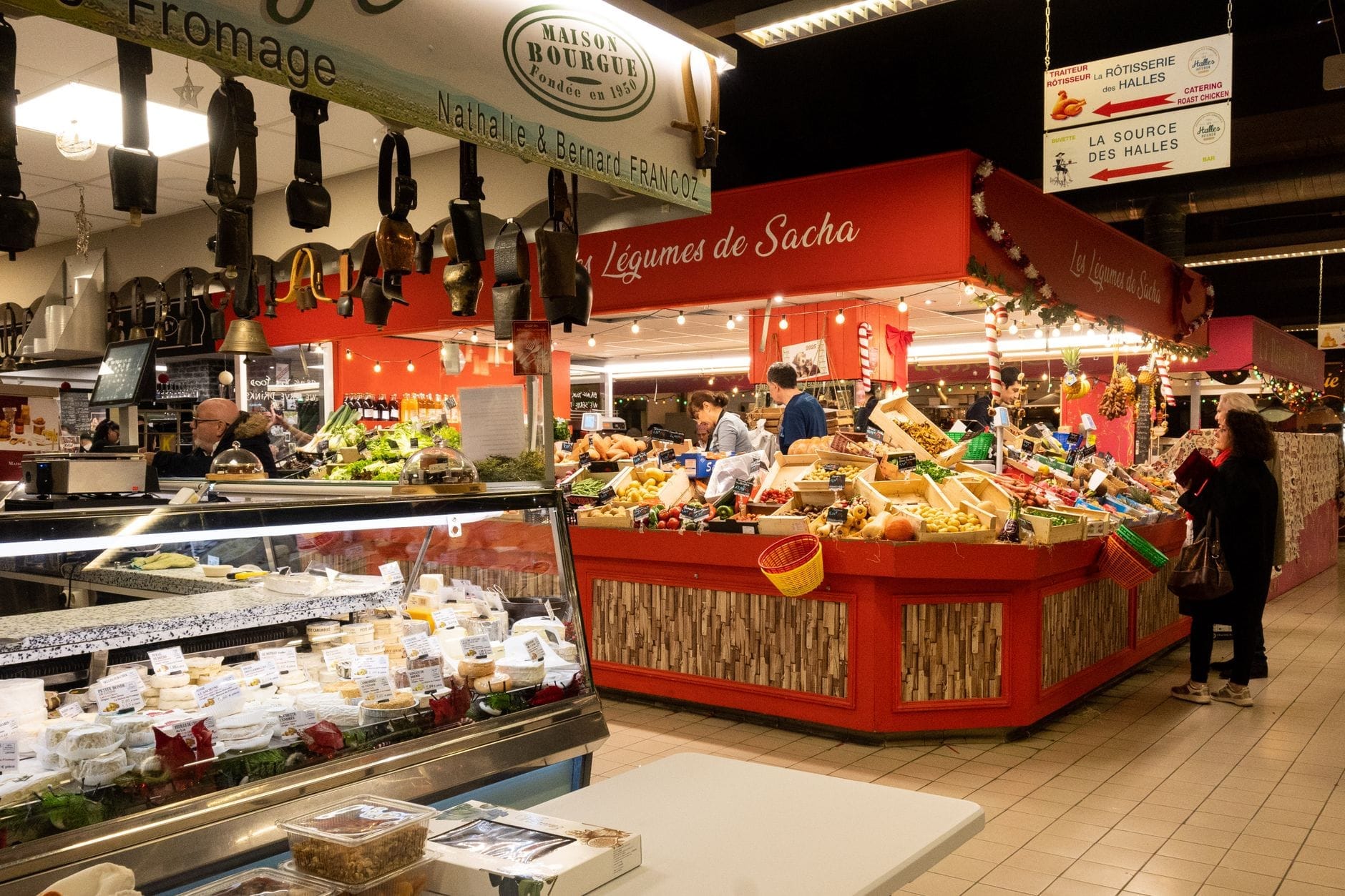
The Halles Centrales is Le Havre's central covered food market, occupying a full city block in the heart of the UNESCO-listed reconstruction district. It is not a tourist market. It is not a food hall designed for visitors. It is a working municipal market where locals buy cheese, fish, charcuterie, vegetables, and flowers on their way home from work. That distinction matters, because it means the experience here is honest and unperformed.
The current building was inaugurated on 5 May 1960, constructed between 1958 and 1960 following a design competition held in 1953. Its reinforced-concrete frame fits precisely within the modernist logic of Perret's rebuilt grid. The hall replaced a 19th-century predecessor: the earlier market halls dated from 1855, were modified in 1885, and were destroyed entirely in the Allied bombing raid of 5 September 1944. The site itself has held a market since 1835, making it one of the longest-running commercial locations in the city's history.
The Halles Centrales sits within a protected architectural heritage zone (ZPPAUP) established in 1995, and the surrounding streetscape is part of the wider UNESCO World Heritage area. For a fuller picture of how this market fits into the post-war urban plan, the Maison du Patrimoine / Atelier Perret is a short walk away and provides detailed context on the reconstruction architecture.
💡 Local tip
Opening hours: Monday to Saturday 08:30–19:30, Sunday 09:00–13:00. Entry is free.
The Building: Concrete, Light, and Perret's Grid
From the outside, the Halles Centrales reads as a low, horizontal block of pale concrete set into a pedestrian area, its facades facing Rue Voltaire, Rue Louis-Brindeau, Rue Bernardin-de-Saint-Pierre, and Rue Dicquemare. There is no grand entrance sequence. You simply step off the pavement and you are inside.
The interior is organised around a central hall with perimeter shops and stalls arranged in a grid pattern. The concrete structure is left largely visible: columns, beams, and ceiling surfaces are unadorned. Natural light enters from high-level windows and roof openings, casting flat, diffuse light across the stalls. The overall effect is practical rather than decorative, which is consistent with Perret's ethos across the rebuilt city centre. This is not a glass-and-steel spectacle market. The beauty, if you find it, is in the proportions and the logic of the space.
If you are visiting Le Havre specifically to understand the Perret reconstruction, pairing the Halles Centrales with the nearby Église Saint-Joseph and the Hôtel de Ville gives a clear sense of how the same architectural language plays out across civic, religious, and commercial building types.
Tickets & tours
Live prices and dates from our booking partner. If you book, we may earn a commission at no extra cost to you.
Customized private D-day Normandy landing excursion from Le Havre
From 1.300 €Instant confirmationFree cancellationFull-day trip to Giverny and Rouen from Le Havre
From 1.200 €Instant confirmationFree cancellation
What You Find Inside: The Stalls and the Traders
The market carries the full range expected of a serious French municipal hall. The fish and seafood section reflects Le Havre's port location directly: expect whole fish, shellfish including oysters and mussels, and catch that arrived via the nearby coast. The smell of the fish stalls hits you before you reach them, sharp and marine, and is not subtle. This is not a polished food court. It is a market.
Elsewhere you find cheese counters with Normandy staples like Camembert, Livarot, and Pont-l'Évêque sold by weight, charcuterie and pork products, fresh bread and pastry traders, and vegetable stalls piled with seasonal produce. Flower sellers occupy one section of the perimeter. Perimeter units include more permanent shops selling deli goods, spices, and prepared foods.
Traders and regular customers know each other by name. Transactions happen quickly, in French, without fanfare. English is not commonly used in the market stalls, though basic pointing and numbers will get you through any purchase without difficulty.
How the Experience Changes Through the Day
The market is at its fullest and loudest from mid-morning through to early afternoon on weekday days, particularly between 09:30 and 12:30. This is when traders are fully set up, produce is freshest, and the local shopper traffic peaks. The concrete hall amplifies noise: vendors calling out prices, the scrape of crates, the chatter of the fish counter. It is louder than most covered markets of similar size.
By late afternoon on weekdays, stalls begin to thin. Some traders pack down by 17:00, particularly those selling fresh fish or cut flowers. If you are coming to shop rather than observe, aim for the morning. If you are coming to photograph, late afternoon light through the upper windows creates longer shadows and a quieter floor.
Sunday mornings from 09:00 to 13:00 are worth prioritising if your schedule allows. The market is busier than any weekday morning, the range of stalls is at its widest, and the surrounding pedestrian streets fill with secondary market activity. This is the session that most resembles the traditional weekly French market experience.
⚠️ What to skip
The market closes at 13:00 on Sundays. If you are arriving from the cruise port or planning a late Sunday morning start, time this carefully. The market closes at 13:00 on Sundays. If you are arriving from the cruise port or planning a late Sunday morning start, time this carefully.
Who This Suits and Who Should Probably Skip It
The Halles Centrales rewards travellers who are genuinely interested in food, local commerce, or post-war architectural urbanism. For self-catering visitors staying in Le Havre, it is the obvious first stop for provisions. For food-curious travellers, the Normandy cheese and seafood counters alone justify a visit.
Travellers expecting a curated food experience, artisan stalls aimed at tourists, or a scene with English-language signage may find the market underwhelming. It is a utilitarian space serving a utilitarian purpose. The architecture rewards slow observation, but it does not announce itself. If your time in Le Havre is limited and you are choosing between this and the city's major cultural sites, the Halles Centrales should probably be secondary to the Église Saint-Joseph or the Musée Malraux. As a complement to a longer visit, it earns its place easily.
Cruise passengers with a short stopover should factor travel time carefully. The market is walkable from the city centre but requires some planning around the port. The Le Havre cruise port guide covers transit options from the terminal to the city centre in practical detail.
Practical Notes: Getting There, Accessibility, and Photography
The Halles Centrales occupies a central block in the Perret reconstruction grid, bounded by pedestrian and semi-pedestrian streets. The surrounding area is flat and paved, and the market hall itself operates at street level with no steps at the main entrances, making access straightforward for those with pushchairs or mobility aids. No detailed official accessibility statement covering adapted facilities is currently published on the market's own website, so if this is a specific requirement, contacting the market directly in advance is advisable.
The LiA tram and bus network stops are within walking distance of the market; the central pedestrian zone makes driving to the market impractical, and parking in the immediate area is limited. On foot from the main Hôtel de Ville square, the walk takes around five minutes along the shopping streets.
Photography inside the market is possible without restriction, though crowded morning sessions make wide-angle shots of the hall interior difficult. Early weekday mornings before 09:30 offer the best light from upper windows and fewer people in frame. Stall traders are generally tolerant of cameras at a respectful distance, though asking before photographing individual vendors or customers is both courteous and advisable.
The Halles Centrales sits within the broader centre-ville Perret district, which contains most of Le Havre's post-war architectural landmarks. A half-day walking circuit of the area can reasonably include the market, the Hôtel de Ville, Saint-Joseph, and the Perret show flat without covering more than two kilometres on foot.
Insider Tips
- Sunday mornings before 10:30 are the best time to visit if you want the full market atmosphere: maximum stall coverage, fresh arrivals, and the surrounding pedestrian streets animated with additional vendors.
- The perimeter shops along the inner arcade sell prepared Normandy specialities including rillettes and terrines that are not available at the open stalls. These are worth a slow look even if you are not buying.
- Bring cash. Most fresh produce traders in French municipal markets prefer cash, and while some permanent perimeter shops accept card payments, the open fish and vegetable stalls may not.
- The fish section is toward the back of the hall, away from the main street entrances. First-time visitors often only see the produce and flower stalls near the doors without realising the scale of the seafood offering inside.
- Pair the market visit with a walk along the pedestrian shopping streets immediately outside. The block is integrated into Le Havre's main retail zone, and the architectural sequence of the surrounding Perret-era buildings makes the walk worthwhile in its own right.
Who Is Halles Centrales For?
- Self-catering travellers who want to stock up on Normandy produce and seafood
- Architecture enthusiasts studying the Perret reconstruction at ground level
- Food-curious visitors wanting to see what locals actually buy and eat
- Families looking for a free, covered activity that works in any weather
- Travellers with a longer stay who want to move beyond the main tourist circuit
Nearby Attractions
Other things to see while in Centre Ville Perret (UNESCO District):
- Bassin du Commerce
The Bassin du Commerce is a 500-metre historic dock at the centre of Le Havre's UNESCO-listed rebuild, where post-war concrete architecture meets open water. Free to visit during public hours, it serves as the city's most photogenic public space and a genuine crossroads of daily life.
- Cathédrale Notre-Dame du Havre
Standing on rue de Paris in central Le Havre, the Cathédrale Notre-Dame du Havre is a rare pre-war survivor in a city rebuilt almost entirely from concrete after 1944. Its layered Gothic and Renaissance architecture tells a longer story than the modernist grid surrounding it. Entry is free, and the contrast with Auguste Perret's rebuilt city makes it one of the most thought-provoking stops in the centre.
- Église Saint-Joseph
Designed by Auguste Perret and structurally completed in 1957 (with consecration in 1964), Église Saint-Joseph is the defining monument of Le Havre's UNESCO-listed city centre. Its 107-metre lantern tower and 12,768 panels of coloured glass make it one of the most architecturally significant post-war churches in Europe. Entry is free.
- Hôtel de Ville (City Hall)
Inaugurated in 1958 and designed by Auguste Perret, Le Havre's Hôtel de Ville is one of the most architecturally significant post-war civic buildings in France. The 72-metre tower rises above a five-hectare square, offering guided visits to a 17th-floor belvedere with sweeping views across the UNESCO-listed city centre and the port beyond.
Planning a trip? Discover personalized activities with the Nomado app.