Église Saint-Joseph: Le Havre's Towering Post-War Masterpiece
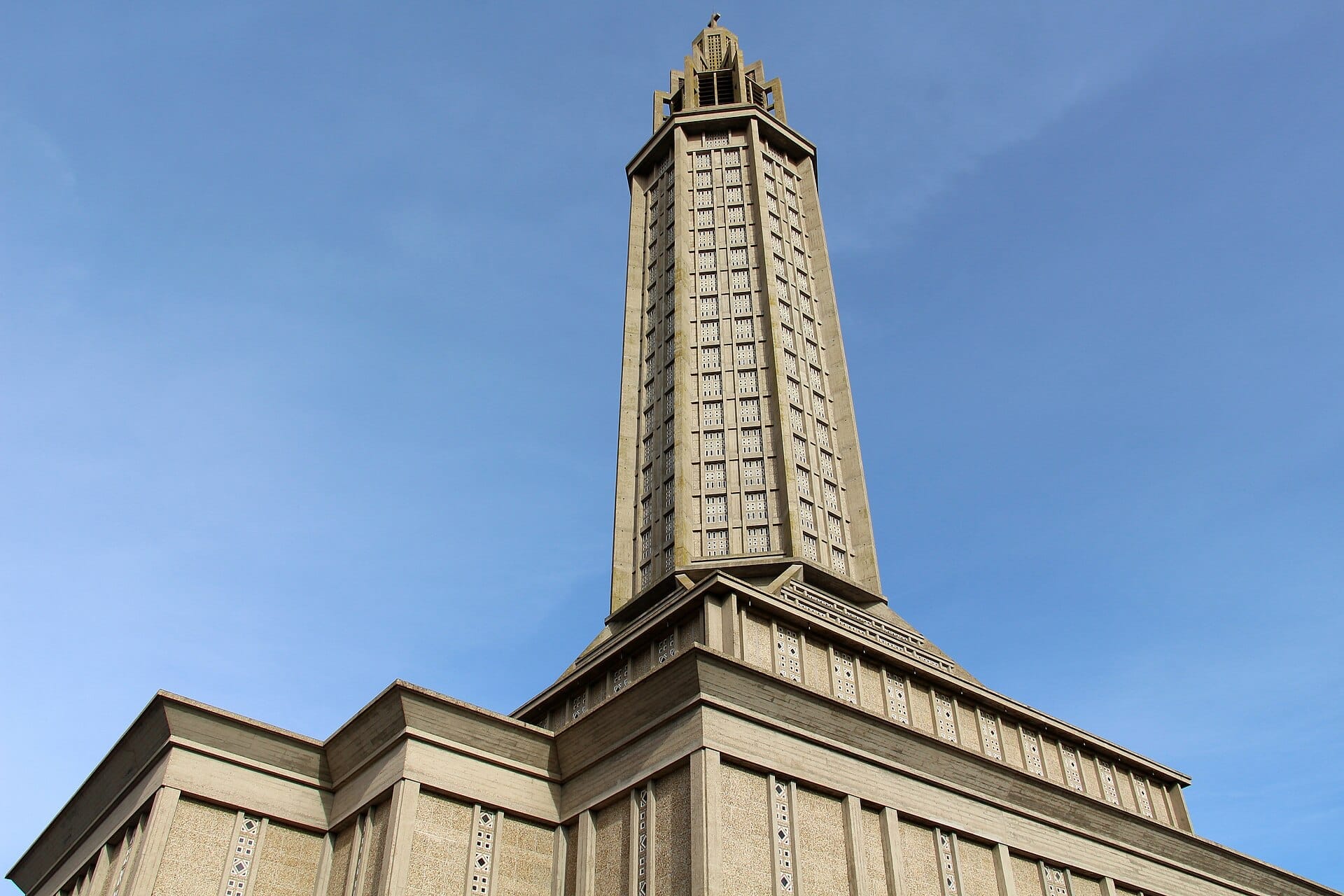
Designed by Auguste Perret and structurally completed in 1957 (with consecration in 1964), Église Saint-Joseph is the defining monument of Le Havre's UNESCO-listed city centre. Its 107-metre lantern tower and 12,768 panels of coloured glass make it one of the most architecturally significant post-war churches in Europe. Entry is free.
Quick Facts
- Location
- Boulevard François 1er, 76600 Le Havre (centre-ville Perret)
- Getting There
- Short walk from Le Havre railway station; on the Vélomaritime / EuroVelo 4 cycle route
- Time Needed
- 30–60 minutes
- Cost
- Free entry (closed during religious ceremonies)
- Best for
- Architecture lovers, photography, understanding Le Havre's post-war identity
- Official website
- www.lehavre-etretat-tourisme.com
Why This Church Stands Apart
Église Saint-Joseph is not a traditional French Gothic church. There are no flying buttresses, no nave lined with saints, no centuries-old patina. What you get instead is something far more arresting: a reinforced concrete tower rising 107 metres above the flat grid of Le Havre's rebuilt city centre, visible from the sea, visible from the hills, and unlike almost anything else in French religious architecture.
The church sits at the heart of the Perret-designed city centre, the UNESCO World Heritage reconstruction zone that replaced a city largely destroyed during Allied bombing raids in September 1944. Auguste Perret, the architect credited with pioneering the aesthetic use of reinforced concrete, designed Saint-Joseph as both a parish church and a memorial to the 5,000 civilians killed in those raids. That dual purpose shapes everything about the building, from its soaring verticality to its meditative interior light.
ℹ️ Good to know
Opening hours: daily 10:00–18:00, except during religious ceremonies. Entry is free. Check locally before visiting on Sundays or religious holidays when access may be restricted.
The Architecture: Concrete as a Spiritual Material
Perret began construction in 1951 and the building was structurally complete by 1957, though consecration did not follow until 1964. The church was listed as a historic monument in 1965, then classified at a higher protection level in 2018, reflecting a growing international appreciation for post-war modernist heritage.
From the outside, the octagonal tower-lantern dominates. At 107 metres (recorded precisely at 107.23 m in some surveys), it is one of the tallest church towers in France. The concrete frame is expressed rather than hidden: you can see the structural logic of the building from the street, each element playing its role openly. Perret believed concrete, handled with enough precision and care, could achieve the same nobility as stone. Saint-Joseph is his argument made physical.
The exterior reads as severe at first glance, particularly on grey Norman days when the concrete blends into a pale sky. But approach from Boulevard François 1er in morning light, when low sun catches the textured surface, and the building takes on warmth and depth that photographs rarely capture. The base of the tower is wider than it appears from a distance, and standing directly beneath it creates a genuine sense of compression before you step inside.
Tickets & tours
Hand-picked options from our booking partner. Prices are indicative; availability and final rates are confirmed when you complete your booking.
Customized private D-day Normandy landing excursion from Le Havre
From 1.300 €Instant confirmationFree cancellationFull-day trip to Giverny and Rouen from Le Havre
From 1.200 €Instant confirmationFree cancellation
Inside: 12,768 Panels of Coloured Light
Nothing quite prepares you for the interior of Église Saint-Joseph. The nave is a single unified space, but it is the tower that commands attention the moment you step through the door. The entire octagonal lantern, from its base to its apex, is filled with 12,768 panels of coloured glass designed by artist Marguerite Huré. These are not pictorial stained-glass windows in the medieval tradition: there are no biblical narratives, no saints in medallions. Instead, Huré created an abstract field of amber, blue, green, and red that shifts constantly as cloud and sun move outside.
On a bright afternoon, the effect is extraordinary. The entire interior glows with overlapping washes of colour that move across the concrete walls and floor as you watch. On an overcast morning, the space is quieter, more contemplative, the colours muted to deep jewel tones. Both versions are worth experiencing. The church faces roughly west, so afternoon visits tend to produce the most vivid light in the tower, while morning visits offer a cooler, more even illumination across the nave.
💡 Local tip
For photography: visit on a day with moving cloud rather than flat overcast or harsh direct sun. The shifting light through the coloured glass panels creates more dynamic images than a static bright day. A wide-angle lens helps capture the full height of the tower from the nave floor.
The interior is also remarkably quiet, even when visitors are present. The concrete absorbs and diffuses sound in a way that keeps the space contemplative rather than reverberant. Conversations happen in low voices without anyone asking. The floor is cool underfoot, and the air inside maintains a steady chill year-round, making the church a welcome retreat on the rare genuinely hot Le Havre summer afternoon.
Saint-Joseph as a War Memorial
It is easy to visit Église Saint-Joseph as a piece of architecture and leave without registering its memorial function. That would be a partial experience. The church was conceived explicitly to honour the 5,000 inhabitants of Le Havre who died in the 1944 bombing raids. The vertical thrust of the tower, reaching upward in an unbroken line, is inseparable from that commemorative intention.
To understand the full weight of what Le Havre lost and rebuilt, it helps to approach Saint-Joseph alongside the city's broader post-war story. The Le Havre World War II history guide provides context that transforms the church from an aesthetic object into a civic act of remembrance. And the Maison du Patrimoine / Atelier Perret nearby offers a detailed look at how Perret's reconstruction was planned and executed, making it a natural companion visit.
Visiting in Practice: What to Expect
The church is open daily from 10:00 to 18:00, except during religious ceremonies. Admission is free. The building is located on Boulevard François 1er and is within easy walking distance of Le Havre railway station, making it a practical first or last stop on a city visit. The surrounding streets are part of the Perret grid, so the walk from the station already introduces you to the architectural language Perret used throughout the rebuild.
Visitor numbers are generally moderate rather than overwhelming. The church rarely feels crowded in the way that Notre-Dame de Paris does, and there are no queues. Peak visits tend to cluster in the late morning and early afternoon during summer months, when cruise passengers from the port make their way into the city centre. Arriving before 11:00 or after 15:30 usually means a quieter experience.
The surrounding area is worth exploring on foot. The Hôtel de Ville and the Le Volcan cultural centre are both within easy walking distance, and the seafront promenade is roughly 10 minutes on foot. For a structured route through the Perret district, the Le Havre walking tour guide maps out a logical sequence that includes Saint-Joseph alongside the city's other major architectural landmarks.
⚠️ What to skip
The church may be closed without advance notice during funerals, weddings, and major religious feast days. If your visit is specifically planned around Saint-Joseph, check locally or with the tourist office before arrival, especially on Sundays.
Honest Assessment: Is It Worth Your Time?
For anyone with even a passing interest in twentieth-century architecture, Église Saint-Joseph is genuinely unmissable within Le Havre. It is one of the most coherent and emotionally affecting examples of post-war modernist religious architecture in Europe, and the fact that entry is free makes it an absurdly easy decision.
However, if your primary interest in French churches is medieval stonework, baroque altarpieces, or relics of saints, Saint-Joseph will feel unfamiliar and possibly cold. There is no ornamentation in the traditional sense, no figurative religious art beyond the abstract glass. The concrete is the art. Visitors who approach it expecting a conventional Catholic church interior sometimes leave underwhelmed, which says more about expectation than about the building.
It is also worth noting that the tower cannot be climbed by visitors. The views from ground level inside the nave are the full experience the building offers publicly. If you are hoping for a panoramic view over Le Havre from height, the clifftop at Sainte-Adresse provides that far more effectively.
Insider Tips
- Stand directly beneath the central octagonal tower and look straight up. The perspective compresses the 107-metre height into a single vertiginous upward view through layered rings of coloured glass. It is the single best vantage point in the building and most visitors miss it by staying near the entrance.
- Visit on a partly cloudy afternoon rather than a fully overcast day. Moving cloud produces constantly shifting light through the Huré glass panels, turning the interior into a slow colour performance that changes minute by minute.
- The church exterior reads very differently depending on the direction of approach. Coming from the railway station along Boulevard François 1er gives you the full frontal scale. Approaching from the seafront side, walking north through the Perret grid, reveals how the tower functions as a visual anchor across the entire rebuilt city.
- If you want to understand what you are looking at architecturally, visit the Maison du Patrimoine / Atelier Perret before Saint-Joseph rather than after. The working drawings and models on display there make the structural logic of the church far more legible when you stand inside it.
- The church is noticeably cooler inside than the surrounding streets in summer. If you are walking the city in July or August, it makes a natural mid-morning rest stop as well as an architectural visit.
Who Is Église Saint-Joseph For?
- Architecture and design enthusiasts, particularly those interested in modernist or post-war concrete construction
- Photographers seeking dramatic interior light and geometric compositions
- Travellers on a short stopover from the cruise port who want to see Le Havre's most iconic building quickly and for free
- Anyone tracing the story of Le Havre's reconstruction and wanting to understand why the city centre earned UNESCO World Heritage status
- Visitors seeking a quiet, contemplative space away from the seafront crowds
Nearby Attractions
Other things to see while in Centre Ville Perret (UNESCO District):
- Bassin du Commerce
The Bassin du Commerce is a 500-metre historic dock at the centre of Le Havre's UNESCO-listed rebuild, where post-war concrete architecture meets open water. Free to visit during public hours, it serves as the city's most photogenic public space and a genuine crossroads of daily life.
- Cathédrale Notre-Dame du Havre
Standing on rue de Paris in central Le Havre, the Cathédrale Notre-Dame du Havre is a rare pre-war survivor in a city rebuilt almost entirely from concrete after 1944. Its layered Gothic and Renaissance architecture tells a longer story than the modernist grid surrounding it. Entry is free, and the contrast with Auguste Perret's rebuilt city makes it one of the most thought-provoking stops in the centre.
- Halles Centrales
Built between 1958 and 1960 as part of Auguste Perret's post-war reconstruction, the Halles Centrales is Le Havre's working food market. Free to enter and open seven days a week, it offers fresh produce, local traders, and a ground-level view of everyday city life inside a landmark modernist concrete shell.
- Hôtel de Ville (City Hall)
Inaugurated in 1958 and designed by Auguste Perret, Le Havre's Hôtel de Ville is one of the most architecturally significant post-war civic buildings in France. The 72-metre tower rises above a five-hectare square, offering guided visits to a 17th-floor belvedere with sweeping views across the UNESCO-listed city centre and the port beyond.