Cathédrale Notre-Dame du Havre: The City's Oldest Building and Its Unlikely Survival
Standing on rue de Paris in central Le Havre, the Cathédrale Notre-Dame du Havre is a rare pre-war survivor in a city rebuilt almost entirely from concrete after 1944. Its layered Gothic and Renaissance architecture tells a longer story than the modernist grid surrounding it. Entry is free, and the contrast with Auguste Perret's rebuilt city makes it one of the most thought-provoking stops in the centre.
Quick Facts
- Location
- Rue de Paris, central Le Havre (centre-ville Perret), Seine-Maritime, Normandy
- Getting There
- Short walk from central tram and LiA bus stops in downtown Le Havre
- Time Needed
- 30–60 minutes for a thorough visit; longer if you linger in the nave
- Cost
- Free admission (2025–2026). Closed during religious ceremonies.
- Best for
- History seekers, architecture lovers, travellers wanting context for Perret's reconstruction
Why This Cathedral Matters in Le Havre
The Cathédrale Notre-Dame du Havre occupies an unusual position in a city that is, by design, almost entirely mid-20th-century. When Allied bombing levelled Le Havre in September 1944, the cathedral was damaged but not destroyed, and today it stands on rue de Paris between the Hôtel de Ville and the port as a surviving fragment of a city that otherwise no longer exists. Walking here from the Hôtel de Ville, the abrupt shift from raw concrete and flat rooflines to Renaissance stonework and a 16th-century bell tower is genuinely striking.
The cathedral was elevated to its current status in 1974, when the Diocese of Le Havre was created, and the building’s roots go back to the city’s early years after its founding, making it one of the oldest surviving religious structures in Le Havre and one of the oldest substantial buildings that most visitors will encounter in the city centre.
ℹ️ Good to know
Opening hours: daily 10:00–18:00, year-round (2025–2026). Closed during religious ceremonies. Free admission. Always confirm locally before visiting on major religious holidays.
Five Centuries of Construction: What You're Actually Looking At
The history of this building is not a single architectural statement but a slow accumulation of centuries. After Le Havre was founded in 1517 by King Francis I to replace the silted-up ports of Honfleur and Harfleur, a wooden chapel was built around 1522 on the street that would eventually become rue de Paris. Stone construction began from 1536, and the bell tower dates from this 16th-century phase.
The building took shape incrementally over more than a century. The choir was completed in 1585, the nave (without its vault) by 1597, and the western façade was constructed between 1611 and 1638. The result is a church that reads as multiple architectural periods in conversation: late Gothic structure in some sections, Renaissance detailing in others, and the practical marks of ongoing patronage and interrupted construction budgets across the decades.
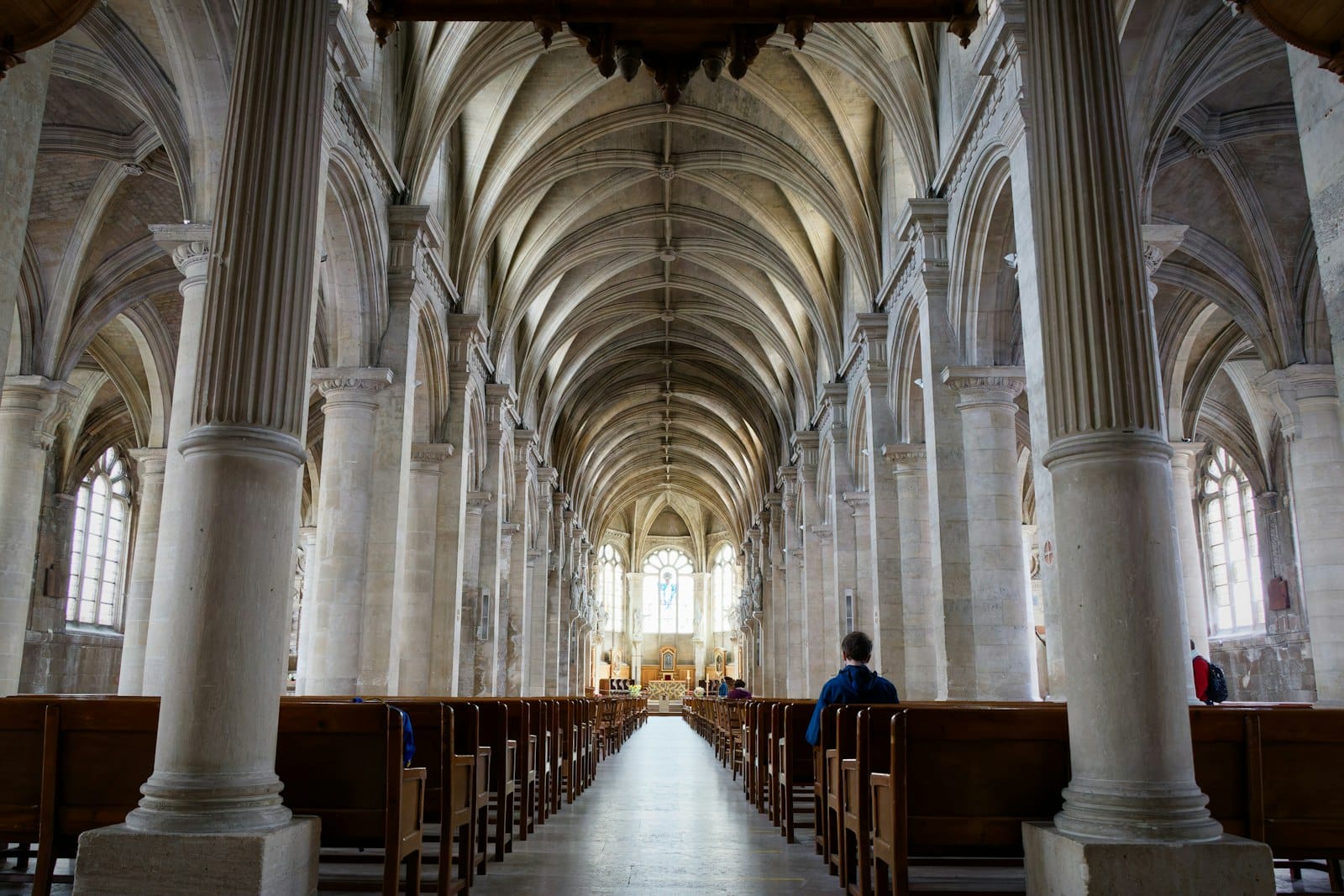
The nave rises to roughly 13 metres at the vault key, which feels appropriately solemn without being overwhelming. If you arrive with expectations set by the great Gothic cathedrals of northern France, recalibrate: this is a port-town church, built with the resources of a commercial harbour city, not a royal or ecclesiastical capital. Its quality is in its texture and its survival, not in its scale.
Tickets & tours
Hand-picked options from our booking partner. Prices are indicative; availability and final rates are confirmed when you complete your booking.
Customized private D-day Normandy landing excursion from Le Havre
From 1.300 €Instant confirmationFree cancellationFull-day trip to Giverny and Rouen from Le Havre
From 1.200 €Instant confirmationFree cancellation
Bombing, Reconstruction, and the 1974 Elevation
The cathedral was damaged in the September 1944 Allied bombardment that destroyed most of Le Havre. Unlike the majority of the city's pre-war fabric, enough of the structure remained to be salvageable, and restoration work was completed in 1974, the year when the parish church became the cathedral of the Diocese of Le Havre.
The reconstruction work is visible if you know what to look for: areas where stonework is noticeably cleaner or where joinery between old and restored sections is apparent. This is not a deficiency. In a city whose entire identity was reshaped by wartime destruction and modernist rebuilding, the visible layers of damage and repair in the cathedral become part of its meaning. It is worth reading this building alongside the WWII history of Le Havre to understand the scale of what was lost elsewhere.
The cathedral was classified as a Monument historique in 1919, which provided a degree of institutional protection even before the war.
What the Visit Actually Feels Like
The exterior on rue de Paris is the first encounter, and it is worth spending a few minutes here before going inside. The western façade, completed between 1611 and 1638, faces the street directly. The stone has darkened unevenly with age and weathering, which gives it visual weight compared to the pale concrete of the surrounding Perret city. The bell tower to the side dates from the original 16th-century construction and is the most visibly old element of the exterior.
Inside, the cathedral is cool and relatively dim for much of the day. Morning light, entering through the stained glass on the eastern end, is the best time for photography of the interior. By midday, the light becomes more uniform and less dramatic. The sound environment inside is genuinely quiet compared to the city outside, which amplifies the sense of stepping into a different era.
On weekday mornings, the cathedral is typically very quiet, with occasional local worshippers but few tourists. Weekend afternoons bring more visitors, particularly in summer when cruise passengers and day visitors are moving through the city centre. Even then, it rarely feels crowded, partly because it is not prominently promoted as a primary attraction in most Le Havre itineraries.
💡 Local tip
Visit on a weekday morning between 10:00 and noon for the best combination of interior light and near-silence. If you arrive and find the doors closed for a ceremony, wait 20–30 minutes or return later in the afternoon.
The Cathedral in Its Urban Context
The cathedral's position on rue de Paris places it on one of the central axes of Perret's rebuilt city. The street runs roughly from the Hôtel de Ville toward the port, and walking it end to end is one of the better ways to understand how the post-war reconstruction was organised. The Perret architecture of Le Havre forms the dominant visual context for almost everything else in the city centre, which makes the cathedral's contrast all the more legible.
The Bassin du Commerce and the city's commercial core are a short walk away, as is the Maison du Patrimoine (Atelier Perret), which provides the most useful architectural interpretation of the reconstruction for visitors who want to understand what surrounds the cathedral. Consider combining both in a half-day walking circuit.
Practical Information for Your Visit
The cathedral is free to enter and requires no booking. Rue de Paris is a flat, paved central street, making the approach on foot straightforward from the main tram corridor through the city centre. The LiA network covers the surrounding area with both tram and bus lines.
Photography is generally possible inside, though you should be respectful if services are in progress. The interior is dimly lit, so a phone with a reasonable low-light camera or a compact camera with a wide aperture will produce better results than a standard daytime phone setting. Tripods are generally not appropriate in active churches without prior permission.
No specific information on step-free interior access or adapted facilities is provided in official tourism listings. Visitors with reduced mobility should verify conditions directly with the parish before visiting.
⚠️ What to skip
The cathedral closes during religious ceremonies. Hours are listed as daily 10:00–18:00 for 2025, but this can vary on major feast days or during special services. Check locally if your timing is critical.
Honest Assessment: Who This Is For and Who Can Skip It
The Cathédrale Notre-Dame du Havre is not a destination that will satisfy visitors looking for spectacular Gothic grandeur or richly decorated interiors. It earns its place on an itinerary through historical significance and contextual contrast rather than visual spectacle. If your time in Le Havre is very limited and you are prioritising the city's post-war UNESCO identity, the Église Saint-Joseph designed by Auguste Perret is the architectural anchor of that story and arguably a more visually arresting building.
That said, for travellers who want to understand Le Havre as a city with a history longer than 1945, this cathedral is the most direct evidence available in the centre. It pairs well with a broader Le Havre walking tour that moves between the pre-war survivor and the modernist reconstruction around it. The free admission and central location mean the cost of visiting is simply time, which makes the decision straightforward.
Visitors with no interest in religious or architectural history, and those travelling with young children looking for interactive or outdoor experiences, are unlikely to find 30 minutes here compelling. The cathedral is quiet and largely uninterpreted inside, without audioguides or information panels in English.
Insider Tips
- Walk the full length of rue de Paris before entering the cathedral. The visual transition from Perret concrete to 16th-century stone is much more legible when you approach from the Hôtel de Ville end rather than arriving directly by transit.
- Morning light enters from the east and picks up the stained glass most effectively in the hour or two after 10:00. If interior photography matters to you, do not arrive in the afternoon.
- The bell tower is the oldest visible element of the exterior and dates from the original 16th-century stone construction phase. Look at it separately from the western façade, which was added between 1611 and 1638.
- If the cathedral is closed for a ceremony on arrival, the exterior alone is worth the short detour. The contrast between the stonework and the surrounding Perret buildings is most visible from slightly across the street.
- The cathedral is classified as a Monument historique (since 1919), which gives it a protected heritage status within Le Havre’s architectural landscape.
Who Is Cathédrale Notre-Dame du Havre For?
- Travellers interested in the architecture and urban history of Le Havre's reconstruction who want to understand what came before Perret
- History visitors tracing the WWII bombing and survival story of individual Le Havre buildings
- Architecture enthusiasts doing a comparative walk between pre-war and post-war building styles in the city centre
- Cruise passengers or day visitors who want a quiet, no-cost pause in the middle of a city-centre walk
- Visitors following the religious heritage of Normandy who want to connect Le Havre to the region's broader ecclesiastical landscape
Nearby Attractions
Other things to see while in Centre Ville Perret (UNESCO District):
- Bassin du Commerce
The Bassin du Commerce is a 500-metre historic dock at the centre of Le Havre's UNESCO-listed rebuild, where post-war concrete architecture meets open water. Free to visit during public hours, it serves as the city's most photogenic public space and a genuine crossroads of daily life.
- Église Saint-Joseph
Designed by Auguste Perret and structurally completed in 1957 (with consecration in 1964), Église Saint-Joseph is the defining monument of Le Havre's UNESCO-listed city centre. Its 107-metre lantern tower and 12,768 panels of coloured glass make it one of the most architecturally significant post-war churches in Europe. Entry is free.
- Halles Centrales
Built between 1958 and 1960 as part of Auguste Perret's post-war reconstruction, the Halles Centrales is Le Havre's working food market. Free to enter and open seven days a week, it offers fresh produce, local traders, and a ground-level view of everyday city life inside a landmark modernist concrete shell.
- Hôtel de Ville (City Hall)
Inaugurated in 1958 and designed by Auguste Perret, Le Havre's Hôtel de Ville is one of the most architecturally significant post-war civic buildings in France. The 72-metre tower rises above a five-hectare square, offering guided visits to a 17th-floor belvedere with sweeping views across the UNESCO-listed city centre and the port beyond.