Hôtel de Ville du Havre: Le Havre's Civic Heart in Concrete and Light
Inaugurated in 1958 and designed by Auguste Perret, Le Havre's Hôtel de Ville is one of the most architecturally significant post-war civic buildings in France. The 72-metre tower rises above a five-hectare square, offering guided visits to a 17th-floor belvedere with sweeping views across the UNESCO-listed city centre and the port beyond.
Quick Facts
- Location
- Place de l'Hôtel-de-Ville, 76600 Le Havre (centre-ville Perret)
- Getting There
- LiA bus and tram network; the square is walkable from Le Havre railway station in about 15 minutes
- Time Needed
- 30–45 min for the exterior and square; up to 1.5 hours with a guided tower visit
- Cost
- Exterior and public areas free; guided 17th-floor tower visits organised by Le Havre Étretat Tourisme (check current tariffs before visiting)
- Best for
- Architecture lovers, urban photographers, Perret enthusiasts, cruise passengers on a tight schedule
- Official website
- www.lehavre.fr
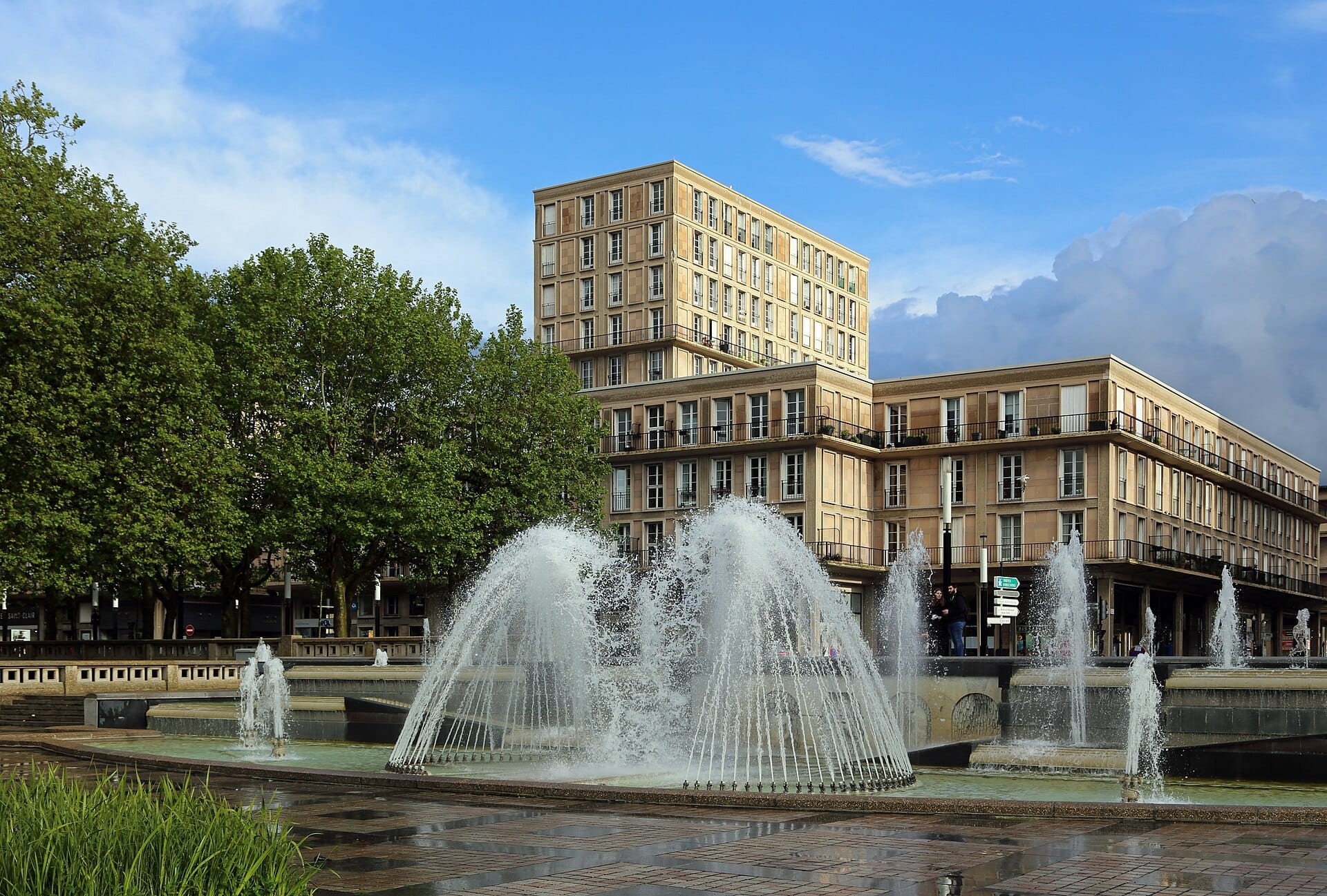
What the Hôtel de Ville Actually Is
The Hôtel de Ville du Havre is Le Havre's functioning city hall and one of the defining monuments of Auguste Perret's post-war reconstruction of the city. It is not a museum or a tourist attraction in the conventional sense. It is a working civic building that happens to be a classified Monument historique, embedded within a UNESCO World Heritage Site. That distinction matters: the building is serious architecture, not decorative heritage.
The complex breaks into two distinct parts. The horizontal wing, 92 metres long, contains the main reception salons and a theatre. Rising above it is the beffroi tower, 72 metres of reinforced concrete reaching 17 floors, which functions as an office block for municipal departments. The surrounding Place de l'Hôtel-de-Ville covers approximately five hectares, making it one of the largest civic squares in France.
ℹ️ Good to know
The building's municipal services are open Monday to Friday 08:00–17:00 and Saturday 09:00–11:50 for civil status services. Guided visits to the 17th-floor belvedere are a separate activity organised by Le Havre Étretat Tourisme — check their website for current availability and pricing before you arrive.
The Architecture: Why Perret Built It This Way
Auguste Perret, working alongside architect Jacques Tournant, saw the Hôtel de Ville inaugurated in 1958, almost exactly on the footprint of the pre-war city hall that was destroyed during the Allied bombing raids of World War II. The choice of year was deliberate: the post-war context gave the opening a civic weight that went beyond architecture.
Perret's signature approach is visible in every detail. His method, sometimes called béton armé classicisme, treated reinforced concrete not as an industrial material to be hidden but as the legitimate successor to stone. Look at the tower's facade: the vertical ribs of exposed concrete create a rhythm that reads almost like a Gothic screen when the afternoon light rakes across it. The proportions are precise, not accidental. Perret trained under and eventually surpassed the classicist tradition, and the Hôtel de Ville is one of his last major completed works.
The building sits at the northeastern end of the grand axis connecting the Place de l'Hôtel-de-Ville to the seafront, a deliberate urban planning gesture that links civic authority to the sea. If you want to understand how this fits into the broader grid Perret designed for the entire city centre, the Perret architecture guide explains the logic of the street layout and the buildings that surround this square.
Tickets & tours
Hand-picked options from our booking partner. Prices are indicative; availability and final rates are confirmed when you complete your booking.
Customized private D-day Normandy landing excursion from Le Havre
From 1.300 €Instant confirmationFree cancellationFull-day trip to Giverny and Rouen from Le Havre
From 1.200 €Instant confirmationFree cancellation
The Square: Reading the Space at Different Hours
The Place de l'Hôtel-de-Ville changes character noticeably depending on when you visit. In the early morning, before 09:00, the square is nearly empty. The horizontal building catches low northern light cleanly, and the tower casts a long shadow westward. This is the best time for photography: no parked vehicles interrupt the sightlines, and the scale of the space reads clearly without crowds.
By midday on a weekday, the square fills with office workers and people passing through on foot or by bicycle. The surrounding arcaded streets draw pedestrians under cover, which is particularly useful in Normandy's reliably unpredictable weather. The square has a slightly formal quality even at its liveliest: Perret designed it as a place of civic ceremony, and that intention survives. It rarely feels like a casual gathering spot.
On weekends, especially in summer, the square becomes a venue for the city's outdoor events programme. During Un Été au Havre, the city's annual contemporary art festival, the square and the surrounding streets often host monumental installations. If your visit coincides with the festival (typically June to September), the architectural backdrop becomes a genuine element of the artwork.
💡 Local tip
For the clearest view of the tower's vertical proportions, position yourself near the centre of the square facing south-east in the late afternoon. The concrete ribs catch the light from the west and the building gains depth it lacks in flat midday light.
The 17th-Floor Tower Visit: What You Actually See
Guided visits to the belvedere on the 17th floor of the tower are arranged through the local tourism office rather than the city hall itself. The visit takes you up through municipal office floors, which gives the experience an unexpectedly behind-the-scenes quality. You are not walking through a curated exhibition but through a functioning government building with its attendant bureaucratic atmosphere.
The view from 72 metres is comprehensive. To the south, the reconstructed grid of the UNESCO city centre spreads out in its full clarity: the uniform cornice heights, the wide boulevards, the church of Saint-Joseph visible as a concrete lantern about 800 metres away. To the north, the port and its container terminals dominate the horizon, a reminder that Le Havre's civic grandeur has always been underwritten by industrial port activity. On a clear day, the cliffs at Sainte-Adresse are visible to the west.
The tower view is the best fixed viewpoint for understanding the urban planning logic of Perret's reconstruction. If you want to compare it with a coastal perspective, the impressionist viewpoints at Sainte-Adresse offer an entirely different angle on the city from the clifftops to the west.
⚠️ What to skip
Tower visits are not self-guided and are not available daily on a drop-in basis. Book through Le Havre Étretat Tourisme in advance, particularly in summer when slots fill quickly. Accessibility details for the elevator and upper-floor areas should be confirmed directly with the tourism office when booking.
Practical Walkthrough: Getting There and Around
The Place de l'Hôtel-de-Ville is straightforward to reach on foot from the city centre. From Le Havre railway station, the walk takes roughly 15 minutes along Boulevard de Strasbourg heading south-west. The LiA urban bus network also serves the area; check the current route map at transports-lia.fr for stop locations near the square.
The main public entrance for municipal services is on the north side of the building, on Avenue du Général Leclerc. This entrance is at ground level. The building's main reception is accessible to the public during service hours, and even a brief walk through the public foyer gives a sense of Perret's interior detailing: the proportions of the entrance hall, the quality of the concrete finish, and the relationship between solid walls and glazed sections are all worth a few minutes of attention.
The Hôtel de Ville sits close to several other Perret-designed landmarks. The Église Saint-Joseph is less than 10 minutes on foot to the south-west and is arguably the more spectacular building for interior drama. The Maison du Patrimoine Atelier Perret provides the essential architectural context if you want to understand the reconstruction project as a whole before exploring the city.
Weather, Seasons, and Honest Expectations
Le Havre's oceanic climate means the Hôtel de Ville and its square look different depending on the sky. On overcast days, which are common in Normandy outside of June to August, the concrete takes on a grey heaviness that some visitors find austere. On clear days, especially in summer, the building reads much more warmly: the surface texture becomes legible, and the play of light across the vertical ribs gives it genuine visual interest.
The tower belvedere visit is obviously most rewarding in clear weather. Normandy sea fogs can reduce visibility significantly, and the tourism office does not guarantee conditions at the time of booking. If panoramic views are your primary reason for visiting, build flexibility into your schedule and aim for morning visits in summer, when visibility tends to be better before afternoon cloud develops.
For a full understanding of when to plan your trip to Le Havre given the climate, the best time to visit Le Havre guide covers seasonal conditions in detail.
Who Should Skip This
If you have no particular interest in post-war architecture or urban planning, the Hôtel de Ville may disappoint. The exterior is severe by the standards of French civic buildings: there are no ornate facades, no decorative ironwork, no period grandeur. Visitors expecting the kind of ornate city hall found in Paris or Rouen will find it cold and functional.
The square itself offers limited shade in summer and little shelter from wind in winter. It is a place for looking and understanding, not lingering at length. Families with young children will find the square perfectly safe but not particularly engaging without the tower visit as an anchor. The tower visit itself involves elevator access through working office floors, which is an acquired taste.
Insider Tips
- Book the 17th-floor tower visit through Le Havre Étretat Tourisme well in advance in July and August. Slots are limited and this is the only way to access the belvedere legally.
- The arcaded streets immediately surrounding the square provide cover during rain and are lined with independent shops and cafés. These arcades are a key feature of Perret's reconstruction and worth examining for their concrete detailing at close range.
- Saturday morning before 10:00 is the single best window to photograph the building: the square has not yet filled with weekend activity, the light from the east catches the tower face, and the farmers' market at the nearby Halles Centrales gives you a secondary stop within walking distance.
- The Place de l'Hôtel-de-Ville frequently hosts major civic events for Le Havre, including national celebrations such as Bastille Day on 14 July. If your visit coincides, the square takes on an entirely different character with crowds, temporary structures, and evening illuminations.
- From the centre of the square, look south-west along the main axis at dusk: the silhouette of Saint-Joseph's tower aligns with the descending sun in certain seasons, creating a skyline view that appears in many architectural photographs of the city.
Who Is Hôtel de Ville (City Hall) For?
- Architecture enthusiasts tracing Perret's reconstruction of Le Havre
- Photographers wanting the definitive overhead view of the UNESCO city grid
- Cruise passengers with a half-day in port who want one landmark that captures the city's identity
- Travellers following the Perret architecture trail through the city centre
- Urban planners and students of modernist civic design
Nearby Attractions
Other things to see while in Centre Ville Perret (UNESCO District):
- Bassin du Commerce
The Bassin du Commerce is a 500-metre historic dock at the centre of Le Havre's UNESCO-listed rebuild, where post-war concrete architecture meets open water. Free to visit during public hours, it serves as the city's most photogenic public space and a genuine crossroads of daily life.
- Cathédrale Notre-Dame du Havre
Standing on rue de Paris in central Le Havre, the Cathédrale Notre-Dame du Havre is a rare pre-war survivor in a city rebuilt almost entirely from concrete after 1944. Its layered Gothic and Renaissance architecture tells a longer story than the modernist grid surrounding it. Entry is free, and the contrast with Auguste Perret's rebuilt city makes it one of the most thought-provoking stops in the centre.
- Église Saint-Joseph
Designed by Auguste Perret and structurally completed in 1957 (with consecration in 1964), Église Saint-Joseph is the defining monument of Le Havre's UNESCO-listed city centre. Its 107-metre lantern tower and 12,768 panels of coloured glass make it one of the most architecturally significant post-war churches in Europe. Entry is free.
- Halles Centrales
Built between 1958 and 1960 as part of Auguste Perret's post-war reconstruction, the Halles Centrales is Le Havre's working food market. Free to enter and open seven days a week, it offers fresh produce, local traders, and a ground-level view of everyday city life inside a landmark modernist concrete shell.