Impressionist Viewpoints: Sainte-Adresse & Cap de la Hève
The clifftops and seafront promenade of Sainte-Adresse and Cap de la Hève are where Claude Monet found some of his most enduring compositions. A marked outdoor trail with interpretive panels connects the exact spots where canvases like 'Terrace at Sainte-Adresse' and 'La Pointe de la Hève' were painted, all freely accessible and open at any hour.
Quick Facts
- Location
- Sainte-Adresse & Cap de la Hève, immediately west and north-west of Le Havre city centre
- Getting There
- LiA bus from Le Havre centre toward Sainte-Adresse; cliff-top section at Cap de la Hève best reached on foot or by car
- Time Needed
- 1.5 to 3 hours for the full trail; the Sainte-Adresse promenade alone can be done in 45 minutes
- Cost
- Free — open public outdoor spaces with no ticket required
- Best for
- Art history enthusiasts, coastal walkers, photographers, and anyone curious about Normandy's Impressionist legacy
What These Viewpoints Actually Are
The Impressionist Viewpoints of Sainte-Adresse and Cap de la Hève are not a museum, a ticketed site, or a formal monument. They are a network of marked outdoor positions along the coast north-west of Le Havre, each corresponding to a spot where Claude Monet stood to paint during the 1860s. Interpretive panels identify the exact vantage points and reproduce the relevant paintings alongside the present-day view, letting you compare the canvas to the scene in real time.
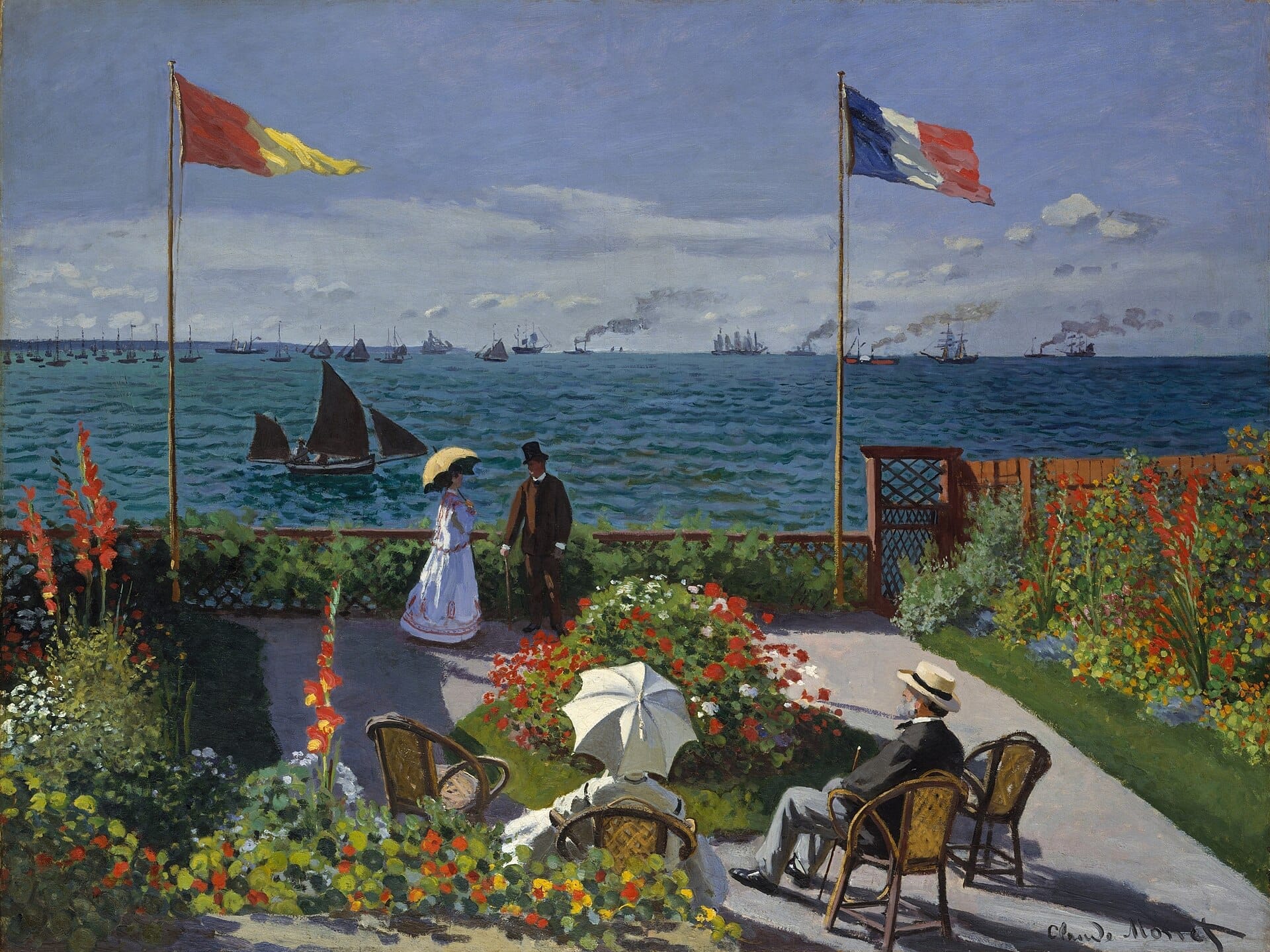
The two anchor paintings are 'Terrace at Sainte-Adresse' (1867), now in the Metropolitan Museum of Art in New York, and 'La Pointe de la Hève, Sainte-Adresse' (1864), held in the National Gallery, London. That second painting, an oil on canvas of roughly 41 × 73 centimetres, captures the low sandy headland and the grey Channel horizon with a directness that still reads clearly when you stand at the same position today. These are not obscure works: they are among the most reproduced views of the Normandy coast in art history, and the fact that you can reach them freely by walking the promenade gives the experience a quality that indoor exhibitions cannot replicate.
The viewpoints are part of the broader Le Havre Impressionist Art Trail, a marked route that connects coastal and urban sites across the Seine Estuary region, coordinated through the Voyages Impressionnistes network.
💡 Local tip
The interpretive panels are weatherproof but positioned at eye level — bring the paintings up on your phone screen before you arrive so you can make the comparison properly when you're standing at each marker.
The Sainte-Adresse Promenade: Monet's Terrace in Context
Sainte-Adresse is a residential seaside commune that sits directly against Le Havre's western edge, separated from it more by atmosphere than by any clear physical boundary. The promenade along its beachfront is paved, level, and bordered on the seaward side by a low wall above the pebble beach. The water beyond is the mouth of the Seine estuary meeting the English Channel, and on clear days you can see container ships moving at surprising speed along the shipping lanes.
When Monet painted 'Terrace at Sainte-Adresse' in the summer of 1867, he was staying with his family here. The painting looks north-west from a garden terrace, with the Channel filling the background and two flag-topped poles marking the foreground. The terrace itself no longer exists in the same form, but the orientation and the quality of the light are unchanged. In high summer, the seafront faces north-west, which means afternoons deliver long, raking light across the water rather than direct overhead glare. This is the light Monet captured and it is still the most rewarding time to visit for photography.
Morning on the promenade is quieter. Dog walkers, joggers, and a handful of early swimmers are the main company before 9 a.m. The water smells of salt and cold seaweed, and the pebbles on the beach click and shift in the small waves. By late morning on weekends in summer, families and day-trippers arrive in numbers. The light is still good but the contemplative quality diminishes. For the experience closest to the paintings, an overcast day in May or September can be more effective than a bright August Saturday.
Tickets & tours
Hand-picked options from our booking partner. Prices are indicative; availability and final rates are confirmed when you complete your booking.
Customized private D-day Normandy landing excursion from Le Havre
From 1.300 €Instant confirmationFree cancellationFull-day trip to Giverny and Rouen from Le Havre
From 1.200 €Instant confirmationFree cancellation
Cap de la Hève: The Cliff Walk and the 1864 Canvas
Cap de la Hève is the headland that rises at the north-western tip of the Le Havre peninsula, where the chalk cliffs of the Pays de Caux begin their run northward toward Étretat and beyond. The walk up from Sainte-Adresse takes 20 to 30 minutes and gains elevation steadily along a coastal path. The ground underfoot shifts from tarmac to packed earth and then to grass and loose chalk near the top. Suitable footwear makes a real difference, particularly after rain.
At the cap itself, the view opens abruptly. The Seine estuary spreads below to the south-east, with the port of Le Havre visible in full, its cranes and container stacks forming an industrial counterpoint to the chalk and sea grass around you. On clear days, the Normandy coast curves away toward Honfleur and the Calvados shore. The lighthouse at Cap de la Hève is operational and visible from well offshore; it has stood in various forms on this headland since the 19th century, though the current structure dates from the post–Second World War period after wartime damage.
Monet's 1864 painting 'La Pointe de la Hève, Sainte-Adresse' shows the cap from a lower position, looking along the waterline rather than down from above, with stranded boats and flat, pewter-coloured sea. Standing at the designated panel brings this low angle into focus. The Cap de la Hève viewpoint is one of the most exposed positions on this stretch of coast, and wind is a near-constant factor. In autumn and winter, gusts can be strong enough to make standing at the cliff edge genuinely uncomfortable.
⚠️ What to skip
The cliff-top path near Cap de la Hève includes unfenced sections close to the edge. Keep children and dogs close. After heavy rain, chalk paths become slippery. This section is not wheelchair accessible.
How the Experience Changes Through the Day and Seasons
This is an outdoor experience shaped entirely by weather and light. The Seine estuary faces north-west, which means sunrise falls on the back of the cliffs rather than the sea. Sunset, by contrast, drops directly into the water from Cap de la Hève on clear evenings, creating the pale gold and grey tones that Monet was working with across his Normandy compositions. Late afternoon in summer, roughly 5 to 8 p.m., is the most visually rewarding window.
Overcast days are not a reason to avoid this trail. Normandy's classic flat, diffuse light reduces shadows and brings out the greens of the cliff grass and the blue-grey of the channel in a way that direct sun does not. Monet painted repeatedly in these conditions precisely because they produced the tonal range he was exploring. Rain, however, makes the cliff path hazardous and the panels harder to read. Check the forecast before attempting the full Cap de la Hève section.
For timing your visit to Le Havre more broadly, the best time to visit Le Havre guide covers seasonal weather patterns, which directly affect how enjoyable this coastal trail will be.
The Historical Weight of the Location
When Monet painted these views in the 1860s, Sainte-Adresse was already a fashionable resort for the Parisian bourgeoisie, accessible by the recently opened railway from the capital. The combination of fashionable bathing culture and the raw visual drama of the Seine estuary drew artists and writers throughout the second half of the 19th century. Monet returned here repeatedly, partly because his family had connections to the area, and partly because the quality of the coastal light was unlike anything available closer to Paris.
Le Havre itself was almost entirely destroyed during Allied bombing raids in 1944 and subsequently rebuilt by architect Auguste Perret in a rationalist concrete style that earned UNESCO World Heritage status in 2005. Sainte-Adresse escaped much of the destruction and retains more of its pre-war character, which is part of why the visual connection to Monet's canvases remains as legible as it does. The town feels like a different register from Le Havre's disciplined grid, more residential and unhurried.
If the wartime history of the area interests you, Le Havre's World War II history is covered in depth separately, with context for how the destruction and reconstruction shaped the city you see today.
Practical Walkthrough: How to Actually Do This Trail
The most logical route starts at the Le Havre seafront, walks west along the beach promenade into Sainte-Adresse, uses the panel at the Sainte-Adresse viewpoint, then continues on foot or by road up to Cap de la Hève. The walk from Le Havre's beach to the cap and back takes approximately 2.5 to 3 hours at a relaxed pace, with time to stop at each panel. If you only want the promenade section, a 45-minute one-way walk is enough to reach the main Sainte-Adresse viewpoint.
LiA buses from Le Havre city centre serve Sainte-Adresse. Check current routes and timetables at the LiA network website before travel, as schedules are updated periodically. Driving to Cap de la Hève and parking near the lighthouse is also practical; this cuts the elevation gain for those with mobility concerns, though the cliff-edge path remains uneven. The Sainte-Adresse neighborhood guide covers the wider area including cafés and the beach, which is useful if you are combining the art trail with a half-day along the coast.
Photography: the panels are positioned so that you can frame the modern view with the panel's reproduction of the painting visible in the same shot. A wide-angle lens or a standard phone camera works well for this. For the sea and cliff shots, a polarising filter or phone equivalent reduces glare significantly on bright days. The light from the north-west in late afternoon is worth planning around.
ℹ️ Good to know
The full Impressionist trail in this region extends beyond Sainte-Adresse to Étretat and other coastal points. If you are planning a multi-day itinerary, the Voyages Impressionnistes network (voyagesimpressionnistes.com) maps the complete route across the Seine Estuary.
Is This Worth Your Time? An Honest Assessment
If you have a basic awareness of Impressionism and enjoy coastal walking, this trail delivers something genuinely satisfying: the rare experience of standing in the exact geography that produced canonical works of Western art, for free, at your own pace. The interpretive panels are well made without being over-explained. The views on a clear day, particularly from Cap de la Hève, are among the most dramatic on the Normandy coast north of the Seine.
That said, this is not for everyone. Visitors who prefer structured, indoor experiences with climate control, café service, and clear ticketing will find the outdoor, self-guided format loose by comparison. In poor weather, the trail from the promenade to the cap is a damp and windswept slog with mud underfoot and panels that are harder to engage with. There is no shelter, no on-site guide, and the trail requires you to bring your own curiosity. If Monet means nothing to you and coastal walking doesn't appeal, skip this and visit the Musée d'Art Moderne André Malraux instead, which holds a major Impressionist collection indoors and in comfort.
For cruise passengers with limited time, this trail works as a half-day excursion from the port, particularly combined with the Sainte-Adresse beach and a meal in the village. The Le Havre cruise port guide covers logistics for day visitors arriving by ship.
Insider Tips
- Download the paintings onto your phone before you leave — specifically 'Terrace at Sainte-Adresse' (1867, Metropolitan Museum of Art) and 'La Pointe de la Hève, Sainte-Adresse' (1864, National Gallery London). Having the full-resolution image to compare against the actual view beats squinting at the panel reproduction.
- The Sainte-Adresse promenade viewpoint is best in late afternoon on a day with some cloud cover. Flat Normandy light brings out the grey-blue tones of the Channel in a way that mirrors Monet's palette more closely than midday sun does.
- If you are driving, park near the lighthouse at Cap de la Hève and walk the cliff section first while your legs are fresh, then descend to Sainte-Adresse for the promenade and a coffee afterward. This sequence avoids the long uphill at the end.
- The shipping lanes visible from Cap de la Hève carry some of Europe's heaviest container traffic. The scale of the vessels, barely moving against the horizon, gives you a sense of the same maritime commerce that made Le Havre prosperous enough to attract leisure visitors in Monet's era.
- On summer weekends, the Sainte-Adresse promenade fills with local families from mid-morning. Come before 9 a.m. or after 6 p.m. if you want the view without the crowd noise — and the evening light is better anyway.
Who Is Impressionist Viewpoints (Sainte-Adresse & Cap de la Hève) For?
- Art history enthusiasts who want to stand in Monet's precise footsteps rather than just read about them
- Coastal walkers looking for a route with cultural depth beyond standard seaside scenery
- Photographers seeking the Channel light that defined early French Impressionism
- Cruise day-trippers who want a meaningful half-day experience within walking or short bus distance of the port
- Families with older children who can manage a moderate cliff-top walk and have an interest in art or history
Nearby Attractions
Other things to see while in Sainte-Adresse:
- Cap de la Hève
Cap de la Hève is a dramatic chalk cliff headland rising about 100–115 metres above the English Channel at the northern tip of Sainte-Adresse. Free to access year-round, it marks the boundary between the Côte d'Albâtre and the Baie de Seine, offering panoramic coastal views, a hidden tidal beach, and layers of military history stretching back to the 19th century.
- Cimetière Sainte-Marie
Cimetière Sainte-Marie is one of France's officially listed remarkable cemeteries, covering 18 hectares on the hills north of Le Havre with over 20,000 tombs. It holds 2,063 Commonwealth war graves from both World Wars, an 1861 chapel, and layers of local history that reward unhurried exploration.
- Chapelle Notre-Dame-des-Flots
Perched on the heights of Sainte-Adresse above the Seine estuary, Chapelle Notre-Dame-des-Flots is a neo-Gothic chapel built in the late 1850s as a sanctuary for sailors and fishermen. Its interior fills with ex-votos, model ships, and votive paintings dedicated to those lost at sea, making it one of the most quietly moving heritage sites in the Le Havre area. Admission is free.
- Plage de Sainte-Adresse
Plage de Sainte-Adresse is a large pebble beach on the northwestern edge of Le Havre, framed by a historic jetty and sweeping views across the Seine estuary. Free, unhurried, and steeped in Impressionist history, it rewards visitors who make the short trip from the city centre.