Chapelle Notre-Dame-des-Flots: Sainte-Adresse's Chapel of the Sailors
Perched on the heights of Sainte-Adresse above the Seine estuary, Chapelle Notre-Dame-des-Flots is a neo-Gothic chapel built in the late 1850s as a sanctuary for sailors and fishermen. Its interior fills with ex-votos, model ships, and votive paintings dedicated to those lost at sea, making it one of the most quietly moving heritage sites in the Le Havre area. Admission is free.
Quick Facts
- Location
- 13 Rue Charles-Alexandre Lesueur, 76310 Sainte-Adresse, above Le Havre
- Getting There
- LiA bus (such as lines 1, 3 or 7) to Sainte-Adresse, then a short uphill walk to the chapel
- Time Needed
- 30–60 minutes for the chapel and surrounding viewpoint gardens
- Cost
- Free admission
- Best for
- History, maritime heritage, coastal views, quiet contemplation
What Is Chapelle Notre-Dame-des-Flots?
Chapelle Notre-Dame-des-Flots, whose name translates as the Chapel of Our Lady of the Waves, sits on the cliffs of Sainte-Adresse, a residential suburb that rises sharply above Le Havre's port and bay. From the outside, it reads as a compact but composed neo-Gothic structure in pale stone, its modest scale belying the intensity of devotion recorded inside. The chapel is free to enter and carries no tourist theatre: no audio guides, no queues, no souvenir kiosks (a small boutique opens limited hours in summer). What it offers instead is something rarer in northern France's heritage circuit: a genuinely working sailors' chapel that still functions as a place of faith and communal memory.
The chapel is the main heritage draw within the Sainte-Adresse neighbourhood, and pairs naturally with the clifftop viewpoints above Le Havre that famously inspired the Impressionists. For visitors working through the wider area, it sits at the natural end of a coastal walk from the seafront promenade below.
History: Stone from the Fortifications, Faith from the Sea
The chapel's origin lies with Abbé Duval-Pirou, parish priest of Sainte-Adresse, who conceived a sanctuary specifically dedicated to the Virgin as protector of sailors and fishermen. Construction dates to the late 1850s, and the architect was Théodore Huchon, a Le Havre practitioner working in the neo-Gothic idiom fashionable across Normandy at the time. The contractor Paul Pupin oversaw the building work on the chapel.
The solemn blessing took place in 1859, with contemporary accounts describing a large gathering of the local maritime community. For a coastal community whose daily rhythms were dictated by tides, weather, and the departure of fishing fleets into the Channel, the chapel addressed a real and constant anxiety. It became a pilgrimage site almost immediately, drawing families from across the Le Havre maritime community.
That original function has not been lost. The chapel continues to receive both worshippers and visitors, and it remains under the pastoral care of the local diocese. Heritage documentation is provided by Le Havre Seine Patrimoine, the Pays d'Art et d'Histoire designation body for the area, which treats the chapel as a significant example of 19th-century religious architecture in the Seine-Maritime department.
Tickets & tours
Hand-picked options from our booking partner. Prices are indicative; availability and final rates are confirmed when you complete your booking.
Customized private D-day Normandy landing excursion from Le Havre
From 1.300 €Instant confirmationFree cancellationFull-day trip to Giverny and Rouen from Le Havre
From 1.200 €Instant confirmationFree cancellation
Inside the Chapel: Ex-Votos and Maritime Memory
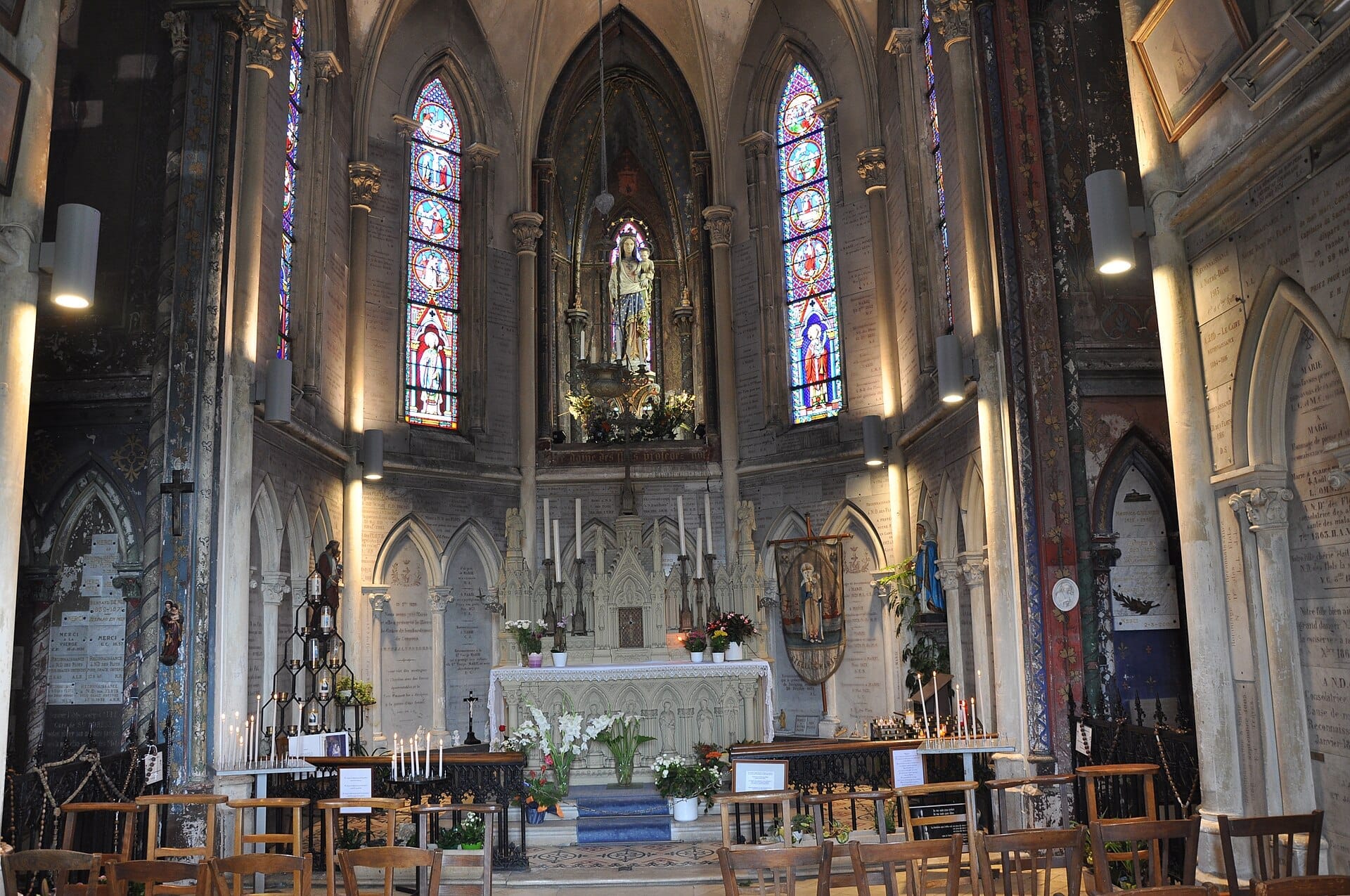
The interior of Chapelle Notre-Dame-des-Flots is small enough that you can take it in from a single position near the entrance, but the details reward a slower circuit. The walls and surfaces carry ex-votos: votive offerings left by sailors, fishermen, and their families in gratitude for survival or in memory of those who did not return. Among these are model ships in glass cases, painted maritime scenes, and dedicatory plaques. The cumulative effect is less ornamental than archival. Each object represents a specific moment of danger at sea, a petition made or a promise kept.
The neo-Gothic architecture is restrained rather than elaborate. Pointed arches, ribbed vaulting, and narrow windows create the characteristic play of filtered light that the style was designed to produce, but there is no excess of decorative stonework or elaborate stained glass. The dominant sensory impression inside is quiet and slightly dim, with the smell of old stone and candle wax that is common to small active chapels across Normandy.
💡 Local tip
If you visit when the chapel is open for prayer or a service, wait respectfully outside or enter quietly. The space is actively used for worship, not only heritage tourism.
The Setting: Cliffs, Gardens, and Sea Views
The chapel's position on the Sainte-Adresse heights is as important to the visit as the building itself. Immediately behind and around it lies what is sometimes described as a poets' garden, a small elevated green space with benches and paths that frame views across the Seine estuary toward the open Channel. On clear days, the panorama takes in the full sweep of Le Havre's port infrastructure below, the industrial scale of the container terminal to the south, and the water beyond. The contrast between the chapel's intimate scale and the working port beneath it gives the site an unusual double character.
This is also the territory that drew painters to Sainte-Adresse throughout the second half of the 19th century. The clifftop light and shifting weather patterns visible from these heights were part of what made the location a subject for artists associated with the early Impressionist movement. For context on those connections, the Impressionist viewpoints at Sainte-Adresse are within easy walking distance and provide dedicated interpretation.
The uphill approach to the chapel from the main road through Sainte-Adresse involves a noticeable gradient. The paths and garden terrain around the site include slopes and uneven surfaces. Visitors with reduced mobility should be aware that there is no confirmed wheelchair-accessible route to the chapel entrance, and specific arrangements are best checked with the Sainte-Adresse municipality before visiting.
When to Visit and What the Experience Is Like at Different Times
The chapel rewards a weekday morning visit before tour groups arrive at the adjacent viewpoints. At that hour, particularly in spring and early autumn, the light on the estuary is clean and angled, and the site is almost always quiet. The garden paths are largely empty, and you can spend time with the exterior stonework and the sea view without interruption.
Summer afternoons bring more visitors to Sainte-Adresse as a whole, including families using the beach below and walkers following the cliff route. The chapel itself rarely becomes crowded, but the surrounding viewpoint areas can be busy on sunny July and August afternoons. Weekend mornings in summer represent the most congested window; if the goal is quiet reflection inside the chapel, aim for a weekday or early morning.
Winter visits have their own appeal. The Channel coast in November and December can be dramatic, with strong light and sea conditions that make the ex-votos inside feel less like historical objects and more like live testimony. The best time to visit Le Havre guide covers seasonal conditions across the area if you are planning around weather.
⚠️ What to skip
Opening hours for the chapel interior are currently published on a fixed public schedule: as of 2026 it is listed as open every day from 9:00 to 18:00, with access free of charge. Check with the Sainte-Adresse tourist office or municipality for any updates before making a special journey.
Getting There from Le Havre
Sainte-Adresse is immediately adjacent to Le Havre's northern edge, and the journey from the city centre takes roughly ten minutes by car under normal conditions. Local LiA bus services connect Le Havre city centre to Sainte-Adresse; from the bus stop, the chapel requires a short uphill walk. The LiA network covers both buses and trams across the Le Havre agglomeration, and route information is available at transports-lia.fr.
For visitors arriving by cruise ship at Le Havre's terminal, Sainte-Adresse is one of the closer independent excursion options. The Le Havre cruise port guide covers transport options from the terminal into the wider area, including how to reach Sainte-Adresse without a tour group.
There is street parking in Sainte-Adresse for those arriving by car, but spaces near the chapel can be limited on summer weekends. Walking up from the beach promenade below is a practical alternative that also allows you to take in the full height and coastal context of the site.
Photography and Practical Notes
The exterior of the chapel photographs well in morning light, when the pale stone catches the low sun from the east and the sea forms a backdrop to the south. The poets' garden behind the chapel offers framing for both the building and the estuary view, and the combination of historic architecture and working port below gives images a contrast that is hard to find elsewhere in the Le Havre area.
Inside, photography should be approached with discretion. The ex-votos and model ships are close to the walls in a small space, and flash photography is inappropriate when other visitors are present in prayer. Natural light inside is limited; bring a camera capable of handling low-light interiors without flash, or accept that this is a place better experienced than documented.
The chapel combines naturally with a broader half-day circuit of Sainte-Adresse. The beach at Sainte-Adresse is below on the waterfront, and the clifftop walk toward Cap de la Hève connects through open coastal terrain. Together, these three elements make a full morning or afternoon without requiring a car.
Insider Tips
- The boutique adjacent to the chapel reopened in July 2025 with hours Monday to Saturday 14:30 to 17:30, which may give you the best chance of finding the chapel itself open to visitors during those same windows. Confirm locally before relying on this.
- The poets' garden behind the chapel is one of the quieter elevated viewpoints in Sainte-Adresse and tends to be overlooked by visitors who photograph the chapel exterior and move on. Spend ten minutes there for the best estuary panorama.
- The ex-votos inside the chapel span decades and include both painted maritime scenes and three-dimensional model ships. Look closely at the individual plaques for dates and vessel names: they document specific moments in the history of Le Havre's fishing and maritime community in a way that no museum exhibit quite replicates.
- If you are visiting on a weekend in summer, the approach road through Sainte-Adresse can back up. Walking up from the seafront promenade takes about fifteen to twenty minutes and avoids parking frustration entirely.
- The chapel dates from the late 1850s, a period that connects it to a different layer of the city's history, one that predates Auguste Perret's famous postwar reconstruction by decades.
Who Is Chapelle Notre-Dame-des-Flots For?
- History and maritime heritage enthusiasts who want more than architecture
- Photographers looking for a combination of 19th-century stonework and coastal panoramas
- Cruise passengers with a half-day in Le Havre seeking something beyond the UNESCO city centre
- Walkers combining the chapel with the Sainte-Adresse clifftop route toward Cap de la Hève
- Visitors interested in French religious folk art and ex-voto traditions
Nearby Attractions
Other things to see while in Sainte-Adresse:
- Cap de la Hève
Cap de la Hève is a dramatic chalk cliff headland rising about 100–115 metres above the English Channel at the northern tip of Sainte-Adresse. Free to access year-round, it marks the boundary between the Côte d'Albâtre and the Baie de Seine, offering panoramic coastal views, a hidden tidal beach, and layers of military history stretching back to the 19th century.
- Cimetière Sainte-Marie
Cimetière Sainte-Marie is one of France's officially listed remarkable cemeteries, covering 18 hectares on the hills north of Le Havre with over 20,000 tombs. It holds 2,063 Commonwealth war graves from both World Wars, an 1861 chapel, and layers of local history that reward unhurried exploration.
- Impressionist Viewpoints (Sainte-Adresse & Cap de la Hève)
The clifftops and seafront promenade of Sainte-Adresse and Cap de la Hève are where Claude Monet found some of his most enduring compositions. A marked outdoor trail with interpretive panels connects the exact spots where canvases like 'Terrace at Sainte-Adresse' and 'La Pointe de la Hève' were painted, all freely accessible and open at any hour.
- Plage de Sainte-Adresse
Plage de Sainte-Adresse is a large pebble beach on the northwestern edge of Le Havre, framed by a historic jetty and sweeping views across the Seine estuary. Free, unhurried, and steeped in Impressionist history, it rewards visitors who make the short trip from the city centre.