Bassin du Commerce: Le Havre's Living Maritime Heart
The Bassin du Commerce is a 500-metre historic dock at the centre of Le Havre's UNESCO-listed rebuild, where post-war concrete architecture meets open water. Free to visit during public hours, it serves as the city's most photogenic public space and a genuine crossroads of daily life.
Quick Facts
- Location
- Quai George V / Quai Lamblardie, 76600 Le Havre (between city hall and the port)
- Getting There
- LiA tram or bus to city centre; short walk from Hôtel de Ville
- Time Needed
- 30–60 minutes to walk the full perimeter; longer if combining with nearby museums or cafés
- Cost
- Free to access. Fees apply only to optional nautical activities (diving, sailing) run by private operators
- Best for
- Architecture photography, casual waterfront strolls, understanding Le Havre's port identity
- Official website
- www.lehavre.fr
What Is the Bassin du Commerce?
The Bassin du Commerce is a historic inner-city dock measuring approximately 500 metres long and 99 metres wide, sitting at the geographic and symbolic centre of Le Havre. Construction began in 1792, and the basin was inaugurated in 1820, built north of the original Bassin du Roy that marked the city's earliest maritime development. Unlike the container terminals that define Le Havre's working port to the west, this basin long ago shifted from active cargo handling to something harder to categorise: part civic square, part waterfront promenade, part open-air reflection pool.
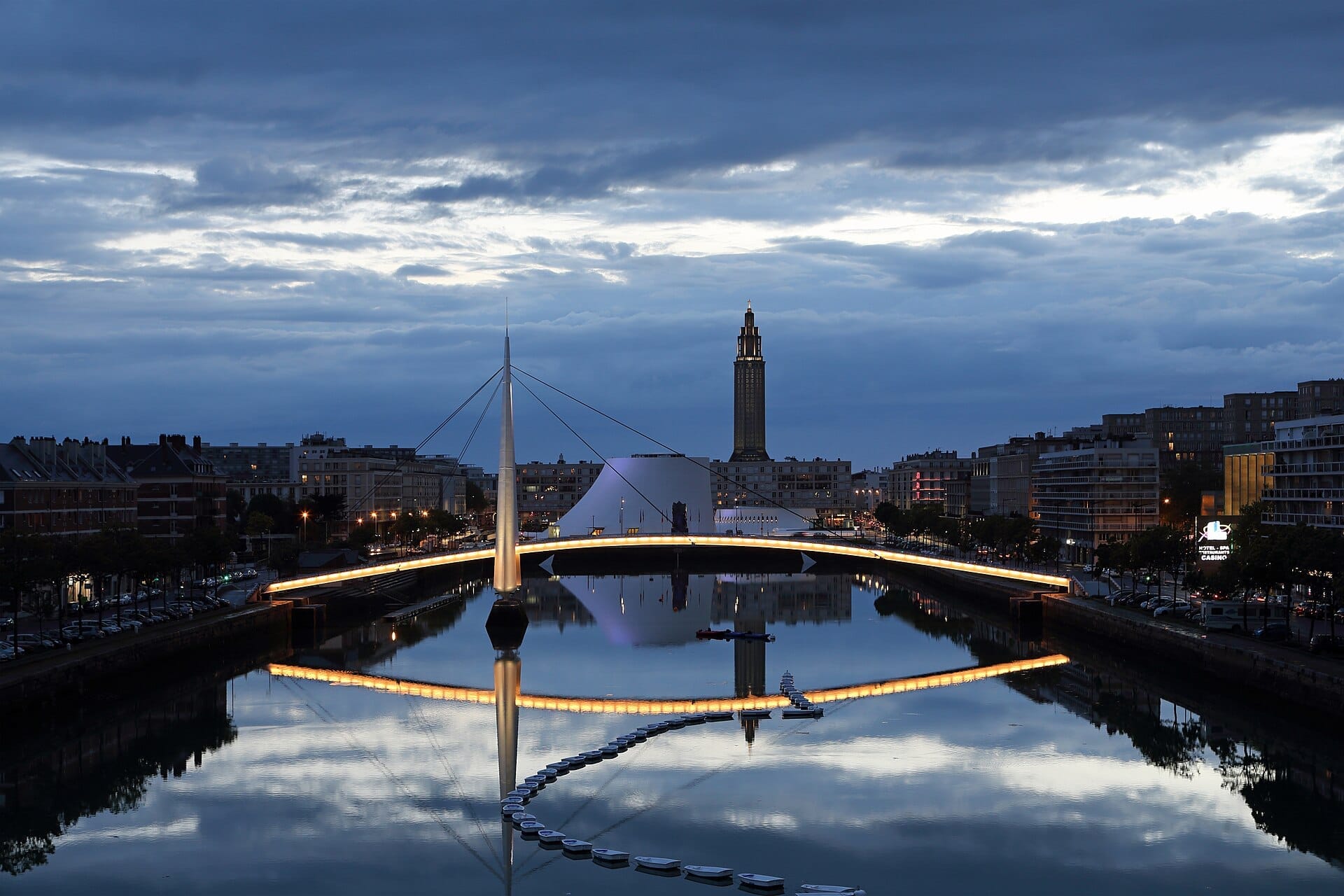
The basin is connected to the sea by a lock, meaning its water level is managed and its surface often sits calm and glass-like, mirroring the straight lines of Perret's reconstructed city blocks on either bank. That quality of reflection is, for many visitors, the most memorable thing about it.
💡 Local tip
The basin is a public open space with no gates or tickets. You can walk the full perimeter — early morning gives you the reflections without the foot traffic.
A Short History of a Near-Erasure
By the middle of the 20th century, the Bassin du Commerce very nearly ceased to exist. Allied bombing during World War II devastated Le Havre, reducing most of the city centre to rubble. During the post-war reconstruction overseen by architect Auguste Perret, a proposal emerged in 1950 to fill in the basin entirely, creating buildable land for the new urban grid. The idea was rejected, a decision that now reads as one of the most consequential preservation choices in the city's history.
The basin survived, and Perret's team designed the surrounding quays with the water as an active element rather than an afterthought. Today, the result is a rare example of modernist urban planning that actually works with its waterfront. The wider UNESCO World Heritage designation of Le Havre's rebuilt centre, granted in 2005, covers the architectural ensemble that frames the basin on all sides. For the full story of the city's reconstruction, the Maison du Patrimoine – Atelier Perret nearby gives detailed context.
In the late 19th century, the basin hosted major public events and became part of Le Havre's wider civic life. That history adds a layer of significance to a space that can otherwise feel deceptively ordinary on a grey Tuesday afternoon.
Tickets & tours
Hand-picked options from our booking partner. Prices are indicative; availability and final rates are confirmed when you complete your booking.
Customized private D-day Normandy landing excursion from Le Havre
From 1.300 €Instant confirmationFree cancellationFull-day trip to Giverny and Rouen from Le Havre
From 1.200 €Instant confirmationFree cancellation
What the Basin Actually Looks Like
Arriving at the Bassin du Commerce from the Hôtel de Ville side, your first impression is of width. The basin does not feel like a canal. It is wide enough that the buildings on the far bank appear at a slight distance, their repetitive concrete facades rendered coherent by the symmetry of the water. The Perret blocks here are not ornate; they are precise, with rhythmic window grids and a palette that shifts between pale grey and warm stone depending on the light and the season.
The Passerelle du Bassin du Commerce, a pedestrian footbridge, crosses the water and breaks the linear geometry just enough to give photographers a diagonal element to work with. On the south side of the basin sits the Le Volcan, Oscar Niemeyer's stark white cultural centre, its circular forms a deliberate counterpoint to the right-angle discipline of the Perret grid. The contrast between Niemeyer's organic shapes and the surrounding modernism is one of the more unexpected visual conversations in French urban architecture.
At water level, the quays are wide and flat, surfaced in stone. Benches line sections of the bank. On warmer days you will find people eating lunch, students with sketchbooks, and the occasional local running a slow circuit of the basin. There are no souvenir stalls, no buskers positioned for tips. The atmosphere is closer to a neighbourhood park than a tourist attraction.
How the Basin Changes Through the Day
Early morning, before 8am, the Bassin du Commerce is nearly deserted. The water is at its calmest, and the reflections of the Perret facades and Le Volcan's white dome are sharp enough to feel like a second city beneath the surface. The light from the east catches the upper floors of the surrounding buildings while the quay stones are still cool and damp from overnight air. This is the best time for photography, and in summer it is already light by 6am.
By mid-morning the foot traffic picks up considerably. Office workers cut across the pedestrian bridge. Deliveries arrive at the commercial buildings framing the north quay. By noon in summer, the basin becomes a genuine gathering spot, with people eating lunch on the quay walls and children occasionally dropping lines into the water. The sound is urban rather than maritime: conversation, the occasional tram, pigeons.
Late afternoon light in summer, particularly from about 5pm onwards, hits the western face of the surrounding buildings and turns the concrete a warm amber. The reflections at this hour are softer and more atmospheric than the crisp morning versions. In winter, the low sun barely clears the buildings to the south, and the basin can sit in shadow for much of the day. The off-season is not without its appeal, but come with waterproof layers; the quays are exposed and the wind off the inner port has nothing to break it.
⚠️ What to skip
In overcast or rainy conditions, the reflections that make this basin photogenic largely disappear. If weather is the priority, check the forecast and aim for a clear morning.
Practical Walkthrough: Getting There and Getting Around
The Bassin du Commerce sits between Quai George V and Quai Lamblardie, within easy walking distance of the Hôtel de Ville. The Hôtel de Ville itself is one of Perret's signature civic buildings and worth a few minutes on the way in or out. LiA trams and buses serve the city centre; the stop network covers the surrounding streets adequately. Once at the waterfront, no additional navigation is required; the perimeter is simple and entirely flat.
The full circuit of the basin on foot takes around 30 minutes at a slow pace. The quays on both the north and south banks are accessible, and the Passerelle footbridge allows you to cross mid-basin rather than walking to either end. Accessibility is generally good on the flat quayside sections, though the bridge design should be checked locally by anyone with specific mobility requirements, as it may involve ramps or steps.
If you are building a broader walking itinerary, the basin integrates naturally into a longer circuit of the Perret city centre. The Perret architecture guide maps out the key buildings and public spaces within a walkable radius, including the church of Saint-Joseph and the show flat on Rue de Paris.
ℹ️ Good to know
Nautical and diving activities at the basin are run by independent operators with their own schedules and fees. Check locally for current availability — the basin's calm, enclosed water makes it a practical training site for divers.
Photography Tips
The Bassin du Commerce rewards photographers who plan by light rather than convenience. A wide-angle lens captures the full span of the water and both banks in a single frame. The Passerelle footbridge offers an elevated central position that allows symmetrical compositions with the basin extending in both directions. The southern bank looking north gives you Le Volcan in the foreground and the grid of Perret buildings receding behind it, which is the classic shot.
For reflection photography, prioritise still mornings after a calm night. Wind disturbs the surface quickly and even light gusts will break up the mirror effect. Polarising filters are less useful here than in natural water settings, since the reflections are improved by keeping them, not cutting them. A tripod allows longer exposures that smooth out any residual movement in the water surface.
Combining the Basin with the Surrounding Area
The Bassin du Commerce works best as part of a longer itinerary rather than a standalone visit. It sits within the heart of the UNESCO-listed Perret district, and the buildings framing it are the same architectural ensemble you will be reading about everywhere in Le Havre. The Le Havre walking tour uses the basin as a natural waypoint between the Hôtel de Ville to the north and the seafront to the south.
The Musée d'Art Moderne André Malraux (MuMa) is a ten-minute walk towards the seafront and represents one of the stronger reasons to extend your time in this part of the city. It holds the most significant Impressionist collection outside Paris and has direct thematic links to Le Havre's maritime heritage. Combining the basin with MuMa and a walk along the seafront promenade makes for a coherent half-day.
The basin is not, by itself, a two-hour destination. Visitors who arrive expecting the visual intensity of a major waterfront renovation like Marseille's Vieux-Port or Bordeaux's quays may find Le Havre's version more restrained than expected. The appeal here is quieter: a working urban space that happens to carry significant history and sits within extraordinary architecture. That combination is more than enough, but it helps to arrive knowing what you are looking for.
Insider Tips
- For the sharpest reflections, visit on a calm morning between late April and September, ideally before 8am. Even a modest breeze disrupts the mirror surface that makes the basin so photogenic.
- The view from the Passerelle footbridge looking south towards Le Volcan gives you one of the few angles in Le Havre where Niemeyer's circular white forms and Perret's grid coexist in a single frame. It is a genuinely unusual composition that most visitors walk past.
- The commercial quays on the north side of the basin often have moored boats in the early morning, adding a human-scale foreground element that the empty quays lack later in the day.
- If you visit during the annual Un Été au Havre arts festival (typically summer), the basin and its surroundings frequently host monumental installations or site-specific works that change the space considerably from one year to the next. Check the festival programme before your trip.
- The Maison du Patrimoine nearby has free or low-cost entry and contains architectural models of the Perret reconstruction that help explain the spatial logic of what you are looking at from the quayside.
Who Is Bassin du Commerce For?
- Architecture and urban design enthusiasts who want to understand Le Havre's UNESCO-listed rebuild in its spatial context
- Photographers seeking strong reflection shots and modernist geometry without crowds
- Walkers combining the basin with a broader circuit of the Perret city centre and seafront
- Visitors with limited time who want a single outdoor space that captures Le Havre's port identity and post-war character
- Cruise port arrivals looking for an accessible, central landmark within easy walking distance of the main transport connections
Nearby Attractions
Other things to see while in Centre Ville Perret (UNESCO District):
- Cathédrale Notre-Dame du Havre
Standing on rue de Paris in central Le Havre, the Cathédrale Notre-Dame du Havre is a rare pre-war survivor in a city rebuilt almost entirely from concrete after 1944. Its layered Gothic and Renaissance architecture tells a longer story than the modernist grid surrounding it. Entry is free, and the contrast with Auguste Perret's rebuilt city makes it one of the most thought-provoking stops in the centre.
- Église Saint-Joseph
Designed by Auguste Perret and structurally completed in 1957 (with consecration in 1964), Église Saint-Joseph is the defining monument of Le Havre's UNESCO-listed city centre. Its 107-metre lantern tower and 12,768 panels of coloured glass make it one of the most architecturally significant post-war churches in Europe. Entry is free.
- Halles Centrales
Built between 1958 and 1960 as part of Auguste Perret's post-war reconstruction, the Halles Centrales is Le Havre's working food market. Free to enter and open seven days a week, it offers fresh produce, local traders, and a ground-level view of everyday city life inside a landmark modernist concrete shell.
- Hôtel de Ville (City Hall)
Inaugurated in 1958 and designed by Auguste Perret, Le Havre's Hôtel de Ville is one of the most architecturally significant post-war civic buildings in France. The 72-metre tower rises above a five-hectare square, offering guided visits to a 17th-floor belvedere with sweeping views across the UNESCO-listed city centre and the port beyond.