Musée d'Art Moderne André Malraux (MuMa): Le Havre's Impressionist Treasure on the Sea
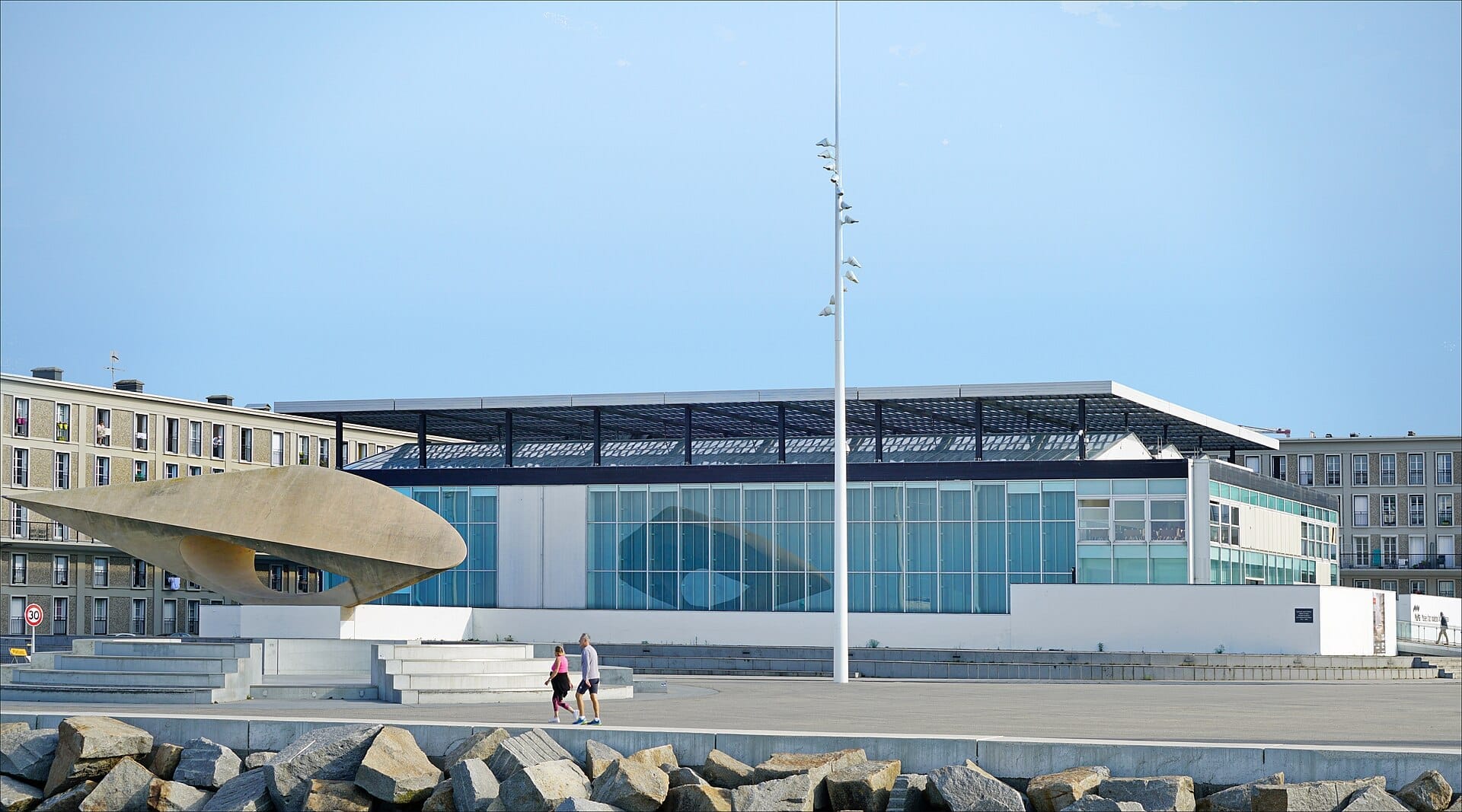
The Musée d'Art Moderne André Malraux, known as MuMa, stands directly on Le Havre's seafront promenade and holds one of the largest collections of Impressionist and Post-Impressionist paintings in France, often cited as the leading collection outside Paris. Its 1961 glass-and-steel building lets daylight wash over canvases by Monet, Boudin, Pissarro, and Dufy in a way few museums anywhere manage to achieve.
Quick Facts
- Location
- 2 Boulevard Clemenceau, 76600 Le Havre (seafront)
- Getting There
- Bus Line 7 to 'MuMa' stop from Hôtel de Ville; free parking directly in front of the museum and in the Benjamin Normand Street parking area
- Time Needed
- 1.5 to 2.5 hours for the permanent collection; 3+ hours if a major temporary exhibition is running
- Cost
- €5–€10 full / €3–€6 reduced depending on exhibition; free under 26 and first Saturday of the month; Pass Musées €20/year
- Best for
- Art lovers, Impressionism enthusiasts, rainy-day culture, photography, architecture fans
- Official website
- www.muma-lehavre.fr
What MuMa Actually Is (and Why It Matters)
The Musée d'Art Moderne André Malraux occupies a category of its own among French regional museums. It is not a catch-all civic collection assembled from donated odds and ends. MuMa holds one of the largest gatherings of Impressionist and Post-Impressionist works in France, trailing only the major Paris museums in scale. That is not a marketing claim: the collection numbers over 4,000 works, with particular depth in Eugène Boudin, Raoul Dufy, and Claude Monet, artists who each had direct ties to the Normandy coast.
The collection's roots go back to 1845, when Le Havre first established a civic art collection aimed at presenting European painting from the Renaissance onward. That founding ambition evolved through the 19th century into something more focused and more interesting: a serious commitment to the artists who had actually come here to paint the Channel light, the fishing boats, and the estuary. By the time the current building opened in 1961, inaugurated by Culture Minister André Malraux, MuMa had become a genuinely authoritative collection rather than a provincial imitation of Parisian institutions.
ℹ️ Good to know
Free admission applies every first Saturday of the month, and to all visitors under 26. If your schedule is flexible, these are the smartest times to visit from a budget perspective.
The Building: Light as a Design Philosophy
The architecture is as much of the experience as the art inside. The 1961 building, designed by Guy Lagneau, Michel Weill, and Jean Dimitrijevic, is almost entirely transparent on its seafront face. Floor-to-ceiling glass panels run the length of the main gallery, and a system of adjustable louvres on the ceiling filters natural light down onto the paintings below. The architects were solving a specific problem: how do you show Impressionist paintings, works that were made in daylight, under the kind of light that most closely resembles what the artists actually saw?
The answer they arrived at feels obvious in retrospect and remains rare in practice. Standing in the permanent collection rooms on a bright morning, the light quality genuinely shifts as clouds move over the Channel outside. A Boudin seascape looks different at 11:00 on a grey November morning than it does at 14:00 on a clear July afternoon. Most art museums work hard to keep natural light out. MuMa built its entire experience around letting it in.
The building sits directly on Boulevard Clemenceau, the road that runs along Le Havre's seafront promenade. Through the glass, you can see the beach, the horizon, and on clear days, the coast curving toward Sainte-Adresse. The architecture connects the art to the geography that produced it in a way that is quietly effective.
Tickets & tours
Live prices and dates from our booking partner. If you book, we may earn a commission at no extra cost to you.
Customized private D-day Normandy landing excursion from Le Havre
From 1.300 €Instant confirmationFree cancellationFull-day trip to Giverny and Rouen from Le Havre
From 1.200 €Instant confirmationFree cancellation
The Collection: What You Will Actually See
The permanent collection is organized to move from earlier 19th-century works toward the mid-20th century, with Impressionism forming the dense core of the experience. Eugène Boudin, who was born in nearby Honfleur and who mentored the young Claude Monet in the practice of plein-air painting, has the largest single-artist presence in the museum. His beach scenes at Trouville and his harbor studies of Le Havre itself are displayed in quantity, which gives you something that single-painting encounters in other museums cannot: an understanding of how his technique developed, and how obsessively he returned to the same light conditions over different decades.
Raoul Dufy, who was born in Le Havre in 1877, gets comparable depth. His works here span from early Fauve-period canvases to the decorative, almost musical compositions he became known for later in life. For anyone who knows Dufy only from reproductions, seeing a concentrated group of originals makes clear how much his color choices depend on scale and surface texture, details that reproductions flatten entirely.
The Monet holdings are significant without being overwhelming: quality over quantity. There are works that connect directly to the Impressionist viewpoints at Sainte-Adresse, the clifftop suburb just north of Le Havre where Monet painted some of his most recognized early works. Visiting MuMa and then walking or taking a short bus ride to Sainte-Adresse to see those same views in person is one of the most coherent art-and-landscape experiences Le Havre offers.
Beyond the Impressionist core, the collection extends into Fauvism, Cubism, and mid-century abstraction, though these later rooms feel less essential and receive less visitor attention. The temporary exhibition program, which typically runs one major show per year from late spring through late summer, has brought in significant loans and thematic surveys. Check the museum website before your visit to see what is on: ticket prices for major temporary exhibitions are typically at the top end of the €5–€10 full range (€3–€6 reduced), and the shows sometimes reshape how the permanent collection is displayed.
Timing Your Visit: How the Experience Changes by Hour
MuMa opens at 11:00 every day it is open. The first hour, from 11:00 to roughly noon, is consistently the quietest period on weekdays. Tour groups and cruise passengers rarely arrive before midday, and the school groups that occasionally fill the galleries tend to come in late morning blocks. If you want to spend time with the Boudin and Dufy rooms without navigating around other visitors, Tuesday through Friday at 11:00 is the clearest window.
Weekend afternoons bring noticeably larger crowds. The museum closes at 19:00 on Saturdays and Sundays, which creates a pleasant late-afternoon slot from about 16:30 onward when crowds thin again and the light through the seafront glass takes on a lower, warmer angle. This is arguably the best natural light for the Impressionist rooms.
💡 Local tip
The museum is closed on Mondays and on 1 January, 1 May, 14 July, 11 November, and 25 December. Plan around this if you are in Le Havre for only one or two days.
MuMa fits naturally into a broader day along the seafront. The seafront promenade runs directly past the building, and the beach is a few steps across the road. A morning at MuMa followed by lunch at one of the Boulevard Clemenceau cafés and an afternoon walk north toward Sainte-Adresse covers a full and varied day without requiring any transport.
Practical Walkthrough: Getting In and Getting Around
The main entrance faces Boulevard Clemenceau and the sea. Wheelchair access is via the Rue Benjamin Normand entrance on the side of the building. The museum is single-level, which makes it genuinely easy to navigate with a pram or mobility aid once inside. Reduced-price tickets are available for visitors with reduced mobility and one accompanying carer, on presentation of relevant disability documentation.
Bus Line 7 stops directly at the 'MuMa' stop from the city centre's Hôtel de Ville. By car, there is free parking directly in front of the museum and in the Benjamin Normand Street parking area. From Le Havre's main railway station, the museum is reachable by bus or on foot in about 20 to 25 minutes along the seafront.
For visitors arriving on a cruise ship, MuMa is one of the most logistically straightforward cultural stops in Le Havre: it is close to the seafront, well served by bus, and the permanent collection can be seen thoroughly in 90 minutes. The Le Havre cruise port guide covers transit options from the terminal in detail.
Lockers are available at the entrance for bags and coats. The museum has a small bookshop near the exit with a solid selection of catalogues, Impressionism titles, and Dufy and Boudin monographs, several of which are available in English. There is a restaurant and tea salon inside the museum with a view of the sea, and additional cafés are close at hand along the seafront.
Historical Context: Why Le Havre Has This Collection
The depth of MuMa's Impressionist holdings is not accidental. Le Havre had direct relationships with several of the artists now considered central to the movement. Boudin taught Monet here. Dufy was born here. The city's position on the Channel coast, its particular light, and its harbor life made it a natural subject for painters interested in capturing atmosphere over form.
The post-war reconstruction of Le Havre, overseen by Auguste Perret after the city's near-total destruction in World War II bombing, coincidentally produced an urban environment receptive to architectural modernism. The 1961 MuMa building arrived into a city that had just rebuilt itself around modernist concrete. The glass-and-steel museum did not look out of place in a UNESCO-listed urban grid of Perret's prefabricated concrete modules. For a fuller understanding of that architectural context, the Perret architecture guide covers the reconstruction story in depth.
The museum's name changed in its modern history: it was renamed Musée Malraux in honor of the minister who inaugurated it in 1961, and later rebranded as MuMa, a shorter, more usable name that has since become the standard local reference. The full official name remains Musée d'Art Moderne André Malraux.
Photography and What to Bring
Non-flash photography for personal use is generally permitted in the permanent collection at MuMa, though you should confirm this at the entrance desk as policies for temporary exhibitions sometimes differ. The glass facade creates interesting exterior photography opportunities, particularly in early morning when the sky and sea are reflected in the panels. From the promenade side, the building's horizontal lines frame views of the beach and horizon in a way that works well for wide-angle shots.
Inside, the Dufy rooms have strong natural light that benefits from a slightly raised ISO rather than flash. If you are following the Le Havre Impressionist art trail, MuMa is typically the anchor stop, and the artworks here give visual context to the outdoor viewpoints you will visit before or after.
⚠️ What to skip
The museum is closed on Mondays. This is a common source of frustration for visitors who arrive at the weekend and plan a Monday visit as part of a two-day itinerary. Double-check your dates before planning around it.
Insider Tips
- The museum's free-admission first Saturday of each month is popular but not overwhelmingly crowded: arrive at opening time (11:00) and you will have the Boudin rooms almost to yourself for the first 30 minutes.
- The seafront glass wall means the Impressionist galleries face northwest. On overcast days, the light is softer and more diffuse, which is actually closer to the painting conditions Boudin and his contemporaries worked in. Do not write off a grey day visit.
- Pick up the free map at the entrance desk rather than relying on wall labels alone: the layout of the permanent collection can feel non-linear, and the map shows clearly where the Boudin, Dufy, and Monet concentrations are.
- The bookshop near the exit stocks several affordable exhibition catalogues in both French and English, often at lower prices than you would find for equivalent art books in Paris. Worth browsing even if you are traveling light.
- If you are visiting with children, ask at the desk about the family discovery kits (parcours famille), which turn the permanent collection into an observation game. These are free to borrow and make the visit more manageable with younger visitors.
Who Is Musée d'Art Moderne André Malraux (MuMa) For?
- Art lovers with a specific interest in Impressionism and Post-Impressionism who want to go beyond the Musée d'Orsay crowd
- Cruise passengers with 3 to 4 hours in Le Havre who want one high-quality cultural stop
- Rainy-day visitors looking for a meaningful indoor experience on the seafront
- Architecture enthusiasts interested in how 1960s modernist design approaches the challenge of displaying art
- Families with older children who can engage with guided discovery materials and art-focused conversation
Nearby Attractions
Other things to see while in Seafront & Beach:
- Plage du Havre (Le Havre Beach)
Plage du Havre is a long public beach stretching from the harbour entrance to the cliffs near Sainte-Adresse, right at the edge of one of France's most architecturally significant city centres. Free to access year-round, it offers an unexpectedly raw coastal experience within walking distance of a UNESCO World Heritage cityscape.
- Seafront Promenade (Promenade Maritime)
Le Havre's Promenade Maritime stretches a little over 2 kilometres along a shingle beach facing the English Channel, connecting the city's UNESCO-listed rebuilt centre to open coastal air. Free and accessible around the clock, it reads very differently at dawn, midday, and dusk, and is worth knowing before you arrive.
Planning a trip? Discover personalized activities with the Nomado app.