Promenade Maritime: Le Havre's Seafront Walk Explained
Le Havre's Promenade Maritime stretches a little over 2 kilometres along a shingle beach facing the English Channel, connecting the city's UNESCO-listed rebuilt centre to open coastal air. Free and accessible around the clock, it reads very differently at dawn, midday, and dusk, and is worth knowing before you arrive.
Quick Facts
- Location
- Promenade des Régates, 76600 Le Havre (seafront-and-beach neighbourhood)
- Getting There
- LiA urban buses from city centre; walkable from Perret's rebuilt centre in about 15 minutes
- Time Needed
- 45 minutes for a straight walk; 2+ hours if you stop, sit, or wait for the light to change
- Cost
- Free. Individual café or activity providers set their own prices
- Best for
- Walkers, photographers, families, cruise passengers wanting sea air without a ticket
What the Promenade Maritime Actually Is
The Promenade Maritime, sometimes called the Front de mer du Havre, is a flat, paved seafront walkway running a little over 2 kilometres along Le Havre's shingle beach. On one side is the English Channel, wide and grey-green depending on the weather; on the other, the low modernist skyline that Auguste Perret designed after Allied bombing flattened most of the city during World War II. The result is an unusual combination: a working port city's seafront that feels genuinely spacious and uncluttered, with long sight lines in every direction.
This is not a manicured resort promenade lined with palm trees. The beach is shingle rather than sand, the sea wind arrives without ceremony, and the scale of the surrounding port infrastructure reminds you that Le Havre is first and foremost a working city. That honesty is part of what makes the walk rewarding. Access is free, the path is flat, and there are no barriers between you and the Channel.
💡 Local tip
The promenade is at its most photogenic in the early morning, when low-angle light catches the shingle and the port cranes appear as silhouettes. By mid-morning on summer weekends it fills with joggers, cyclists, and families.
How the Promenade Changes by Time of Day
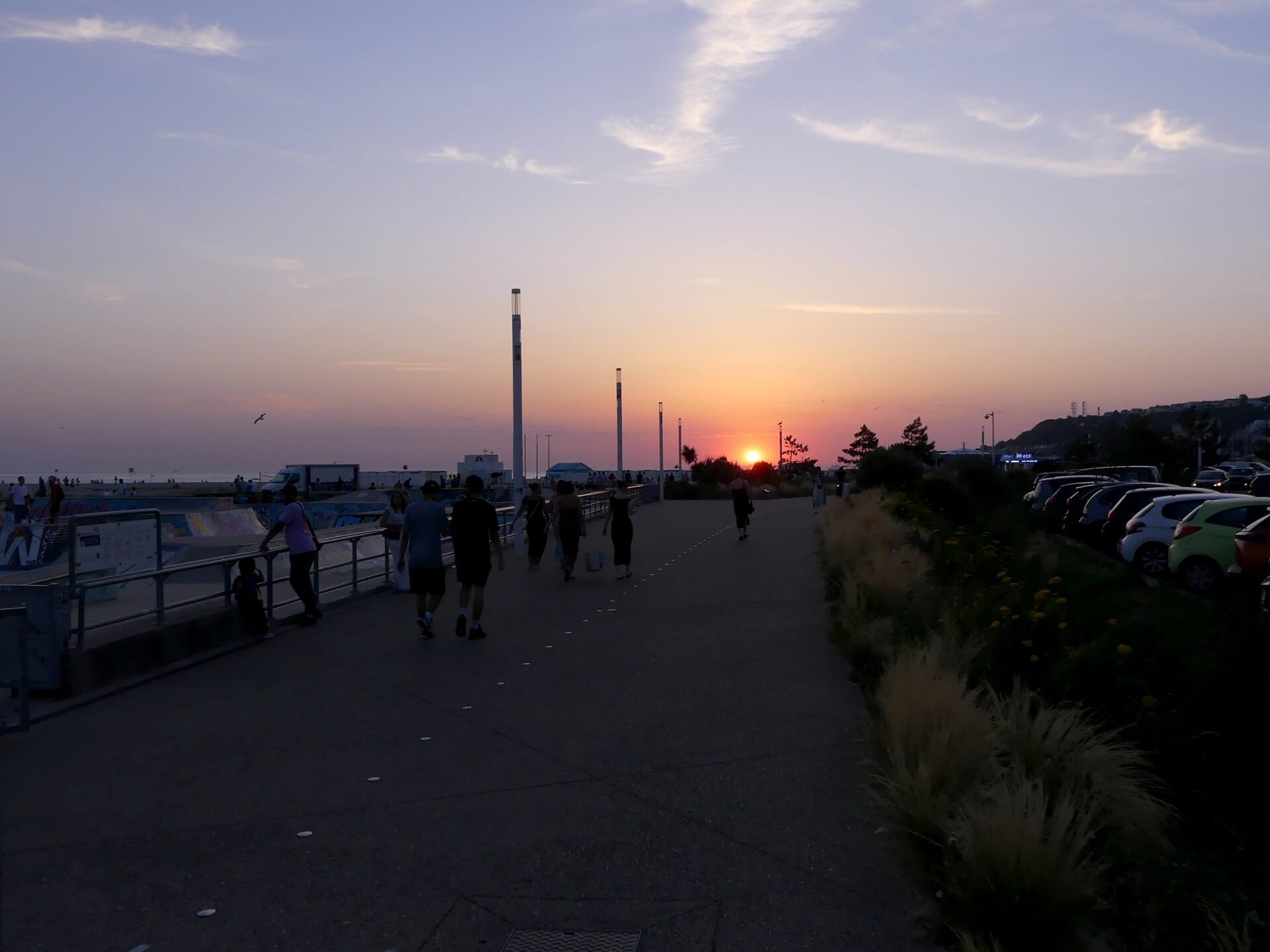
At dawn, especially in the cooler months, the promenade belongs almost entirely to dog walkers and early joggers. The sound is predominantly wind and the rhythmic drag of waves over shingle. The light on the water can shift from charcoal to pale silver in under ten minutes, and the absence of crowds makes this one of the better times to understand the promenade's actual scale.
By late morning on a summer weekday, the atmosphere changes considerably. Beach towels appear on the upper sections of shingle, a handful of cafés raise their shutters, and the sailing school boats begin appearing offshore. Children make their way down to the water's edge. The noise is still moderate compared to resort beaches, partly because the shingle tends to discourage the kind of casual all-day sunbathing that a sandy beach encourages.
Evenings in July and August are the most social. Locals walk in groups, the light turns amber over the Channel, and the water takes on colour it lacks during the flat midday hours. If you want to understand how Le Havre residents actually use their seafront rather than how it looks in photographs, arrive around 7 pm on a warm evening.
⚠️ What to skip
The promenade is exposed. In autumn and winter, Channel winds arrive with real force. A layer you can zip up is not optional outside of summer, and even in July the wind can make a static café visit feel cold. Dress accordingly.
Tickets & tours
Hand-picked options from our booking partner. Prices are indicative; availability and final rates are confirmed when you complete your booking.
Customized private D-day Normandy landing excursion from Le Havre
From 1.300 €Instant confirmationFree cancellationFull-day trip to Giverny and Rouen from Le Havre
From 1.200 €Instant confirmationFree cancellation
The Beach: Shingle, Not Sand
Plage du Havre is a shingle beach, and this is worth stating plainly before you arrive expecting sand. The stones are smooth and grey-beige, tightly packed near the waterline, looser higher up. Walking on dry shingle is slow and slightly effortful; walking barefoot on the wet shingle near the water is easier. Sun loungers do not work here the way they do on a sandy Mediterranean beach. Bring a mat or a thick towel if you plan to stay.
The beach itself sits within the broader seafront and beach neighbourhood, which includes facilities for sailing, beach volleyball, and open-water swimming in season. The sea temperature in the English Channel is cool even in August, typically staying well below 20°C, which keeps casual swimming sessions short. If that sounds unappealing, note that most visitors spend more time on the promenade than in the water.
Historical and Architectural Context
The seafront as it exists today is inseparable from Le Havre's post-war history. After Allied bombing in September 1944 destroyed a large portion of the city, Auguste Perret was commissioned to rebuild the centre using reinforced concrete. The resulting grid, which became a UNESCO World Heritage Site in 2005, shapes the rebuilt centre next to the seafront area. The wide boulevard running parallel to the promenade reflects Perret's approach: generous scale, standardised façades, an insistence on horizontal openness.
That architectural logic is most visible when you stop and look inland from the promenade. The relationship between the reconstructed city and the water it faces is deliberate. If you want to understand the design thinking behind what you are looking at, the Maison du Patrimoine and Atelier Perret offers one of the clearest explanations of the reconstruction, and it is worth an hour before or after your walk.
The port, visible to the south, adds a layer of industrial scale that is unique to Le Havre. Container ships move slowly in and out of the estuary. Cargo cranes rise behind the waterfront buildings. This is not incidental scenery; Le Havre is one of France's largest container ports, and the port's presence is part of the city's identity. The promenade does not pretend otherwise, and that is to its credit. For more on the port's scale and visitor access, the Port of Le Havre has its own profile.
Walking the Promenade: A Practical Route
The promenade is a straightforward linear walk with no decision points to navigate. Most people begin near the Hôtel de Ville end of the seafront boulevard and walk northwest toward Sainte-Adresse, or start further along and walk in the opposite direction. The full promenade section is a little over 2 km and an out-and-back takes roughly 45 minutes at a steady pace, more if you stop.
The northern end of the promenade approaches the cliffs and the quieter beach of Sainte-Adresse, the elevated neighbourhood that overlooks the city and bay. The views from this direction, with the city receding behind you and the Seine estuary opening ahead, are among the best along the entire stretch. If you have time, the Impressionist viewpoints at Sainte-Adresse are a logical extension of the walk.
Café options along the promenade are concentrated in the central and southern sections. Most open in spring and run through September. Outside of summer, the choice thins considerably. In autumn and winter, carrying your own coffee is a reliable strategy.
ℹ️ Good to know
Cyclists share the seafront path. On summer weekend mornings in particular, the pace on the path mixes fast road cyclists with slow family groups. Stay to one side and be aware of traffic behind you if you stop to photograph.
Photography and Light
The promenade faces roughly west to northwest, which means the best light for photography is in the late afternoon and early evening, when the sun drops toward the water. Morning light comes from behind the city and catches the beach and sea surface rather than illuminating the inland skyline. For shots that include the port cranes and the reconstructed buildings together, late afternoon in autumn gives the warmest colours with the least glare.
During the annual Un Été au Havre summer arts festival, the seafront often features large-scale outdoor installations that alter the visual character of the promenade completely. These temporary works vary year to year, so check before visiting if this is part of your plan. The festival is also one of the main reasons to read more about visiting Le Havre in summer before booking.
Who Should and Should Not Visit
The promenade is genuinely well-suited to walkers, joggers, families with children, and anyone arriving by cruise ship who wants immediate sea air without paying for an attraction. It is also a useful orientation point: walking its length gives you a clear sense of the city's scale and its relationship to the sea.
Visitors expecting a Mediterranean-style resort beach experience will be disappointed. The shingle, the wind, the Channel grey, and the industrial port backdrop are not incidental; they are the character of the place. If you are weighing up whether Le Havre's coast is right for your trip, the guide on whether Le Havre is worth visiting addresses this directly.
Visitors with significant mobility limitations should note that while the promenade path itself is flat and paved, access down to the shingle beach involves an uneven slope. The path along the top is generally manageable. Detailed accessibility information for specific facilities should be verified directly with the Le Havre tourism office before travel.
Insider Tips
- The shingle changes colour after rain. Wet stones reflect the sky in a way that dry stones do not, and overcast post-rain mornings produce the most atmospheric light on the beach.
- If you are walking from the city centre, approach via Boulevard Albert 1er rather than side streets. The moment the sea appears at the end of the boulevard is the best first view of the promenade.
- Bring something to sit on if you plan to stay on the beach. The shingle is hard and irregular, and café seating along the promenade fills quickly on warm weekend afternoons.
- In summer, the northern stretch of the promenade near the Sainte-Adresse boundary is noticeably quieter than the central section. Walk an extra ten minutes beyond the main facilities to find space.
- The promenade is a working part of the city, not a tourist zone. Locals run, cycle, and walk here year-round. Behaving like a resident rather than a visitor, observing pace and keeping to one side of the path, makes the experience feel less like an attraction and more like being somewhere real.
Who Is Seafront Promenade (Promenade Maritime) For?
- Walkers and joggers wanting a flat, open seafront route with good views
- Cruise passengers from the port of Le Havre looking for a short, free coastal walk
- Photographers interested in industrial-coastal light and the contrast between port infrastructure and open sea
- Families with children who want an accessible outdoor space without an entry fee
- Architecture enthusiasts using the promenade as a vantage point to read Perret's reconstructed city from the outside
Nearby Attractions
Other things to see while in Seafront & Beach:
- Musée d'Art Moderne André Malraux (MuMa)
The Musée d'Art Moderne André Malraux, known as MuMa, stands directly on Le Havre's seafront promenade and holds one of the largest collections of Impressionist and Post-Impressionist paintings in France, often cited as the leading collection outside Paris. Its 1961 glass-and-steel building lets daylight wash over canvases by Monet, Boudin, Pissarro, and Dufy in a way few museums anywhere manage to achieve.
- Plage du Havre (Le Havre Beach)
Plage du Havre is a long public beach stretching from the harbour entrance to the cliffs near Sainte-Adresse, right at the edge of one of France's most architecturally significant city centres. Free to access year-round, it offers an unexpectedly raw coastal experience within walking distance of a UNESCO World Heritage cityscape.