Le Volcan (Oscar Niemeyer Cultural Centre): Le Havre's Most Distinctive Building
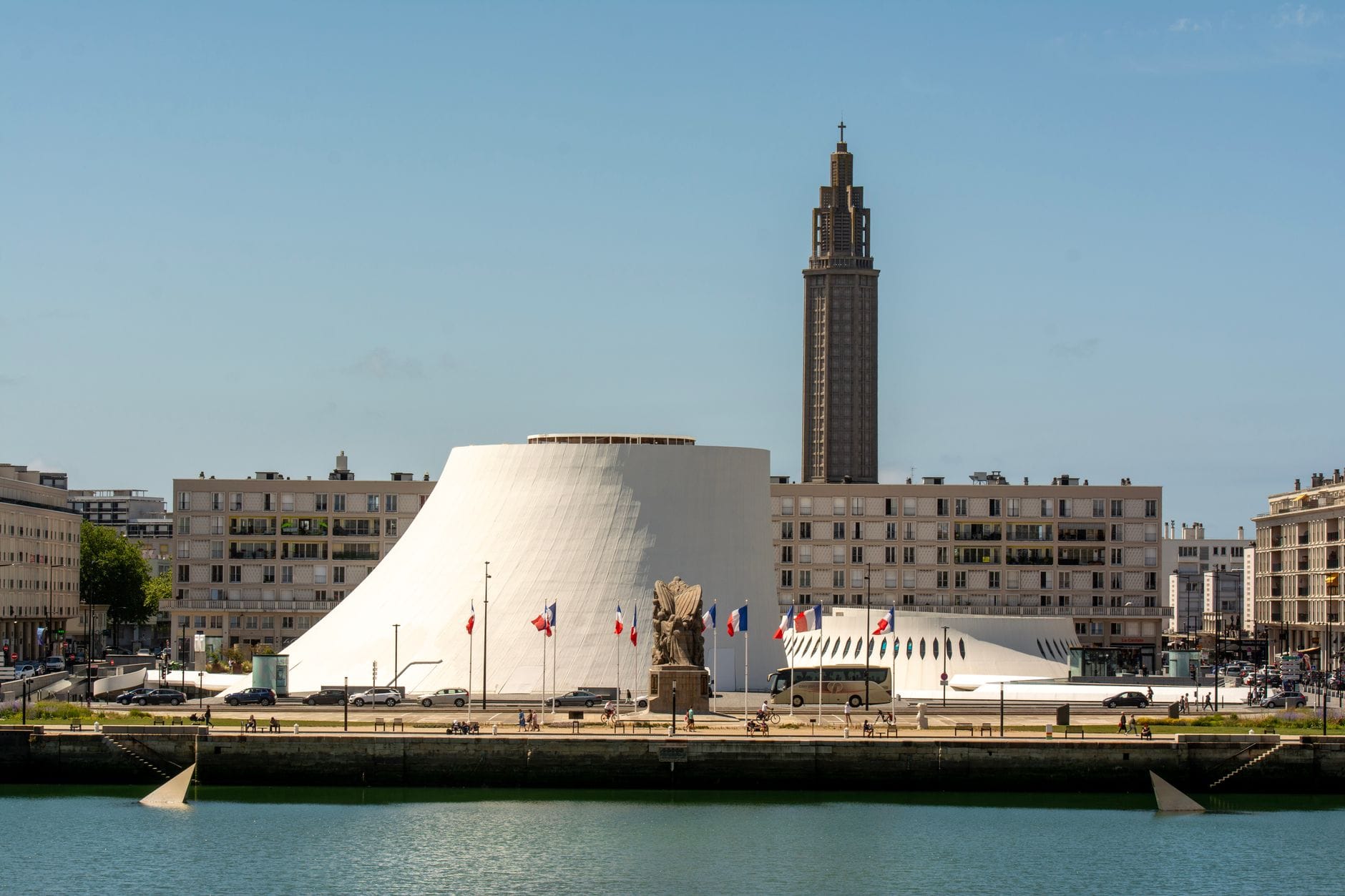
Le Volcan is a pair of white concrete cylinders rising from a sunken plaza in the heart of Le Havre's UNESCO-listed city centre. Designed by Oscar Niemeyer and inaugurated in 1982, this performing arts venue is as much an architectural landmark as it is a working theatre and concert space.
Quick Facts
- Location
- Former Place Gambetta, city centre of Le Havre (Centre-Ville Perret), at the extension of the Bassin du Commerce
- Getting There
- Central Le Havre; close to LiA bus and tram stops in the city centre. Within walking distance of Le Havre railway station.
- Time Needed
- 30 min to view exterior; 2–3 hours for a performance or exhibition
- Cost
- Free to view exterior plaza. Performance tickets vary by event — check levolcan.com for current pricing.
- Best for
- Architecture enthusiasts, performing arts visitors, photography, curious city walkers
- Official website
- www.levolcan.com
What Le Volcan Actually Is
Le Volcan, officially known as the Scène nationale du Havre or Espace Oscar Niemeyer, is a national performing arts centre occupying a full urban block in the heart of Le Havre's postwar city centre. It is not a museum, not a monument, and not a passive landmark — it is a working cultural institution that hosts theatre, concerts, contemporary circus, and cross-disciplinary performances throughout the year.
The building takes its name from the two white concrete cylinders that rise from a sunken public plaza. The larger of the two stands approximately 22 metres high with a base diameter of around 50 metres — wide-mouthed, hollow at the top, and unmistakably volcanic in silhouette. The smaller cylinder echoes its form at a reduced scale. Below street level, the two structures sit within a moulded concrete enclosure about 500 metres in circumference, supported on 239 foundation piles. Almost everything functional is underground.
ℹ️ Good to know
The exterior is accessible at all times and free to view. To attend a performance or access interior spaces, you will need a ticket — check the current programme at levolcan.com before your visit.
The Architecture: Why It Matters Here
Le Volcan was commissioned in the early 1970s, with the project running from 1972 to 1978 and construction on site from 1978 until its inauguration on 18 November 1982. Oscar Niemeyer, the Brazilian architect responsible for much of Brasília's civic architecture, designed it in collaboration with Jean-Maur Lyonnet. It was renamed Le Volcan in 1990, having originally been called the Maison de la Culture du Havre. For context on the broader architectural landscape it sits within, the Perret architecture guide provides essential background on the postwar reconstruction that shapes everything around it.
What makes Le Volcan architecturally striking is how deliberately it breaks from its surroundings. Auguste Perret's rebuilt city centre is a study in rational modernism: concrete certainly, but governed by grids, vertical rhythms, and civic restraint. Niemeyer rejected all of that. His forms are curved, expressive, and frankly sculptural. The two cylinders read as geological intrusions into the urban grid, as if something organic had erupted through Perret's orthogonal order. Whether you find this thrilling or jarring depends on your taste, but the dialogue between the two visions is architecturally significant in ways that are rarely acknowledged in passing tourist coverage.
The Atelier Perret heritage centre nearby is a useful counterpoint visit — it gives you the logic and method of the reconstruction before you encounter Niemeyer's deliberate departure from it.
Tickets & tours
Hand-picked options from our booking partner. Prices are indicative; availability and final rates are confirmed when you complete your booking.
Customized private D-day Normandy landing excursion from Le Havre
From 1.300 €Instant confirmationFree cancellationFull-day trip to Giverny and Rouen from Le Havre
From 1.200 €Instant confirmationFree cancellation
What You See at Street Level
Arriving at Le Volcan on foot, the first impression is spatial before it is architectural. The plaza is sunken below the level of the surrounding streets, so from the pavement you are looking down at the tops of the cylinders rather than up at a facade. The white concrete surfaces catch the northern French light in ways that shift dramatically through the day — flat and bleached at midday, warm and textured in the late afternoon, and almost luminous at dusk when the building's lighting activates.
Access to the sunken plaza is via ramps that curve down from street level, consistent with Niemeyer's preference for gentle slopes over abrupt stairs. The ramp approach is practical rather than just aesthetic — it also makes the complex substantially accessible without resort to separate adapted entrances, though anyone with specific mobility requirements should confirm current arrangements with the venue directly.
Once in the plaza, the scale becomes clearer. The big volcano's open crown is wide enough to feel like a landscape feature rather than a building detail. On event nights, the plaza fills with people arriving for performances, and the ambient sound from the surrounding city drops noticeably below street level — a subtle acoustic effect of the sunken design. On quiet weekday mornings, the space feels almost entirely private despite being in central Le Havre.
💡 Local tip
For photography, the best exterior light falls on the white concrete in the late afternoon, roughly an hour before sunset. The curved forms cast strong shadows that emphasise the geometry in a way that midday shots rarely capture.
Inside Le Volcan: The Performance Spaces
The interior of Le Volcan is almost entirely underground. The main auditorium holds around 800 seats following a renovation that altered the original 1,200-seat configuration. There is also a 125-seat smaller hall, and a concert café that functions as a more informal venue for smaller acts and late-evening programming. The renovation brought the acoustic and technical infrastructure in line with contemporary performance standards while preserving the essential spatial concept.
The programming at Le Volcan as a Scène nationale tends toward ambitious and sometimes challenging work: contemporary dance, theatre, live music across genres, and interdisciplinary productions that would not fit comfortably in a conventional concert hall. It is not primarily a tourist attraction in the way that a museum is. If you are visiting Le Havre without a specific interest in the performing arts, the exterior is the main event. But if you have the opportunity to time your visit around a performance, the interior experience completes the picture in ways the exterior cannot.
Le Volcan in the Context of the City
Le Volcan sits at the extension of the Bassin du Commerce, the rectangular water basin that forms one of the visual anchors of central Le Havre. The Bassin du Commerce and its surrounding walkways are a short walk away, making a natural circuit for anyone exploring the reconstructed city centre on foot.
A few hundred metres in the other direction, the Église Saint-Joseph offers a very different kind of architectural encounter — Perret's beacon-like tower church, with its remarkable coloured glass interior. Visiting both in the same half-day creates a genuinely coherent architectural argument about what Le Havre is and why it received UNESCO recognition in 2005. The city's rebuilt centre is listed not as a collection of individual monuments but as a unified urban ensemble, and Le Volcan complicates that ensemble in productive ways.
If you want to understand the full scope of what the reconstruction produced, and where Le Volcan fits within it, the Le Havre walking tour guide covers the main architectural sequence across the city centre.
Practical Notes for Visitors
There is no admission charge to visit the sunken plaza and view the exterior. The space is open throughout the day and into the evening. Performance schedules vary considerably by season, with the programme generally running from autumn through to late spring, following the French national theatre calendar. Summer months tend to have a reduced programme, so if attending a performance is part of your plan, check the schedule at levolcan.com well in advance.
Le Volcan is centrally located and reachable on foot from most of the city centre's main points of interest. The LiA tram and bus network stops near the city centre, and the walk from Le Havre's main railway station takes around ten to fifteen minutes. There is no dedicated car park at the venue itself; street parking in the surrounding grid follows standard French urban conventions.
The white concrete exterior is exposed to the weather, and Le Havre's oceanic climate means overcast skies are the norm for much of the year. The building does not suffer from grey days — the concrete surfaces are designed to function in northern European light, and the contrast with a stormy sky can be genuinely dramatic. Rain, however, makes the ramps slippery, so appropriate footwear is worth considering.
⚠️ What to skip
Le Volcan is not a museum and has no permanent exhibition open to casual visitors. If you arrive outside of an event, you will see the exterior plaza only. Plan accordingly, and check the official website for what might be open on your specific date.
Is Le Volcan Worth Your Time?
For architecture enthusiasts and anyone seriously interested in Le Havre's urban identity, yes, without qualification. Le Volcan is one of relatively few Niemeyer buildings in France, and its relationship to the Perret reconstruction around it raises genuine questions about identity, memory, and civic ambition that you will not find discussed anywhere else in the city.
For casual visitors who are not drawn to architecture or performing arts, the exterior requires perhaps twenty to thirty minutes at most. It is not the kind of attraction that rewards extended contemplation without some prior interest in what you are looking at. If your time in Le Havre is limited, combine it with the Bassin du Commerce and Saint-Joseph as part of a broader city centre circuit rather than treating it as a standalone destination.
Cruise passengers with a half-day in port are well placed to include it: Le Volcan is centrally located and works naturally into a compact city centre itinerary. The Le Havre cruise port guide covers how to make the most of limited time ashore.
Insider Tips
- The sunken plaza is at its most photogenic around an hour before sunset, when the low northern light rakes across the curved concrete surfaces and the shadows deepen. At midday, the flat overhead light flattens the geometry considerably.
- On performance nights, arrive fifteen to twenty minutes early and spend time in the plaza before entering. The crowd gathering in the sunken space, with the city humming above, gives the building a different quality entirely from its daytime quietude.
- The small volcano is often overlooked by visitors focusing on its larger sibling. Walk around it fully: the relationship between the two cylinders, and the way the moulded enclosure wall connects them, only becomes legible from multiple angles.
- Le Volcan's programme as a Scène nationale often includes free or low-cost events alongside ticketed performances. Check the website for open rehearsals, public talks, or festival events that allow interior access without a full ticket price.
- If you are visiting in summer for the Un Été au Havre arts festival, the plaza and its surroundings sometimes form part of the outdoor programming — the space has been used for installations and events that are not part of the venue's regular calendar.
Who Is Le Volcan (Oscar Niemeyer Cultural Centre) For?
- Architecture and design enthusiasts wanting to see Niemeyer's only major work in Normandy in northern France
- Performing arts visitors attending a theatre, dance, or music programme at the Scène nationale
- Photographers seeking strong geometric subjects in an unusual urban setting
- Travellers building a coherent architectural itinerary of Le Havre's UNESCO-listed city centre
- Cruise passengers with a half-day in port who want a concentrated city centre cultural circuit
Nearby Attractions
Other things to see while in Centre Ville Perret (UNESCO District):
- Bassin du Commerce
The Bassin du Commerce is a 500-metre historic dock at the centre of Le Havre's UNESCO-listed rebuild, where post-war concrete architecture meets open water. Free to visit during public hours, it serves as the city's most photogenic public space and a genuine crossroads of daily life.
- Cathédrale Notre-Dame du Havre
Standing on rue de Paris in central Le Havre, the Cathédrale Notre-Dame du Havre is a rare pre-war survivor in a city rebuilt almost entirely from concrete after 1944. Its layered Gothic and Renaissance architecture tells a longer story than the modernist grid surrounding it. Entry is free, and the contrast with Auguste Perret's rebuilt city makes it one of the most thought-provoking stops in the centre.
- Église Saint-Joseph
Designed by Auguste Perret and structurally completed in 1957 (with consecration in 1964), Église Saint-Joseph is the defining monument of Le Havre's UNESCO-listed city centre. Its 107-metre lantern tower and 12,768 panels of coloured glass make it one of the most architecturally significant post-war churches in Europe. Entry is free.
- Halles Centrales
Built between 1958 and 1960 as part of Auguste Perret's post-war reconstruction, the Halles Centrales is Le Havre's working food market. Free to enter and open seven days a week, it offers fresh produce, local traders, and a ground-level view of everyday city life inside a landmark modernist concrete shell.