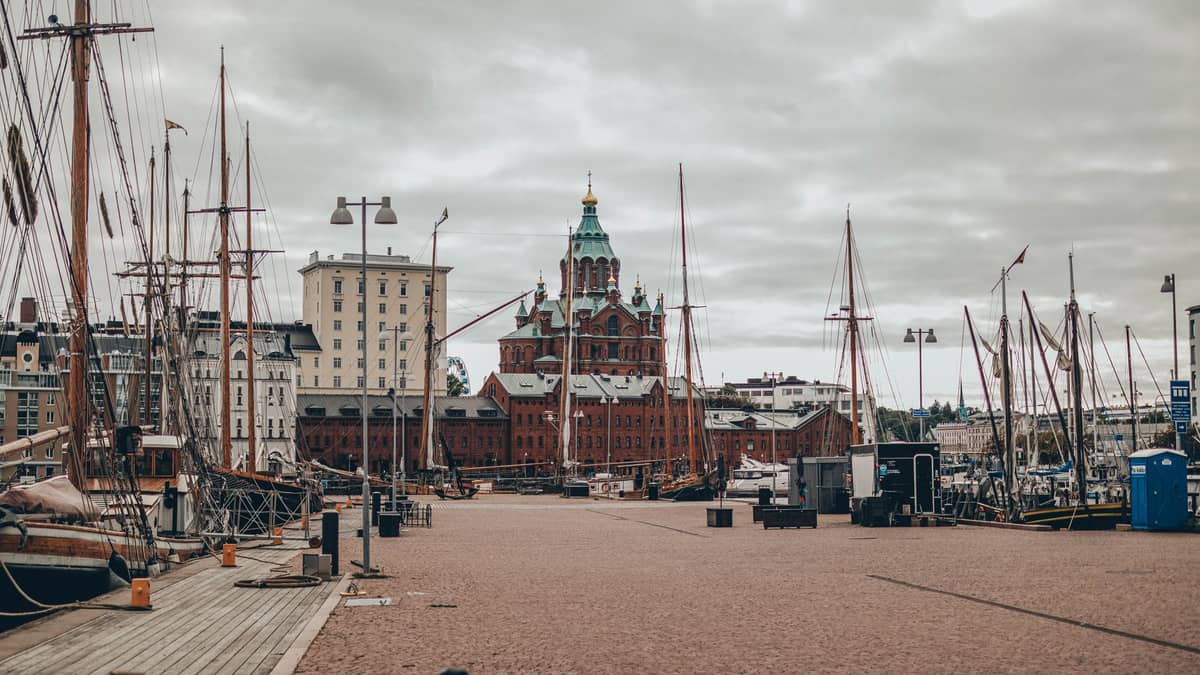
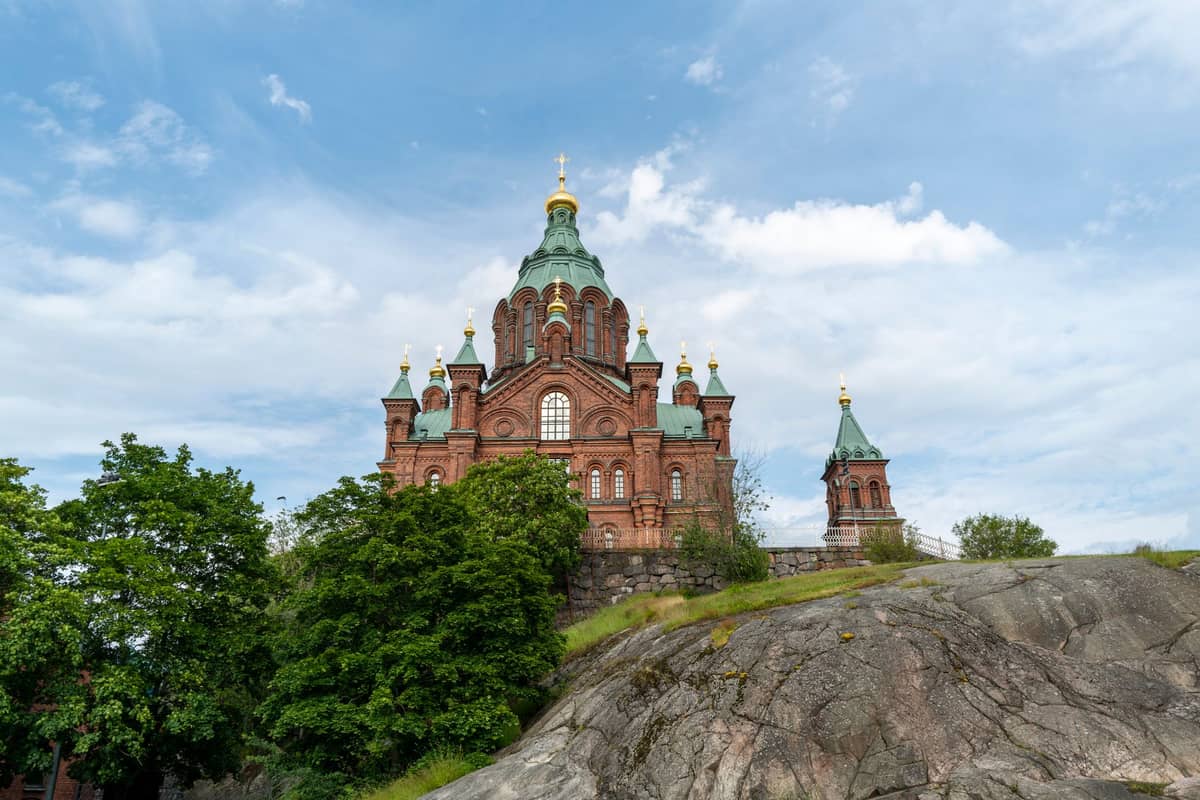
Katajanokka is a compact peninsula just east of Helsinki's city center, defined by its ornate Art Nouveau architecture, Russian Orthodox cathedral, and calm waterfront edges. Once a naval and warehouse district, it now draws visitors with its distinctive skyline, the famous prison-turned-hotel, and easy access to the harbor.
Katajanokka is a narrow peninsula that juts east from Helsinki's city core, separated from the mainland by a short canal and framed on three sides by the sea. It is one of the most architecturally coherent neighborhoods in the city, dense with Jugendstil facades, a Russian Orthodox cathedral crowning its ridge, and a waterfront that feels removed from the energy of the center despite being a ten-minute walk from Senate Square.
Orientation
Katajanokka sits immediately east of central Helsinki, connected to the city by bridges over the narrow canal that separates it from Kruununhaka to the north and the South Harbor area to the west. It is a small, self-contained peninsula: roughly 1 kilometer long and no more than 500 meters wide at its broadest point. The western edge faces the South Harbor and Market Square; the northern shore looks toward the Hakaniemi area across the water; the eastern and southern tips face open sea toward the outer islands.
The peninsula's central spine runs roughly east-west, with Satamakatu as one of the key cross streets behind Uspenski Cathedral. The canal side is dominated by the long Merikasarmi (Sea Barracks) complex, a neoclassical ensemble built between 1816 and 1820 that now houses the Finnish Ministry for Foreign Affairs. The waterfront promenade on the eastern tip offers open views toward the Helsinki archipelago and, on clear days, the outer islands.
Katajanokka is not isolated, but it does feel distinct. The canal crossing takes less than a minute on foot, and Senate Square and Kruununhaka are within easy walking distance to the northwest. The South Harbor and Market Square (Kauppatori) are a short stroll to the west. Despite this proximity, many visitors never cross the canal, which means Katajanokka retains a noticeably quieter character than the tourist core.
Character & Atmosphere
The defining quality of Katajanokka is its architectural unity. The residential blocks built in the late 19th and early 20th centuries are among the finest examples of Finnish Jugendstil in the country: ornate stone facades with carved animal motifs, bay windows, and elaborate doorways line the main streets. Walking along Luotsikatu or Katajanokanranta in the morning, when the light comes in low from the east and catches the texture of the stonework, the street looks more like a curated open-air museum than a residential district. But people do live here, and the neighborhood functions as a genuine community.
Mornings are quiet. There are no large markets or transit hubs on the peninsula itself, so the streets wake up slowly. Residents walk dogs along the waterfront path, and the few cafes open early fill with local regulars rather than tourists. By midday, visitors start arriving, drawn primarily by Uspenski Cathedral and the waterfront views. The cathedral sits on a rocky ridge above the western approach, its red brick and golden onion domes visible from across the harbor. It is genuinely striking, and the steps below it offer one of the better elevated views of Market Square and Senate Square.
By late afternoon, the atmosphere shifts. The cruise terminal at the peninsula's southern edge brings short-term visitors in summer, and the streets around the terminal can feel temporarily congested when large ships dock. But the effect is temporary; an hour later the same streets are quiet again. After dark, Katajanokka has no significant bar or restaurant strip of its own. The nightlife energy of central Helsinki does not reach this far east, and that is part of the point: staying here means trading convenience for calm.
ℹ️ Good to know
Katajanokka has a functioning cruise ship terminal. If a large vessel is scheduled to dock during your visit, expect a brief surge of foot traffic near the southern tip of the peninsula, typically in the early afternoon.
History
Katajanokka's character is inseparable from its military and maritime history. The peninsula was developed in the 18th and 19th centuries as a naval base and logistics area for the Russian Empire, which governed Finland from 1809 to 1917. The Merikasarmi (Sea Barracks) complex along the northern canal shore was built between 1816 and 1820 to house the Russian military garrison, and the ensemble of neoclassical buildings remains largely intact today. After Finnish independence, the complex passed through various uses before becoming the home of the Foreign Ministry.
Uspenski Cathedral, completed in 1868, was built to serve the Russian Orthodox congregation in Helsinki and remains the largest Orthodox church in Northern and Western Europe. Its hilltop position was deliberate: the cathedral was meant to be visible from the harbor and to signal the presence of Russian Orthodoxy in the heart of the Finnish capital. After independence, the cathedral remained in use by the Finnish Orthodox Church, which is a separate entity from the Russian Orthodox Church.
The residential Art Nouveau blocks were built between the 1890s and 1910s, as Helsinki expanded rapidly and architects trained in the new Jugendstil movement found in Katajanokka a largely blank canvas. The result is a concentration of high-quality early 20th-century architecture that has survived remarkably well. The former city prison on the peninsula, built in 1837 and expanded through the 20th century, was decommissioned as a working jail and converted into a hotel, which now markets the cells-turned-rooms as a distinctive accommodation option.
What to See & Do
The primary draw is Uspenski Cathedral, which rewards both the exterior walk-around and the interior visit. The inside is richly decorated with icons, candles, and painted walls, and adult admission is €5 outside services (under-18s free). Plan to spend 20 to 30 minutes inside. The steps and terrace around the cathedral offer elevated views of the harbor, the Presidential Palace, and the roofline of Senate Square, making this one of the better vantage points in central Helsinki without requiring any climbing.
The Merikasarmi complex along Laivastokatu is not open to the public as it functions as government offices, but the yellow neoclassical facades are worth seeing from the street. The courtyard, glimpsed through gates, gives a sense of the scale of what was once a full naval garrison. Walking the canal-side path along the northern edge of the peninsula is pleasant on its own terms, with views back toward Kruununhaka and the old city.
The peninsula's residential streets between Luotsikatu and Katajanokanranta are worth walking slowly. Look for the carved stonework above doorways, the wrought-iron railings, and the variety of facade treatments from building to building. The Stora Enso headquarters at the western tip of the peninsula, designed by Alvar Aalto and completed in 1962, provides a striking contrast to the surrounding historical fabric: a transparent-looking stone and glass building that faces Market Square. Whether or not it succeeds in that context is a matter of opinion that the Helsinki architecture community has debated since it was built.
Uspenski Cathedral: exterior and interior, free entry, typically open Tuesday–Friday during the day, Saturday morning to mid-afternoon, and Sunday afternoons
Waterfront promenade along Katajanokanranta: quiet walk with harbor views toward the outer archipelago
Art Nouveau street architecture: concentrated on Luotsikatu and surrounding residential streets
Merikasarmi complex: neoclassical naval barracks, viewable from street level
Katajanokka Prison Hotel: even non-guests can walk past and view the historic exterior
Canal-side path: connecting back to Kruununhaka, with views toward the city center
If you want to extend your visit beyond the peninsula, the Suomenlinna ferry departs from the South Harbor, a five-minute walk from the western edge of Katajanokka. The Suomenlinna sea fortress is one of Helsinki's most significant historical sites and can be reached in about 15 minutes by ferry.
Eating & Drinking
Katajanokka is not a dining destination in the way that Punavuori or Kallio are. The food and drink scene here is small, focused, and largely tied to the hotel and the residential community rather than to any broader restaurant culture. There are no large market halls, no street food vendors, and no late-night bar strips.
The Katajanokka Prison Hotel has a restaurant in the former prison building, which is the most distinctive dining option on the peninsula. The setting, vaulted ceilings, heavy doors, and narrow corridors, is unlike anything else in Helsinki's restaurant scene. The menu tends toward Finnish and Nordic ingredients, with pricing at the upper end of the mid-range bracket. It is worth considering for dinner if the novelty of the setting appeals to you, though the food itself is competent rather than exceptional.
For more casual eating and drinking, the practical reality is that most visitors walk back across the canal to the South Harbor area or into Kruununhaka. The Old Market Hall at Eteläranta is a five-minute walk and offers a much wider range of food options, from Finnish fish dishes to international street food stalls.
The Old Market Hall (Vanha Kauppahalli) near the South Harbor is the best nearby option for a broader food experience, with vendors selling smoked fish, fresh produce, Finnish pastries, and hot meals in a restored 19th-century hall. It is typically busiest at lunchtime on weekdays.
💡 Local tip
If you are staying in Katajanokka and want coffee and a pastry in the morning without walking far, look for small neighborhood cafes on the streets near the canal. The selection is limited but reliable. For more options, it is a short walk into Kruununhaka.
Getting There & Around
Katajanokka has no metro or train station. The peninsula is served by trams, with the closest tram stops at Vyökatu and Kauppiaankatu on the routes connecting the peninsula to the city center. Tram lines 4 and 6T, and at times 7T, all pass through the area, linking Katajanokka to the central railway station and to destinations further west and south.
For most visitors, the easiest access is on foot from the city center. Walking east from Senate Square along Aleksanterinkatu and then across the canal bridge takes about ten minutes. From Market Square at the South Harbor, it is roughly the same distance heading east along the waterfront. The walk is flat and straightforward, and crossing the canal on foot is the most natural way to arrive.
Public transport in Helsinki is run by HSL (Helsinki Regional Transport Authority) and operates on a zone-based fare system. A single ticket covers trams, buses, metro, and local ferries within the central zone. For a full overview of how to navigate Helsinki by transit, the getting around Helsinki guide covers all modes in detail, including the Helsinki Card, which includes unlimited travel.
⚠️ What to skip
Katajanokka is a peninsula with limited bus frequency after around 22:00. If you are staying here and planning to be out late in central Helsinki, check the last tram and bus times in advance or budget for a taxi back. The walk from Market Square takes about 15 minutes and is safe, but it can be cold in winter.
Where to Stay
Katajanokka has a small but distinctive accommodation scene. The most well-known option is the Katajanokka Prison Hotel, housed in a converted 19th-century jail. The rooms occupy former cells, with stone walls and heavy doors that have been converted to comfortable, if compact, hotel rooms. It is the kind of place that either appeals to you immediately or does not at all. The hotel is well managed, the location is quiet, and it is a short walk from the city center.
Beyond the Prison Hotel, accommodation options are limited on the peninsula itself. The area is primarily residential, with apartment-style rentals available through short-term platforms. These suit travelers who want a quiet base with easy access to the city center and prefer not to be in the middle of tourist foot traffic. The trade-off is fewer nearby amenities compared to staying in Kamppi, Punavuori, or the immediate city center district.
For travelers deciding where to base themselves in Helsinki, Katajanokka suits those who prioritize calm, architectural character, and harbor proximity. For a broader comparison of neighborhoods and hotel options across the city, the Helsinki accommodation guide covers all the main districts with honest assessments of each.
Is Katajanokka Worth Visiting?
Katajanokka is worth an hour or two for anyone spending more than a day in Helsinki. The combination of Uspenski Cathedral, the Art Nouveau residential streets, and the waterfront promenade is genuinely interesting, and the area rewards slow walking in a way that the tourist-heavy center does not always allow. For a neighborhood that is ten minutes from Senate Square, it receives a fraction of the foot traffic, which in itself is a reason to cross the canal.
It is not a place to come for dinner or nightlife. The food options are thin, and the neighborhood goes quiet early. But as an architectural and waterfront detour from the main city circuit, it holds up well. On a summer afternoon, the combination of light on the water, the Orthodox cathedral above the harbor, and the quiet residential streets makes for one of the more memorable short walks in central Helsinki.
If you are building a walking itinerary that takes in Senate Square, the harbor, and the Old Market Hall, adding Katajanokka requires only a short detour east across the canal. Combine it with a stop at Uspenski Cathedral and a stroll back along the waterfront, and you have a half-morning well spent. For a broader Helsinki walking framework, the Helsinki walking tour guide shows how Katajanokka fits into a full city circuit.
TL;DR
Katajanokka is a compact Art Nouveau peninsula east of central Helsinki, best visited on foot as part of a harbor and Old Town circuit.
The standout attraction is Uspenski Cathedral, the largest Orthodox church in Northern and Western Europe, with good views over the South Harbor from its hilltop position.
The residential streets are among the finest examples of Finnish Jugendstil architecture in the city and reward slow walking.
The neighborhood is quiet with limited dining and nightlife options: plan to eat elsewhere and check late-night transit connections if staying here.
Best suited for architecture enthusiasts, travelers seeking a calm base near the city center, or anyone who wants to see a side of Helsinki that most visitors overlook entirely.
Helsinki rewards a focused two-day visit better than almost any other Nordic capital. This itinerary covers the essential landmarks, best neighborhoods, and a few genuinely worthwhile detours — with practical transport details, honest cost breakdowns, and seasonal advice built in.
Helsinki offers more than its compact scale suggests when it comes to museums. From the golden-age canvases at the Ateneum to open-air farmhouses on a forested island, the city's collections span Finnish identity, world-class design, and contemporary art. This guide covers the best museums in Helsinki, with practical advice on what to expect at each.
Helsinki rewards visitors in every season, but the experience varies dramatically. This guide breaks down weather, crowd levels, prices, and what actually happens on the ground across all four seasons, so you can pick the timing that matches your priorities.
Helsinki is compact enough to explore in a couple of days, but the surrounding region rewards further exploration. From the medieval streets of Tallinn across the Gulf of Finland to the wooden old town of Porvoo and the wilderness of Nuuksio National Park, these are the day trips worth building time into your itinerary for.
Finnish food is more than fish and potatoes. This guide covers the essential dishes to try in Helsinki, where to find them, what they cost, and which seasonal specialties are worth planning around.
Helsinki punches well above its weight for free experiences. From permanently free museums and UNESCO World Heritage sites to urban beaches, sweeping architecture, and peaceful island walks, this guide covers the best free things to do in Helsinki across every season.
Helsinki has one of the most logical public transport systems in Northern Europe, built around a zone-based ticketing network that covers buses, trams, metro, commuter trains, and ferries. This guide covers every mode of transport, from landing at Helsinki Airport to island-hopping by ferry, with practical advice on what to use and what to skip.
The Helsinki Card promises free entry to 25+ attractions plus sightseeing tours from €51 for 24 hours. But does it actually save you money? This guide runs the real numbers, explains the three card versions, and tells you exactly when it's worth buying and when it isn't.
Helsinki's Christmas market season runs from late November through December, centered on the atmospheric Tuomaan Markkinat at Senate Square. This guide covers dates, opening hours, what to expect, and how to make the most of your visit in the Finnish winter.
Helsinki offers more than its compact scale suggests when it comes to design. From the combined Architecture and Design Museum to the underground wonder of Amos Rex, plus one of Europe's most concentrated design shopping districts, this guide covers everything you need to experience the city's design culture properly.
Summer transforms Helsinki into one of Northern Europe's most rewarding city destinations. Nearly 19 hours of daylight, major arts festivals, waterfront saunas, and island escapes make June through August the city's peak season. This guide covers everything you need to plan a summer trip, from the reality of the midnight sun to navigating Midsummer closures.
Helsinki in winter is a different city entirely. Snow-dusted streets, just six hours of daylight, and a culture built for cold. This guide covers everything from average temperatures and transport to the best seasonal activities, so you can decide if a winter visit is right for you.
Helsinki is defined by its archipelago. With dozens of islands ranging from a UNESCO World Heritage fortress to tiny sauna islands, knowing which to visit and how to reach them makes the difference between a great trip and a missed opportunity. This guide covers the best islands for every type of visitor.
Helsinki's market halls are the city's most reliable year-round food destinations, offering everything from fresh Finnish fish and game to evening dining and weekend flea markets. This guide covers all three halls — Old Market Hall, Hakaniemi, and Hietalahti — with practical details on what to eat, when to go, and how to get there.
Helsinki's nightlife runs later than most visitors expect, with licensed venues legally permitted to serve alcohol until 04:00 and some clubs closing even later. This guide covers the best neighborhoods, key venues, alcohol laws, and how to get home safely after a long night in the Finnish capital.
Helsinki has a reputation for being expensive, and it partly deserves it. But with the right strategy, you can see the best of Finland's capital without hemorrhaging euros. This guide covers transport costs, free attractions, the Helsinki Card, and practical tips for keeping your daily spend under control.
Sauna is not a wellness trend in Helsinki — it is infrastructure. This guide breaks down the best public saunas in the city by type, price, and experience, with practical advice on booking, etiquette, and what each venue actually delivers.
Helsinki is a surprisingly strong shopping destination. This guide covers the city's best shopping districts, indoor market halls, open-air markets, and the Finnish design brands worth seeking out, with practical hours, seasonal tips, and practical advice on what to skip.
The Helsinki to Tallinn ferry is one of the busiest short sea crossings in Europe, with up to 6 daily sailings per direction, crossing times as short as 2 hours, and fares starting around €15. This guide covers every operator, pricing reality, port logistics, and seasonal tips so you can book smart.
Vappu transforms Helsinki into Finland's largest outdoor celebration every 30 April and 1 May. From the iconic Havis Amanda statue capping ceremony to sprawling picnics in Kaivopuisto Park, this guide covers everything you need to know to experience the festivities like a local.
Helsinki is a city defined by water, sky, and open horizon. Whether you're scanning the harbour from a cathedral terrace or watching the sun set from a rooftop bar, these are the best viewpoints in the city, ranked and organised by type.
This guide walks you through the best self-guided route across central Helsinki, covering Senate Square, the waterfront, Esplanadi Park, Oodi Library, and beyond. Get practical stop-by-stop advice, timing tips, and honest notes on what to skip.
Helsinki's climate swings from dark, snowy winters to long-lit summers with near-19 hours of daylight. This guide breaks down Finland weather month by month, covering temperatures, precipitation, daylight, and exactly what to wear and plan for each season.
Helsinki is one of Northern Europe's most practical cities for families, with a compact layout, excellent public transport, and a strong mix of indoor and outdoor attractions that work across all seasons. This guide covers the best kid-friendly experiences, clear pricing, seasonal logistics, and what to skip.
Helsinki divides opinion. Some travelers leave wondering what the fuss was about; others come back every year. This guide cuts through the noise with specific costs, seasonal realities, and an honest take on what the Finnish capital actually delivers — and where it falls short.
Helsinki packs an extraordinary range of experiences into a compact, walkable city on the Baltic coast. This guide covers the best things to do in Helsinki across culture, nature, food, and nightlife, with practical advice on what's worth your time and what to skip.
Helsinki is compact enough that almost any central neighbourhood works as a base, but the right choice depends on your budget, travel style, and priorities. This guide breaks down the best areas to stay, typical hotel prices by category, and what to watch out for before you book.