Senate Square (Senaatintori): Helsinki's Neoclassical Heart
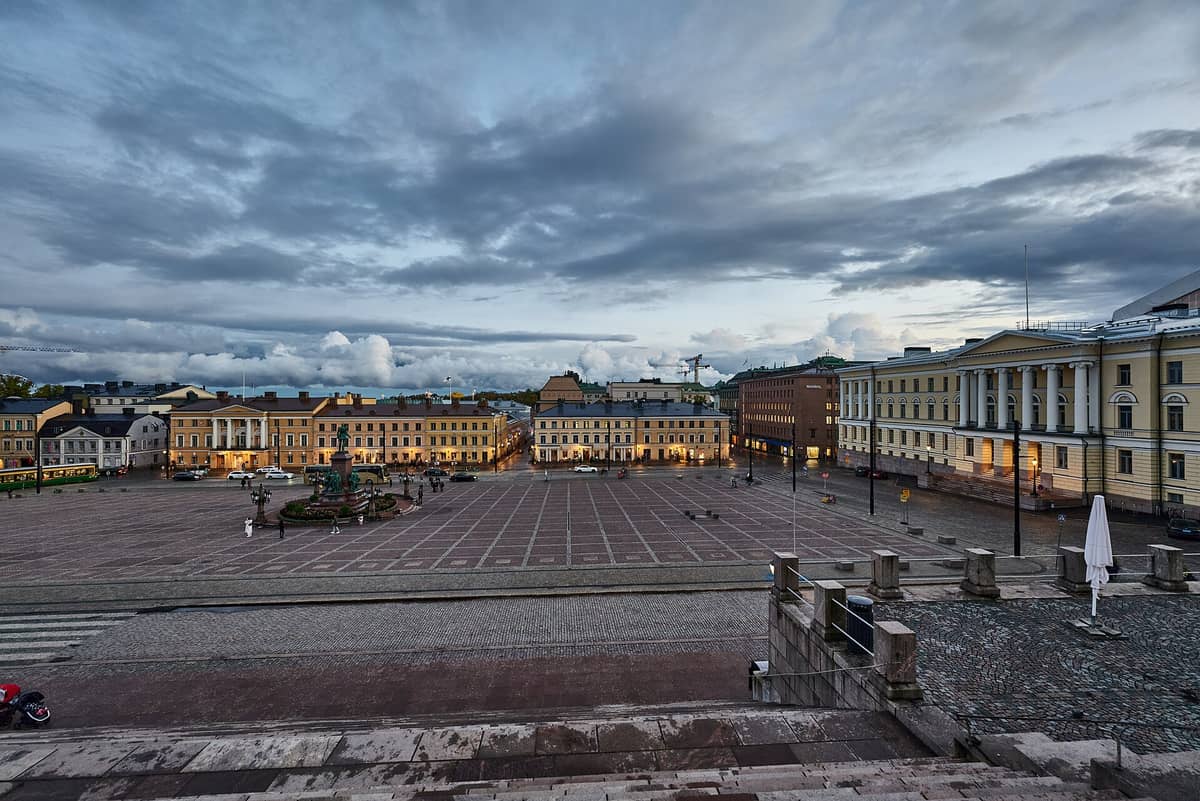
Senate Square is Helsinki's most architecturally coherent public space, framed by four neoclassical buildings designed or influenced by Carl Ludwig Engel in the 19th century. It is free to enter at any hour and works as a starting point for understanding how the Finnish capital was planned and built.
Quick Facts
- Location
- Senaatintori, 00170 Helsinki – Kruununhaka district
- Getting There
- Walk from Helsinki Central Railway Station (15 min) or tram to the city centre; many tram lines stop on nearby Aleksanterinkatu
- Time Needed
- 30–60 minutes for the square; 2–3 hours if you visit the Cathedral and surrounding buildings
- Cost
- Free – the square is a public space open 24 hours a day, 365 days a year
- Best for
- Architecture lovers, history enthusiasts, first-time visitors to Helsinki
- Official website
- www.myhelsinki.fi/places/senate-square
What Senate Square Actually Is
Senate Square (Finnish: Senaatintori; Swedish: Senatstorget) is a large open granite-paved square in the Kruununhaka district of central Helsinki. It is not a museum, a park, or a ticketed attraction. It is a public square that happens to be surrounded by four of the most significant 19th-century neoclassical buildings in Northern Europe, all designed within a single coherent urban vision. That coherence is the point. Very few European capital cities have a civic ensemble this intact and this unified in style.
The square is dominated on its north side by Helsinki Cathedral, which sits atop a broad flight of stairs. To the east stands the Government Palace (formerly the Senate, which gave the square its name). The main building of the University of Helsinki lines the west side. The City Hall of Helsinki stands by the nearby Market Square at the South Harbour rather than directly on the square itself. Each building is white or pale yellow, with classical columns and pediments, and together they create a sense of formal civic order that was deliberate and political: this was the new capital of the Grand Duchy of Finland under Russian imperial rule, being built from scratch in the early 1800s to project authority and permanence.
ℹ️ Good to know
The square is free and open at all hours. If you want to see it at its quietest and most photogenic, arrive before 8:00 on a weekday morning, when the light is soft and the granite stairs are nearly empty.
The Architecture: C. L. Engel and the Neoclassical Plan
The man responsible for the square's visual identity was Carl Ludwig Engel, a German-born architect who moved to Helsinki in 1816 and became the chief architect of the newly designated Finnish capital. Engel designed Helsinki Cathedral (completed 1852, after his death), the Government Palace, the University's main building, and the University Library, all in a neoclassical style drawing from the traditions of St. Petersburg and Berlin. The result is one of the most disciplined examples of planned civic architecture from that era anywhere in Europe.
Helsinki Cathedral is the obvious focal point. Its pale green copper dome and white Corinthian columns sit at the top of 52 granite steps, which function as informal seating for much of the year. The cathedral's interior is deliberately austere by the standards of European cathedrals, reflecting Lutheran tradition: white walls, minimal ornamentation, and a strong geometric clarity. Entry to the cathedral itself is free of charge, and it is worth at least a brief visit to understand the contrast between the grand exterior and the restrained interior.
The square's proportions reward close attention. The central statue of Tsar Alexander II, erected in 1894, gives a sense of scale and serves as a reminder of the political context in which the square was built. For more on how this area fits into Helsinki's historic core, the Helsinki City Museum nearby offers a well-curated account of the city's development from its founding through to the present day.
Tickets & tours
Hand-picked options from our booking partner. Prices are indicative; availability and final rates are confirmed when you complete your booking.
Helsinki Beautiful Canal Route, archipelago cruise
From 26 €Instant confirmationFree cancellationHelsinki Panorama Sightseeing Bus Tour With Audio Guide
From 35 €Instant confirmationFree cancellationHelsinki Pasila Street art district tour with a local
From 99 €Instant confirmationFree cancellationSurvival suit floating experience
From 125 €Instant confirmationFree cancellation
How the Square Changes Through the Day
Early mornings are the best time to appreciate the architecture undistracted. By around 7:30 on a summer morning, the low northern light catches the white facades at a shallow angle, and the square is largely empty apart from a few joggers cutting through. The granite paving reflects the sky. The steps of the cathedral are clear. This is the window for photography without crowds in the frame.
By mid-morning, tour groups begin arriving. Senate Square is a standard stop on almost every Helsinki walking tour, and between 10:00 and 14:00 in summer it can feel genuinely crowded, with guided groups pausing at the statue and on the cathedral steps. This is not necessarily a reason to avoid it, but it does change the character of the visit. The square is large enough that you can usually find a quieter angle.
Evenings, particularly in summer when Helsinki stays light until 11:00 pm or later, bring a different kind of atmosphere. People sit on the cathedral steps with takeaway food or coffee. The facades take on a warm golden tone. Winter visits are less comfortable but visually striking: on clear days, snow covers the square and the white cathedral blends into the pale sky in a way that feels uniquely Finnish.
Seasonal Events and the Square as a Public Stage
Senate Square functions as Helsinki's main civic gathering space. Several of the city's major public events are held here, including outdoor concerts, the Christmas Market in December, and political and cultural commemorations. The Christmas Market in particular transforms the square from late November through December, with wooden stalls, mulled wine, and the cathedral lit up behind. It is one of the more atmospheric winter market settings in the Nordic capitals, though it attracts large crowds on weekends.
In summer, the square occasionally hosts outdoor performances and public gatherings. The Finnish Independence Day celebrations on 6 December both give the square a particular significance. If you are planning a visit around a specific season, the best time to visit Helsinki guide covers how the city's calendar and climate interact across the year.
💡 Local tip
The Helsinki Christmas Market at Senate Square runs from late November through December. Weekend afternoons are the busiest. If you want to browse the stalls without shoulder-to-shoulder crowds, arrive on a weekday morning.
Getting There and Navigating the Area
Senate Square sits in the Kruununhaka district, roughly 15 minutes on foot from Helsinki Central Railway Station. The most direct walking route takes you down Aleksanterinkatu, one of Helsinki's main commercial streets. Several tram lines serve Aleksanterinkatu and stop within a short walk of the square. The area is flat and the route is straightforward.
The square itself has lowered curbs and largely flat granite paving, making it accessible to most visitors. During major events, accessible portable toilets are typically provided, and the main accessible approach is from the Unioninkatu-Aleksanterinkatu corner. For orientation, Senate Square is a logical starting or ending point for a walk through Helsinki's historic centre. The Market Square (Kauppatori) is about a 10-minute walk south toward the waterfront, and the Uspenski Cathedral is visible from the square's eastern edge, a few minutes' walk up the hill.
There is no dedicated parking at or near the square, and driving into central Helsinki is generally not recommended. Public transport, cycling, and walking are the practical options for most visitors.
Photography and What Most Visitors Miss
The standard photograph is taken from the base of the cathedral steps looking out across the square, with the Government Palace in the background. It is a good shot, but it is also the one on every postcard. A less obvious angle is from the top of the cathedral steps looking down: the symmetry of the square and the statue framed by the surrounding buildings works well from that elevation.
What many visitors walk past is the University Library, just to the north of the University's main building. Engel considered it among his finest works, and the reading room interior is one of the most beautiful neoclassical spaces in Finland. Access to the library's public areas is typically possible during university opening hours, though specific areas may be restricted.
The surrounding streets of Kruununhaka and the nearby Senate Square and Kruununhaka neighbourhood retain much of their 19th-century building stock and are worth a short walk if you want to see how the planned neoclassical core transitions into the older residential fabric of the city.
Honest Assessment: Who Will Get the Most From This
Senate Square delivers most clearly for visitors with an interest in architecture, urban planning, or European history. The ensemble is genuinely impressive on those terms. If you are visiting Helsinki primarily for its food scene, saunas, island hopping, or contemporary culture, the square works as a 20-minute orientation stop rather than a destination in its own right.
It is also worth being direct about one thing: the square itself, stripped of its buildings, is just a large paved open space. The experience depends almost entirely on what surrounds it. On a grey November afternoon outside of any event period, with the cathedral closed and the square largely empty, it can feel more functional than atmospheric. Visit when the Cathedral is open, and take the time to climb the steps.
If you are traveling with children, the Cathedral steps work well as a picnic spot in good weather, but the square itself has few interactive elements for young visitors. For family-oriented activities in the wider city centre, the Helsinki with kids guide covers more suitable options.
Insider Tips
- The cathedral interior is worth 10 minutes. Peak-season visitor admission is typically €10 for adults (under-18s free); in winter the €8 fee is voluntary. Most visitors photograph the exterior from the steps and never go inside, where the deliberately sparse Lutheran interior is its own kind of architectural statement.
- The University Library (Kansalliskirjasto), just north of the main University building, is arguably more impressive inside than any other building on the square. It is open to the public during library hours and almost never crowded.
- For the cleanest exterior photographs with no tour groups, arrive before 8:30 am on any day in summer. In winter, the square after a fresh snowfall and before the morning commute is the most visually striking version of it.
- The granite steps of the Cathedral are used as informal seating by Helsinkians year-round. On warm evenings, it is a legitimate local gathering spot, not just a tourist backdrop. Sitting on the steps with coffee from a nearby café is a perfectly normal thing to do.
- The statue at the centre of the square is of Tsar Alexander II, not a Finnish historical figure. Understanding why a Russian tsar stands at the centre of Helsinki's civic square tells you more about Finnish history than most guidebooks will.
Who Is Senate Square For?
- Architecture and urban history enthusiasts
- First-time Helsinki visitors wanting a geographical and historical orientation to the city
- Photographers, especially early morning or in winter after snowfall
- Visitors attending the December Christmas Market
- Anyone combining a walking route between the city centre and the South Harbour waterfront
Nearby Attractions
Other things to see while in Senate Square & Kruununhaka:
- Ateneum Art Museum
The Ateneum Art Museum holds Finland's largest collection of classical art, from 19th-century Finnish masters to early 20th-century modernism. Located directly opposite Helsinki Central Railway Station, it is one of the most accessible and rewarding museums in the Nordic countries.
- Helsinki Cathedral
Helsinki Cathedral (*Helsingin tuomiokirkko*) is the defining landmark of the Finnish capital, rising above Senate Square on a steep granite staircase that doubles as one of the city's most photographed gathering spots. The neoclassical Lutheran cathedral charges a modest fee for the main hall in summer, while the crypt has free admission when open. Here is everything you need to decide whether it deserves time on your itinerary.
- Helsinki Central Railway Station
Helsinki Central Railway Station is more than a place to catch a train. Designed by Eliel Saarinen and completed in 1919, it is one of Finland's most recognizable buildings and the beating heart of the city's transport network. Whether you are arriving in Helsinki for the first time or simply passing through, the station repays a slow, deliberate look.
- Helsinki City Hall
Helsinki City Hall (Helsingin kaupungintalo) stands on Pohjoisesplanadi facing Market Square, its neoclassical facade one of the defining sights of the city's historic waterfront. Entry to the lobby is free, and the building's location makes it a natural stop on any walk through the Senate Square district.