Helsinki City Hall: The Empire-Style Heart of Civic Helsinki
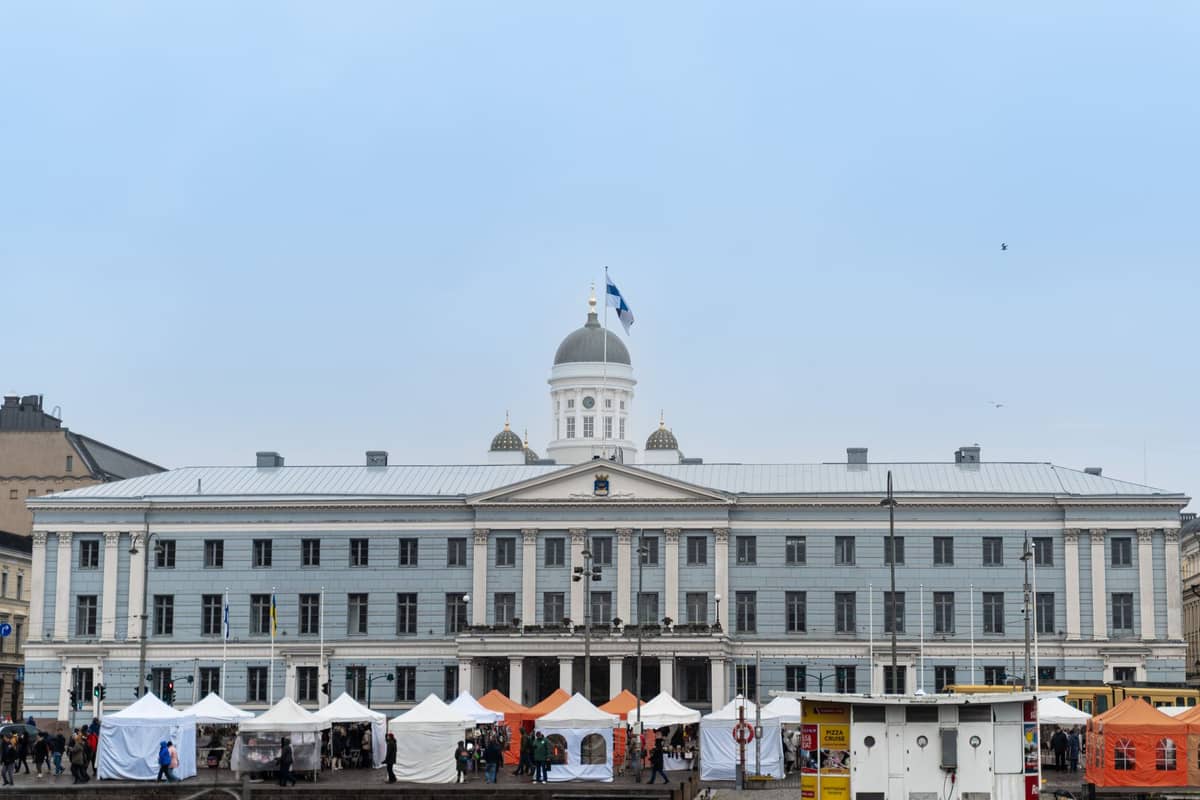
Helsinki City Hall (Helsingin kaupungintalo) stands on Pohjoisesplanadi facing Market Square, its neoclassical facade one of the defining sights of the city's historic waterfront. Entry to the lobby is free, and the building's location makes it a natural stop on any walk through the Senate Square district.
Quick Facts
- Location
- Pohjoisesplanadi 11–13, Kruununhaka, Helsinki
- Getting There
- Multiple tram and bus lines serve Market Square (Kauppatori); walkable from the city centre
- Time Needed
- 20–40 minutes for the exterior and lobby
- Cost
- Free (public lobby and exhibitions)
- Best for
- Architecture lovers, history walkers, and anyone exploring the Senate Square waterfront
- Official website
- www.hel.fi/kanslia/en/welcome-to-city-hall
What Helsinki City Hall Actually Is
Helsinki City Hall (Finnish: Helsingin kaupungintalo) is the central administrative building of the City of Helsinki, housing the Mayor's office, Deputy Mayors, and key municipal departments. It occupies a commanding position on Pohjoisesplanadi, directly facing Market Square and the South Harbour, making it one of the most photographed facades in the city.
For most visitors, City Hall functions as a landmark rather than a destination in itself. You are not visiting a museum or a gallery with a programme of ticketed events. What you get is free access to the entrance lobby on weekdays, an empire-style exterior worth examining closely, and a location that puts you at the centre of Helsinki's most architecturally coherent neighbourhood.
ℹ️ Good to know
The public lobby is open Monday to Friday, generally 9:00–18:00, though if there are no events the doors may close around 16:00. This is a working government building, not a public attraction, so areas beyond the lobby and any temporary exhibitions are not accessible to casual visitors. Verify current hours before planning your visit, as they can change.
The Building: Architecture and Historical Context
The exterior of Helsinki City Hall is a textbook example of Finnish empire-style architecture, the neoclassical idiom that shaped much of central Helsinki during the early nineteenth century when the city was being redeveloped as the capital of the Grand Duchy of Finland under Russian imperial rule. The style draws heavily on the St Petersburg model: symmetrical facades, pilastered walls, restrained ornamentation, and a scale designed to project civic authority without excess.
This stretch of Pohjoisesplanadi forms a ceremonial civic row alongside the Presidential Palace and, a short walk inland, Helsinki Cathedral and the broader Senate Square ensemble. Together these buildings represent one of the most intact examples of nineteenth-century neoclassical urban planning in Northern Europe.
The interior has been rebuilt in a contemporary style since the original construction, so the dramatic contrast between the historical exterior and a functional modern interior is noticeable the moment you step through the doors. Do not expect ornate state rooms open to public view. The lobby is clean, institutional, and quietly impressive in its civic straightforwardness.
Tickets & tours
Hand-picked options from our booking partner. Prices are indicative; availability and final rates are confirmed when you complete your booking.
Helsinki Beautiful Canal Route, archipelago cruise
From 26 €Instant confirmationFree cancellationHelsinki Panorama Sightseeing Bus Tour With Audio Guide
From 35 €Instant confirmationFree cancellationHelsinki Pasila Street art district tour with a local
From 99 €Instant confirmationFree cancellationArchitecture tour of Helsinki
From 60 €Instant confirmationFree cancellation
The Waterfront Setting: What You See When You Arrive
City Hall's position directly on Pohjoisesplanadi, facing the South Harbour, means that arriving here on foot from the Market Square (Kauppatori) is genuinely one of the better short walks in the city. The building's pale facade reads clearly from across the square, especially in the low-angle light of a morning or late afternoon.
On summer mornings, the market stalls along the harbour waterfront are active from early, and the smell of fresh coffee and cardamom buns from the vendors drifts across Pohjoisesplanadi. The ferry terminal for Suomenlinna is visible from the steps of City Hall, giving the whole scene a pleasantly layered quality: government buildings, open-air market, harbour ferries, and the open Gulf of Finland beyond.
In winter, the same view is quieter and starker. The market stalls thin out, the harbour occasionally shows ice at its edges in deep winter, and the pale stone of City Hall reflects the flat grey light in a way that feels distinctly Nordic. Neither version is better, just different in mood.
💡 Local tip
For photographs of the facade, morning light from the east hits the building directly. Position yourself on the harbour side of Pohjoisesplanadi with the market square behind you for the cleanest composition. Midday in summer can wash the details out with flat overhead light.
How to Visit: Practical Walkthrough
Most visitors do two things at City Hall: study the exterior and step briefly inside the lobby. The exterior takes around ten minutes if you walk the full facade and look at the architectural details, longer if you are comparing it with the neighbouring Presidential Palace. The lobby is worth a quick look for the contrast between historical exterior and contemporary interior, and to check whether any temporary public exhibitions are on display.
The Register Office of the City of Helsinki operates within the building, open Monday to Friday 9:00–15:00, with document drop-off at reception from 8:00–9:00 and again from 15:00–16:00. For most tourists this is irrelevant, but it is worth knowing that the building is active with city business on weekdays, which gives the lobby a different quality from a museum entrance hall.
There is no dedicated parking adjacent to the building. The most practical approach by public transport is to take any tram or bus serving the Market Square area. The building is also a natural stop on foot when walking between the central railway station and the waterfront, a route that passes through Senate Square and takes under fifteen minutes from the station.
⚠️ What to skip
City Hall’s public lobby is primarily accessible on weekdays, and casual visitor access may be limited or unavailable on weekends or public holidays depending on events and building use. Plan accordingly if your Helsinki visit falls on a Saturday or Sunday. The exterior is always visible and freely photographable from the public pavement.
Fitting City Hall Into a Broader Itinerary
Helsinki City Hall makes most sense as part of a wider Senate Square and waterfront walk rather than a standalone visit. The logical sequence is to approach from Senate Square, descend toward the harbour past the Presidential Palace, take in City Hall's facade, then cross into Market Square and continue to the Old Market Hall a few minutes' walk along the waterfront. This circuit covers the best of central Helsinki's historic civic architecture in under two hours.
If you are travelling with children or want a broader overview of the city's districts, the Helsinki walking tour guide maps out exactly how these landmarks connect. The waterfront walk is flat, well-paved, and manageable regardless of fitness level.
Honest Assessment: Who Will Get the Most From This Visit
Visitors with a genuine interest in neoclassical and empire-style architecture will find City Hall worth a careful look, particularly when seen in context with the Presidential Palace and Helsinki Cathedral nearby. The coherence of the ensemble is the main event, and understanding how these buildings were designed as a unified civic statement gives the whole area much more meaning.
Casual tourists who simply want to check it off a list will likely spend fewer than ten minutes here before moving on to Market Square. That is a perfectly reasonable approach. The building does not pretend to be a visitor attraction in the conventional sense. It is a functioning government building that happens to have a significant facade in a prime location.
Those expecting grand interior spaces, guided tours, or a dedicated visitor programme should adjust their expectations. The public access here is limited to the lobby on weekdays. If you are looking for rich interior spaces in this part of Helsinki, the Uspenski Cathedral and Helsinki Cathedral are both nearby and more rewarding inside.
Insider Tips
- The best elevated view of the City Hall facade and the harbour together is from the upper deck of any of the Suomenlinna ferries departing from the pier directly across the street. Leave five minutes early for your ferry and look back as the boat pulls away.
- Weekday mornings before 10:00 are the quietest time in this part of the waterfront. The market vendors are setting up, tour groups have not yet arrived, and the light on the building's east-facing facade is at its best.
- The empire-style architectural row along Pohjoisesplanadi reads much better when you know what to look for. Before you visit, spend two minutes looking at the Wikipedia article on Finnish neoclassical architecture to understand why the proportions and ornamentation were deliberate political choices, not just aesthetic ones.
- In December, the area around Market Square and City Hall is used for seasonal market activity and winter events. The combination of the lit waterfront, the pale facades, and the low winter light makes this one of the more photogenic spots in Helsinki in the dark season.
- If you need help or city services information, staff inside the lobby are accustomed to tourist enquiries and can direct you in English, Finnish, and Swedish.
Who Is Helsinki City Hall For?
- Architecture enthusiasts interested in nineteenth-century neoclassical and empire-style civic buildings
- First-time visitors to Helsinki completing the Senate Square and waterfront walking circuit
- Photographers looking for the classic Helsinki harbour panorama in morning or winter light
- Travellers with limited time who want to cover several significant landmarks in a single compact walk
- History-minded visitors interested in Helsinki's development as a planned imperial capital
Nearby Attractions
Other things to see while in Senate Square & Kruununhaka:
- Ateneum Art Museum
The Ateneum Art Museum holds Finland's largest collection of classical art, from 19th-century Finnish masters to early 20th-century modernism. Located directly opposite Helsinki Central Railway Station, it is one of the most accessible and rewarding museums in the Nordic countries.
- Helsinki Cathedral
Helsinki Cathedral (*Helsingin tuomiokirkko*) is the defining landmark of the Finnish capital, rising above Senate Square on a steep granite staircase that doubles as one of the city's most photographed gathering spots. The neoclassical Lutheran cathedral charges a modest fee for the main hall in summer, while the crypt has free admission when open. Here is everything you need to decide whether it deserves time on your itinerary.
- Helsinki Central Railway Station
Helsinki Central Railway Station is more than a place to catch a train. Designed by Eliel Saarinen and completed in 1919, it is one of Finland's most recognizable buildings and the beating heart of the city's transport network. Whether you are arriving in Helsinki for the first time or simply passing through, the station repays a slow, deliberate look.
- Helsinki City Museum
The Helsinki City Museum occupies a cluster of restored historic buildings at the edge of Senate Square, offering free admission to anyone curious about how this Baltic capital grew from a small coastal town into Finland's cultural and political centre. It is the only museum in the world dedicated exclusively to Helsinki.