Presidential Palace Helsinki: What to Know Before You Visit
The Presidential Palace (Presidentinlinna) stands at the heart of Helsinki's waterfront, facing Market Square and Senate Square. It's not open for regular tours, but as a neoclassical landmark in one of the city's most photogenic corners, it earns a place on any walking route through central Helsinki.
Quick Facts
- Location
- Mariankatu 2–4, corner of Pohjoisesplanadi, Helsinki — opposite Market Square and South Harbour
- Getting There
- 10–15 min walk from Helsinki Central Railway Station; trams and buses serve Kauppatori (Market Square)
- Time Needed
- 15–30 min exterior visit; longer during special open-house events
- Cost
- Free to view from outside; no regular interior admission. Special open days have been free of charge
- Best for
- Architecture enthusiasts, history buffs, waterfront walkers, photography
- Official website
- www.presidentti.fi/en
What the Presidential Palace Actually Is — and Isn't
The Presidential Palace (Finnish: Presidentinlinna, Swedish: Presidentens slott) is one of three official residences of the President of the Republic of Finland, alongside Mäntyniemi in Helsinki and Kultaranta in Naantali. It sits at Mariankatu 2–4, on the corner of Pohjoisesplanadi, directly overlooking Market Square and the South Harbour in the very center of Helsinki. Its position places it within a few hundred meters of Senate Square and Helsinki Cathedral to the north, and the waterfront ferry piers to the south.
It is not a museum. There are no regular daily tours, no ticket booth, and no scheduled admission. The palace functions as an active official workspace and ceremonial venue, and public access is limited to occasional special open-house days tied to national events or post-renovation showcases. If you arrive expecting a walk-in attraction, you will find locked gates and a security perimeter. The value here is almost entirely architectural and contextual: understanding what you are looking at, and how it fits into the civic story of Helsinki, makes the exterior visit genuinely worthwhile.
⚠️ What to skip
The Presidential Palace is not open for regular public visits. Before planning any interior visit, check the official website at presidentti.fi for current announcements about open-house events, as dates and conditions vary by year.
The Building: Neoclassical Authority on the Waterfront
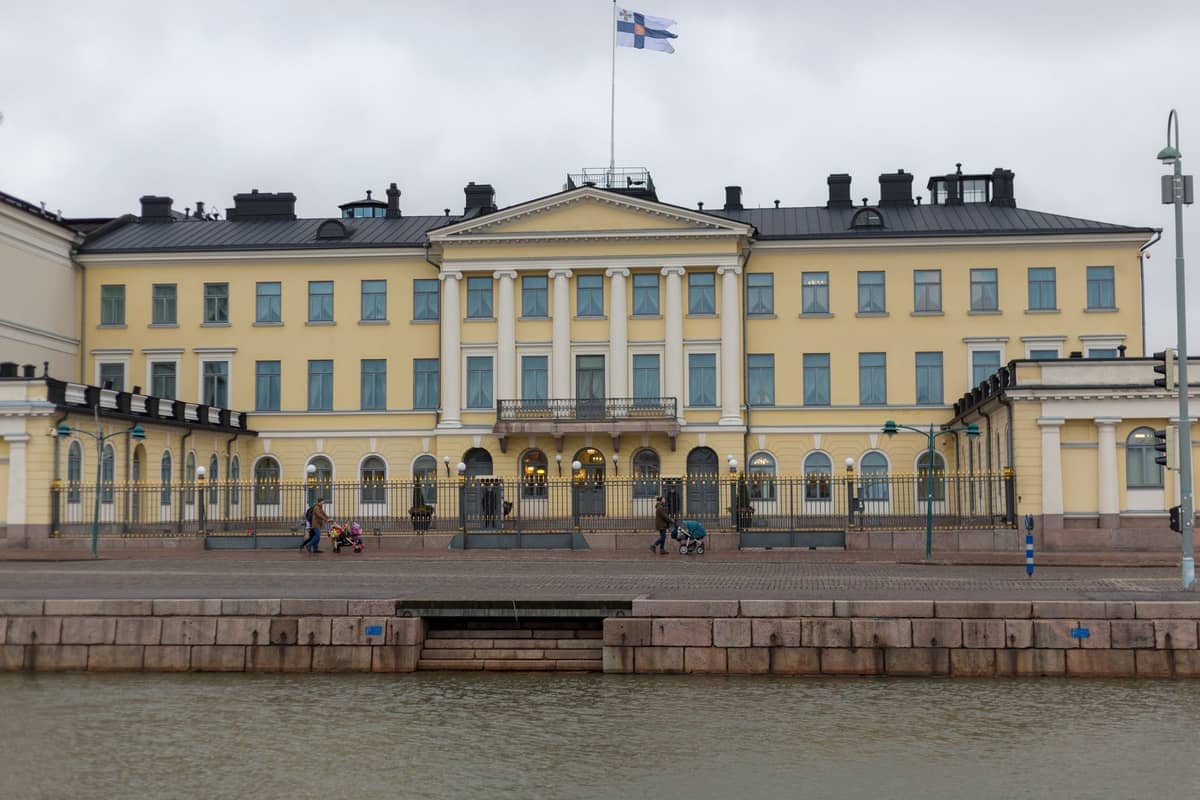
The palace is a substantial 19th-century neoclassical structure with about 3,000 square meters of floor space, encompassing state rooms, offices, and private apartments. The facade is restrained in the way that Finnish neoclassicism tends to be: pale render, symmetrical window rows, and a columned entrance portico that reads as dignified without veering into excess. Compared to the more theatrical neoclassical palaces of Central Europe, this one has a Nordic understatement to it.
From the cobblestones of Market Square, the building reads clearly: a two-story block anchoring the northern edge of the harbor, framed by the open water to the south and the formal geometry of Esplanadi to the west. The Helsinki City Hall sits just along the same quayside stretch, and together these two buildings give the waterfront its civic gravity. Early morning, before the market stalls fill in, the light off the harbor catches the facade in a way that makes it easier to read the proportions and detailing without interference.
The palace underwent significant renovations in the 2010s, after which the Office of the President opened the building for limited public viewings to showcase the restored interiors. Those events drew significant interest. A subsequent comprehensive Helsinki City Museum exhibition has documented the capital's architectural heritage, and the palace features in that broader story of how Helsinki developed its neoclassical core during the period of Russian imperial rule in the 19th century.
Tickets & tours
Hand-picked options from our booking partner. Prices are indicative; availability and final rates are confirmed when you complete your booking.
Helsinki Beautiful Canal Route, archipelago cruise
From 26 €Instant confirmationFree cancellationHelsinki Panorama Sightseeing Bus Tour With Audio Guide
From 35 €Instant confirmationFree cancellationHelsinki Pasila Street art district tour with a local
From 99 €Instant confirmationFree cancellationSurvival suit floating experience
From 125 €Instant confirmationFree cancellation
The Surrounding Area: Why This Corner of Helsinki Repays Time
The palace sits at the intersection of several of Helsinki's most rewarding zones for walking. Directly across the square is Market Square (Kauppatori), where ferry passengers, fish sellers, and coffee drinkers coexist around the harbor edge. The ferries to Suomenlinna leave from the pier just beyond, and the Old Market Hall is a two-minute walk along the waterfront.
Walk north from the palace for five minutes and you reach Senate Square and the white dome of Helsinki Cathedral rising above it — the most photographed sequence in the city. The palace, the square, and the cathedral form a coherent architectural ensemble that reflects Helsinki's rapid transformation from a small market town into a planned imperial capital during the early 19th century. The urban design is deliberate, and it shows.
To the west, Esplanadi park runs from the harbor toward the city center, flanked by the Esplanadi Park, cafes, and design shops. This is one of the more pleasant stretches of pavement in Helsinki on a warm afternoon. The cumulative effect of walking from the palace along the park toward the city center, then looping back through Senate Square, covers the dense core of Helsinki's historic architecture in under an hour at an easy pace.
Visiting the Exterior: Practical Observations
The palace facade is always visible from the public streets and Market Square. There is no charge to look, photograph, or linger on the cobblestones outside. Security is present, and the entrance on Mariankatu is gated, so do not attempt to enter without prior knowledge of an open event.
Photography from the square is straightforward. The building faces roughly south, so morning light from the southeast catches the facade front-on, while afternoon light shifts to the side. The wide-open space of Market Square means you do not need to fight for distance: even a standard phone camera captures the full width of the building without distortion. The harbor, market stalls, and ferry activity in the foreground add context that makes for more interesting images than a straight architectural shot.
In summer, the square fills quickly after 8am as market vendors set up. Arriving before that, or in the evening after stalls close, gives you a much quieter scene. Winter visits, particularly when there is snow on the cobblestones and the harbor is partially frozen, have a particular atmosphere: fewer people, sharper light, and the stark white of the palace facade against a grey sky. Dress warmly; the harbor location means wind even when the temperature is not extreme.
💡 Local tip
For the cleanest exterior photographs, come before 8am in summer. The square is nearly empty, the light is good, and you can take your time composing a shot that includes the harbor or the neighboring City Hall without crowds walking through the frame.
Getting Inside: Open Days and the Virtual Tour
The Presidential Palace has, on specific occasions, opened its doors to the public for free. These events have typically been organized around national celebrations or following major renovations, and they give visitors access to the formal state rooms: reception halls with period furniture, ceremonial spaces, and the kinds of interiors that convey how Finnish state protocol looks in practice. When such events occur, the Office of the President announces them on the official website (presidentti.fi) and through Finnish national media. Admission has been free of charge at past events, with entry via the Mariankatu entrance and a fixed route through selected rooms. Large bags and prams have typically been restricted; it is worth checking current event conditions before attending.
For those who cannot attend an open day, the official website hosts a 360-degree virtual tour of the palace interiors. It is a detailed tour that covers the main state rooms with navigable panoramas. It is not a substitute for being in the building, but it provides a clear picture of the scale, decoration, and arrangement of the interior spaces.
Historical Context: From Merchant's House to Presidential Seat
The building's history traces the transformation of Helsinki from a minor Swedish coastal town into the purpose-built capital of a Finnish Grand Duchy under Russian imperial authority. The original structure on this site dates to the early 19th century, and it was reworked and expanded into its current neoclassical form as Helsinki was systematically redesigned around Senate Square, the cathedral, and the harbor. The palace became an imperial palace for Tsar Alexander II's visits — a function reflected in the formal reception rooms — before transitioning to its current role as the official presidential residence.
This neighborhood, Senate Square and Kruununhaka, retains a higher density of preserved 19th-century civic architecture than anywhere else in Finland. The palace is not an isolated monument but part of a coordinated urban composition that includes the cathedral, the university, and the government buildings framing the square. Understanding this helps clarify why the exterior visit, even without interior access, carries real historical weight.
Who This Attraction Suits — and Who Should Look Elsewhere
The Presidential Palace works well as a component of a broader walking route through central Helsinki. For architecture enthusiasts, the building itself and its urban setting repay close attention. For anyone interested in Finnish political history or the period of Russian imperial rule, the palace anchors a very legible piece of Helsinki's development. Photographers will find the combination of the neoclassical facade, the harbor, and the market square useful.
For travelers who want an interactive indoor experience, this is not the right stop unless an open-house event is running. In that case, combine it with the Old Market Hall and a walk along the Esplanadi for a half-day that covers both architecture and local atmosphere. Families with young children will likely find the exterior visit brief; the nearby waterfront and market square provide more engagement.
Insider Tips
- Check presidentti.fi in the weeks before Finnish Independence Day (December 6) and around major national commemorations. Open-house events, when they occur, tend to cluster around these dates and are announced with relatively short notice.
- The best exterior vantage point is not from directly in front of the gates, but from the southeastern corner of Market Square near the harbor edge, where you get the full width of the facade with the water in the foreground.
- The palace and the neighboring Helsinki City Hall are close enough to photograph in the same frame from the ferry pier. If you are taking the Suomenlinna ferry, the departure queue gives you an unhurried view of both buildings from the water side.
- If you are visiting Helsinki in winter and the harbor is frozen, the ice adds an unusual foreground element that you will not find in any summer guidebook photo. The silence at that time of year makes the civic scale of the area more apparent.
- The virtual tour on presidentti.fi is worth exploring before or after visiting in person. It gives a sense of the interior scale and decor that contextualizes the otherwise closed building considerably.
Who Is Presidential Palace For?
- Architecture and urban history enthusiasts who appreciate 19th-century neoclassical civic design
- Photographers looking for Helsinki's most photogenic waterfront composition
- Visitors building a walking route through Helsinki's historic core around Senate Square
- Anyone with a specific interest in Finnish political institutions and presidential history
- Travelers who time their visit around a special open-house event and want rare interior access
Nearby Attractions
Other things to see while in Senate Square & Kruununhaka:
- Ateneum Art Museum
The Ateneum Art Museum holds Finland's largest collection of classical art, from 19th-century Finnish masters to early 20th-century modernism. Located directly opposite Helsinki Central Railway Station, it is one of the most accessible and rewarding museums in the Nordic countries.
- Helsinki Cathedral
Helsinki Cathedral (*Helsingin tuomiokirkko*) is the defining landmark of the Finnish capital, rising above Senate Square on a steep granite staircase that doubles as one of the city's most photographed gathering spots. The neoclassical Lutheran cathedral charges a modest fee for the main hall in summer, while the crypt has free admission when open. Here is everything you need to decide whether it deserves time on your itinerary.
- Helsinki Central Railway Station
Helsinki Central Railway Station is more than a place to catch a train. Designed by Eliel Saarinen and completed in 1919, it is one of Finland's most recognizable buildings and the beating heart of the city's transport network. Whether you are arriving in Helsinki for the first time or simply passing through, the station repays a slow, deliberate look.
- Helsinki City Hall
Helsinki City Hall (Helsingin kaupungintalo) stands on Pohjoisesplanadi facing Market Square, its neoclassical facade one of the defining sights of the city's historic waterfront. Entry to the lobby is free, and the building's location makes it a natural stop on any walk through the Senate Square district.