Helsinki Central Railway Station: Architecture, Access, and What to Expect
Helsinki Central Railway Station is more than a place to catch a train. Designed by Eliel Saarinen and completed in 1919, it is one of Finland's most recognizable buildings and the beating heart of the city's transport network. Whether you are arriving in Helsinki for the first time or simply passing through, the station repays a slow, deliberate look.
Quick Facts
- Location
- Kaivokatu 1, 00100 Helsinki (central Helsinki, near Senate Square)
- Getting There
- Metro and multiple tram lines stop directly outside; the station is itself the terminus for commuter and long-distance trains
- Time Needed
- 20–45 minutes to explore the architecture and main hall; longer if connecting onward by train
- Cost
- Free to enter the building; train tickets purchased separately via VR (prices vary by route)
- Best for
- Architecture lovers, first-time visitors arriving in Helsinki, photographers, transit travelers
- Official website
- paarautatieasema.fi/en
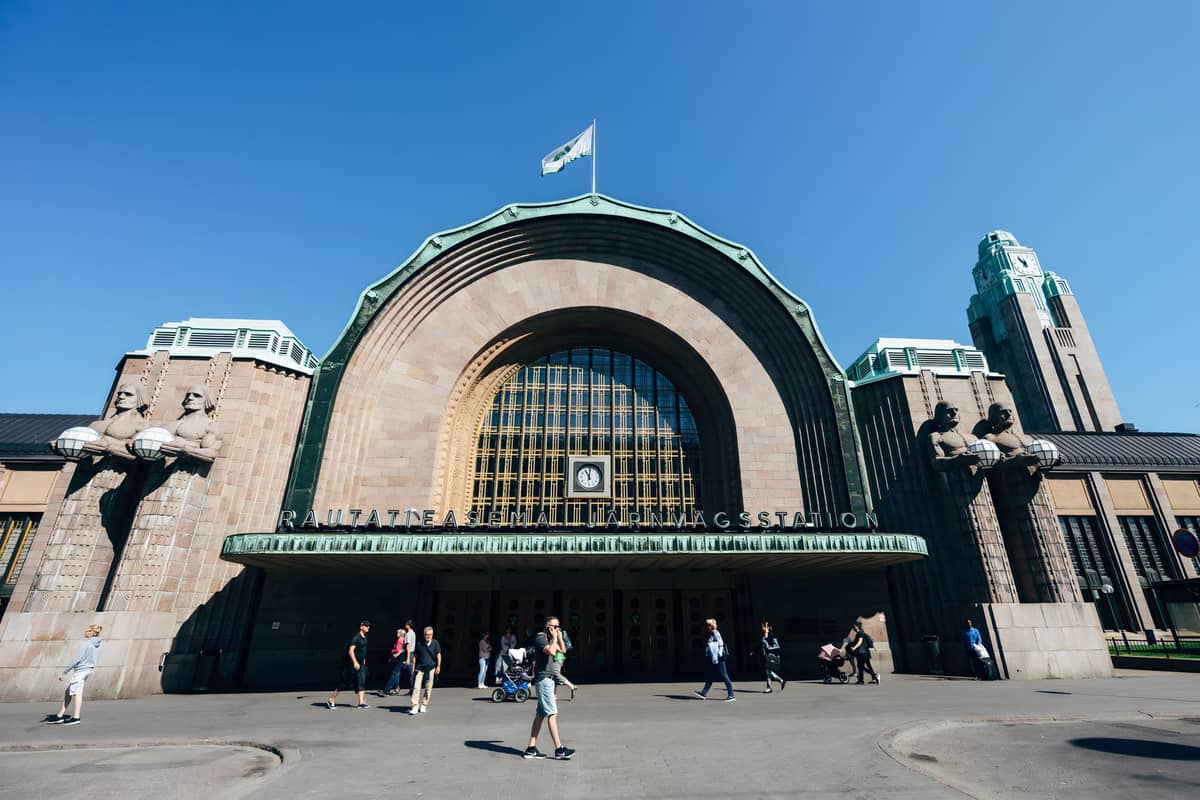
First Impressions: Arriving at Helsinki Central Railway Station
Step out of Elielinaukio Square and the station's granite facade stops you before you even reach the doors. The clock tower rises above the entrance arch, and on either side of the main doorway stand four colossal stone figures, each holding a globe-shaped lantern. These are not decorative afterthoughts. They are the image of Helsinki that greets everyone arriving by train from the airport, from Tampere, from Turku, from every corner of Finland.
The official name, Helsingin päärautatieasema in Finnish and Helsingfors centralstation in Swedish, was formally adopted on 7 June 2010. In English it is simply Helsinki Central Railway Station. The building is located at Kaivokatu 1, in the heart of the city, a short walk from Senate Square and the main shopping streets.
💡 Local tip
The station building is open daily from 05:00 to 02:00. There is no admission charge for the public areas. You do not need a train ticket to walk inside and look around.
The Architecture: National Romanticism in Granite
The station was designed by Finnish architect Eliel Saarinen and completed in 1919. It is widely regarded as one of the finest examples of National Romantic architecture in Finland, a style that drew on folk art, medieval Scandinavian forms, and Art Nouveau influences to create something distinctly Finnish at a time when the country was asserting its own cultural identity. Saarinen himself later revised his original more ornate design after criticism from younger architects, resulting in the cleaner, more monumental form that stands today.
The exterior is clad in Finnish granite, which gives the building a weight and permanence that feels entirely appropriate for a national gateway. The four lantern-bearers flanking the main entrance were sculpted by Emil Wikström. Up close, they are far more imposing than they appear in photographs: each figure stands several metres tall, carved with a gravity that sits somewhere between Art Nouveau ornament and ancient monument.
The clock tower is the station's visual anchor and one of the city's most-photographed landmarks. Arrive on the square at dusk in winter, when the lanterns glow against a dark sky and the granite takes on a colder, more dramatic colour, and you understand why this building has stayed in the Finnish imagination for over a century.
If you are interested in how this building fits into Helsinki's broader architectural story, the Museum of Finnish Architecture is a short walk away and provides excellent context for the National Romantic period and what came after it.
Tickets & tours
Hand-picked options from our booking partner. Prices are indicative; availability and final rates are confirmed when you complete your booking.
Helsinki Beautiful Canal Route, archipelago cruise
From 26 €Instant confirmationFree cancellationHelsinki Panorama Sightseeing Bus Tour With Audio Guide
From 35 €Instant confirmationFree cancellationHelsinki Pasila Street art district tour with a local
From 99 €Instant confirmationFree cancellationArchitecture tour of Helsinki
From 60 €Instant confirmationFree cancellation
Inside the Main Hall: What You Actually See
The interior is a working station, not a museum, and it reads that way. The main concourse is a high, arched hall with large windows that let in strong northern light on clear days. The space is practical and uncluttered, with departure boards, ticket counters, a VR service point at Elielinaukio 3, and the usual mix of cafes, convenience shops, and waiting areas that you find in any major European terminus.
What is worth pausing for is the proportions. The hall was designed for a different era of travel, when passengers arrived with trunks and waited with patience. The ceiling height, the width of the arches, the way light moves across the stone floor during morning and afternoon hours: these are details that get lost in the rush of a commute but reward anyone who arrives early and walks slowly.
The waiting room is open during the same hours as the building, 05:00 to 02:00. Seating is available and the space is warm in winter. The station has public toilets, left-luggage lockers, and a pharmacy. It is genuinely useful infrastructure, not a heritage experience dressed up to look useful.
ℹ️ Good to know
The VR service point for train tickets and travel assistance is at Elielinaukio 3, inside the station complex. For passengers with accessibility needs, an assistance point is located beside platform 11 under the glass roof. Accessible travel assistance can be pre-booked via VR's free customer service number 0800 188 822.
How the Station Changes by Time of Day
Early morning, roughly 06:00 to 08:00, the station is filled with commuters moving quickly and with purpose. The concourse smells of coffee from the kiosks, bags scrape across stone floors, and conversations are brief. There is a pleasing momentum to this hour, especially in winter when it is still dark outside and the interior light feels particularly concentrated.
Midday is the calmest window for unhurried visitors. Crowds thin between the morning rush and the afternoon wave, and you can walk the main hall, stand under the arch at the entrance, and look at the building with some breathing room. This is also the best time for photography inside, when the light from the high windows hits the floor at a low angle that the overhead artificial lighting at other hours cannot replicate.
Evening arrivals get a different experience altogether. From outside on the square, the lanterns above the stone figures light up and the clock tower takes on a cinematic quality. On winter evenings especially, the contrast between the cold granite exterior and the warm, lit interior makes the building feel more alive, not less. The square in front of the station stays active late, with people arriving from and departing to the airport on the ring rail line, which makes the journey from Helsinki-Vantaa Airport in approximately 30 minutes.
The Station as Transport Hub: Practical Connections
Helsinki Central Railway Station is the focal point of the city's entire transport network. Commuter trains serving greater Helsinki depart from the platforms below the glass roof. Long-distance VR trains to Tampere, Turku, Oulu, and other Finnish cities leave from here. The ring rail line to Helsinki-Vantaa Airport runs with regular frequency, making this the practical starting and ending point for most visits to the city.
Directly adjacent to the station, on Elielinaukio Square and Kaivokatu, tram stops serve multiple lines running across central Helsinki. A metro entrance with an accessible elevator connects to the Helsinki Metro, which covers east-west corridors across the city and into Espoo. All public transport in Helsinki operates under the HSL (Helsinki Regional Transport Authority) integrated ticketing system, so a single ticket covers trams, metro, and commuter trains within the relevant zones.
For a practical overview of how to navigate Helsinki's transport network, the guide to getting around Helsinki covers routes, ticket types, and zone maps in detail.
The station area also has a taxi stand on Asema-aukio Square on the eastern side of the building. Accessible routes to the platforms and the metro are clearly signed; the official accessibility route uses the archway corridor from Elielinaukio Square, with automatic doors throughout.
⚠️ What to skip
Train fares and timetables change regularly. Always check current prices and schedules directly with VR at vr.fi before travelling. Ticket costs are not listed here because they vary by route, booking class, and time of purchase.
Photography, Context, and Honest Expectations
The station exterior photographs best from Elielinaukio Square on the western side, where you can frame the full facade with the clock tower centred. Early morning in winter, before the square fills up, gives you the cleanest shots. Summer mornings work well too, but the light is softer and the square tends to be occupied from early hours.
To be straightforward about expectations: the interior is a functional railway station. It is architecturally significant but it is not an elaborate heritage site with guided tours or interpretive displays. You are looking at a working building, used hard every day by around 200,000 passengers on a busy day. The grime, the commercial tenants, and the worn stone floor are part of what it is, not a disappointment.
Visitors who come specifically for the architecture will find the exterior more rewarding than the interior. Those passing through on their way elsewhere will likely appreciate the efficiency and the scale of the main hall without needing to seek anything out. Either approach works.
The station sits at the northern edge of the city centre, within walking distance of Senate Square and the Helsinki Cathedral, making it a natural starting point for a walking loop through the historic core.
Who Should Skip This
If you are looking for a quiet, curated cultural experience, the station is not the right stop. It is loud during peak hours, crowded in summer, and resolutely practical in its organization. Travelers who have already spent time in grand European railway terminals like Amsterdam Centraal or Helsinki's visual peer in scale will find this building compelling but not overwhelming. Families with young children who are not catching a train may find the concourse a stressful place to navigate without a specific purpose.
If the city's public architecture is your focus, the Helsinki Central Library Oodi nearby offers a dramatically different approach to civic design and is genuinely designed for leisurely exploration.
Insider Tips
- The best exterior photography angle is from the far western end of Elielinaukio Square, low and slightly left of centre, so the clock tower and the lantern-bearers appear in a single frame without the commercial signage on the right side of the facade.
- The station's underground levels connect directly to the Sokos department store and from there to Kamppi shopping centre via tunnels, giving you a warm, dry route across a large section of the city centre in winter without going outside.
- If you are arriving from Helsinki-Vantaa Airport on the ring rail line, sit on the left side of the train in the direction of travel for views across the northern suburbs before the tracks descend into the city.
- The VR service point inside the station can help with seat reservations and accessibility bookings even if you purchased your ticket online. It is useful for long-distance journeys where seat allocation matters.
- At night in December and early January, the stone lantern-bearers at the entrance are subtly lit from below, and the square in front of the station is typically decorated for the season. Arriving or departing by train during these weeks gives the building an atmosphere the daytime visit does not fully provide.
Who Is Helsinki Central Railway Station For?
- First-time visitors arriving in Helsinki who want to orient themselves immediately at the city's transport centre
- Architecture and design enthusiasts with a specific interest in early twentieth-century Finnish National Romanticism
- Photographers looking for dramatic granite civic architecture, especially at dusk or in winter light
- Travelers using Helsinki as a rail hub for day trips or onward journeys within Finland
- Anyone building a walking route through central Helsinki, since the station is a natural anchor point
Nearby Attractions
Other things to see while in Senate Square & Kruununhaka:
- Ateneum Art Museum
The Ateneum Art Museum holds Finland's largest collection of classical art, from 19th-century Finnish masters to early 20th-century modernism. Located directly opposite Helsinki Central Railway Station, it is one of the most accessible and rewarding museums in the Nordic countries.
- Helsinki Cathedral
Helsinki Cathedral (*Helsingin tuomiokirkko*) is the defining landmark of the Finnish capital, rising above Senate Square on a steep granite staircase that doubles as one of the city's most photographed gathering spots. The neoclassical Lutheran cathedral charges a modest fee for the main hall in summer, while the crypt has free admission when open. Here is everything you need to decide whether it deserves time on your itinerary.
- Helsinki City Hall
Helsinki City Hall (Helsingin kaupungintalo) stands on Pohjoisesplanadi facing Market Square, its neoclassical facade one of the defining sights of the city's historic waterfront. Entry to the lobby is free, and the building's location makes it a natural stop on any walk through the Senate Square district.
- Helsinki City Museum
The Helsinki City Museum occupies a cluster of restored historic buildings at the edge of Senate Square, offering free admission to anyone curious about how this Baltic capital grew from a small coastal town into Finland's cultural and political centre. It is the only museum in the world dedicated exclusively to Helsinki.