Helsinki Cathedral: The Icon Above Senate Square
Helsinki Cathedral (*Helsingin tuomiokirkko*) is the defining landmark of the Finnish capital, rising above Senate Square on a steep granite staircase that doubles as one of the city's most photographed gathering spots. The neoclassical Lutheran cathedral charges a modest fee for the main hall in summer, while the crypt has free admission when open. Here is everything you need to decide whether it deserves time on your itinerary.
Quick Facts
- Location
- Unioninkatu 29, Senate Square, Kruununhaka, Helsinki
- Getting There
- Tram line 2 (Senaatintori stop); ~10-min walk from Helsinki Central Railway Station
- Time Needed
- 30–60 minutes for interior; allow extra time to explore Senate Square
- Cost
- Summer: €10 / €8 (concession) for main hall, voluntary €8 in winter; visitors under 18 and Crypt entry free
- Best for
- Architecture lovers, first-time visitors to Helsinki, photography
- Official website
- www.helsingintuomiokirkko.fi/en/index/uusipaataso.html
What Is Helsinki Cathedral?
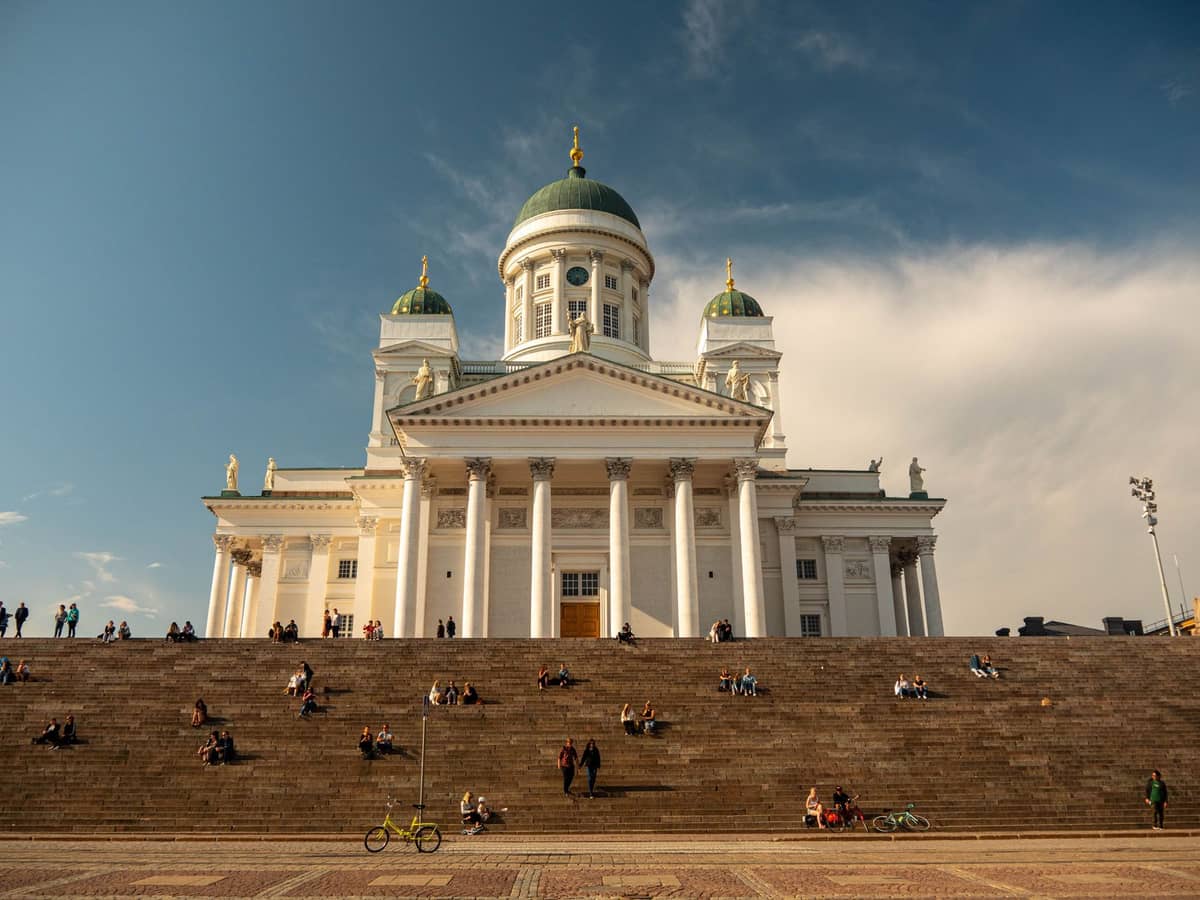
Helsinki Cathedral (*Helsingin tuomiokirkko*) is a Lutheran cathedral and the mother church of the Diocese of Helsinki. It stands at the northern edge of Senate Square in the Kruununhaka district, elevated above the square on a wide cascade of granite steps that makes it visible from the waterfront and from ferries arriving in the harbour. The building's pale grey-white facade and five green copper domes are the single most recognizable image of the Finnish capital.
The cathedral is an active place of worship, which means its schedule is shaped by services and seasonal events, not purely by tourism. Visiting hours change throughout the year, and access to the main hall may be restricted during services. Check the official site before your visit if timing matters to you.
ℹ️ Good to know
Admission in summer: €10 (adult) / €8 (concession). In winter, an €8 admission is voluntary. Under-18s enter free. The Crypt level has free admission when open. Visiting hours vary by season and can be interrupted by church events — confirm current hours at helsingintuomiokirkko.fi before visiting.
The Architecture Up Close
The cathedral was designed in the neoclassical style, defined by its symmetrical portico, Corinthian columns, and the large central dome flanked by four smaller ones. The exterior is understated by the standards of many European cathedrals. There is no dramatic Gothic tracery or Baroque gilding on the outside. What you get instead is a controlled, almost severe geometry that the bright Nordic light suits remarkably well.
The interior continues that restraint. The main hall is predominantly white, with clean vaulted ceilings and relatively sparse ornamentation compared to Catholic or Orthodox counterparts. The altarpiece and the statues of the twelve apostles positioned in the main space are the primary focal points. The overall effect is one of calm and proportion rather than visual excess. Visitors expecting a baroque spectacle may find it unexpectedly quiet in atmosphere.
The Uspenski Cathedral across the harbour, by contrast, offers a completely different aesthetic experience — ornate, red-brick Russian Orthodox architecture that makes for an instructive comparison. Many visitors do both on the same afternoon. For context on how the cathedral fits into the broader architectural landscape of the district, the nearby Senate Square page covers the surrounding Empire-style ensemble in detail.
Tickets & tours
Hand-picked options from our booking partner. Prices are indicative; availability and final rates are confirmed when you complete your booking.
Helsinki private and guided walking tour
From 162 €Instant confirmationFree cancellationHelsinki Beautiful Canal Route, archipelago cruise
From 26 €Instant confirmationFree cancellationHelsinki Panorama Sightseeing Bus Tour With Audio Guide
From 35 €Instant confirmationFree cancellationHelsinki Pasila Street art district tour with a local
From 99 €Instant confirmationFree cancellation
Senate Square: The Stage Around the Cathedral
The cathedral cannot really be separated from the square in front of it. Senate Square is a coherent Empire-style ensemble built largely in the first half of the 19th century, when Helsinki was being remade as the capital of the Grand Duchy of Finland under Russian rule. The University of Helsinki main building, the Government Palace (used by the Finnish Government), and the Helsinki City Hall form the other three sides of the square, with a statue of Tsar Alexander II at the centre.
The square itself is worth time on its own terms. In summer it hosts outdoor events and occasional markets; in winter it becomes the site of Helsinki's Christmas market. The cobblestones, the neoclassical facades on all sides, and the cathedral steps create one of the more photogenic urban spaces in Northern Europe. If you want to understand the area's political and cultural history, the Helsinki City Museum is a short walk away and entry is free.
How the Experience Changes by Time of Day
The cathedral steps are in use from early morning to late evening. In the morning, particularly on weekdays, the square is relatively quiet — a few commuters crossing, early tourists positioning for photographs before the tour groups arrive. The light at this hour hits the facade directly from the east, which makes the pale stone glow and renders the copper domes a deeper green than at midday.
By late morning and early afternoon, tour groups begin to fill the steps. The square never becomes unpleasantly crowded in the way that truly high-volume attractions do, but the steps themselves become a social space: people sit on them, eat lunch on them, and use them as a vantage point over the square. Photography of the facade from ground level becomes harder as more people are present.
Late afternoon and evening are the most atmospheric times to visit, particularly in summer when Helsinki's long daylight hours mean warm golden light well into the evening. The tour groups have largely dispersed, the square quietens, and the scale of the ensemble becomes easier to take in. In winter, the low sun angle means dramatic shadows even at midday, and the cathedral against a pale winter sky has a particular stark quality that summer visits do not offer.
💡 Local tip
For unobstructed photographs of the facade, arrive before 9am or after 6pm in summer. The steps face roughly south, so the facade is in shade in the early morning — ideal for even, non-blown-out exposures. Evening light from the west catches the domes particularly well.
The Crypt: Often Overlooked, Worth Seeing
Beneath the cathedral is a crypt level that serves both practical and contemplative purposes. Entry to the crypt is free when it is open in summer and it is accessible via the entrance at Kirkkokatu 18 — notably, this is also the accessible entrance for wheelchair users and anyone for whom the main staircase presents a difficulty. The crypt hosts a small cafe, exhibition spaces, and serves as a venue for concerts and events.
The crypt's stone vaulting and lower ceilings create a different atmosphere from the main hall — cooler, quieter, more enclosed. On a hot summer afternoon it is noticeably refreshing. Many visitors who come in through the front steps entirely miss this level, which means it is usually less crowded than the main hall during peak visiting hours. If the main hall is closed for a service, the crypt may still be accessible.
Practical Walkthrough: Getting There and Moving Around
Helsinki Cathedral is in the centre of the city, making it accessible on foot from most central accommodation. Tram lines 2 and 4 stop at Senaatintori (Senate Square), putting you at the foot of the steps. From Helsinki Central Railway Station, the walk takes around 10 minutes south along Aleksanterinkatu or Unioninkatu.
The main entrance is from the top of the steps on the southern facade. The accessible entrance at Kirkkokatu 18 leads directly into the crypt level. Inside the main hall, the space is relatively compact — there is no long processional nave to navigate, and most visitors move around freely between the entrance, the main altar area, and the side spaces. Photography is permitted in the main hall, though flash use and tripods during services would be inappropriate.
If you are planning a half-day in this part of the city, the cathedral pairs well with a walk down to the waterfront. The Market Square (Kauppatori) is roughly 700 metres south, and the Uspenski Cathedral is visible across the water on the Katajanokka peninsula. A combined visit to both cathedrals and a stop at the market takes around two to three hours at a relaxed pace.
⚠️ What to skip
The cathedral is an active church. Services take place regularly, and access to the main hall will be restricted during these times. The visiting hours listed on the official site reflect this, but schedules can change at short notice around religious holidays and special events.
Who This Attraction Suits, and Who It Might Not
First-time visitors to Helsinki will almost certainly end up at Senate Square regardless of planning — it is the geographical and symbolic heart of the city centre, and the cathedral is impossible to ignore. For that reason alone it is worth going inside rather than just photographing the steps.
Visitors with a strong interest in religious architecture will find the interior genuinely interesting as an example of Nordic neoclassicism, though they should be prepared for an aesthetic that prioritises restraint over richness. Travelers looking for ornate interiors comparable to Notre-Dame de Paris or the Cologne Cathedral will be less satisfied. The cathedral is not the most elaborate or historically layered religious building in Helsinki — that distinction arguably belongs to Uspenski Cathedral for sheer visual impact, or Temppeliaukio for spatial drama.
Families with children can visit comfortably. The steps themselves are a practical playground, and the interior is calm enough for a brief stop without requiring extended engagement. If you are planning a broader itinerary for younger visitors, the guide to Helsinki with kids covers how to structure time in this part of the city.
Insider Tips
- The view from the top of the cathedral steps looking south over Senate Square toward the harbour is one of the better urban viewpoints in Helsinki at ground level. Walk to the top of the steps before entering the building, not after.
- The crypt cafe is a genuinely useful stop for coffee and a rest, especially in winter when the cold makes short breaks between outdoor sights more appealing. It is quieter and often less expensive than the tourist-oriented cafes around the square.
- If you visit during a service (particularly Sunday mornings), wait outside and listen — the acoustics carry the organ clearly through the stone exterior, which is an experience in itself without requiring entry.
- The accessible entrance at Kirkkokatu 18 on the north side of the building is worth knowing even if you do not need step-free access, because it puts you directly in the crypt rather than the main hall, letting you explore from the bottom up.
- In winter, the Christmas market on Senate Square runs in December and transforms the square's atmosphere considerably. The cathedral facade lit at dusk during this period is one of the more quietly striking seasonal sights in the city centre.
Who Is Helsinki Cathedral For?
- First-time visitors to Helsinki who want to understand the city's core layout and historical identity
- Architecture and urban design enthusiasts interested in Nordic neoclassicism and coherent civic planning
- Photographers looking for a reliable, high-impact subject at different times of day and in different seasons
- Travelers combining a waterfront walk with Senate Square and the nearby market
- Anyone seeking a quiet, no-pressure interior space in the middle of the city centre
Nearby Attractions
Other things to see while in Senate Square & Kruununhaka:
- Ateneum Art Museum
The Ateneum Art Museum holds Finland's largest collection of classical art, from 19th-century Finnish masters to early 20th-century modernism. Located directly opposite Helsinki Central Railway Station, it is one of the most accessible and rewarding museums in the Nordic countries.
- Helsinki Central Railway Station
Helsinki Central Railway Station is more than a place to catch a train. Designed by Eliel Saarinen and completed in 1919, it is one of Finland's most recognizable buildings and the beating heart of the city's transport network. Whether you are arriving in Helsinki for the first time or simply passing through, the station repays a slow, deliberate look.
- Helsinki City Hall
Helsinki City Hall (Helsingin kaupungintalo) stands on Pohjoisesplanadi facing Market Square, its neoclassical facade one of the defining sights of the city's historic waterfront. Entry to the lobby is free, and the building's location makes it a natural stop on any walk through the Senate Square district.
- Helsinki City Museum
The Helsinki City Museum occupies a cluster of restored historic buildings at the edge of Senate Square, offering free admission to anyone curious about how this Baltic capital grew from a small coastal town into Finland's cultural and political centre. It is the only museum in the world dedicated exclusively to Helsinki.