Ateneum Art Museum: Finland's Greatest Art Collection in the Heart of Helsinki
The Ateneum Art Museum holds Finland's largest collection of classical art, from 19th-century Finnish masters to early 20th-century modernism. Located directly opposite Helsinki Central Railway Station, it is one of the most accessible and rewarding museums in the Nordic countries.
Quick Facts
- Location
- Kaivokatu 2, 00100 Helsinki (Rautatientori / Central Railway Square)
- Getting There
- Helsinki Central Railway Station (all trains), Rautatientori metro station, multiple tram and bus stops at the square
- Time Needed
- 2 to 3 hours for a focused visit; half a day if exploring temporary exhibitions thoroughly
- Cost
- Adults €23 at the desk or €21 online; reduced €13; under-18s free; free with Finnish Museum Card
- Best for
- Finnish art history, 19th-century European painting, rainy-day culture, architecture enthusiasts
- Official website
- ateneum.fi/en
What the Ateneum Actually Is
The Ateneum Art Museum (Finnish: Ateneumin taidemuseo) is one of three institutions that make up the Finnish National Gallery, and it holds the distinction of housing Finland's largest collection of classical art. That phrase undersells it. This is where Finnish painting reached its defining voice: Albert Edelfelt's portraits with their cool northern light, Akseli Gallen-Kallela's raw mythological scenes from the Kalevala, Hugo Simberg's quietly unsettling allegories. These are not minor national curiosities. They are works of European significance, and seeing them in their original institutional home adds a layer that no reproduction can replicate.
The museum's collection spans Finnish and international art from the 19th century through to the early 1960s, after which contemporary works transfer to Kiasma. Alongside the permanent Finnish collection, the Ateneum hosts major temporary exhibitions drawn from international institutions, which often sell out in advance during busy periods.
💡 Local tip
Book tickets online before you visit. The online price is typically €2–3 cheaper than the door price, and popular temporary exhibitions sell out days in advance, especially on weekends.
The Building: Architecture Worth Stopping For
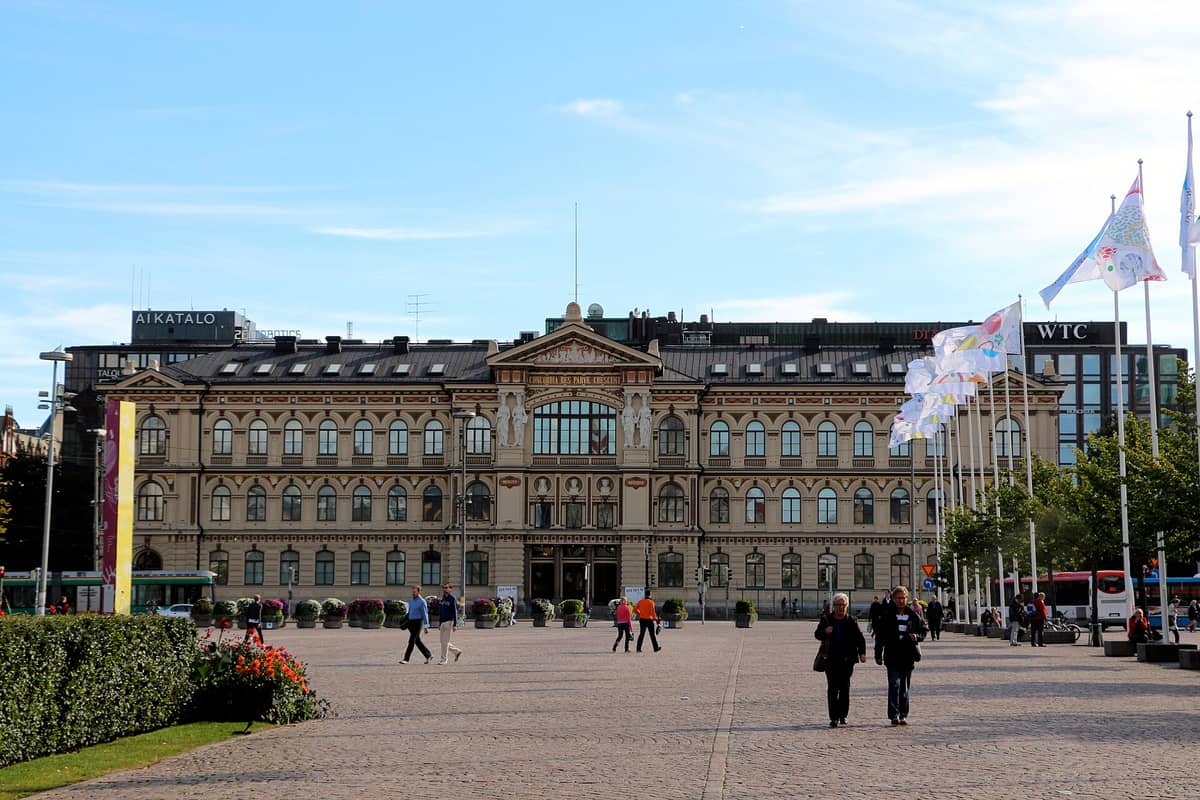
The Ateneum building dates from 1887 and was designed by Theodor Höijer in a Neo-Renaissance style, part of the broader civic ambition that shaped Helsinki's monumental centre in the late 19th century. The façade faces Rautatientori (Central Railway Square), and the contrast with the functionalist granite mass of Helsinki Central Station directly opposite is instructive: the Ateneum belongs to an older idea of cultural aspiration, its stone facade decorated with the carved busts of Bramante, Phidias, and Raphael above the main entrance.
Standing on Kaivokatu looking up at the building before you enter is genuinely worthwhile. The proportions are confident without being overwhelming, and the sculptural details reward a few minutes of attention. Inside, the main staircase and upper galleries retain the high ceilings and parquet floors of the original design, though the lighting has been updated to modern museum standards.
If you are interested in the wider architectural context of this area, the Senate Square and Helsinki Central Railway Station are both within a five-minute walk and together form one of the most coherent sequences of historic public architecture in Northern Europe.
Tickets & tours
Hand-picked options from our booking partner. Prices are indicative; availability and final rates are confirmed when you complete your booking.
Helsinki Pasila Street art district tour with a local
From 99 €Instant confirmationFree cancellationArt and culture tour in Helsinki with a local
From 81 €Instant confirmationFree cancellationHelsinki Beautiful Canal Route, archipelago cruise
From 26 €Instant confirmationFree cancellationHelsinki Panorama Sightseeing Bus Tour With Audio Guide
From 35 €Instant confirmationFree cancellation
The Collection: What You Will Actually See
The permanent collection is organized chronologically across the upper floors. The 19th-century Finnish rooms are the emotional core of the museum for most visitors. Works by Edelfelt, Eero Järnefelt, and Helene Schjerfbeck document the moment Finnish visual culture became self-aware and began asserting a national identity through landscape, light, and rural life. Schjerfbeck's paintings in particular, including her evolving series of self-portraits, are among the most quietly powerful works in any Nordic museum.
Akseli Gallen-Kallela's large-format Kalevala paintings occupy their own space and draw consistent attention. The scale alone commands the room, and the mythological subject matter has a raw, almost expressionist quality that feels modern despite its 19th-century origins. If you have limited time, the rooms containing Gallen-Kallela and Schjerfbeck are the ones to prioritize.
The international collection, which includes European masters from the Dutch Golden Age through to Impressionism, provides context for understanding where Finnish painters were in dialogue with broader European movements. It is solid rather than spectacular compared to major European encyclopedic museums, but it serves its purpose well within the Ateneum's narrative.
ℹ️ Good to know
Gallery labels are in Finnish, Swedish, and English throughout the permanent collection. Audio guides are available for hire at the ticket desk and cover the main highlights in multiple languages.
When to Visit: How the Experience Changes by Time and Season
Tuesday and Wednesday mornings, shortly after the 10:00 opening, are reliably the quietest times. The galleries have a stillness then that suits the paintings, particularly the more intimate Schjerfbeck rooms where crowds genuinely disrupt the experience. Thursday evenings, when the museum stays open until 20:00, attract a specific after-work crowd and have a different atmosphere, more relaxed and conversational, but still manageable.
Weekend afternoons from late spring through August are the busiest periods, particularly when a major temporary exhibition is running. The lobby and ticket area can feel congested, though the upper permanent collection galleries rarely become uncomfortably crowded. Saturday mornings are a reasonable compromise: the building is livelier than weekday mornings but not yet at weekend-afternoon capacity.
Winter visits have their own logic. Helsinki's grey December and January light means many visitors drift toward indoor culture, and the Ateneum sees steady traffic from both tourists and locals. The museum is well heated, which matters after a cold walk from the station. Summer brings the bonus of long daylight, and Thursday evening visits in June or July, with light still in the sky at 20:00, have a particular quality worth seeking out.
⚠️ What to skip
The museum is closed on Mondays outside the July–August summer period. During summer (1 July to 31 August), it opens on Mondays 11:00–17:00. Verify current hours at ateneum.fi before your visit, as seasonal schedules may change.
Practical Walkthrough: Getting There and Getting Around Inside
The location is exceptionally central. The museum sits on Kaivokatu directly facing Helsinki Central Railway Station, which is served by commuter and long-distance trains, the metro (Rautatientori station), and a dense convergence of tram and bus routes. From the station exit on the Kaivokatu side, the Ateneum's facade is visible immediately across the square. The walk from the station doors takes under two minutes.
The accessible entrance is on Ateneuminkuja, the side street running alongside the building, where a lift provides level access to all floors. Wheelchairs are available on loan from the cloakroom at no charge, though they cannot be reserved in advance. The cloakroom is mandatory for large bags and backpacks; plan for a short queue on busy days. Accessible, gender-neutral toilets are available, as is a quiet area on the first floor separated by a screen, which is useful for visitors who need a lower-stimulation space. Support persons accompanying disabled visitors are admitted free of charge.
The Ateneum is included in the Finnish Museum Card, which offers unlimited free entry to over 300 museums across Finland and pays for itself after two or three museum visits. The best museums in Helsinki guide covers which institutions accept the card and how to make the most of it across a multi-day visit.
Standard adult admission at the door runs approximately €22. Buying online in advance typically saves €2 and guarantees entry to timed-entry temporary exhibitions. Visitors aged under 18 enter free. Discounted tickets are available for students, visitors aged 18–24, pensioners, and the unemployed at around €12; bring supporting ID. The museum also observes several free admission days per year, announced on the official website.
Photography, the Café, and Honest Limitations
Photography without flash is permitted in the permanent collection galleries. Temporary exhibitions often have individual photography restrictions, which are posted at gallery entrances. The grand staircase and the main hall are particularly photogenic, with the kind of proportioned interiors that reward a wide-angle lens.
The museum café on the ground floor is a practical option for a break between floors. It is not a destination in itself, but the coffee is decent and the seating near the windows gives a view of the square outside. The museum shop carries a well-edited selection of Finnish art books, prints, and design objects, with a stronger focus on Finnish artists than a generic museum shop.
One honest note: visitors expecting the depth of a major European encyclopedic museum, a Rijksmuseum or Prado, will find the international collection modest by comparison. The Ateneum's strength is specifically Finnish art, and that is where the visit earns its full value. If contemporary Finnish and international art is your priority, Kiasma Museum of Contemporary Art is a five-minute walk away and covers the post-1960s work that falls outside the Ateneum's scope.
Visitors with very limited time and no particular interest in 19th-century painting will not get the same return from the Ateneum as those who come with some curiosity about Finnish history or Nordic visual culture. The museum rewards context. If you can spend ten minutes reading about Gallen-Kallela or Schjerfbeck before you arrive, the experience will be noticeably richer.
Insider Tips
- Thursday evenings until 20:00 are the best combination of lower crowds and full gallery access. The upper permanent collection floors are often nearly empty after 18:00 on Thursdays.
- The Ateneum is directly on the route from Helsinki Central Station toward Senate Square and the waterfront. Build it into a walking circuit rather than treating it as a standalone detour: station, Ateneum, Senate Square, and down to Market Square makes a coherent half-day loop.
- Free admission days are published on the official website at the start of each year. If your dates are flexible and aligning with one of these days is possible, the saving on adult admission is meaningful.
- The museum's own app and website offer digital collection access before and after your visit, which is particularly useful for reading more about specific works that catch your attention in the galleries.
- Large bags must be left in the cloakroom, which is free of charge. If you are carrying camera equipment or a substantial daypack, factor in a few extra minutes at the start and end of your visit.
Who Is Ateneum Art Museum For?
- Travelers interested in Finnish national identity and how it was constructed through art in the 19th and early 20th centuries
- Fans of Helene Schjerfbeck, Akseli Gallen-Kallela, or Albert Edelfelt who want to see major works in their original institutional context
- Rainy-day or cold-weather visits when outdoor sightseeing is less appealing
- Architecture enthusiasts interested in Helsinki's late 19th-century Neo-Renaissance civic buildings
- Museum Card holders looking to maximize value across Helsinki's cultural institutions
Nearby Attractions
Other things to see while in Senate Square & Kruununhaka:
- Helsinki Cathedral
Helsinki Cathedral (*Helsingin tuomiokirkko*) is the defining landmark of the Finnish capital, rising above Senate Square on a steep granite staircase that doubles as one of the city's most photographed gathering spots. The neoclassical Lutheran cathedral charges a modest fee for the main hall in summer, while the crypt has free admission when open. Here is everything you need to decide whether it deserves time on your itinerary.
- Helsinki Central Railway Station
Helsinki Central Railway Station is more than a place to catch a train. Designed by Eliel Saarinen and completed in 1919, it is one of Finland's most recognizable buildings and the beating heart of the city's transport network. Whether you are arriving in Helsinki for the first time or simply passing through, the station repays a slow, deliberate look.
- Helsinki City Hall
Helsinki City Hall (Helsingin kaupungintalo) stands on Pohjoisesplanadi facing Market Square, its neoclassical facade one of the defining sights of the city's historic waterfront. Entry to the lobby is free, and the building's location makes it a natural stop on any walk through the Senate Square district.
- Helsinki City Museum
The Helsinki City Museum occupies a cluster of restored historic buildings at the edge of Senate Square, offering free admission to anyone curious about how this Baltic capital grew from a small coastal town into Finland's cultural and political centre. It is the only museum in the world dedicated exclusively to Helsinki.