Kiasma Museum of Contemporary Art: Helsinki's Most Architecturally Striking Gallery
The Museum of Contemporary Art Kiasma sits at the heart of Helsinki's cultural district, combining Steven Holl's curve-and-light architecture with bold, frequently rotating contemporary exhibitions. It's free for visitors under 18 and opens late on Tuesdays and Fridays.
Quick Facts
- Location
- Mannerheiminaukio 2, 00100 Helsinki (Töölö / central Helsinki)
- Getting There
- 5-minute walk from Helsinki Central Railway Station; trams along Mannerheimintie stop directly nearby
- Time Needed
- 1.5 to 3 hours depending on exhibitions
- Cost
- €21 online / €23 at desk; reduced €13; under 18 free; first Friday of each month free for all
- Best for
- Contemporary art lovers, architecture enthusiasts, rainy-day culture seekers
- Official website
- kiasma.fi/en
What Kiasma Actually Is
The Museum of Contemporary Art Kiasma is Finland's primary public institution for contemporary art, and one of three museums that make up the Finnish National Gallery alongside the Ateneum Art Museum and the Sinebrychoff Art Museum. It opened in 1998 and takes its name from the architectural concept of chiasma, referring to the intertwining of two elements, in this case the building's relationship between the city grid and the Finnish landscape. The word also nods to the crossing of optical nerves, an apt metaphor for a place that asks visitors to look differently.
The collection and exhibition program focuses on art made from roughly the 1960s onward, with a strong emphasis on Finnish and Nordic contemporary work alongside international voices. Kiasma doesn't have a permanent hang in the traditional sense. Galleries are rearranged regularly, and what you encounter on one visit may be completely different six months later. That's both a strength and a limitation worth knowing before you go.
💡 Local tip
Check Kiasma's website before visiting. Exhibitions change frequently, and the program sometimes includes ticketed special events or temporary closures of specific floors. The first Friday of each month offers free admission for everyone.
The Building: Steven Holl's Curving Landmark
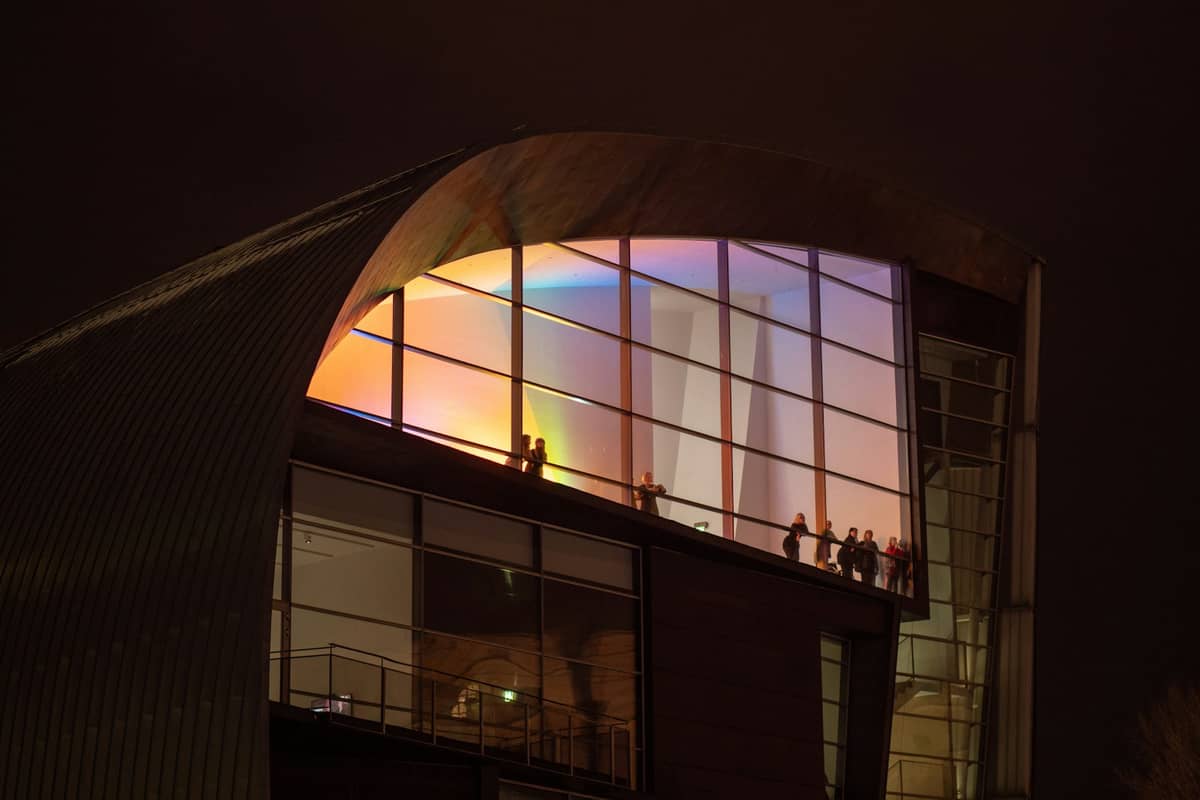
American architect Steven Holl won an international competition to design Kiasma, and the building that resulted in 1998 is among his most celebrated works. The structure is immediately recognizable from the street: a curved zinc and glass form that bends away from the strict geometry of the surrounding blocks, its surface catching the flat northern light in ways that change from hour to hour.
Holl's design concept centered on intertwining two geometries: the city's grid alignment and the curve of the nearby Töölönlahti bay. The result is a building that never quite meets the street at right angles, creating unusual interior volumes where natural light is the primary material. Skylights, angled windows and translucent walls direct daylight deep into the galleries, meaning the experience of being inside Kiasma shifts noticeably depending on the season and time of day.
The building sits at the northern edge of Töölönlahti Bay, a position that gives it visual breathing room rarely found in a city centre. On clear summer evenings, the curved facade reflects a pale luminosity that the zinc cladding absorbs differently than it does on grey winter afternoons. Architecturally, it's worth spending time outside before you go in, walking around the perimeter to understand how the building meets the ground.
Tickets & tours
Hand-picked options from our booking partner. Prices are indicative; availability and final rates are confirmed when you complete your booking.
Helsinki Pasila Street art district tour with a local
From 99 €Instant confirmationFree cancellationArt and culture tour in Helsinki with a local
From 81 €Instant confirmationFree cancellationHelsinki contemporary seaside floating sauna experience
From 0 €Instant confirmationHelsinki Beautiful Canal Route, archipelago cruise
From 26 €Instant confirmationFree cancellation
Inside: Galleries, Light and Movement
The interior is organized across five floors connected by a gently rising ramp that runs the length of the building. This is not a staircase-and-corridor museum. The ramp is part of the spatial experience: you ascend slowly, with gallery openings appearing on either side, and the curve of the building means you're rarely looking down a straight corridor. For visitors used to conventional gallery layouts, this takes some adjustment.
The galleries themselves vary considerably in scale. Some rooms are large enough for major video installations or sculptural works that require space to breathe. Others are intimate, almost unsettling in how closely they place you with a work. The ceiling heights shift floor by floor, and the natural light that enters through Holl's carefully positioned apertures creates pools and gradients that interact with whatever is on display. When the programming works well, the architecture and art are in genuine conversation.
The ground floor includes the museum shop, café and ticketing area. The Kiasma Theatre, a small performance and screening space, hosts film programs, performances and talks that often run alongside current exhibitions. If you're visiting for a longer stay in Helsinki, it's worth checking the theatre program separately, as events there are sometimes free or modestly priced.
ℹ️ Good to know
Kiasma is fully accessible. All floors are reachable by lift. Wheelchairs, rollators and walking sticks can be borrowed from the cloakroom at no charge. Induction loops are installed at the information desk, in the Kiasma Theatre, and in the Seminar Room. Personal assistants of disabled visitors enter free of charge.
When to Visit and How the Experience Changes
Kiasma is open Tuesday through Sunday, closed on Mondays. On Tuesdays and Fridays the museum stays open until 20:00, which gives you a genuine evening option in a city where most attractions close by 18:00. Late afternoons on Tuesdays and Fridays tend to draw a younger, post-work crowd; the atmosphere is more social than during quiet weekday mornings.
For the galleries themselves, weekday mornings between 10:00 and 12:00 are the least crowded. You'll have large installations almost to yourself, which matters more than usual here because many contemporary works require both physical space and a degree of quiet attention to read properly. Weekend afternoons attract families with children, which is encouraged by the museum's educational programming, but can make certain galleries noisier.
Seasonally, summer brings more international visitors and the light inside the building is at its most dynamic, with long bright days sending shafts through the skylights well into the evening. In winter the low-angle Nordic light creates a softer, more diffused quality inside, and the building's insulation from the cold makes it a genuinely comfortable retreat when temperatures drop below freezing outside.
💡 Local tip
Book tickets online to save €2 per person and skip the desk queue, which can build up around midday on weekends. The Helsinki Card includes entry to Kiasma, worth considering if you plan to visit multiple museums in the city.
Practical Walkthrough: Getting There and Around
Kiasma is at Mannerheiminaukio 2, roughly 500 metres from Helsinki Central Railway Station, a walk of about five minutes along Mannerheimintie. Multiple tram lines run along Mannerheimintie and stop close to the museum entrance. It's one of the most accessible major attractions in the city, and the central location makes it easy to combine with nearby institutions. The Helsinki Central Library Oodi is directly across the open plaza, and the Finlandia Hall is a short walk further north along the bay.
The museum's entrance is at street level on the Mannerheiminaukio square. The push-button door opener and step-free access begin at the entrance. Once inside, bag check is available at the cloakroom before you enter the galleries. Large bags and backpacks must be checked in, which is standard practice at Finnish national museums.
Photography policies inside Kiasma vary by exhibition. Many shows permit non-flash photography for personal use, but specific installations may be restricted. Always check the notice at the gallery entrance rather than assuming. For broader planning in the area, the best museums in Helsinki guide covers how Kiasma fits into a multi-day cultural itinerary.
Honest Assessment: Who This Works For, and Who It Doesn't
Kiasma is not a museum that eases visitors in gently. There's no chronological survey of art history, no permanent collection laid out for orientation. If you arrive expecting a primer on Finnish art or a structured narrative, you'll need to recalibrate. What the museum offers instead is immersion in a particular moment of contemporary practice, which requires a willingness to sit with work that may be unfamiliar, uncomfortable, or deliberately opaque.
For travelers with a genuine interest in contemporary art, especially those curious about Nordic and Finnish perspectives, Kiasma is one of the strongest institutions of its kind in Northern Europe. The building alone is worth the visit for architecture enthusiasts. But visitors who prefer representational painting, historical narratives, or the kind of encyclopedic museum experience offered by national art history collections will likely find the programming frustrating. The Ateneum, a short walk away, is a better fit for that kind of engagement.
Families with children are explicitly welcomed, and Kiasma runs regular workshops and child-oriented programming, particularly on weekends. The under-18 free admission policy removes the financial barrier entirely. If you're travelling with kids interested in hands-on creative activities, check the museum's event calendar. For families planning a broader Helsinki visit, the Helsinki with kids guide covers how to combine Kiasma with other child-friendly stops.
Insider Tips
- The first Friday of each month is completely free for everyone, including the evening hours until 20:00. This is one of the best times to visit if you're on a budget, though expect higher attendance than usual.
- The museum café on the ground floor has large windows facing the Mannerheiminaukio plaza and is open to non-ticket holders. It's a reasonable coffee stop even if you're not visiting the exhibitions.
- If you have the Museum Card (a subscription card used widely across Finland), Kiasma is included and grants free admission. For frequent museum-goers spending more than a few days in Helsinki, the card pays for itself quickly.
- The ramp that connects all five floors means you can experience the entire building without retracing your steps. Walk up via the ramp and take the lift down, or vice versa, to get two different spatial reads of the building.
- Kiasma's library and archive, focused on contemporary art documentation, is accessible to researchers. It's not a general visitor facility, but worth knowing if you're looking for deeper engagement with Finnish contemporary art history.
Who Is Kiasma Museum of Contemporary Art For?
- Contemporary art enthusiasts, particularly those interested in Nordic and Finnish perspectives
- Architecture lovers drawn to Steven Holl's distinctive approach to light and form
- Travelers on rainy or cold days looking for a substantial indoor cultural experience
- Families with children under 18, who enter free and have access to dedicated workshop programming
- Evening visitors on Tuesdays and Fridays when the museum opens until 20:00
Nearby Attractions
Other things to see while in Töölö:
- Finlandia Hall
Finlandia Hall is Helsinki's most architecturally significant congress and concert venue, designed by Alvar Aalto and completed on the western shore of Töölönlahti Bay. Whether you come for the permanent Aalto exhibition, a concert evening, or simply to study the building's striking white marble facade up close, the hall sits at the intersection of Finnish cultural identity and modernist design.
- Finnish National Opera and Ballet
The Finnish National Opera and Ballet, known locally as Kansallisooppera ja -baletti, is Finland's foremost performing arts institution, occupying a purpose-built house on the edge of Töölönlahti Bay. Whether you are new to opera or a longtime ballet devotee, the venue delivers a polished, accessible experience at the heart of Helsinki's cultural calendar.
- Helsinki Central Library Oodi
Opened on 5 December 2018, Helsinki Central Library Oodi is a landmark public building at Kansalaistori Square, steps from the Central Railway Station. It combines a working library with makerspaces, a cinema, a rooftop terrace, and a cafe, all free to enter. The architecture alone justifies a visit, but the building earns its reputation by being genuinely useful.
- Helsinki Olympic Stadium
Built for the 1952 Summer Olympics, the Helsinki Olympic Stadium in Töölö is Finland's most storied sports venue. Visitors can climb its landmark tower for sweeping city views, tour the TAHTO Sports Museum, and walk the same track that once hosted the world's greatest athletes.