Töölönlahti Bay: Helsinki's Green Heart in the City Centre
Töölönlahti Bay is a flat, walkable waterfront park wrapping around a former sea inlet just north of Helsinki's railway station. Free to enter at any hour, it connects major cultural landmarks, offers reliable birdwatching, and works equally well as a morning run route or an unhurried afternoon stroll.
Quick Facts
- Location
- Taka-Töölö, Helsinki — just north of the Central Railway Station, off Mannerheimintie
- Getting There
- Multiple tram and bus lines along Mannerheimintie stop within a short walk; 10-minute walk from Helsinki Central Railway Station
- Time Needed
- 45–60 minutes (loop walk) to 2–3 hours (with landmark stops)
- Cost
- Free — the bay, paths, and park are fully open to the public at no charge
- Best for
- Walkers, runners, birdwatchers, and anyone wanting green space within minutes of the city centre
- Official website
- www.myhelsinki.fi/places/toolonlahti-bay
What Töölönlahti Bay Actually Is
Töölönlahti Bay is a shallow inner-city lake and park loop in the Töölö district, forming the southern starting point of Helsinki's long Central Park (Keskuspuisto). Technically a current lake rather than a true sea bay, it was historically connected to the Gulf of Finland before urban development gradually closed off direct tidal exchange. The name has stuck regardless.
The circuit path around the water measures roughly 2–2.5 kilometres and stays almost entirely flat, making it one of the most accessible green routes in the Finnish capital. It is not a manicured garden or a gated park. There are no entry points, no barriers, and no closing time. You simply arrive and walk.
What makes the route genuinely interesting is its position at the intersection of Helsinki's most significant civic buildings. The walk connects Finlandia Hall, the Helsinki Olympic Stadium, the National Opera, the National Museum, and the Parliament building, all within comfortable walking distance of the water. You get city context alongside the greenery.
The Experience by Time of Day
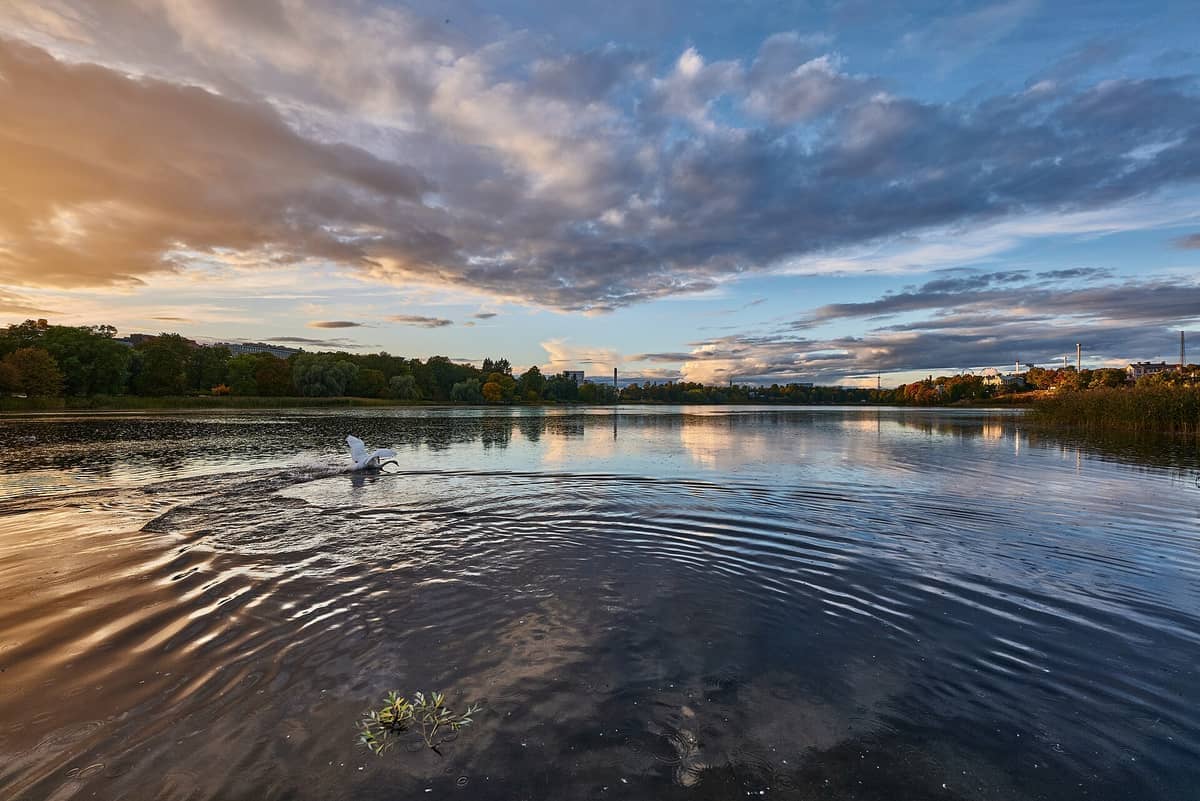
Early mornings, especially on weekdays, belong to runners and dog walkers. The path is quiet enough that you can hear coots calling across the water and the occasional splash of a great crested grebe diving. The light on the bay at 7am in summer is low and golden, catching the rippled surface between the reeds on the eastern shore. Bring layers even in June: the water creates a noticeable chill before the city warms up.
Midday shifts the character entirely. Office workers from the surrounding government and cultural institutions cross through on lunch breaks. The gravel sections near the National Museum fill up with cyclists, and the benches along the western bank get occupied by people eating from paper bags. It is never unpleasantly crowded the way a tourist beach would be, but solitude is hard to find between noon and 2pm on fair-weather days.
Evening visits in summer offer the most atmospheric version of the bay. Helsinki's long June and July daylight means the park stays light until nearly midnight. Locals gather on the grassy slopes near the Opera House for informal picnics, the water takes on a copper tone, and swifts cut low arcs over the surface in pursuit of insects. In winter, if temperatures drop far enough to freeze the bay, some residents walk directly across the ice — though conditions are unpredictable and should only be attempted when the city has confirmed ice safety.
💡 Local tip
For the quietest and most photogenic experience, arrive before 8am in summer. The water is usually calm, light is directional, and you share the path with a handful of joggers rather than the midday crowd.
Tickets & tours
Hand-picked options from our booking partner. Prices are indicative; availability and final rates are confirmed when you complete your booking.
Helsinki Beautiful Canal Route, archipelago cruise
From 26 €Instant confirmationFree cancellationHelsinki Panorama Sightseeing Bus Tour With Audio Guide
From 35 €Instant confirmationFree cancellationHelsinki Pasila Street art district tour with a local
From 99 €Instant confirmationFree cancellationSurvival suit floating experience
From 125 €Instant confirmationFree cancellation
The Loop Walk: What You Pass and When It Matters
Starting from the southern end of the bay near Mannerheimintie, the path quickly separates into two character zones. The western bank runs close to Finlandia Hall and feels more urban: paved sections, clear sight lines to the white marble facade of the building, and a steady flow of pedestrians. This is the side for architecture viewing.
The eastern and northern banks are quieter and greener. Reeds grow at the water's edge, the path narrows to gravel in places, and the buildings recede. This is where birdwatching pays off. Mallards, pochards, coots, and tufted ducks are reliable year-round residents; waders and migratory species pass through during spring and autumn. The northern tip of the bay connects to the edge of Keskuspuisto, and you can extend your walk northward into proper forest if the roughly 2–2.5 km loop feels too short.
The full circuit takes 40 to 55 minutes at a comfortable pace. If you plan to combine it with visits to nearby institutions, the Kiasma Museum of Contemporary Art sits at the southern entry point and the National Museum is a short detour off the western bank. Both have their own admission fees and hours, separate from the free park itself.
Historical Context: A Bay That Almost Became Something Else
Urban planners have debated the future of Töölönlahti for well over a century. By the late 19th century the bay had become heavily polluted by industrial use and was widely considered an eyesore. Proposals included filling it in completely to create a grand civic square or a railway terminus extension. That none of these schemes materialised is one of Helsinki's quieter urban planning victories.
The shift toward treating the bay as a green amenity rather than a liability gathered pace in the 20th century. Water quality improved as industrial activity moved away, and the surrounding cultural institutions began to be built with the open waterfront in mind. Alvar Aalto positioned Finlandia Hall deliberately in relationship to the bay's edge, intending the building's white Carrara marble to be reflected in the water when viewed from across the park.
The area around Töölönlahti continues to evolve. Discussions about development on the remaining undeveloped plots near the northern shore have surfaced periodically in Helsinki city planning. The current balance of open green space, cultural buildings, and residential edges is not a historical given but an outcome of long negotiation.
Practical Details for the Visit
Access requires nothing but showing up. The paths are open continuously, entry is free, and no registration is required. The most common approach on foot is from Helsinki Central Railway Station, heading north along Mannerheimintie for roughly 10 minutes until the water becomes visible to the right. Trams running along Mannerheimintie stop near both the southern and western edges of the bay.
If you are planning a broader day in the area, the bay pairs naturally with a walk through the Esplanadi Park further south, or with a visit to the Helsinki Central Library Oodi, which sits just south of the bay near the railway station. Together these three stops form a comfortable half-day walking route through the cultural spine of the city centre.
The path surface varies around the loop. Sections near the Opera House and Finlandia Hall are paved and suitable for wheelchairs and pushchairs. The northern and eastern sections include compacted gravel that can become soft after heavy rain or uneven under snow and ice in winter. Anyone with mobility considerations should check current City of Helsinki accessibility information before visiting in winter months.
⚠️ What to skip
In winter, icy path sections can appear without warning, particularly on the shaded northern bank. Wear shoes with grip between November and March. The bay can partially freeze, but do not walk on the ice unless the City of Helsinki has issued an official ice safety notice.
Photography and Seasonal Considerations
The bay photographs differently across the year in ways that are worth factoring into expectations. Summer brings lush green reeds, long soft light, and reflections of Finlandia Hall when the water is calm, typically early morning or after 8pm. Autumn turns the surrounding trees amber and orange, with the cultural buildings providing strong architectural contrast. Winter ice and snow create a minimalist Nordic scene that can be striking, though grey overcast days make up a significant share of the season.
For photography specifically, the western bank looking south toward Finlandia Hall gives the most iconic composition. The view looking north from the southern tip of the bay, with the stadium tower visible in the distance above the treeline, is a classic Helsinki skyline shot rarely seen in travel photography. If weather or timing matter to your plans, the Helsinki weather guide covers seasonal conditions in detail.
The bay is not primarily a photography destination in the way that a monument or a designed viewpoint would be. It rewards patient, unhurried observation more than quick snapping. Spend time sitting by the water rather than walking the circuit at speed, and the details appear: a heron standing motionless in the reeds, a rowing club launching sculls in early morning, the way the light shifts from grey to silver when a cloud clears.
Insider Tips
- The northeastern corner of the bay, near the point where the path bends around toward the Opera House, is the least-visited stretch and consistently the best for birdwatching. Arrive before 9am and stand still for a few minutes rather than walking past.
- Finlandia Hall's reflection in the bay requires calm water, which happens most reliably early on windless mornings. By 10am on any summer weekend, foot traffic and a light breeze usually disturb the surface.
- The grassy slope on the western bank just north of Finlandia Hall is an unofficial evening picnic spot for locals in summer. Supermarkets on Mannerheimintie are a short walk away if you want to pick up food before settling in.
- If you are running the loop, start counterclockwise (east bank first). The quieter, narrower eastern section is better to handle before the midday crowd builds on the western bank near Finlandia Hall.
- The bay connects directly to Keskuspuisto, Helsinki's long urban forest park, at its northern tip. Most visitors do not realise this and turn back at the top of the loop. A short extension into the forest adds genuine quiet even on busy summer days.
Who Is Töölönlahti Bay For?
- Runners and walkers looking for a flat, safe, and interesting city route
- Travellers who want to combine green space with major cultural landmarks in one walk
- Birdwatchers visiting during spring migration or in the quiet early mornings
- Families with young children seeking open, pram-friendly outdoor space near the city centre
- Photographers working on early-morning Nordic light and urban reflection shots
Nearby Attractions
Other things to see while in Töölö:
- Finlandia Hall
Finlandia Hall is Helsinki's most architecturally significant congress and concert venue, designed by Alvar Aalto and completed on the western shore of Töölönlahti Bay. Whether you come for the permanent Aalto exhibition, a concert evening, or simply to study the building's striking white marble facade up close, the hall sits at the intersection of Finnish cultural identity and modernist design.
- Finnish National Opera and Ballet
The Finnish National Opera and Ballet, known locally as Kansallisooppera ja -baletti, is Finland's foremost performing arts institution, occupying a purpose-built house on the edge of Töölönlahti Bay. Whether you are new to opera or a longtime ballet devotee, the venue delivers a polished, accessible experience at the heart of Helsinki's cultural calendar.
- Helsinki Central Library Oodi
Opened on 5 December 2018, Helsinki Central Library Oodi is a landmark public building at Kansalaistori Square, steps from the Central Railway Station. It combines a working library with makerspaces, a cinema, a rooftop terrace, and a cafe, all free to enter. The architecture alone justifies a visit, but the building earns its reputation by being genuinely useful.
- Helsinki Olympic Stadium
Built for the 1952 Summer Olympics, the Helsinki Olympic Stadium in Töölö is Finland's most storied sports venue. Visitors can climb its landmark tower for sweeping city views, tour the TAHTO Sports Museum, and walk the same track that once hosted the world's greatest athletes.