Esplanadi Park: Helsinki's Living Room in the Heart of the City
Esplanade Park (Esplanadinpuisto) is a narrow, tree-lined urban park running through the centre of Helsinki from Erottaja Square to Market Square. Free to enter at any hour, it functions as a public gathering space, a summer concert venue, and one of the city's most natural walking routes down to the waterfront.
Quick Facts
- Location
- Eteläesplanadi / Pohjoisesplanadi, between Erottaja Square and Market Square, Helsinki
- Getting There
- Multiple tram and bus routes along Pohjoisesplanadi and Eteläesplanadi; short walk from Helsinki Central Railway Station
- Time Needed
- 20–45 minutes to walk through; longer if you stop at a terrace café or attend a concert
- Cost
- Free. Open 24 hours, every day of the year
- Best for
- Leisurely walks, people-watching, summer outdoor events, and connecting the city centre to the waterfront
What Is Esplanadi Park?
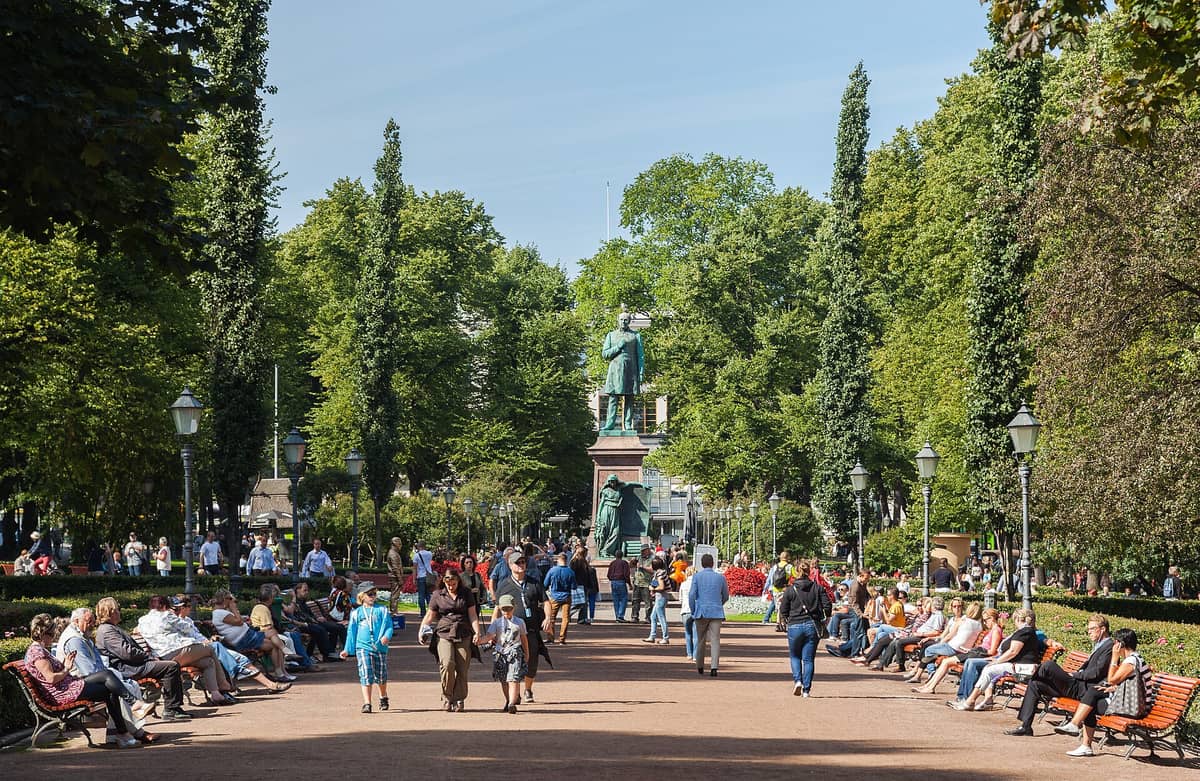
Esplanade Park, known in Finnish as Esplanadinpuisto and in Swedish as Esplanaden, is a historic urban park about 1.75 hectares in size, stretching east to west through the core of central Helsinki. It sits between two parallel streets, Eteläesplanadi (South Esplanade) and Pohjoisesplanadi (North Esplanade), forming a green corridor from Erottaja Square in the west to Market Square (Kauppatori) and the waterfront in the east.
The park is not large. You can walk its full length in under ten minutes. But size is beside the point. Esplanadi functions as Helsinki's most central public gathering space, the kind of place where office workers eat lunch on a bench, tourists orient themselves before heading to the harbour, and locals walk through simply because it is a more pleasant route than the surrounding streets. On a warm summer evening, it can feel like the entire city has decided to be outdoors at once.
💡 Local tip
Esplanade Park is completely free and open 24 hours a day year-round. No tickets, no gates, no booking required. Public toilets are available nearby at Esplanadin puiston yleisövessa.
The Layout: What You Actually See
The park is long and narrow, with paved central paths flanked by mature trees and grass areas on either side. The design is classic 19th-century esplanade style: orderly, symmetrical, built for promenading rather than wilderness. Benches line the main walkway. The trees provide real shade in summer, which matters in July when the sun barely sets and the city radiates heat.
At the eastern end of the park stands the statue of Johan Ludvig Runeberg, often regarded as Finland’s national poet, which was unveiled here in 1885. The area around the statue is paved and open, making it a natural meeting point. Immediately east of this, the park opens onto Market Square and the South Harbour, where ferries depart for the islands and the smell of the sea becomes noticeable on days with a southerly breeze.
The western end near Erottaja is quieter and transitions into the surrounding shopping streets. From here you are within easy walking distance of the Design District to the southwest, and the main shopping thoroughfares heading north toward Helsinki Central Railway Station.
Tickets & tours
Hand-picked options from our booking partner. Prices are indicative; availability and final rates are confirmed when you complete your booking.
Helsinki Beautiful Canal Route, archipelago cruise
From 26 €Instant confirmationFree cancellationHelsinki Panorama Sightseeing Bus Tour With Audio Guide
From 35 €Instant confirmationFree cancellationHelsinki Pasila Street art district tour with a local
From 99 €Instant confirmationFree cancellationSurvival suit floating experience
From 125 €Instant confirmationFree cancellation
How the Park Changes Through the Day and Year
Early mornings, especially on weekdays, the park is quiet. Joggers pass through. A few commuters cut across on foot. The light at this hour in summer is already bright by 5am, filtering through the canopy in long horizontal shafts. In winter the same early hours are dark and cold, the paths sometimes dusted with snow, and the park essentially empty.
The midday crowd is reliable from late spring through early autumn. The terrace of Kappeli restaurant, located at the eastern end of the park in a striking 19th-century glass pavilion building, fills with people. Café chairs appear on the grass-adjacent paths. The benches are occupied. This is when the park has the most human texture: language students with headphones, tourists with city maps, pensioners feeding birds, delivery cyclists weaving through.
Summer evenings are when Esplanadi reaches its most animated. The park hosts a summer programme of outdoor concerts and events on its main stage, drawing crowds that spill across the grass. The combination of long daylight hours, warm temperatures, and the open social culture of Finnish summer makes this genuinely enjoyable rather than merely crowded. By contrast, a December evening here is silent, dark, and punctuated only by the glow of street lamps on icy paths.
ℹ️ Good to know
The Esplanadi summer concert programme typically runs from late spring into late summer. Performances are generally free and held at the park's central stage. Check the City of Helsinki events calendar for current scheduling, as programming changes annually.
Historical and Cultural Context
The esplanade layout was part of the urban planning that reshaped Helsinki in the early 19th century, when the city was being developed as the new capital of the Grand Duchy of Finland under Russian imperial rule. The neoclassical ambitions of that era are visible throughout this neighbourhood: the Senate Square, the Cathedral, the grid of wide boulevards. Esplanadi was conceived as a formal promenade connecting the civic centre to the harbour, a piece of urban design with clear European precedents.
The park's surroundings reinforce this historical layer. The Market Square at the eastern end has functioned as Helsinki's primary outdoor market since the city's early development. The Presidential Palace and Helsinki City Hall both face the harbour just steps from the park's eastern entrance, placing Esplanadi in direct visual and physical relationship with the city's most significant civic buildings.
The Runeberg statue is worth pausing at. Johan Ludvig Runeberg wrote Vårt land (Maamme), which became Finland's national anthem, and his work was foundational to Finnish cultural identity in the 19th century. The statue itself, created by his son Walter Runeberg, was unveiled in 1885 and remains one of the most photographed monuments in the city. On Runeberg Day (February 5th) each year, wreaths are placed here in a small public ceremony.
Practical Walkthrough: Navigating Esplanadi
The most natural direction is to enter from the west, near Erottaja, and walk east toward the harbour. This means you finish at the water, which provides a sense of arrival. The path is flat throughout and paved centrally, making it straightforward for strollers and wheelchairs. The grass areas alongside are not always accessible in early spring when ground conditions are soft.
If you are combining this with a wider circuit of the centre, the park connects logically to several worthwhile stops. Turn right at the eastern end to reach the harbour ferry terminal for boats to Suomenlinna. The Old Market Hall is immediately adjacent. Continue along the south waterfront for the Allas Sea Pool.
For photography, the eastern end of the park offers clean lines toward the water and the dome of Uspenski Cathedral visible on the Katajanokka peninsula. The afternoon light in summer is best from around 4pm onward, when the sun angles from the southwest and catches the tree canopy. In winter, the park is photogenic under fresh snow, particularly in the blue hour just before sunrise.
⚠️ What to skip
In winter, the paved paths can be icy, particularly after overnight freezing rain. The City of Helsinki maintains the main paths, but traction aids on your footwear are worth considering between November and March.
Honest Assessment: Is It Worth Your Time?
Esplanade Park is not a destination in the way a major museum or landmark is. You would not travel to Helsinki specifically to see it. What it offers is something more useful: a pleasant, historically grounded public space that connects the commercial city centre to the waterfront, adds texture to any itinerary, and costs nothing to walk through.
Visitors who arrive expecting gardens, large green expanses, or a park in the English landscape tradition may find it underwhelming. The park is formal and linear, not sprawling. For a fuller experience of Helsinki's nature and open space, Kaivopuisto Park to the south and Töölönlahti Bay to the north offer considerably more room.
That said, on a warm summer evening during the concert programme, Esplanadi is one of the more genuinely enjoyable urban experiences the city offers. People sit on the grass, music carries across the park, and the light stays long after 10pm. That version of the park is worth planning around.
Insider Tips
- The Kappeli restaurant terrace at the eastern end of the park is one of the most atmospheric spots in central Helsinki on a summer evening. The building dates to the 19th century and the setting, with the park behind you and the harbour ahead, justifies the prices better than the food alone would.
- Runeberg Day on February 5th brings a small but genuine ceremony to the park's eastern statue. If you happen to be in Helsinki that day, it is a low-effort window into Finnish cultural life.
- The North Esplanade street (Pohjoisesplanadi) running alongside the park is lined with design and flagship stores. Walking the full length of the park and then browsing back along the north side covers two of the city's best shopping stretches in one loop.
- If you are visiting in summer and want to avoid the thickest crowds, the park is at its most peaceful before 9am. The light is excellent for photography and the benches are yours.
- The park is directly on the route between the city centre and the harbour ferry terminals. Rather than checking a map for the harbour, simply walk east through Esplanadi until the trees end and you arrive at the water.
Who Is Esplanadi Park For?
- First-time visitors using it as a navigational anchor to understand Helsinki's city centre layout
- Travellers combining a harbour walk with Market Square, the Old Market Hall, and a ferry to the islands
- Summer visitors who want to catch free outdoor concerts in a central location
- Photographers looking for clean urban compositions with historical architecture and water in the same frame
- Anyone wanting a genuine public-space experience alongside Helsinki's tourist circuit, without paying admission to anything
Nearby Attractions
Other things to see while in Market Square & Esplanadi:
- Allas Sea Pool
Allas Sea Pool sits on a floating deck in Helsinki's South Harbour, offering a heated pool, a direct-feed Baltic Sea pool, and three saunas with views across the water to the city skyline. Open year-round, it is one of the most distinctive ways to experience Finnish sauna culture without leaving the city centre.
- Market Square (Kauppatori)
Kauppatori, Helsinki's open-air Market Square, occupies a prime stretch of the South Harbor waterfront. Free to enter and open daily, it draws locals buying fresh fish at dawn and visitors browsing berry stalls and souvenir tents by midday. The square also serves as the departure point for ferries to nearby islands, making it a natural crossroads rather than a destination in itself.
- Old Market Hall (Vanha Kauppahalli)
Opened in the late 19th century on Helsinki's South Harbor waterfront, the Old Market Hall (Vanha Kauppahalli) is a beautifully preserved indoor food market where Finnish produce, artisan goods, and café culture converge under one ornate roof. Entry is free, the vendors change with the seasons, and the building alone is worth the detour.