Self-Guided Walking Tour of Helsinki: The Complete Route Guide
This guide walks you through the best self-guided route across central Helsinki, covering Senate Square, the waterfront, Esplanadi Park, Oodi Library, and beyond. Get practical stop-by-stop advice, timing tips, and honest notes on what to skip.

Plan and book this trip
Tools from our partner Travelpayouts help you compare flights and hotels. If you book through them, we may earn a commission at no extra cost to you.
Flights
Hotels map
TL;DR
- The classic self-guided walking tour of Helsinki covers Senate Square, Helsinki Cathedral, the Market Square waterfront, Esplanadi Park, the Central Railway Station, Oodi Library, and Uspenski Cathedral in roughly 3-4 hours.
- The route itself is free to walk; individual attraction entry fees vary, and some app-based audio guides charge a small fee.
- Summer (June to August) gives you the longest visiting hours and best weather, but late May and early September offer similar conditions with smaller crowds.
- Helsinki is compact and flat enough that most of the central route can be walked without public transport; trams are useful for returning from Katajanokka.
- Check cathedral opening hours before you go: Helsinki Cathedral and Uspenski Cathedral both close for services, and schedules shift seasonally. See the Senate Square area guide for current details.
Why Walk Helsinki Instead of Taking the Tram

Helsinki's city centre is deceptively walkable. The distance from Helsinki Central Railway Station to the Market Square waterfront is under 1.5 km, and most of the major landmarks sit within a roughly 3 km radius of Senate Square. Walking gives you access to things a tram window cannot: the scale of the neoclassical architecture around Senate Square, the smell of fresh bread outside the Old Market Hall, and the shift in character from the political core of the city to the Russian Orthodox grandeur of Uspenski Cathedral.
Helsinki is also an officially bilingual city with Finnish and Swedish as its two official languages, so you will see street signage in both. This is not just administrative detail: it reflects the city's layered identity, which the walking route makes tangible in ways a metro ride never would. For a broader orientation before you set out, the main Helsinki guide covers the full range of what the city offers.
ℹ️ Good to know
There is no single official 'self-guided walking tour' of Helsinki. Multiple commercial apps and route providers offer their own versions. This guide gives you a practical, independently researched route that you can follow for free using any map app.
The Core Route: Stop by Stop
The route described here follows a loose loop through central Helsinki, starting at Helsinki Central Railway Station and ending at Uspenski Cathedral on the Katajanokka peninsula. The total walking distance is around 4-5 km depending on detours, with the main stops taking between 10 minutes and an hour each.
- Helsinki Central Railway Station Start here. The station itself is a landmark: a 1919 National Romantic granite building with four figures holding spherical lamps flanking the main entrance. Free to enter the main hall. Allow 10-15 minutes.
- Oodi Central Library (Helsinki Central Library Oodi) A 5-minute walk northwest from the station. Completed in 2018, this public library is free to enter and represents the opposite end of Helsinki's architectural spectrum from the railway station. The third-floor terrace gives one of the better views of Töölönlahti Bay. Allow 20-30 minutes.
- Parliament House and Esplanadi Head south from Oodi toward the Parliament House (exterior only; guided tours must be pre-booked), then down to Esplanadi Park. The park's central boulevard runs east toward the waterfront and is lined with terraced cafes.
- Market Square (Kauppatori) and Old Market Hall At the eastern end of Esplanadi you hit the waterfront. The open-air Market Square operates year-round with fish, produce, and tourist stalls. The Old Market Hall (Vanha Kauppahalli) inside is better for food: smoked fish, reindeer, Finnish cheeses, and fresh coffee. Allow 30-45 minutes here.
- Senate Square and Helsinki Cathedral Walk north from the Market Square up the broad steps toward Senate Square. The Cathedral (Tuomiokirkko) dominates the space. Peak-season visitor admission is typically €10 for adults (under-18s free); check hours as they vary by season and close for services. The square is surrounded by the Government Palace, the university main building, and merchant houses on the south side. Allow 20-30 minutes.
- Uspenski Cathedral Head east along Aleksanterinkatu or through the Katajanokka district to reach Uspenski Cathedral, the largest Orthodox church in Western Europe. The interior is worth seeing. Current summer hours (verify before visiting): Tue-Fri 10:00-18:00, Sat 10:00-15:00, Sun 13:00-16:00; closed Mondays. Adult admission is €5 outside services; under-18s enter free.
💡 Local tip
Plan the Market Square stop between 9:00 and 14:00 on weekdays or Saturday mornings. The outdoor stalls are most active during these hours, and the Old Market Hall usually stays open into the late afternoon (typically until 18:00). Sundays see reduced vendor activity.
Extending the Route: What to Add If You Have More Time
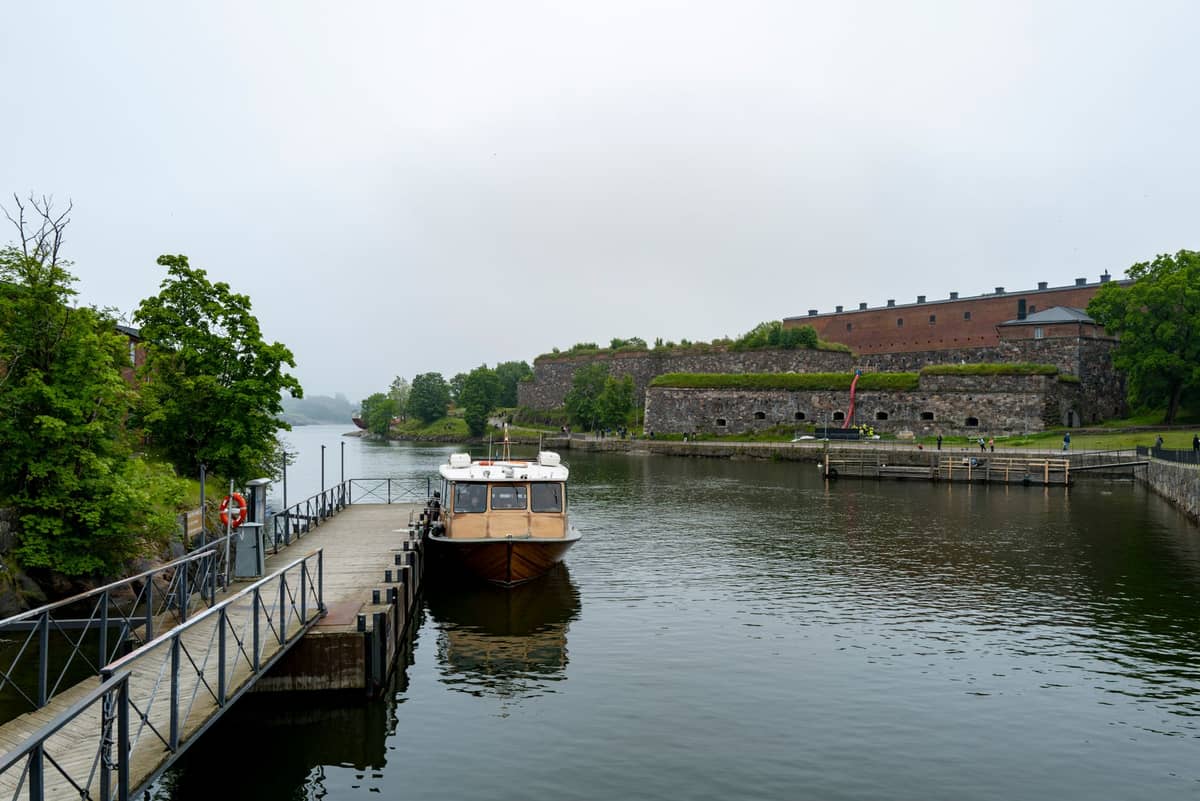
The core loop above takes 3-4 hours at a relaxed pace. If you have a full day, there are several worthwhile extensions. The most significant is a ferry to Suomenlinna sea fortress, a UNESCO World Heritage Site on an island about 15 minutes by ferry from the Market Square. This adds at least 2-3 hours and should be treated as a half-day trip in itself rather than a quick detour.
Closer to the main route, Temppeliaukio Church (the Rock Church) is a 20-minute walk northwest of the railway station. It charges an entry fee and can get busy with tour groups mid-morning. Go before 10:00 or after 15:00 to avoid the worst of the crowds. Worth it for the architecture alone: a Lutheran church excavated directly into a granite outcrop, completed in 1969.
For design and architecture, the Design District south and southwest of Esplanadi covers over 25 streets and is best explored on foot. This is not a single street or mall but a mapped cluster of design studios, galleries, and independent shops. Pick up the free Design District map from the tourist information office at Aleksanterinkatu 24 (open Mon-Sun 9:00-16:00).
Practical Logistics: Timing, Footwear, and Weather
Helsinki sits at about 60.17 degrees north, which has real implications for walking tours. In summer (June to August), daylight runs well past 22:00 near the solstice, so you can start a walking tour at 18:00 and still have hours of bright light. In winter, you are looking at around 6 hours of usable daylight, meaning start times before 10:00 matter.
The terrain is mostly flat granite and paved streets. Standard walking shoes work fine in summer. From November through March, ice is a genuine hazard on cobblestones, particularly around Senate Square and the Market Square waterfront. Shoes with grip matter more than you might expect. The Senate Square approach from the waterfront involves a wide staircase that can become extremely slippery after freezing rain.
Temperature swings are significant across seasons: July averages around 17-18°C, while February averages around -4 to -6°C. Dressing in layers is standard practice. For a detailed seasonal breakdown including what to expect month by month, the Helsinki weather guide covers this in depth.
⚠️ What to skip
Helsinki Cathedral and Uspenski Cathedral both close for religious services without prior notice. Do not build your schedule around a specific entry time without checking the official cathedral websites on the day. Uspenski is closed entirely on Mondays.
- Start the route by 9:30 if you want to hit the Market Square at peak activity
- Carry a reusable water bottle: tap water in Helsinki is safe to drink and available free in many public buildings including Oodi Library
- Trams 2 and 3 run useful cross-city routes through central Helsinki and can help you get back to your starting point after visiting Katajanokka (check current routes, as they no longer form a single continuous circular loop).
- The HSL single ticket covers all tram, metro, and bus travel within the city zone; buy through the HSL app or at ticket machines to avoid surcharges
- Public toilets are available inside Oodi Library, the Old Market Hall, and the Central Railway Station (the station charges a small fee, currently a little over €1).
Using Apps and Maps vs. Walking Independently
Several commercial platforms offer Helsinki walking tour routes through their apps, including gamified or audio-guided versions. These can add context and structure, particularly if you prefer narrated history at each stop. They typically charge between 5 and 15 euros per route. If you are on a budget or simply want flexibility, a downloaded offline map (Google Maps, Maps.me, or the official Helsinki map available via MyHelsinki) is entirely sufficient.
The tourist information office at Aleksanterinkatu 24 stocks free printed maps including an English-language version of the official Helsinki city map. This is worth picking up as a backup even if you are navigating by phone. For travelers who want to combine walking with broader trip planning, the 2-day Helsinki itinerary integrates this walking route into a full visit structure.
✨ Pro tip
Download your offline map before leaving your accommodation. Helsinki's city centre has good mobile coverage, but Suomenlinna island and some parks have patchy data. An offline map also saves battery by reducing constant data syncing.
Honest Assessment: What the Walking Tour Does Not Cover

The classic central Helsinki walking loop is weighted toward neoclassical landmarks and the waterfront. This reflects the city's political and commercial history, but it underrepresents the neighborhoods where Helsinki actually lives day to day. Kallio, the inner-city district north of the centre, has a completely different character: denser housing, a younger population, and better independent restaurant options per square metre. It is not on the classic tourist route, but it is a 20-minute walk from Senate Square.
Similarly, the walking route focuses on architecture and public spaces rather than Helsinki's museum scene. The city has several excellent museums within or near the route, including Kiasma Museum of Contemporary Art near Oodi and the Ateneum Art Museum opposite the railway station. Both charge entry fees and each warrants a separate visit rather than a rushed 20-minute stop between landmarks.
If outdoor swimming or sauna is part of your Helsinki visit, neither fits neatly into a walking tour itinerary. The Löyly sauna on the southern waterfront is a 30-minute walk or short tram ride from the Market Square, and it requires advance booking. Plan it as a separate activity, ideally in the evening.
FAQ
How long does a self-guided walking tour of Helsinki take?
The core route covering the Central Railway Station, Oodi Library, Esplanadi, Market Square, Senate Square, Helsinki Cathedral, and Uspenski Cathedral takes around 3 to 4 hours at a relaxed pace, including short stops inside each attraction. Adding Temppeliaukio Church extends this by about an hour. A full day allows you to add the Design District or take the ferry to Suomenlinna.
Is the self-guided walking tour of Helsinki free?
Walking the route on public streets and squares is free. Helsinki Cathedral usually charges an admission fee for most adult visitors during standard visiting hours, and Uspenski Cathedral may also apply a modest entrance fee; check current details before you go. The Old Market Hall and Oodi Library are free. Temppeliaukio Church charges an entry fee. Commercial app-based audio tour guides typically charge 5 to 15 euros. The Suomenlinna ferry charges a regular HSL fare.
What is the best time of year for a walking tour of Helsinki?
June to August gives the best weather and longest daylight hours, with temperatures typically between 18 and 25 degrees Celsius. Late May and early September offer similar conditions with fewer visitors. Winter walking tours are possible but require warm layers, grippy footwear for icy cobblestones, and adjusted expectations around daylight hours, which drop to around 6 hours in December and January.
Can I do the Helsinki walking tour without a guide or app?
Yes. The route is entirely navigable using any standard map app or the free printed Helsinki city map available at the tourist information office at Aleksanterinkatu 24. All major stops are clearly signed in both Finnish and English. A commercial audio guide adds historical context but is not necessary to complete the route.
Is Helsinki's city centre walkable for people with mobility limitations?
Most of the central route is on flat, paved surfaces and is generally accessible. Senate Square involves a broad staircase from the waterfront side; there are alternative level approaches. Uspenski Cathedral has steps at the entrance. Helsinki trams and the metro are accessible alternatives for covering longer sections of the route.