Temppeliaukio Church: Inside Helsinki's Extraordinary Rock Church
Temppeliaukio Church, known as the Rock Church, is a Lutheran church excavated directly into a granite outcrop in the Töölö neighborhood. Its circular interior, raw stone walls, and copper-ribbed dome create an acoustic and visual experience unlike any other church in Northern Europe. Here is everything you need to decide whether it belongs on your Helsinki itinerary.
Quick Facts
- Location
- Lutherinkatu 3, 00100 Helsinki (Töölö neighborhood)
- Getting There
- Trams 1 and 2 stop nearby; approx. 15-min walk from Helsinki Central Railway Station
- Time Needed
- 30–60 minutes
- Cost
- €8 for adults (18+); under-18 free; some city-card holders free or discounted
- Best for
- Architecture lovers, classical music fans, photography, quiet contemplation
- Official website
- www.temppeliaukionkirkko.fi/en
What Makes This Church Different
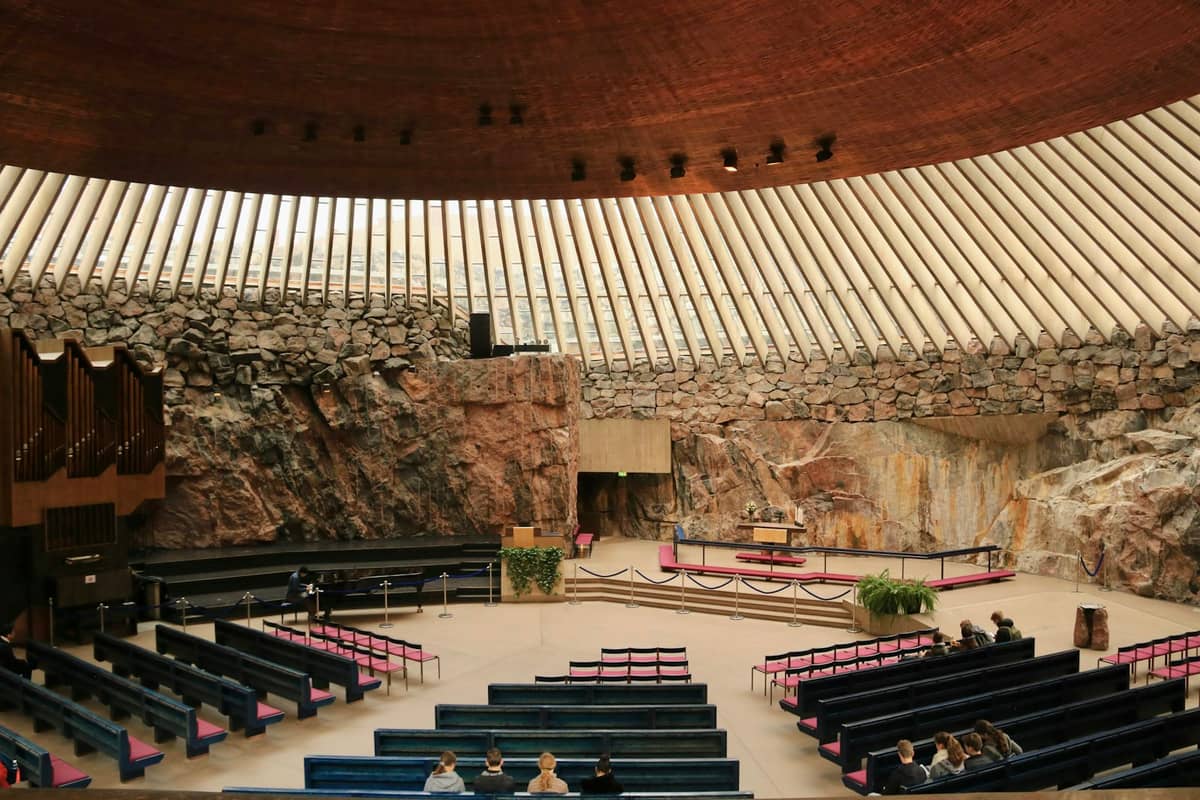
Temppeliaukio Church is not a church that happens to be made of stone. It is a church carved into a living granite hill, with the rough-hewn rock left entirely exposed as the interior wall. Stand in the center of the circular nave and look around: instead of painted plaster or tile, you face several meters of raw, irregular bedrock rising to meet a rim of skylights and a massive copper-ribbed dome. There is no other religious building in Helsinki, and arguably in all of Scandinavia, that achieves anything quite like this.
The church is officially known as Temppeliaukion kirkko in Finnish, Lutherska Klippkyrkan in Swedish, and is a functioning Lutheran parish church operated by the Evangelical Lutheran Church of Finland. It is not a monument or a museum. Services are held regularly, and the building closes to sightseeing during worship, weddings, and funerals. That dual identity, sacred space and architectural attraction, shapes the entire visitor experience.
💡 Local tip
Check the official weekly timetable at temppeliaukionkirkko.fi before you visit. The church closes during services and ceremonies even within standard opening hours, and closures are not always predictable. Arriving to find the doors shut is one of the most common disappointments visitors report.
The Architecture: How a Rock Becomes a Church
The building was designed by brothers Timo and Tuomo Suomalainen and completed in 1969 after decades of earlier proposals and false starts. The site, a natural rocky knoll in the Töölö district, had been earmarked for a church since the 1930s, but war, budget constraints, and architectural disagreements delayed construction repeatedly. The Suomalainen brothers won a competition in 1961 with a solution that embraced rather than removed the granite: blast the interior cavity, leave the walls rough, and cover the opening with a domed skylight supported by copper strips.
The dome itself consists of 180 copper strips radiating outward like the ribs of an enormous inverted bowl. A continuous band of skylights runs along the base of the dome, filling the space with diffuse natural light that changes significantly with the season and time of day. In summer, the light is bright and almost warm. In winter, the low Nordic sun catches the copper and casts a softer, amber-tinged glow across the stone. Neither version is unimpressive, but they are genuinely different experiences.
The acoustics that result from the curved stone walls and domed ceiling are exceptional. Temppeliaukio Church is a regular venue for organ recitals and chamber concerts, and the sound behavior inside is the reason. The reverb time is long and even, the kind that makes unaccompanied voices sound three times their size. If you happen to be inside during a rehearsal or a concert, that acoustic quality becomes the most memorable thing about the building.
Tickets & tours
Hand-picked options from our booking partner. Prices are indicative; availability and final rates are confirmed when you complete your booking.
Helsinki Beautiful Canal Route, archipelago cruise
From 26 €Instant confirmationFree cancellationHelsinki Panorama Sightseeing Bus Tour With Audio Guide
From 35 €Instant confirmationFree cancellationHelsinki Pasila Street art district tour with a local
From 99 €Instant confirmationFree cancellationSurvival suit floating experience
From 125 €Instant confirmationFree cancellation
What You See and Hear Inside
Entering from Lutherinkatu, you descend a short ramp and pass through a low anteroom before the space opens up. The transition is deliberate and effective: the compressed entrance makes the circular nave feel expansive by contrast. The floor is smooth concrete, the pews are simple Finnish wood, and the altar arrangement is modest by the standards of 19th-century Helsinki churches. The emphasis is entirely on the space itself.
The rough granite wall is the first thing most visitors photograph. Up close, the texture is uneven and varied, with cracks and striations visible in detail. In places the stone is dark grey and almost wet-looking; in others it shifts to a warmer brown. Small amounts of water sometimes seep through the rock face during heavy rain, which the designers accounted for with drainage channels at the base. The smell inside is faintly mineral, especially after rainfall.
A gallery runs around the upper perimeter, accessible only by stairs. From that level you can look down into the nave and appreciate the full geometry of the space: the circle of pews, the central aisle leading to the altar, and the way the copper dome sits above everything like a lens focusing light downward. The gallery is not accessible by elevator, which is worth knowing if mobility is a consideration.
ℹ️ Good to know
The main entrance and church hall are fully accessible for wheelchairs, strollers, and walkers. The upper gallery is stairs-only with no elevator access.
When to Visit and How the Experience Shifts
Midmorning on a weekday, particularly Tuesday through Thursday, is consistently the quietest window. By mid-morning, overnight tour groups have cleared out and the midday rush has not yet arrived. The light at that hour is steady and diffuse through the skylights, which gives the stone walls their best visual quality. Saturdays and Sundays see significantly more visitors, and the church also has more service-related closures on those days.
Summer brings the highest visitor numbers, with queues forming outside on busy days. Winter is quieter, and the low angle of the sun creates an entirely different light atmosphere inside. If you visit in December or January, go mid-afternoon when what little daylight exists comes through at a low angle across the copper dome. The effect is genuinely unlike anything the summer version offers.
The church is open every day of the year, but the weekly timetable shifts to accommodate services. As a rough guide, the visiting windows on weekdays are typically in the late morning to late afternoon, often around 09:00–17:00, with Saturday split around a mid-afternoon gap and Sunday mornings closed during the main service. Because these times change with church programming, always verify the current schedule on the official website before planning your arrival.
⚠️ What to skip
Visiting hours on Saturdays and Sundays are reduced to accommodate regular services. Sunday mornings in particular often have a closure of two or more hours. Do not assume standard weekday hours apply on weekends.
Getting There and Practical Logistics
Temppeliaukio Church sits in the Töölö neighborhood, one of Helsinki's most architecturally consistent residential districts. The address is Lutherinkatu 3. From Helsinki Central Railway Station, the walk takes around 15 minutes through central streets. Trams 1, 2, and 8 all stop within a short walk of the church. The area is flat, well-paved, and straightforward to navigate on foot.
The entrance fee is €8 for adults (18 and over) as of mid-2026. Visitors under 18 enter free. Holders of some city passes and museum cards may receive free or discounted entry; check the conditions of your specific pass before assuming it applies. Tickets are purchased at the entrance or can be bought in advance online.
If you are planning multiple paid attractions in Helsinki, it is worth calculating whether the Helsinki Card covers Temppeliaukio Church among its included sites, as entry savings can add up across a multi-day visit.
Honest Assessment: Is It Worth Your Time?
For anyone with a genuine interest in 20th-century architecture or the relationship between built space and natural landscape, Temppeliaukio Church is a compelling 45 minutes. The execution of the concept is precise: the building does exactly what it sets out to do, and the fact that it continues to function as an active parish church rather than becoming a purely touristic exhibit gives it a dimension that many architectural showpieces lack.
That said, visitors who are primarily drawn by curiosity about the Rock Church as a curiosity rather than as architecture may find the interior underwhelming. The space is not large. There is not much to explore beyond the nave and gallery. If you are working through a long list of Helsinki attractions in limited time, it competes directly with the outdoor harbor, the islands, and the city's larger museums for priority.
Temppeliaukio Church pairs naturally with other Töölö sights. The Sibelius Monument is about a 20-minute walk north through Töölö, and Finlandia Hall is a short walk southeast toward Töölönlahti Bay. A half-day loop through this part of the city can combine all three without significant backtracking.
Travelers interested in a broader picture of Helsinki's architectural and cultural identity will find Helsinki's best museums offer useful context for how the city's built environment developed across the 20th century.
Insider Tips
- If there is an organ concert scheduled during your visit window, try to time your arrival for the final 10 minutes. You can often hear the music from the anteroom even if the nave is officially closed to sightseeing during the performance, and the acoustic effect carries through the stone walls noticeably.
- The exterior of the church is buried almost entirely in the rock hill and easy to miss from street level. Look for the low copper dome rising above the surrounding granite outcrop rather than searching for a conventional church facade.
- Photography inside is allowed and the light is generally good for wide-angle shots of the dome. For the best stone-wall texture shots, a position near the altar looking back toward the entrance maximizes the depth of the rough rock face in the frame.
- The surrounding rock hill has a small open-air space at the top that offers an elevated view toward Töölö and the city. It takes less than two minutes to walk up from the entrance level and is often completely empty.
- Visiting in winter can actually be quieter and more atmospheric than summer, when tour-group traffic is at its peak. If you are traveling between November and February, the trade-off of fewer crowds for shorter visiting windows is usually worthwhile.
Who Is Temppeliaukio Church (Rock Church) For?
- Architecture and design travelers who appreciate 20th-century Modernist buildings
- Classical music fans, particularly those interested in exceptional concert acoustics
- Photographers looking for natural light and raw texture inside a built space
- Visitors wanting a quiet, contemplative space away from the busier waterfront attractions
- Travelers on a short Helsinki itinerary who can combine it with a Töölö neighborhood walk
Nearby Attractions
Other things to see while in Töölö:
- Finlandia Hall
Finlandia Hall is Helsinki's most architecturally significant congress and concert venue, designed by Alvar Aalto and completed on the western shore of Töölönlahti Bay. Whether you come for the permanent Aalto exhibition, a concert evening, or simply to study the building's striking white marble facade up close, the hall sits at the intersection of Finnish cultural identity and modernist design.
- Finnish National Opera and Ballet
The Finnish National Opera and Ballet, known locally as Kansallisooppera ja -baletti, is Finland's foremost performing arts institution, occupying a purpose-built house on the edge of Töölönlahti Bay. Whether you are new to opera or a longtime ballet devotee, the venue delivers a polished, accessible experience at the heart of Helsinki's cultural calendar.
- Helsinki Central Library Oodi
Opened on 5 December 2018, Helsinki Central Library Oodi is a landmark public building at Kansalaistori Square, steps from the Central Railway Station. It combines a working library with makerspaces, a cinema, a rooftop terrace, and a cafe, all free to enter. The architecture alone justifies a visit, but the building earns its reputation by being genuinely useful.
- Helsinki Olympic Stadium
Built for the 1952 Summer Olympics, the Helsinki Olympic Stadium in Töölö is Finland's most storied sports venue. Visitors can climb its landmark tower for sweeping city views, tour the TAHTO Sports Museum, and walk the same track that once hosted the world's greatest athletes.