Sibelius Monument: Helsinki's Most Distinctive Outdoor Sculpture
Unveiled in 1967 in Töölö's Sibelius Park, this 24-tonne wave of over 600 stainless-steel pipes is one of the most photographed public artworks in Finland. Entry is free, access is around the clock, and the experience changes substantially depending on when you arrive.
Quick Facts
- Location
- Sibeliuksen puisto, Töölö, 00250 Helsinki
- Getting There
- Tram 2 or 4 toward Töölö, then 5–10 min walk
- Time Needed
- 20–45 minutes
- Cost
- Free, no ticket required
- Best for
- Architecture fans, photography, a short park walk
What the Sibelius Monument Actually Is
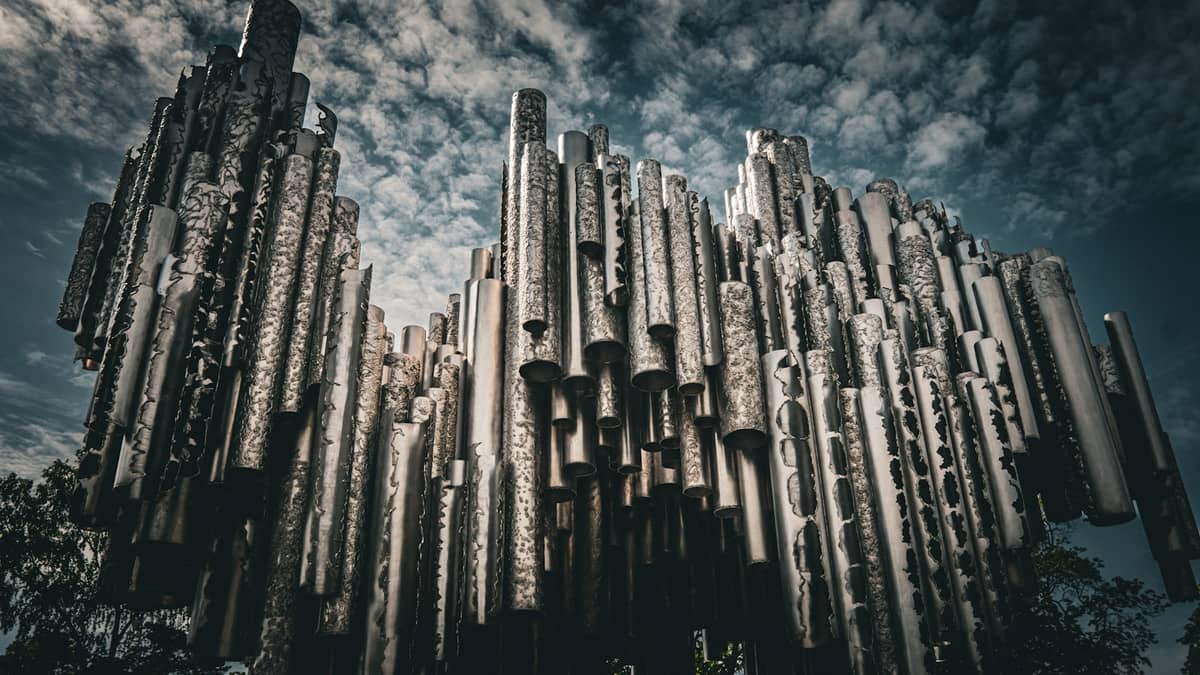
The Sibelius Monument is a large outdoor sculpture in Sibelius Park (Sibeliuksen puisto) in the Töölö district of Helsinki, dedicated to Finnish composer Jean Sibelius. Designed by sculptor Eila Hiltunen and unveiled on 7 September 1967, it consists of more than 600 hollow, acid-resistant stainless-steel pipes welded together into a sweeping, organ-like form. The structure stands approximately 8.5 metres tall, extends 10.5 metres in length and 6.5 metres in depth, and weighs around 24 tonnes.
This is not a conventional figurative statue. There is no stone pedestal, no bronze bust. The pipes cluster and swell like a wave frozen mid-motion, catching and diffusing light in ways that shift noticeably across the day. A secondary element, a relief portrait of Sibelius cast in steel, is mounted to a nearby rock face within the same park area, offering a more traditional counterpoint to the abstract main work.
ℹ️ Good to know
The monument is part of Helsinki's public art collection, managed by HAM Helsinki Art Museum. It is free to visit, accessible 24 hours a day, every day of the year, with no gates or seasonal closures.
A Short History of a Contested Commission
Eila Hiltunen won the commission after a lengthy competition process that began in the late 1950s. Her abstract design was not universally welcomed. Critics and some of Sibelius's relatives argued that the work failed to represent the composer in a recognizable way, and the debate became a public controversy in Helsinki. The compromise that followed is part of why the site includes both the abstract pipe sculpture and the portrait relief: two very different answers to the question of how to honour a national icon.
Jean Sibelius himself, who died in 1957, never saw the finished monument. His music, particularly works like Finlandia and the Violin Concerto, had already made him the defining figure of Finnish cultural identity in the 20th century. The choice to commemorate him with an abstract, forward-looking sculpture rather than a traditional likeness reflected an ambition to place Finnish public art in dialogue with the international modernist movements of the 1960s. Whether the result succeeds on those terms is still debated.
The monument sits within Töölö, one of Helsinki's most architecturally coherent early 20th-century neighborhoods. If you have time, the Töölönlahti Bay waterfront is a short walk east and makes a natural extension to the visit.
Tickets & tours
Hand-picked options from our booking partner. Prices are indicative; availability and final rates are confirmed when you complete your booking.
Helsinki Beautiful Canal Route, archipelago cruise
From 26 €Instant confirmationFree cancellationHelsinki Panorama Sightseeing Bus Tour With Audio Guide
From 35 €Instant confirmationFree cancellationHelsinki Pasila Street art district tour with a local
From 99 €Instant confirmationFree cancellationSurvival suit floating experience
From 125 €Instant confirmationFree cancellation
What It Feels Like to Visit
Arriving at Sibelius Park from the tram stop, you walk through a fairly ordinary residential street before the trees open out into parkland. The sculpture appears suddenly, larger than most visitors expect. The pipes are not polished mirror-bright but carry a matte, slightly weathered finish that makes them read as warm silver in morning light and closer to grey-white under overcast skies. Up close, the scale is genuinely impressive: the tallest cluster of pipes rises well above head height, and standing underneath the structure gives a strong sense of mass and depth.
The surface of the pipes is surprisingly tactile. Many visitors touch them, running fingers along the welds and across the slightly irregular curves. On still days you may hear a faint, low resonance if wind moves through the hollow tubes, which is part of what makes the organ-pipe analogy feel apt rather than just descriptive. The surrounding park is quiet and well-maintained, with grass and birch trees, benches nearby, and clear sightlines to the water in the background during summer.
What the monument does not have is narrative infrastructure. There are no audio guides, no admission desk, no shop. A small information panel explains the basic facts. This is entirely a standalone encounter with the object itself, which some visitors find refreshing and others find underwhelming. If you need context to engage with abstract public art, it is worth reading about Hiltunen and the commission before you arrive rather than after.
How the Experience Changes by Time of Day and Season
Early morning, particularly on weekdays, is when the park is closest to empty. The low-angle light of a Helsinki morning, especially in spring or autumn, catches the pipe surfaces at an oblique angle that produces strong contrasts between light and shadow across the welded ridges. This is the best light for photography. By mid-morning on summer weekends, tour groups begin arriving in waves, and the area immediately around the sculpture can feel congested for 15 to 20 minutes at a stretch.
In winter, the monument in snow is a different visual proposition entirely. The steel reads colder, more industrial, and the white park around it strips away the softening effect of foliage. Visitor numbers drop sharply, and the experience becomes much more solitary. Temperatures in Helsinki from December through February average around minus 5°C, so dress accordingly if you plan a winter visit.
Summer evenings are worth considering. Helsinki's long midsummer days mean meaningful light persists well into the evening, and the park stays open to walkers and cyclists long after conventional sightseeing hours. The evening light, coming from a low angle in the northwest, is particularly good for the pipe sculpture.
💡 Local tip
For photography: arrive before 9am on a clear day, or after 6pm in summer. Midday produces flat, uninspiring results on the steel surface. Shooting from slightly below the main cluster looking upward emphasizes scale effectively.
Getting There and Getting Around
Trams 2 and 4 serve the Töölö area from central Helsinki. From the tram stop, the walk to the park takes roughly 5 to 10 minutes depending on the exact stop used. The park itself has paved paths and is described as wheelchair accessible, with no significant inclines or obstacles between the street entrance and the monument. Strollers move through without difficulty.
The monument is manageable as a standalone stop, but it works best as part of a longer circuit through Töölö. The Finlandia Hall by Alvar Aalto is about 15 minutes on foot to the southeast, and combining both gives you a coherent look at mid-20th-century Finnish design ambition in a single morning. For a fuller picture of the city's public sculpture collection, Helsinki Art Museum HAM near Tennispalatsi holds the indoor collection.
If you are planning a full day in the area, the Helsinki Olympic Stadium is within reasonable walking distance to the north, and its observation tower offers city views. For guidance on structuring a Helsinki day around free attractions, the free things to do in Helsinki guide covers the options well.
Is It Worth Your Time? An Honest Assessment
The Sibelius Monument is a genuinely unusual object and it photographs well. It is also free, takes fewer than 30 minutes to see properly, and is set in a pleasant park close to other things worth visiting in Töölö. For those reasons, it is an easy addition to a day in this part of the city.
The caveat is that its reputation sometimes outpaces the actual experience. For visitors who are not deeply interested in 20th-century public sculpture or the biography of Sibelius, the monument can feel like a brief pause rather than a destination. There is no immersive context, no performance, no narrative. You look at the pipes, you photograph them, you move on. That is fine if your expectations are calibrated accordingly.
Those who will be least satisfied are visitors expecting a conventional monument with a clear visual connection to its subject, and those who find abstract public art requires more interpretive scaffolding than a single panel provides. If that describes you, the park itself is still a pleasant green space, but the sculpture may not resonate.
⚠️ What to skip
There are toilets, but no cafés or visitor facilities within Sibelius Park itself. Plan accordingly if you are visiting with children or making it a longer stop. Plan accordingly if you are visiting with children or making it a longer stop.
Insider Tips
- Stand directly underneath the main pipe cluster and look up: the convergence of the welded forms is the most dramatic viewpoint in the sculpture and is easy to miss if you only circle it from the outside.
- The portrait relief of Sibelius mounted on the nearby rock is a separate element that many visitors overlook entirely. It is worth finding for the contrast it provides with the abstract pipes.
- Visit on a weekday morning to avoid tour group timing. Summer weekends between 10am and 1pm see the most concentrated foot traffic.
- If you are visiting Helsinki in winter, the snow-covered version of the monument is significantly less photographed and more atmospheric than the summer version. Bring warm layers and plan a short visit.
- Tram line 2 runs on a circular route through central Helsinki and Töölö, making it easy to combine the monument visit with a broader tour of the city without backtracking.
Who Is Sibelius Monument For?
- Architecture and design enthusiasts interested in Finnish modernism
- Photographers looking for strong geometric subjects in natural light
- Travelers pairing the visit with a walk around Töölönlahti Bay or Finlandia Hall
- Anyone wanting a meaningful free stop that requires no advance booking
- Visitors with limited mobility who need accessible, flat outdoor sites
Nearby Attractions
Other things to see while in Töölö:
- Finlandia Hall
Finlandia Hall is Helsinki's most architecturally significant congress and concert venue, designed by Alvar Aalto and completed on the western shore of Töölönlahti Bay. Whether you come for the permanent Aalto exhibition, a concert evening, or simply to study the building's striking white marble facade up close, the hall sits at the intersection of Finnish cultural identity and modernist design.
- Finnish National Opera and Ballet
The Finnish National Opera and Ballet, known locally as Kansallisooppera ja -baletti, is Finland's foremost performing arts institution, occupying a purpose-built house on the edge of Töölönlahti Bay. Whether you are new to opera or a longtime ballet devotee, the venue delivers a polished, accessible experience at the heart of Helsinki's cultural calendar.
- Helsinki Central Library Oodi
Opened on 5 December 2018, Helsinki Central Library Oodi is a landmark public building at Kansalaistori Square, steps from the Central Railway Station. It combines a working library with makerspaces, a cinema, a rooftop terrace, and a cafe, all free to enter. The architecture alone justifies a visit, but the building earns its reputation by being genuinely useful.
- Helsinki Olympic Stadium
Built for the 1952 Summer Olympics, the Helsinki Olympic Stadium in Töölö is Finland's most storied sports venue. Visitors can climb its landmark tower for sweeping city views, tour the TAHTO Sports Museum, and walk the same track that once hosted the world's greatest athletes.