Piazza Navona: Rome's Greatest Baroque Square
Piazza Navona sits at the heart of Rome's historic center, occupying the exact footprint of a first-century Roman stadium. Free to enter and open around the clock, it rewards visitors who arrive early in the morning or linger past sunset, when the fountains are lit and the crowds thin.
Quick Facts
- Location
- Centro Storico, Rome (41°53′56″N 12°28′23″E)
- Getting There
- Bus lines 40, 46, 62, 64 to Corso Vittorio Emanuele II; no direct metro stop
- Time Needed
- 45 minutes to 2 hours depending on how long you linger
- Cost
- Free (public open space, accessible 24/7)
- Best for
- Baroque art lovers, evening strollers, families, history enthusiasts
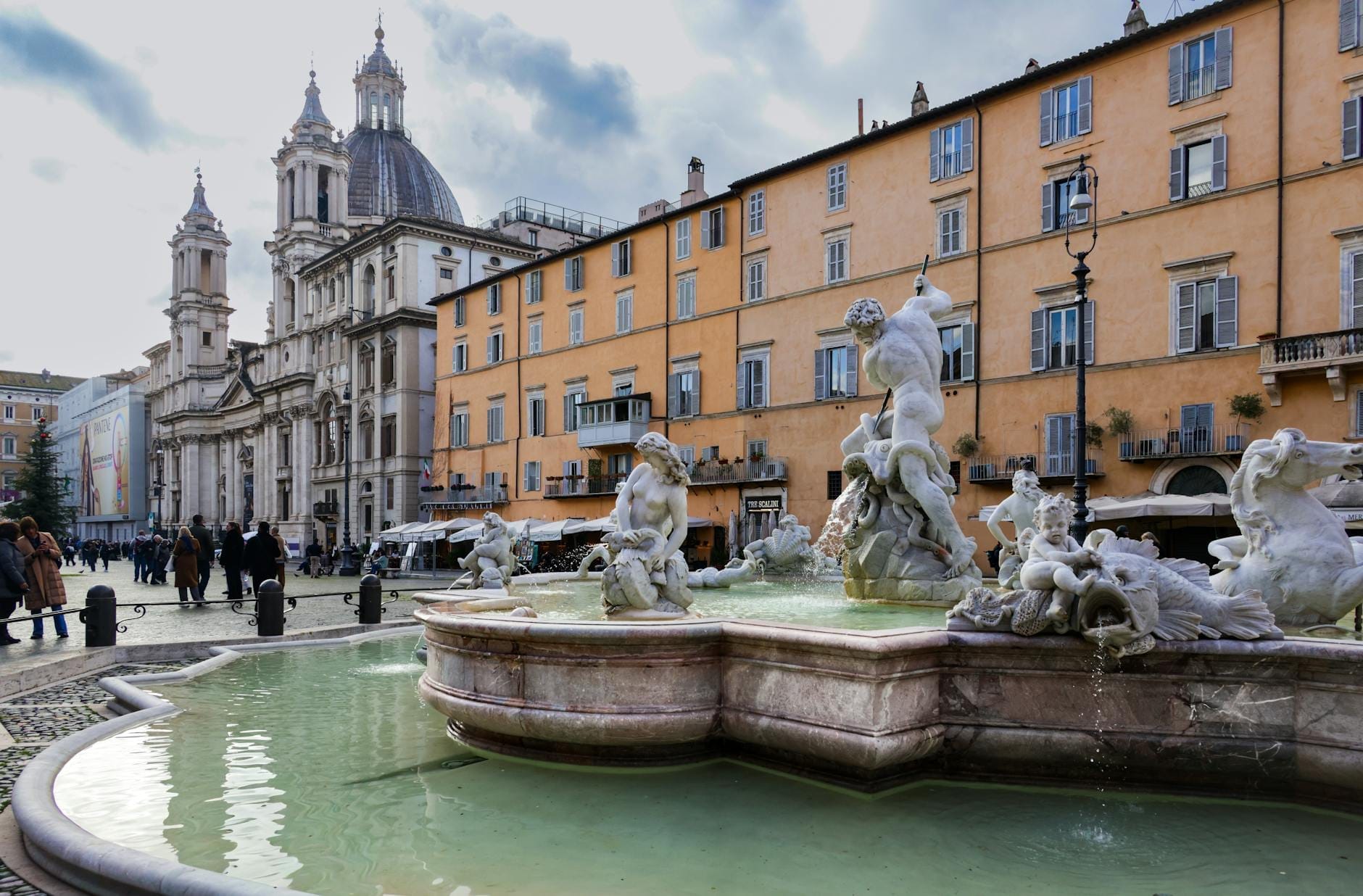
What Piazza Navona Actually Is
Piazza Navona is not just a square. It is a 2,000-year-old Roman stadium that never stopped being used. Emperor Domitian ordered the construction of the Stadium of Domitian in 86 AD to host athletic competitions. The structure held around 30,000 spectators. When the stadium fell out of use, the city grew into it rather than over it: residents built homes against the outer walls, and merchants traded in the central track. By the medieval period, the arena floor had become a market square. The elongated oval you walk through today follows the ancient seating tiers almost exactly.
The name itself traces back to those ancient games. The Latin word Agones referred to the athletic contests held here. Over centuries, the pronunciation shifted: in Agone became Nagone, then Navona. Nothing about the name has anything to do with boats, despite what some vendors might tell you.
ℹ️ Good to know
The square is free to enter and has no closing time. However, it can feel completely different depending on the hour. Early morning visits and late evenings offer the clearest views and the most atmospheric lighting on the fountains.
The Baroque Transformation Under Pope Innocent X
The piazza as it looks today is largely the product of one ambitious pontificate. Pope Innocent X, who held office from 1644 to 1655, decided to remake the square in front of his family palazzo into the most spectacular public space in Rome. He commissioned the Fountain of the Four Rivers, gave his architects a free hand with the church of Sant'Agnese in Agone, and effectively turned what had been a working market into a showpiece of Counter-Reformation grandeur.
The Fontana dei Quattro Fiumi, the great centerpiece fountain, was designed by Gian Lorenzo Bernini and completed between 1647 and 1651. Four colossal marble figures represent the four great rivers of the known world at the time: the Nile, the Ganges, the Danube, and the Rio de la Plata. Each figure is accompanied by regional animals and plants. Above them rises an ancient Egyptian obelisk, which Domitian had originally brought from Egypt and later installed at his Circus on the Appian Way. Bernini placed it here with a papal dove perched at the very top.
The popular story that Bernini designed the Rio de la Plata figure to shield its eyes from the façade of Borromini's church across the square, as a theatrical insult to his rival, is almost certainly invented after the fact. The church was not yet built when Bernini completed the fountain. That said, the rivalry between Bernini and Francesco Borromini was real and bitter. You can read more about the Baroque landscape of the centro storico in the guide to Rome's best churches.
Sant'Agnese in Agone, the concave-façaded church that dominates the western edge of the square, was begun by Carlo and Girolamo Rainaldi and completed by Borromini. The church stands on the site where the Christian martyr Agnes was said to have been exposed and miraculously protected. Its unusual concave frontage creates a sense of depth that makes the building appear larger than it is, a trick of Baroque spatial manipulation that rewards slow looking.
Tickets & tours
Live prices and dates from our booking partner. If you book, we may earn a commission at no extra cost to you.
Semi-private evening walking tour of Rome's piazzas and fountains
From 81 €Instant confirmationFree cancellationRome's underground and piazzas guided walking tour
From 95 €Instant confirmationFree cancellationReserved Entrance Ticket to Rome's Palazzo Altemps
From 30 €Instant confirmationFree cancellationReserved Entrance Ticket to Rome's Palazzo Braschi
From 32 €Instant confirmationFree cancellation
What You Actually See Walking Through the Square
Arriving from the narrow alleys to the north or south, the first thing you notice is scale. The square is around 240 meters long and 65 meters wide, and the surrounding facades are tall enough to create a strong sense of enclosure. The stone underfoot is worn smooth from centuries of foot traffic, slightly uneven in places, and noticeably slick when wet.
Three fountains are arranged along the central axis. The Fontana dei Quattro Fiumi dominates the middle. At the southern end stands the Fontana del Moro, which features a Moor figure wrestling a dolphin, originally commissioned by Pope Gregory XIII in 1574 and later modified by Bernini. At the northern end, the Fontana del Nettuno shows Neptune fighting an octopus, though the figures you see now are 19th-century additions by Antonio Della Bitta and Gregorio Zappala, replacing a simpler basin that stood there for centuries.
The perimeter is lined with restaurant terraces, gelato stands, and artists selling prints and portraits. These are part of the square's character, but also its most commercially aggressive aspect. Expect to be approached if you linger near the outer edges, particularly between midday and early evening.
How the Square Changes Through the Day
At 7:30 in the morning, Piazza Navona is nearly empty. The light comes in low from the east, cutting across the fountain figures and throwing long shadows across the stone. You can hear the water clearly. A few locals cross on their way to work. This is the hour to study the fountains without competition from selfie sticks.
By 11:00, tour groups begin arriving and the terrace cafes open fully. The square reaches peak density between roughly 12:00 and 20:00, when the combination of tourists, street performers, caricature artists, and outdoor diners makes it feel genuinely crowded. Navigating with a stroller or wheelchair during these hours is possible but requires patience.
After 21:00, the atmosphere shifts again. The restaurant lighting reflects off the wet cobblestones, the fountains are illuminated, and the square takes on a quality closer to a stage set than a public space. This is when Piazza Navona is most photogenic, and also when Romans themselves tend to show up for an evening passeggiata.
💡 Local tip
For the best fountain photographs, visit in the hour after sunset when the sky still has color but the artificial lighting is on. Shoot from the narrow end of the square looking lengthwise for a composition that includes all three fountains.
What Lies Beneath: The Stadium of Domitian
The original stadium sits approximately 4.5 to 6 meters below the current street level. Sections of the ancient structure are visible in two places: in the basement of Sant'Agnese in Agone, and beneath a building on the adjacent Piazza di Tor Sanguigna, where a dedicated archaeological site has been established. The Stadium of Domitian underground site offers guided visits to the preserved seating tiers and curved end wall, giving a clear sense of how the original structure determined everything above it. Admission is separate and worth the detour if Roman archaeology interests you.
The curved northern end of the piazza, where the street bends around the semicircular spur, directly follows the curved end of the stadium track. Standing there and looking south along the full length of the square, you are standing in roughly the same position a Roman spectator would have occupied in the upper tiers in the first century. The physical memory of the building has never fully disappeared.
Practical Information for Visiting
Piazza Navona is a public square with no admission charge and no opening hours. There is nothing to book in advance for the square itself. The nearest bus stops are on Corso Vittorio Emanuele II, a five-minute walk to the south, served by multiple lines including 40, 46, 62, and 64. There is no metro station within easy walking distance. Taxis can drop off on the surrounding streets but cannot enter the pedestrianized zone.
The square is in the heart of the Centro Storico, meaning it connects naturally to other major sites. The Pantheon is a 7-minute walk east. Campo de' Fiori is roughly 10 minutes south. If you are planning a full day in this area, the square works well as a starting point or an evening endpoint rather than a destination in its own right.
Eating at the square's terrace restaurants is expensive relative to what you get: expect to pay a premium for location. Better strategy is to use the square as a meeting point or rest stop, then walk one or two streets away for a meal at a fraction of the price. The same applies to coffee: the espresso at a bar two blocks east costs less than half what the piazza terraces charge.
⚠️ What to skip
Pickpocketing is a persistent problem in crowded conditions. Keep bags zipped and in front of you, especially when stopping to photograph the fountains. Organized groups sometimes use distraction techniques near the Fontana dei Quattro Fiumi.
If you are traveling with children, the square works well as a free activity, though be aware that the restaurants and gelato stands will generate requests. For a broader family-oriented itinerary in Rome, see the guide to visiting Rome with kids.
December brings the annual Christmas market to Piazza Navona, a tradition that dates back several centuries. It runs from early December through early January and fills the square with stalls selling toys, sweets, and seasonal food. It is genuinely enjoyable but extremely crowded. For context on planning around Rome's seasonal patterns, the best time to visit Rome guide covers month-by-month conditions.
Insider Tips
- The underground Stadium of Domitian site on Piazza di Tor Sanguigna, immediately adjacent to the north end of the square, is consistently overlooked by visitors who spend 45 minutes at the fountain and leave. It provides essential context for everything above ground.
- Street artists offering to sketch your portrait are operating legally but use aggressive upselling tactics once they start. Agree on the price before they put pencil to paper, or decline clearly from the start.
- The best unobstructed view of the Fontana dei Quattro Fiumi is from the steps of Sant'Agnese in Agone directly opposite. Most visitors stand at the fountain's edge and miss the full elevation of the composition.
- On weekday mornings between 7:00 and 9:00, the square functions as a shortcut for Roman commuters and deliveries. Watching the square in this utilitarian mode, before it converts to tourist space, gives a different and more honest picture of how the city actually uses it.
- The Palazzo Pamphilj on the western side, designed by Girolamo Rainaldi for Pope Innocent X's family, has housed the Brazilian Embassy since 1960. It is not open to the public, but its length and the quality of its facade repay a slow look from across the square.
Who Is Piazza Navona For?
- Architecture and Baroque art enthusiasts wanting to see Bernini and Borromini in the same frame
- Evening walkers who want a well-lit, atmospheric outdoor space with surrounding restaurant options
- Families looking for a free, open space in central Rome where children can move freely
- Photographers, particularly at golden hour or just after sunset when the fountain lighting is active
- History-focused travelers who plan to combine the above-ground square with the underground stadium site
Nearby Attractions
Other things to see while in Centro Storico:
- Ara Pacis
Commissioned in 13 BC to celebrate Augustus's campaigns in Gaul and Spain, the Ara Pacis Augustae is one of the best-preserved monuments of ancient Rome. Today it sits inside a striking modern pavilion on the Tiber's east bank, offering an unusually intimate encounter with imperial-era marble carving at near eye level.
- Campo de' Fiori
Campo de' Fiori is one of Rome's most recognizable piazzas, running a daily produce and flower market Monday through Saturday before reinventing itself as a lively social square after dark. Its paving stones have witnessed public executions, papal power, and centuries of commerce.
- Capitoline Hill
Capitoline Hill sits at the symbolic center of Rome, where Michelangelo's perfectly proportioned piazza crowns a site inhabited since the Bronze Age. Today it holds the world's oldest public museums, Rome's city hall, and some of the most striking views over the Roman Forum in the city.
- Capitoline Museums
Perched atop Capitoline Hill overlooking the Roman Forum, the Musei Capitolini hold some of antiquity's greatest sculptures and paintings across three interconnected palaces. Founded in 1471, they predate the Louvre by more than three centuries and reward visitors with both iconic works and panoramic views that few Rome attractions can match.
Planning a trip? Discover personalized activities with the Nomado app.