Campo de' Fiori: Rome's Market Square With a Dark Past
Campo de' Fiori is one of Rome's most recognizable piazzas, running a daily produce and flower market Monday through Saturday before reinventing itself as a lively social square after dark. Its paving stones have witnessed public executions, papal power, and centuries of commerce.
Quick Facts
- Location
- Piazza Campo de' Fiori, 00186 Rome (Centro Storico)
- Getting There
- Bus stop 'Campo de' Fiori' (lines 46, 62, 64, 70, 916)
- Time Needed
- 45 minutes to 2 hours depending on whether you browse, eat, or join a food tour
- Cost
- Free entry. Optional guided food tours from approx. €45 (2.5 hrs, daily at 11:15 AM or 6:00 PM)
- Best for
- Market browsers, food lovers, history enthusiasts, evening people-watchers
What Campo de' Fiori Actually Is
Campo de' Fiori translates simply as 'Field of Flowers', and the name predates the stone square entirely. Before the 15th century, this was open meadow on the edge of the ancient city. The piazza as it now stands took shape gradually, with its current perimeter defined in 1858. The daily open-air market relocated here from Piazza Navona in 1869 and has operated on the same cobblestones ever since.
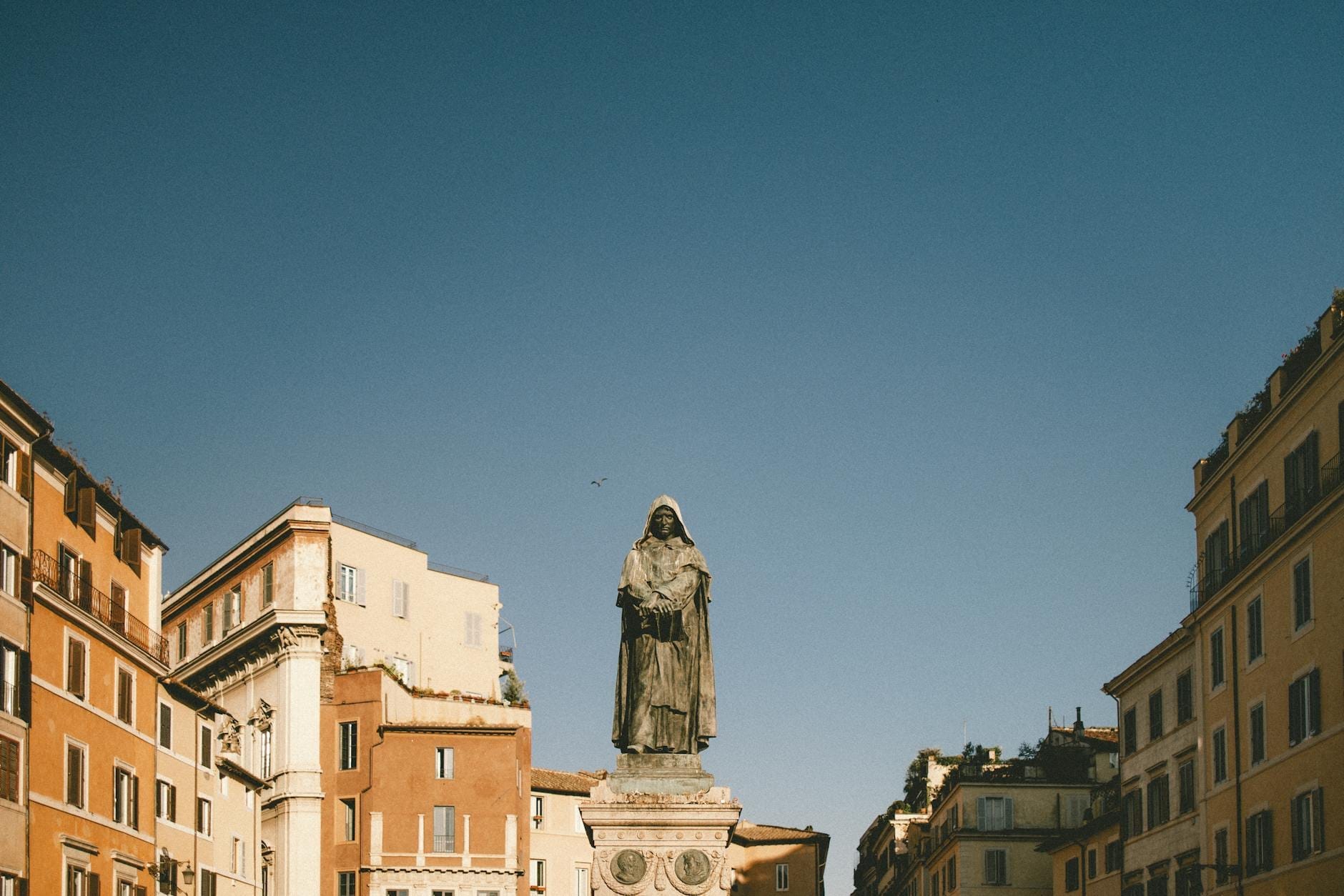
Unlike the Pantheon or the Colosseum, Campo de' Fiori has no ancient Roman ruins and no churches on its perimeter. It is a secular square, which made it unique in papal Rome and also made it a site the Church used for public punishments. The most famous of these was the burning of philosopher Giordano Bruno in 1600, for heresy. His hooded statue stands at the center of the square today, facing toward the Vatican, a deliberate provocation when it was erected in 1889 and still a talking point.
ℹ️ Good to know
Market hours: Monday to Saturday, 7:00 AM to 2:00 PM. Closed Sundays. The square itself is a public space with no admission fee.
The Morning Market: What You'll Find
Arrive before 9:00 AM in spring or summer and the market is already in full swing. Vendors have been setting up since early morning, and the stalls form a dense grid of color across the paving stones: pyramids of blood oranges, bunches of dried chili peppers tied with twine, glossy eggplants, and the namesake flowers in buckets at the perimeter. The smell in the morning combines wet stone, cut herbs, and coffee drifting from the bar at the square's edge.
In fall and winter, the pace shifts. Fewer tourists, more locals doing actual grocery runs. The light is softer, the square less crowded, and vendors are more inclined to chat. The optimal window in cooler months is roughly 10:30 AM to 1:00 PM, when the stalls are fully stocked but not yet packing down.
Beyond produce, you'll find stalls selling dried pasta, local olive oils, fresh-pressed juices, and tourist-oriented goods like branded aprons and dried porcini. The quality skews better toward the produce end than the souvenir end. Prices are not always lower here than in a supermarket, and some vendors near the perimeter quote higher prices to tourists, so watch what the regulars are paying before you commit.
💡 Local tip
Bring cash in small denominations. Most market vendors do not take cards, and the ATMs immediately surrounding the piazza sometimes have queues. Arrive before 11:00 AM for the best selection; stalls begin packing down around 1:30 PM.
Tickets & tours
Live prices and dates from our booking partner. If you book, we may earn a commission at no extra cost to you.
Campo de' Fiori and Trastevere street food walking tour
From 73 €Instant confirmationFree cancellationCampo de' Fiori, Villa Farnesina and Trastevere walking tour
From 149 €Instant confirmationFree cancellationRome food tour in Campo de Fiori, Jewish Ghetto and Trastevere
From 109 €Instant confirmationFree cancellationCampo de' Fiori and Trastevere food tour
From 149 €Instant confirmationFree cancellation
The Giordano Bruno Statue: History You Shouldn't Walk Past
The bronze figure at the center of Campo de' Fiori is easy to overlook when you're distracted by market stalls. It shouldn't be. Bruno was a Dominican friar, philosopher, and cosmological thinker who argued, among other things, that the universe was infinite and that other solar systems existed beyond our own. The Roman Inquisition tried him for eight years before burning him alive on this spot on February 17, 1600.
The statue was placed here in 1889 by Italian freethinkers, partly as an anticlerical statement during a period of tension between the new Italian state and the Vatican. The Vatican expressed displeasure at the time, and Pope John Paul II later expressed regret over Bruno's execution, though the Church has stopped short of formal rehabilitation. Bruno's downward gaze, his face obscured by a hood, gives the statue an unsettling quality that cuts through even a crowded morning market.
Afternoon Lull and the Transition Hour
By 2:30 PM, the vendors are gone and a cleaning crew moves through the square with hoses and brooms. For about an hour, Campo de' Fiori is at its quietest: the stone still damp, the air smelling faintly of discarded greens and citrus peel. This is actually one of the more interesting times to walk through, when the square is between identities and you can read its architecture clearly.
The buildings ringing the square are mostly Renaissance-era palazzi, several of which were owned by the powerful Orsini and Farnese families. The nearby Palazzo Farnese, a short walk south, gives you a sense of the scale of wealth that surrounded this square in the 16th century. The French Embassy occupies it today.
Campo de' Fiori After Dark
By early evening, the restaurants and bars surrounding the piazza pull out their chairs and tables and the square fills with an entirely different crowd. Aperitivo hour brings groups of students, younger tourists, and locals stopping on the way home. The noise level rises considerably. By 9:00 PM on a weekend, Campo de' Fiori is one of the louder spots in central Rome.
The restaurants are generally good but not exceptional for the price. You are paying partly for the location. If you want dinner nearby without the premium, walk two or three blocks toward the Jewish Ghetto or along Via del Pellegrino, where smaller trattorias serve comparable food at noticeably lower prices.
For a broader look at what Rome's evenings offer across different neighborhoods, the Rome at night guide covers the tradeoffs between staying in Campo de' Fiori versus areas like Trastevere or Monti.
⚠️ What to skip
Campo de' Fiori has a well-known pickpocketing problem, particularly at the evening peak. Keep bags zipped and worn across the body. The square is also notably loud at night, which may matter if you're staying nearby.
How to Get There and Getting Around the Neighborhood
Campo de' Fiori sits in the heart of the Centro Storico, where Rome's dense medieval street grid makes it easier to walk than to navigate by transit. The nearest bus stop is 'Vittorio Emanuele / Navona', served by lines 46, 62, 64, and 916. Night buses N5, N15, and N20 also stop nearby, which matters if you're staying out late.
On foot, the square is about five minutes from Piazza Navona and ten minutes from the Pantheon. This positioning makes it a natural midpoint on a Centro Storico walking loop, and most visitors combine it with both.
There is no metro stop within convenient walking distance. Rome's metro network is limited in the historic center by the archaeological constraints of digging in ancient soil, so buses and walking are the practical options here. The square is wheelchair accessible.
Photography and Practical Notes
The market is best photographed in morning light, roughly 8:00 to 10:00 AM, when the stalls are fully loaded, the light is angled and warm, and the square hasn't yet reached peak crowding. The Bruno statue photographs well at dusk, when the light flattens and the surrounding buildings glow amber. Avoid midday in summer: harsh overhead light and high tourist density make both composition and comfort difficult.
If you're planning a focused food and market itinerary, the Rome food guide covers the best places to eat around the Centro Storico and how Campo de' Fiori's market compares to other neighborhood markets in the city.
Who Might Not Enjoy This
If you're visiting on a Sunday, the market is closed and the square is a quiet, largely empty piazza with a statue in the middle. Worth five minutes, not worth a dedicated trip. Travelers specifically seeking ancient Roman history will find nothing architectural here to satisfy that interest. And if you're particularly noise-sensitive or traveling with young children in the evening, the nighttime atmosphere is genuinely loud and alcohol-forward.
Insider Tips
- The best produce stalls are typically toward the center and back of the market grid, not the perimeter stalls facing outward toward tourists. The outer ring is where souvenir pricing tends to creep in.
- Guided food tours departing at 6:00 PM include both the market context and evening tastings at surrounding spots, which is a more efficient way to cover the food scene than eating at the piazza restaurants on your own.
- The streets immediately to the west and south of Campo de' Fiori, particularly Via del Pellegrino and Via dei Cappellari, have a noticeably quieter, more residential character and some of the better-value lunch spots in the neighborhood.
- The Bruno statue's inscription reads, in Italian, 'To Bruno, from the century he predicted, here where the pyre burned.' Standing at the base and reading this in context makes the square feel distinctly different from Rome's many church-adjacent piazzas.
- If you're visiting in the early morning and want coffee, the bars on the square charge a premium for table service. Walk one block in any direction and prices drop significantly.
Who Is Campo de' Fiori For?
- Food travelers who want to shop at a working Italian market rather than photograph it from a distance
- History readers drawn to Inquisition-era Rome and the Bruno story
- Walkers doing a Centro Storico loop who need a natural midpoint between Piazza Navona and the Jewish Ghetto
- Evening social travelers looking for a reliably lively outdoor gathering point
- Photographers working on street and market subjects in morning light
Nearby Attractions
Other things to see while in Centro Storico:
- Ara Pacis
Commissioned in 13 BC to celebrate Augustus's campaigns in Gaul and Spain, the Ara Pacis Augustae is one of the best-preserved monuments of ancient Rome. Today it sits inside a striking modern pavilion on the Tiber's east bank, offering an unusually intimate encounter with imperial-era marble carving at near eye level.
- Capitoline Hill
Capitoline Hill sits at the symbolic center of Rome, where Michelangelo's perfectly proportioned piazza crowns a site inhabited since the Bronze Age. Today it holds the world's oldest public museums, Rome's city hall, and some of the most striking views over the Roman Forum in the city.
- Capitoline Museums
Perched atop Capitoline Hill overlooking the Roman Forum, the Musei Capitolini hold some of antiquity's greatest sculptures and paintings across three interconnected palaces. Founded in 1471, they predate the Louvre by more than three centuries and reward visitors with both iconic works and panoramic views that few Rome attractions can match.
- Fontana dei Quattro Fiumi
The Fontana dei Quattro Fiumi stands at the heart of Piazza Navona, a towering Baroque composition of four river gods, cascading water, and an ancient Egyptian obelisk. Commissioned by Pope Innocent X and completed by Gian Lorenzo Bernini in 1651, it remains one of the most theatrical public sculptures in Europe. Entry is free, and the piazza never closes.
Planning a trip? Discover personalized activities with the Nomado app.