The Pantheon: Rome's Most Perfectly Preserved Ancient Building
The Pantheon stands at the heart of Rome's historic center as the best-preserved major building from antiquity. Originally a Roman temple and now a working church, it draws visitors with its extraordinary domed interior, oculus open to the sky, and a history spanning nearly two millennia.
Quick Facts
- Location
- Piazza della Rotonda, Centro Storico, Rome 00186
- Getting There
- No metro stop nearby; bus routes 40, 64, 70, 492 stop at Largo di Torre Argentina (10-min walk). Taxi or on foot from most central areas.
- Time Needed
- 45 minutes to 1.5 hours
- Cost
- Paid entry (ticket required since July 2023; verify current price at official site). Free on the first Sunday of each month.
- Best for
- Architecture lovers, history enthusiasts, first-time Rome visitors
- Official website
- www.pantheonroma.com/en/home-eng
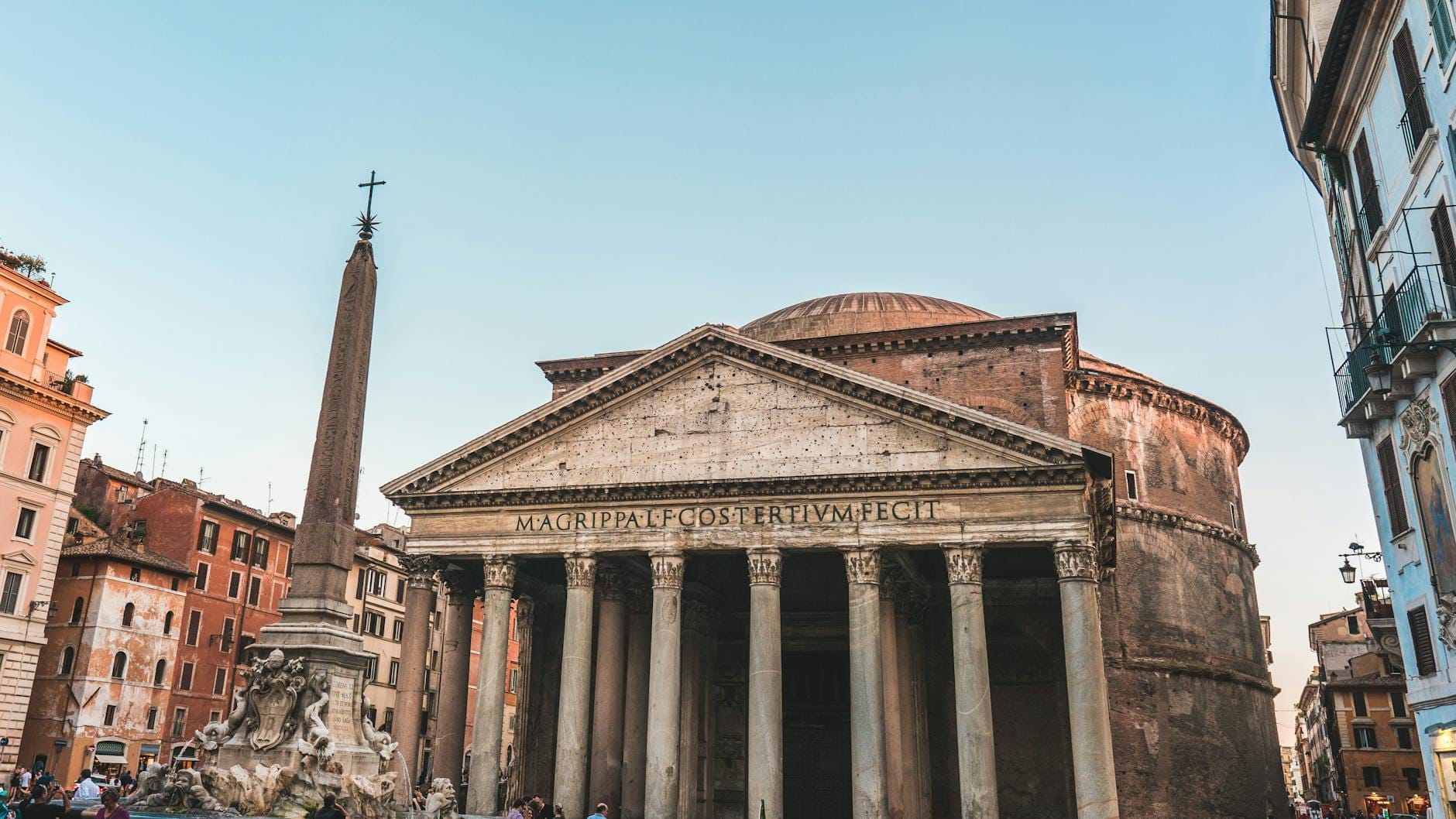
What the Pantheon Actually Is
The Pantheon is not a ruin. That distinction matters more than it might seem. While the Roman Forum crumbles and the Colosseum shows its age in every exposed brick, the Pantheon at Piazza della Rotonda has been in continuous use for nearly 2,000 years. Its dome is intact. Its marble floors are original. The bronze doors at the entrance, each weighing around five tonnes, still swing on ancient pivots. Nothing else from the classical world compares.
Its official name today is the Basilica di Santa Maria ad Martyres, or the Basilica of St. Mary and the Martyrs in English. The building's survival is largely thanks to that conversion: in 609 AD, Pope Boniface IV received the building as a gift from Emperor Phocas and consecrated it as a Christian church. Religious use protected it from the dismantling that destroyed most other ancient Roman structures.
The original temple was commissioned by Marcus Agrippa around 27-25 BC, and the inscription on the facade still reads M·AGRIPPA·L·F·COS·TERTIVM·FECIT, meaning Agrippa, son of Lucius, made this in his third consulship. But the building standing today is not Agrippa's. The current structure was rebuilt by Emperor Hadrian between approximately 118 and 126 AD. Hadrian, unusually modest for an emperor, kept the original inscription rather than replacing it with his own name.
The Dome: Why Architects Still Come to Study It
The dome of the Pantheon is the oldest intact large-span dome in the world and the largest unreinforced concrete dome ever built. It spans 43.3 meters in diameter. Precisely the same distance separates the floor from the top of the oculus. The building fits a perfect sphere inside it, a deliberate mathematical choice that communicates harmony between earth and cosmos.
At the dome's apex is the oculus, an open circular hole 8.7 meters in diameter. There is no glass. Rain falls through it during storms and drains through the slightly convex floor below. On sunny mornings, a shaft of light enters the oculus and sweeps slowly across the coffered ceiling and walls as the earth rotates. Arriving between 9:00 and 10:00 AM on a clear day gives you the best chance of seeing this effect at its most dramatic.
💡 Local tip
If it rains during your visit, don't leave. Watching rain fall through the oculus into the interior of a 2,000-year-old building is an experience unique to the Pantheon. The drainage system manages it quietly.
Roman engineers achieved the dome's strength through a gradual reduction in concrete density toward the top. The base of the dome uses heavy travertine aggregate. By the oculus ring, the mixture shifts to lightweight pumice. The coffered ceiling recesses reduce weight further. No modern reinforcement was used, and the structure has outlasted virtually every building tradition that followed it.
Tickets & tours
Live prices and dates from our booking partner. If you book, we may earn a commission at no extra cost to you.
Pantheon entrance ticket and audio guide
From 15 €Instant confirmationFree cancellationWalking tour with Tiber cruise and Trastevere food tasting
From 45 €Instant confirmationFree cancellationPantheon small group tour with skip-the-line entrance ticket
From 44 €Instant confirmationFree cancellationPantheon entry ticket with downloadable audio guide
From 10 €Instant confirmation
Inside the Pantheon: What You See and How to Read It
Entering through the bronze doors, you pass from the noise of Piazza della Rotonda into a space of startling calm. The interior is circular, about 43 meters across, with a ring of alternating semicircular and rectangular niches around the walls. These once held statues of Roman gods. Today they contain altars, tombs, and religious artwork from the building's centuries as a church.
The floor is the most underappreciated element. It is original Roman marble, laid in a pattern of circles and squares. Stand near the center and look down before you look up. The slight convexity beneath your feet has been draining rainwater through the oculus for nineteen centuries.
The tombs here are significant. Raphael, one of the Renaissance's defining painters, is buried in a wall niche to the left as you enter. His tomb draws quiet pilgrimage from art lovers. Two kings of unified Italy, Vittorio Emanuele II and Umberto I, are also interred here, which explains why you occasionally see a ceremonial guard posted at the entrance.
If you plan to visit other major Roman sites the same day, the Pantheon pairs naturally with nearby Piazza Navona, a ten-minute walk north, or with the Campo de' Fiori market, about eight minutes south. Both are within the same historic center and require no transit.
When to Visit and What to Expect by Time of Day
The Pantheon opens at 9:00 AM and closes at 7:00 PM, with last entry at 6:45 PM. It receives very high visitor numbers throughout the day, and the queue outside Piazza della Rotonda can stretch considerably during peak hours, typically 10:00 AM to 4:00 PM from spring through autumn.
⚠️ What to skip
The Pantheon is free on the first Sunday of every month, which sounds appealing but results in significantly larger crowds than normal paid entry days. Unless your budget requires it, a quieter paid visit is worth the trade-off.
Opening time at 9:00 AM offers the best combination of light, quiet, and manageable crowds. The morning light through the oculus is at its most angled and atmospheric. By 11:00 AM the piazza outside is filling up, and tour groups cycle through in rotation. Midday is the busiest period. Late afternoon, from about 5:00 PM onward, sees crowds thin and the quality of light through the oculus become warmer and more golden, though the light angle is less dramatic than morning.
July and August are the busiest months overall. April, May, September, and October offer better crowd levels and more comfortable temperatures for the walk through the neighborhood afterward. December and January are significantly quieter but the surrounding streets can feel cold and damp.
The Piazza and the Surrounding Neighborhood
Piazza della Rotonda, the square directly in front of the Pantheon, is framed on all sides by cafe tables, tourist kiosks, and the constant movement of people. At its center stands an 18th-century fountain topped by an ancient Egyptian obelisk, itself a layered piece of history. The square is lively at almost any hour. In the mornings, locals pass through on their way to work. By mid-morning the cafe chairs fill up. In the evenings, particularly in warm weather, it becomes a gathering point.
The surrounding streets of the Centro Storico are among the most densely layered in Rome. Medieval lanes run between Renaissance palaces that were themselves built on top of ancient foundations. Within a ten-minute walk you will pass the site of the ancient Baths of Agrippa, the church of Santa Maria sopra Minerva built directly over a temple to Minerva, and multiple papal-era palazzi now occupied by government offices or private collections.
For a broader understanding of Rome's ancient center before or after your visit, the guides on the best museums in Rome and things to do in Rome cover the neighborhood and its nearby sites in more detail.
Practical Information for Your Visit
The Pantheon is open daily from 9:00 AM to 7:00 PM. Last entry is at 6:45 PM. Entry requires a ticket, which became mandatory in July 2023. Tickets can be purchased at the site or through official channels online. The first Sunday of every month offers free entry. Verify current prices at the official website before your trip, as fees are subject to adjustment.
The building is a working church. Mass is celebrated here, and during religious services, tourist access may be paused or restricted. If you arrive during a service, wait outside or return afterward. This is a place of worship alongside being a monument, and it is expected that visitors behave accordingly inside: no loud talking, no flash photography on a tripod, and modest dress covering shoulders and knees.
There is no metro station close to the Pantheon. The nearest metro stops are Spagna (Line A) and Barberini (Line A), each roughly 20 minutes on foot. Bus routes 40, 46, 62, and 64 stop at Largo di Torre Argentina, about a ten-minute walk away. Most visitors in central Rome walk to the Pantheon from wherever they are staying. Taxis can drop off on nearby streets.
ℹ️ Good to know
Photography is permitted inside without a tripod or flash. The oculus provides natural light, so a phone camera performs well in the interior during morning hours. Avoid midday when the light enters more vertically and the space is more crowded.
Accessibility information is listed on the official Pantheon website and through Roma Capitale's accessible tourism resources. The building is at street level with no steps at the main entrance, and the interior floor, while original marble, is relatively even. Contact the site in advance for specific accessibility requirements.
Who Might Not Enjoy the Pantheon
The Pantheon is a relatively small space, and on busy days it fills quickly. If you are uncomfortable in crowds, visiting during peak hours in high season will be genuinely unpleasant. The experience inside takes around 45 minutes for a thorough visit and possibly less if you are not interested in the architectural and historical detail. Travelers expecting a sprawling site with extensive rooms to explore will find it compact.
If you are primarily interested in ancient Roman history through archaeology rather than architecture, the Roman Forum and Colosseum offer a fuller picture of classical Rome, with far more ground to cover.
Insider Tips
- Arrive as close to 9:00 AM as possible on a weekday. The first thirty minutes are noticeably quieter, and the morning light through the oculus is at its most dramatic angle. By 9:45 AM the first tour groups arrive.
- Look up at the dome's coffers carefully: they were originally painted and gilded. What you see now is bare concrete, but the geometry of the 140 individual coffers arranged in five rings was designed to create an illusion of depth and perfect symmetry.
- The Pantheon is a functioning church dedicated to the Virgin Mary and all the Christian martyrs. Attending the Sunday Mass at 10:30 AM (check current schedule) is one way to experience the space in a different register, and it is open to all.
- The Egyptian obelisk in the piazza fountain has its own layered history: carved in ancient Egypt, brought to Rome in antiquity, moved several times across the centuries. It is easy to walk past without noticing what it is.
- Skip the cafes directly on Piazza della Rotonda for coffee. They charge significantly more than bars one or two streets away. Walk one block in any direction for a more reasonable espresso and a less hectic atmosphere.
Who Is Pantheon For?
- First-time visitors to Rome wanting to see the city's single best-preserved ancient building
- Architecture and engineering enthusiasts interested in Roman construction techniques
- Art history travelers, particularly those following Raphael's life and work
- Travelers who prefer compact, self-contained sites rather than large archaeological complexes
- Early risers who can arrive at opening time to experience the building in near-silence
Nearby Attractions
Other things to see while in Centro Storico:
- Ara Pacis
Commissioned in 13 BC to celebrate Augustus's campaigns in Gaul and Spain, the Ara Pacis Augustae is one of the best-preserved monuments of ancient Rome. Today it sits inside a striking modern pavilion on the Tiber's east bank, offering an unusually intimate encounter with imperial-era marble carving at near eye level.
- Campo de' Fiori
Campo de' Fiori is one of Rome's most recognizable piazzas, running a daily produce and flower market Monday through Saturday before reinventing itself as a lively social square after dark. Its paving stones have witnessed public executions, papal power, and centuries of commerce.
- Capitoline Hill
Capitoline Hill sits at the symbolic center of Rome, where Michelangelo's perfectly proportioned piazza crowns a site inhabited since the Bronze Age. Today it holds the world's oldest public museums, Rome's city hall, and some of the most striking views over the Roman Forum in the city.
- Capitoline Museums
Perched atop Capitoline Hill overlooking the Roman Forum, the Musei Capitolini hold some of antiquity's greatest sculptures and paintings across three interconnected palaces. Founded in 1471, they predate the Louvre by more than three centuries and reward visitors with both iconic works and panoramic views that few Rome attractions can match.
Planning a trip? Discover personalized activities with the Nomado app.