Roman Forum: Walking Through the Center of the Ancient World
The Roman Forum was the political, religious, and commercial core of Rome for over a thousand years. Today it is an open-air archaeological site containing temples, basilicas, and triumphal arches that span the entire arc of Roman civilization, from the early Republic to the late Empire.
Quick Facts
- Location
- Rione Campitelli, Rome (between Palatine and Capitoline Hills)
- Getting There
- Metro Line B: Colosseo station (5-min walk)
- Time Needed
- 1.5 to 3 hours, longer if combined with Palatine Hill
- Cost
- Combined ticket with Colosseum and Palatine Hill; book online in advance (prices vary by season, verify at colosseo.it)
- Best for
- History enthusiasts, archaeology lovers, photography, architecture
- Official website
- colosseo.it/en/area/the-roman-forum
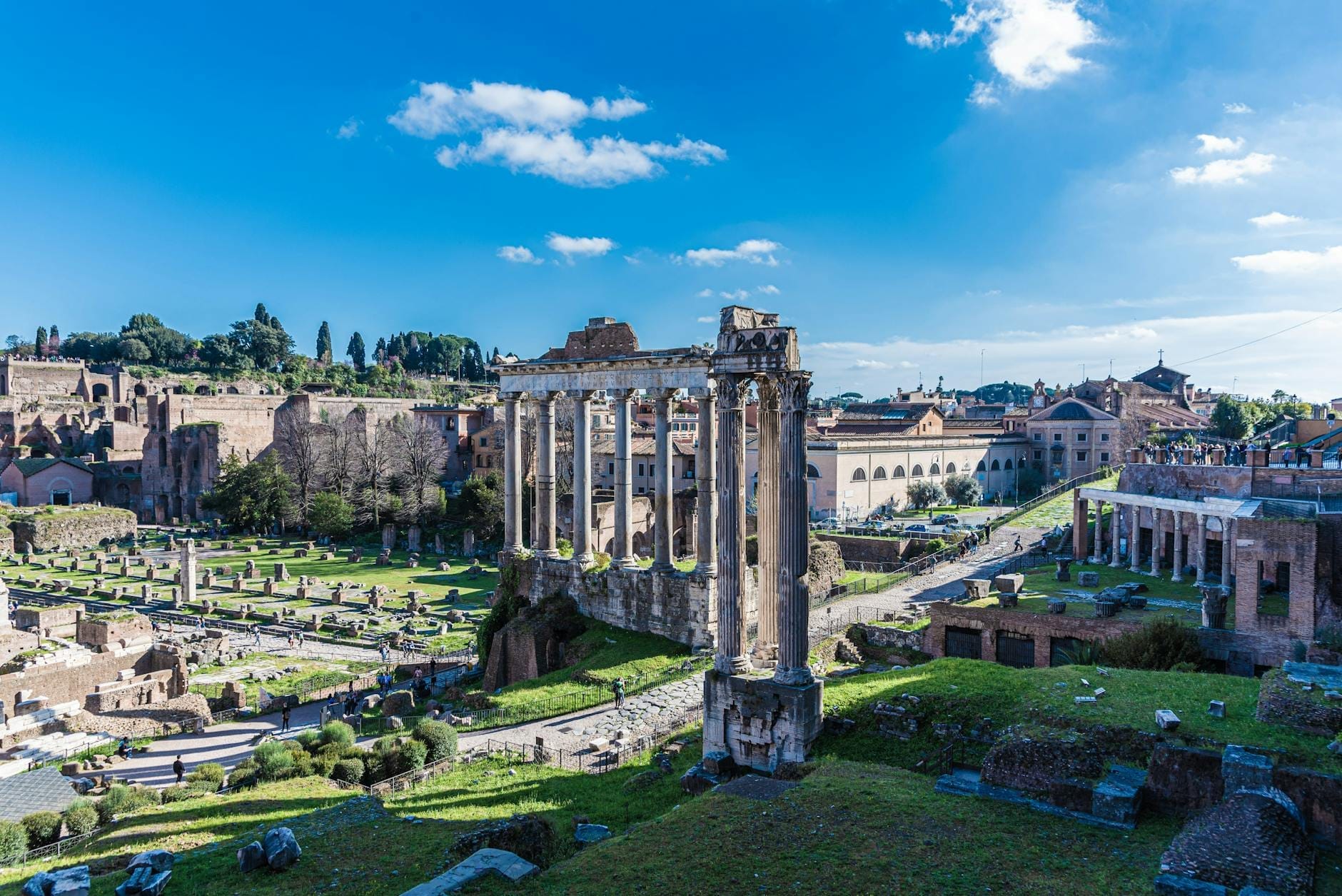
What the Roman Forum Actually Is
The Roman Forum, known in Italian as the Foro Romano and in Latin as the Forum Romanum, is a long rectangular valley sitting between the Palatine and Capitoline Hills in central Rome. For more than a thousand years it served as the city's civic core: the place where laws were debated, elections held, religious rituals performed, triumphs celebrated, and commerce transacted. To stand inside it today is to occupy ground that shaped the entire Western world.
The site was originally a low-lying marsh that was drained in the late 7th century BCE to create usable public space. Over the following centuries it accumulated temples, basilicas, rostra, arches, and shrines until it became one of the most architecturally dense places on earth. What you see now are the layered ruins of all those centuries compressed into a single valley: columns that once held temple roofs, paving stones worn by millions of feet, and foundation walls whose bricks still carry the marks of Roman construction gangs.
💡 Local tip
Tickets for the Forum are sold as part of a combined pass with the Colosseum and Palatine Hill. Buy online in advance at colosseo.it to avoid long queues at the ticket windows, especially in spring and summer.
The Experience: What You See When You Arrive
The most common entry point is on Via Sacra, the ancient Sacred Road that cuts through the length of the Forum from the Arch of Titus at the eastern end toward the Capitoline Hill to the west. As you descend from the street level down into the valley, the first thing you notice is scale. The columns of the Temple of Saturn rise on your left, eight of them still standing after more than two millennia, their Ionic capitals slightly mismatched because they were reassembled from different periods. Ahead, the three white columns of the Temple of Castor and Pollux catch the light differently at almost every hour of the day.
The pavement underfoot is original in places: large, irregular slabs of travertine and basalt worn to a high polish by centuries of foot traffic. In summer, that stone radiates heat by mid-morning, which is worth factoring into your plans. In spring, when the grass along the edges of the site turns green and wildflowers push up between the ruins, the Forum looks closer to a romantic landscape painting than a tourist attraction.
At the western end, the Arch of Septimius Severus dominates the skyline. Built in 203 CE to commemorate the emperor's victories in Mesopotamia and Parthia, it is one of the best-preserved triumphal arches in Rome. The relief panels that cover its faces, though worn, still show Roman soldiers marching captives in procession. Behind it, the Rostra, the great speaker's platform from which Roman orators addressed the crowd, sits low and wide. Julius Caesar was eulogized here. Mark Antony delivered his funeral speech a few steps from where you are standing.
Tickets & tours
Live prices and dates from our booking partner. If you book, we may earn a commission at no extra cost to you.
Key Structures Worth Your Time
Not every ruin in the Forum demands equal attention, and trying to study every plaque in sequence leads to fatigue rather than understanding. A few structures reward close inspection.
- Temple of Saturn (dedicated 497 BCE, rebuilt several times): the eight surviving columns are among the oldest visible Roman architecture in the city. The temple served as Rome's state treasury.
- Temple of Castor and Pollux (dedicated 484 BCE, rebuilt under Tiberius): three Corinthian columns standing at the edge of the Lacus Iuturnae, the sacred spring where the twin gods were said to have watered their horses after the Battle of Lake Regillus.
- Basilica of Maxentius (begun 307-308 CE, completed by Constantine): the largest building in the Forum, its three remaining coffered barrel vaults give the clearest sense of how monumental late-Imperial Roman architecture felt from the inside.
- Arch of Titus (82 CE): located at the eastern entrance, its interior relief panels depict the sack of Jerusalem in 70 CE, including Roman soldiers carrying the seven-branched menorah from the Temple. One of the most historically significant sculptural records from antiquity.
- Temple of Vesta and House of the Vestal Virgins: the circular temple that housed Rome's sacred flame, and the long courtyard residence of the six priestesses responsible for keeping it burning.
If your interest in Roman archaeology runs deep, the Palatine Hill directly above the Forum is included on the same combined ticket and adds crucial context. The hill's imperial palaces look down directly onto the Forum, making the relationship between power and public space physically legible in a way no museum can replicate.
How the Forum Changes Through the Day
The site opens early in the morning and the first hour is consistently the quietest. At that hour the light comes from the east, striking the columns of the Temple of Castor and Pollux head-on and casting long shadows across the Via Sacra paving. The temperature is manageable, there are few crowds, and you can hear birds rather than tour guides. If you are a photographer, this is the window.
By late morning, especially between April and October, the Forum becomes genuinely crowded. Large guided tour groups move in formation along the main paths, and the open stretches of the site can feel congested. The sun, reflecting off pale stone and without much shade, becomes harsh by noon. This is when the experience declines most sharply. Bring water, as there are limited facilities inside the site, and pace yourself.
Late afternoon is the second good window. As the light shifts westward it softens and turns golden, catching the texture of the stone in a way that midday sun flattens completely. Crowds begin to thin from around 4 PM onward. If you visit in late spring or early autumn, this is arguably the best time of day to be inside the Forum.
⚠️ What to skip
July and August midday visits are genuinely uncomfortable. The valley traps heat, shade is almost nonexistent, and the site is at its most crowded. Aim for opening time or the last two hours before closing if visiting in high summer.
Historical and Cultural Context
The Forum did not spring into existence fully formed. Its development tracked Roman history closely. The early Republican Forum was ringed with tabernae, market stalls that were progressively replaced by monumental civic buildings as Rome's wealth and ambitions grew. By the 2nd century BCE, basilicas, those long colonnaded halls used for law courts and business, began to define the Forum's long edges. The basilicas of Aemilia and Julia, both visible today in substantial ruins, date from this period.
Imperial Rome added a different layer. Julius Caesar redesigned parts of the Forum, and Augustus completed his work. Later emperors, from Domitian to Septimius Severus to Constantine, each added or rebuilt structures that announced their power in stone. By the 4th century CE, the Forum was dense with monuments to a degree that was partly decorative and partly self-consciously historical: Rome memorializing Rome.
After the fall of the Western Empire, the Forum was progressively stripped, buried, and built over. Medieval structures were inserted into ancient temples. Marble was burned for lime. The site that Renaissance visitors saw was a field of ruins so buried that it was nicknamed the Campo Vaccino, the cow pasture. Systematic excavation began in the 19th century and has continued intermittently ever since. What you see today is partly ancient, partly 19th-century reconstruction, and partly ongoing archaeological work. Knowing this prevents the common disappointment of expecting a pristine ancient city.
The Forum sits at the geographical and historical heart of the ancient Rome district, surrounded by the Colosseum, Palatine Hill, and Capitoline Hill. Visiting all three in a single day is ambitious but doable if you start early and buy a combined ticket.
Getting There and Getting In
The easiest approach is Metro Line B to Colosseo station. From the station exit you can see the Colosseum immediately; the Forum entrance on Via Sacra is a short walk past the eastern face of the Colosseum. The walk from Termini station takes around 20 to 25 minutes on foot through the Monti neighborhood, which is worth doing at least once for the street-level context it provides.
Access is also possible from the Capitoline Hill side, via the viewpoint at the top of the hill that looks directly down into the Forum. This approach, via Capitoline Hill, gives you the high-level overview before you descend into the site, which many visitors find useful for orientation.
The combined ticket covers the Roman Forum, Palatine Hill, and the Colosseum, and is valid across two consecutive days, which makes it possible to take the Forum at a relaxed pace without trying to see everything in a single session. Audio guides and guided tours can be booked separately and add real depth, particularly for the Basilica of Maxentius and the less-signed sections of the site.
ℹ️ Good to know
The Roman Forum has limited shade and no cafes inside. Fill a water bottle before entering. In summer, a hat and sunscreen are not optional.
Who Should Manage Their Expectations
The Roman Forum is genuinely one of the most historically significant places in Western civilization, but it is not a site that communicates effortlessly. Most of the ruins are low walls, foundation outlines, and column stumps. Without prior reading or a good audio guide, it can feel like an extended walk through rubble with occasional impressive columns. Visitors who expect the visual clarity of, say, the Pantheon or the Colosseum sometimes find it underwhelming.
Travelers who want a wider sense of what Roman antiquity looked like without committing to deep study might find the Colosseum more immediately rewarding, or consider the Baths of Caracalla for well-preserved interiors with far fewer crowds.
Visitors with significant mobility limitations should be aware that the Forum involves uneven ancient paving, some steps, and sloped paths. It is not entirely inaccessible but requires careful navigation. Check the official site at colosseo.it for current accessibility information before visiting.
Insider Tips
- The view from the Tabularium, the ancient records office now incorporated into the Capitoline Museums, looks directly down onto the Forum from above. If you visit the Capitoline Museums on a separate day, this perspective from the galleries reframes everything you saw at ground level.
- The Arch of Titus at the eastern end is frequently bypassed by visitors who enter, head toward the Arch of Septimius Severus, and then retrace their steps. Walk the full length of Via Sacra to the Arch of Titus before doubling back. The interior reliefs are among the most important in Rome and are rarely crowded.
- The combined ticket is valid for one day (check colosseo.it for updates). Use day one for the Forum and Palatine Hill together, and save the Colosseum for day two when you are not already fatigued.
- Early September is a particularly good time to visit. Summer crowds have thinned slightly, the light is excellent in the late afternoon, and the temperature is more bearable than July or August.
- Standing on the Rostra and looking east along the Via Sacra toward the Arch of Titus gives you the same sightline that Roman consuls and emperors had when addressing the crowd. It is one of those moments where the geometry of the ancient city snaps into place.
Who Is Roman Forum For?
- History and classics enthusiasts who want physical contact with Republican and Imperial Roman sites
- Photographers who can visit at opening time or in late afternoon light
- Travelers visiting the Colosseum and Palatine Hill on the same combined ticket
- Those with a background in Roman history who can bring context to the ruins
- Anyone doing a focused ancient Rome day starting at the Forum, continuing to Palatine Hill, and finishing at the Capitoline
Nearby Attractions
Other things to see while in Ancient Rome:
- Appian Way
The Appian Way, or Via Appia Antica, is one of the ancient world's most consequential roads, stretching from Rome's Aurelian Walls into the open Campagna. Built in 312 BCE, it remains walkable today, lined with tombs, pine trees, and broken basalt stones that once carried Roman legions south. Free to enter and car-free on Sundays, it offers a rare escape from the city's tourist core into a landscape that has changed remarkably little in two millennia.
- Baths of Caracalla
The Baths of Caracalla are among the best-preserved and most atmospheric ancient ruins in Rome. Inaugurated in 216 AD, this vast complex once welcomed up to 8,000 visitors a day. Today, the ruins reward anyone willing to look beyond the Colosseum.
- Castel Gandolfo
Perched on a volcanic crater rim 25 km southeast of Rome, the Apostolic Palace of Castel Gandolfo served as the papal summer residence for nearly four centuries. Since Pope Francis opened it to the public in 2016, visitors can tour the baroque interiors, formal gardens, and working farm that once fed the pontiff's household.
- Catacombs of San Callisto
Stretching beneath the Appian Way, the Catacombs of San Callisto served as the official cemetery of Rome's early Christian community from the second century AD. With 10 to 20 kilometers of galleries across four to five levels, the complex holds the Crypt of the Popes, the tomb of Saint Cecilia, and the remains of roughly 500,000 Christians. It is one of the most historically substantial underground sites in the ancient world.
Planning a trip? Discover personalized activities with the Nomado app.