Palatine Hill: Rome's First Address and Imperial Heartland
Rising above the Roman Forum, Palatine Hill is where Rome's founding myths took root and its emperors built their most extravagant palaces. The ruins are vast, the views are extraordinary, and the crowds are noticeably thinner than at the Colosseum next door.
Quick Facts
- Location
- Via di San Gregorio / Via della Salara Vecchia 5/6, Ancient Rome
- Getting There
- Metro Line B – Colosseo station (5-minute walk)
- Time Needed
- 2 to 3 hours on its own; up to a full day combined with Roman Forum
- Cost
- €16 full price (24h combined ticket: Colosseum, Roman Forum, Palatine Hill); reduced €4 for EU citizens 18–25; free under 18 and first Sunday of the month
- Best for
- Ancient history, photography, peaceful ruins walks, escaping Colosseum crowds
- Official website
- colosseo.it/en
What Palatine Hill Actually Is
Palatine Hill is the central of Rome's seven hills and, by most accounts, the oldest continuously inhabited part of the city. Rising roughly 40 metres above the valley floor, it sits directly south of the Roman Forum and overlooks the Circus Maximus on its southern slope. The hill's name is the root of the English word 'palace', which tells you something about what was built here.
For centuries, the Palatino (its Italian name) was the most prestigious address in the Roman world. Augustus was born here and chose to live here after becoming emperor, a decision that set the template for every emperor who followed. Domitian's vast palace complex, the Domus Flavia and the Domus Augustana, consumed most of the hilltop in the late 1st century AD and their footprint still defines the experience today. Vaulted substructures, mosaic floors, and the outlines of colossal reception halls remain visible, even if the marble cladding has long since been stripped away.
💡 Local tip
Your ticket for Palatine Hill is part of the combined 24-hour pass that also covers the Colosseum and Roman Forum. Book the timed Colosseum entry online in advance, then use the same ticket to enter the Forum and Palatine Hill at any point within 24 hours. The Palatine Hill entrance is on Via di San Gregorio, not inside the Forum itself.
Opening Hours and Admission
From 1 April to 31 August, the site opens at 8:30 a.m. and closes at 7:15 p.m., with last admission at 6:15 p.m. Outside this period, including winter months, hours are shorter, typically closing around 4:30 p.m. The site is closed on 25 December and 1 January. On the first Sunday of every month, entry is free for all visitors.
The combined ticket costs €18 for full-price adults and €2 for EU citizens between 18 and 25. Children under 18 enter free, as do EU citizens over 65 and visitors with disabilities (plus one companion), provided they carry appropriate documentation. Prices are subject to change; verify current rates on the official Parco Archeologico del Colosseo website before your visit.
Tickets & tours
Live prices and dates from our booking partner. If you book, we may earn a commission at no extra cost to you.
The Experience: What You Will Actually See
Entering from Via di San Gregorio, you climb a winding path past cypress trees and umbrella pines before the ruins open up around you. The scale is the first thing that registers. This is not a single monument but an entire hilltop of overlapping structures from different centuries, spread across roughly 25 hectares.
The Museo Palatino, housed in a former Renaissance villa on the hill's north side, contains finds excavated from the site: terracotta roof ornaments, painted wall plaster, architectural fragments, and objects from the earliest Iron Age settlements that predate the Roman Republic by centuries. It is compact and rarely crowded, making it one of the more underrated museum spaces in Rome. Labels are in Italian and English.
The Stadium of Domitian (the Hippodrome), a sunken garden enclosure measuring roughly 160 by 50 metres, is one of the most photogenic features. Despite the name, it was almost certainly a private garden, not a racing track. You can look down into it from a raised terrace along its eastern edge. The cypress-lined outline, framed against the sky, is the kind of view that tends to appear in photography books about Rome.
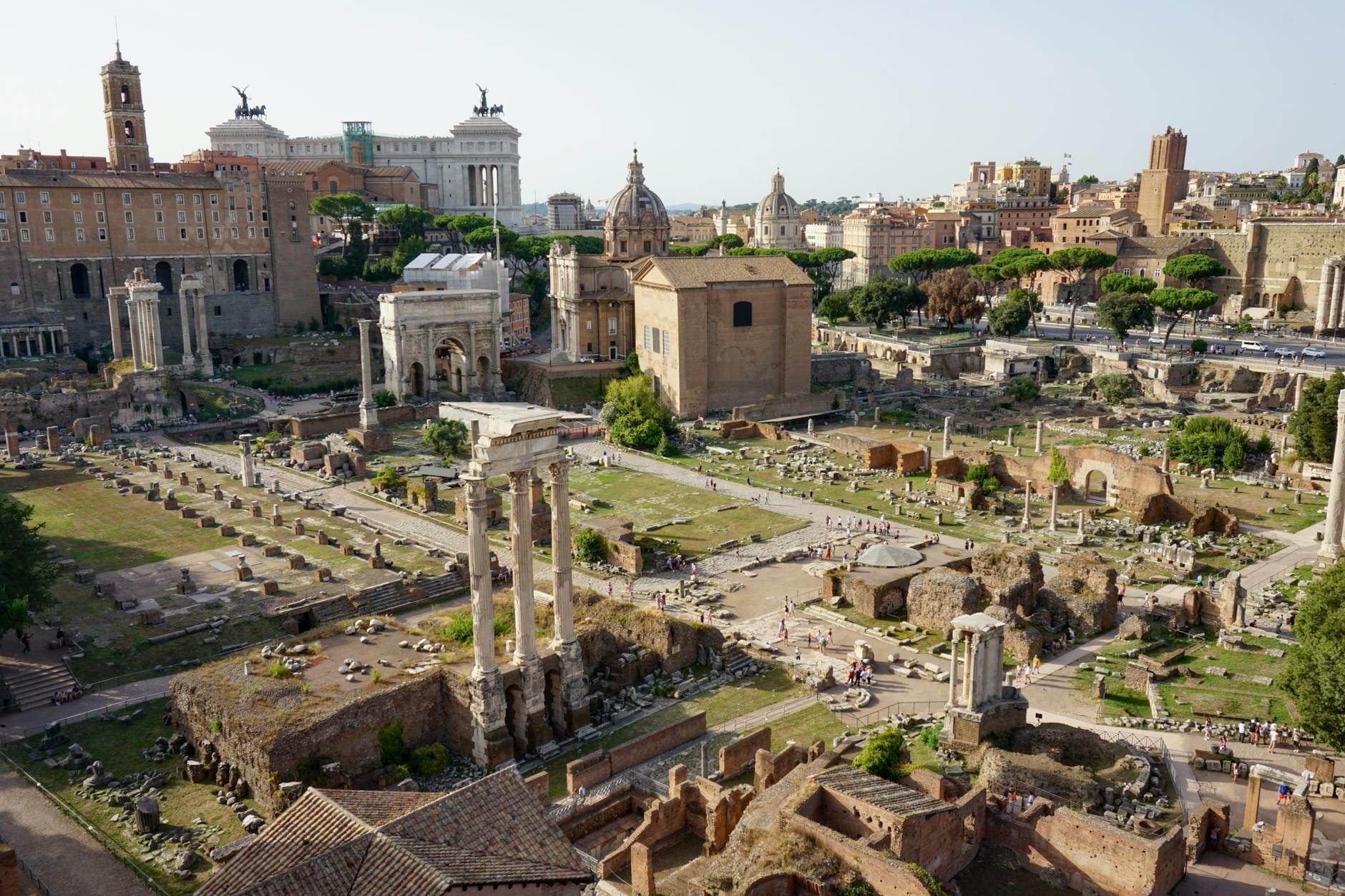
The western edge of the hill offers one of the best unobstructed views of the Roman Forum below. From this vantage point you can read the Forum's layout clearly, something that is almost impossible to do while standing inside it at ground level. The Arch of Titus, the Temple of Saturn, and the Basilica of Maxentius are all identifiable from here on a clear day.
How the Experience Changes by Time of Day
Early morning, around 8:30 to 9:30 a.m., is when the hill is at its most peaceful. The light is soft and raking, which brings out the textures of brick and tufa in ways that midday sun flattens completely. The air in spring carries the scent of fennel growing between the stones, and the only sounds are birds and the occasional crunch of gravel underfoot. If you have come from the Colosseum, the contrast in crowd density is immediately noticeable.
By late morning, school groups arrive and the main terrace areas around the Domus Flavia become more congested. Midday in summer is genuinely uncomfortable: there is limited shade on the upper plateau and temperatures regularly exceed 30°C between June and August. Bring water. There are drinking fountains (nasoni) on the grounds, but they are not always easy to find when you need them.
Late afternoon, from about 4:00 p.m. onward in summer, is arguably the best compromise. Tour groups have largely departed, the light shifts to warm gold, and the southern views toward the Circus Maximus take on a different quality. If you are combining the Palatine with the Roman Forum in one visit, start with the Forum in the morning and arrive on the hill by mid-afternoon.
⚠️ What to skip
Summer heat on Palatine Hill is not to be underestimated. The upper plateau has almost no shade. Wear sunscreen, carry at least one litre of water per person, and consider visiting in the evening rather than at midday from June through August.
Historical and Cultural Context
The hill has been inhabited since at least the 10th century BC, with archaeological evidence of Iron Age huts found near the southwestern edge. The mythological tradition holds that Romulus founded Rome here in 753 BC, a date that should be treated as legend rather than history, but the underlying archaeology confirms this as one of the earliest settled points in the region.
By the late Republic, the Palatine had become the most fashionable residential district in the city. Cicero, Crassus, and Mark Antony all owned houses here. The transformation into an exclusively imperial precinct began under Augustus and continued with Tiberius, Caligula, and Nero before Domitian's architects unified the hilltop under a single enormous complex. The Domus Aurea, Nero's infamous golden house, sprawled across the valley below and extended up the adjacent Esquiline Hill, giving some sense of the scale of ambition that defined this period.
During the medieval period, the hill became the property of powerful Roman families and later of monasteries, which accounts for why so many of the upper structures survived at all, even if the marble was quarried for lime. The Farnese family built botanical gardens here in the 16th century, the Orti Farnesiani, considered among the earliest botanical gardens in Europe. Their terraced layout is still partially visible at the northern end of the hill.
Getting There and Practical Logistics
The most direct approach is Metro Line B to Colosseo station, a five-minute walk from the Via di San Gregorio entrance. Buses 75, 81, and 673 also stop nearby. If you are arriving from Centro Storico, the walk through the Forum entrances on Via della Salara Vecchia is a reasonable alternative and gives you a ground-level read of the Forum before you ascend.
Footwear matters more here than at most Roman sites. The paths combine compacted gravel, uneven stone, and steep gradients. Sandals with no grip are a poor choice, especially on the descent toward the Forum. Mobility-impaired visitors should note that large sections of the hill involve steps and unpaved terrain, though some ramp access exists. Contact the Parco Archeologico directly for detailed accessibility information before visiting.
Photography from Palatine Hill is excellent, but the Forum overlook is the single most rewarding vantage point. A wide-angle lens in the 16–24mm range will let you capture the full sweep of the Forum below. For wider context on Rome's archaeological landscape, the best viewpoints in Rome guide covers several other spots that pair well with a Palatine visit.
Who Should Skip This
Visitors who need clear narrative signage and guided context to engage with ruins will find Palatine Hill frustrating. The site is large, the remains are fragmentary, and without background knowledge it can feel like a walk through a lot of anonymous brickwork. An audio guide (available for hire on site) makes a significant difference, but even then, this is not a self-explanatory attraction in the way that the Colosseum is.
Families with very young children face real logistical challenges: strollers are impractical on the gravel paths, the site is large, and there is nothing to engage small children at ground level in the way that a hands-on museum might. Older children who have been introduced to Roman history will likely find it compelling; younger ones may not.
Insider Tips
- The Museo Palatino is included in your ticket and almost no one goes in. It contains some genuinely impressive finds, including painted wall panels from imperial-era rooms, and is a cool, shaded space worth 30 minutes of your time.
- The Farnese Gardens at the northern end of the hill are the least-visited section. On a weekday morning, you can have the terraced overlooks almost entirely to yourself.
- Audio guides are available for hire at the entrance kiosks. Given how sparse the on-site signage is, this is one of the Rome sites where the audio guide pays for itself.
- If you are visiting on the free first Sunday of the month, arrive right at opening. The combination of free entry across the Colosseum complex means queues form quickly and the hill becomes genuinely crowded by 10:00 a.m.
- The southern terrace above Circus Maximus gives a completely different perspective on the city from the usual tourist routes. Few visitors walk the full perimeter of the hill, so the southwestern edge near the Hut of Romulus archaeological area is almost always quiet.
Who Is Palatine Hill For?
- History enthusiasts who want to understand the physical reality of imperial Rome beyond the Colosseum
- Photographers looking for elevated Forum views and atmospheric ruins with manageable crowds
- Visitors combining a full day in the ancient Roman core, pairing Palatine Hill with the Roman Forum and Capitoline Museums
- Travellers visiting in shoulder season (April to June, September to October) who want space to explore at their own pace
- Anyone on the combined ticket who has already seen the Colosseum and wants to extract full value from their pass
Nearby Attractions
Other things to see while in Ancient Rome:
- Appian Way
The Appian Way, or Via Appia Antica, is one of the ancient world's most consequential roads, stretching from Rome's Aurelian Walls into the open Campagna. Built in 312 BCE, it remains walkable today, lined with tombs, pine trees, and broken basalt stones that once carried Roman legions south. Free to enter and car-free on Sundays, it offers a rare escape from the city's tourist core into a landscape that has changed remarkably little in two millennia.
- Baths of Caracalla
The Baths of Caracalla are among the best-preserved and most atmospheric ancient ruins in Rome. Inaugurated in 216 AD, this vast complex once welcomed up to 8,000 visitors a day. Today, the ruins reward anyone willing to look beyond the Colosseum.
- Castel Gandolfo
Perched on a volcanic crater rim 25 km southeast of Rome, the Apostolic Palace of Castel Gandolfo served as the papal summer residence for nearly four centuries. Since Pope Francis opened it to the public in 2016, visitors can tour the baroque interiors, formal gardens, and working farm that once fed the pontiff's household.
- Catacombs of San Callisto
Stretching beneath the Appian Way, the Catacombs of San Callisto served as the official cemetery of Rome's early Christian community from the second century AD. With 10 to 20 kilometers of galleries across four to five levels, the complex holds the Crypt of the Popes, the tomb of Saint Cecilia, and the remains of roughly 500,000 Christians. It is one of the most historically substantial underground sites in the ancient world.
Planning a trip? Discover personalized activities with the Nomado app.