Domus Aurea: Inside Nero's Underground Golden House
The Domus Aurea is the buried remnant of Emperor Nero's vast imperial palace, built after the Great Fire of 64 AD and later buried by his successors. Today, guided tours lead visitors through dimly lit corridors of frescoed rooms beneath the Oppian Hill, with an optional VR experience that reconstructs the original gilded splendor.
Quick Facts
- Location
- Via della Domus Aurea, 1, 00184 Roma — Oppian Hill, Ancient Rome
- Getting There
- Metro Line B, Cavour station (5-min walk)
- Time Needed
- 1 to 1.5 hours (guided tour only)
- Cost
- €18 standard; €26 with VR/educational tour; +€1 reservation fee; free under 18
- Best for
- Roman history enthusiasts, architecture lovers, travelers seeking an uncrowded ancient site
- Official website
- colosseo.it/en
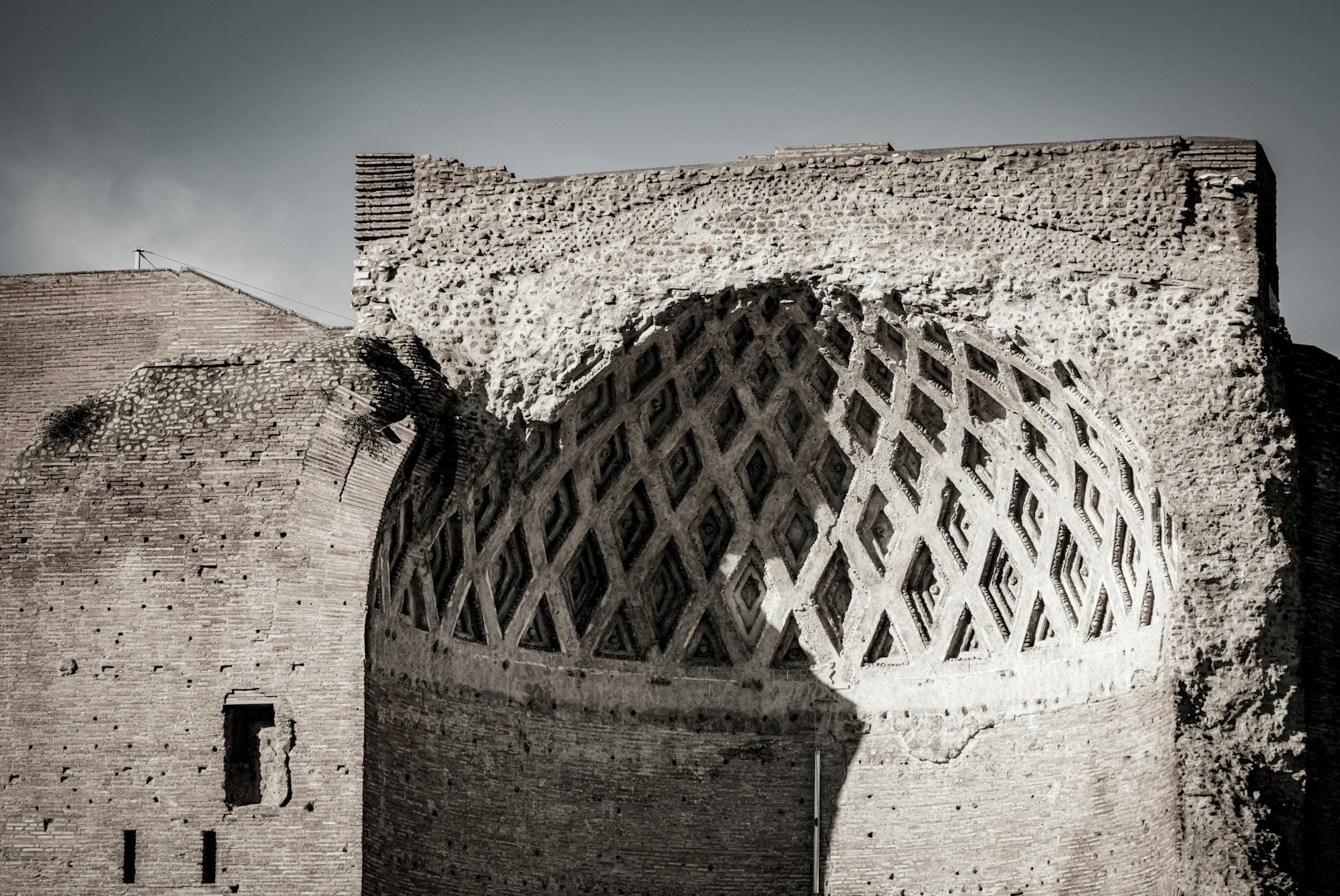
What Is the Domus Aurea?
The Domus Aurea, or Golden House, was Emperor Nero's personal palace complex, constructed after the catastrophic Great Fire of Rome in 64 AD destroyed much of the city's center. At its peak, the complex reportedly covered somewhere between 100 and 300 acres of the most valuable land in Rome, stretching across the Palatine, Esquiline, and Caelian hills. It was not simply a building but an entire artificial landscape: vineyards, forests, pastures, and an artificial lake where the Colosseum now stands.
After Nero's death in 68 AD, his successors methodically erased the palace from Rome's skyline. Vespasian drained the lake and began the Colosseum. Trajan buried the remaining wings under rubble and soil, using the site as the foundation for his own baths. What was once Rome's most extravagant private residence became forgotten infrastructure. It remained buried for roughly 1,400 years until Renaissance artists, including Raphael, Pinturicchio, and Giovanni da Udine, began lowering themselves by rope through holes in the hillside to study the painted ceilings. They called the half-buried rooms 'grottos,' and the style of decoration they found there, sinuous figures entwined with foliage and fantasy creatures, became known as 'grotesque' art, influencing European painting for centuries.
ℹ️ Good to know
Tours run only on Fridays, Saturdays, and Sundays, departing every 15 minutes from 9:00 a.m. to 4:30 p.m. (last admission 3:30 p.m.). The site is closed on the first Sunday of each month and on specific public holidays. Book well in advance through the official Colosseo.it ticketing system — walk-up entry is not available.
The Tour Experience: What You Actually See
Visits are strictly guided and run for approximately 60 to 90 minutes. You enter from Via della Domus Aurea and exit at a separate point on Via di Serapide, so there is no backtracking. The moment you step through the entrance, the temperature drops noticeably. The underground atmosphere is cool, damp, and surprisingly still. Wear a jacket regardless of the season outside.
The tour passes through a sequence of vaulted corridors and chambers that form the Esquiline wing, the most intact surviving portion of the complex. The rooms retain fragmentary frescoes: mythological scenes, architectural fantasies, and the sinuous decorative motifs that once covered nearly every surface. The famous 'Room of the Golden Vault' (Volta Dorata) still shows exceptional detail, with painted panels framed by delicate stucco work. The scale of some corridors is disorienting, since Trajan's builders infilled large sections with concrete and rubble to create flat ground for the baths above, compressing rooms that were originally open to sky.
The octagonal room near the center of the wing is the architectural highlight. Its domed ceiling, pierced by a central oculus, was one of the earliest examples of Roman experimentation with concrete dome construction, predating the Pantheon. Looking up at it in low artificial light, with water occasionally seeping through hairline cracks in the vault above, it feels genuinely ancient in a way that more polished sites do not.
💡 Local tip
The €26 VR tour adds a headset experience that overlays digital reconstructions of the original painted and gilded rooms onto your physical surroundings. For first-time visitors with limited knowledge of Roman imperial art, it significantly helps contextualize what would otherwise look like bare brick. For those already familiar with Roman interiors, it can feel gimmicky.
Tickets & tours
Live prices and dates from our booking partner. If you book, we may earn a commission at no extra cost to you.
Historical and Cultural Context
Nero's construction of the Domus Aurea remains one of the most controversial acts in Roman imperial history. Ancient sources, including Suetonius and Tacitus, described the palace as a monument to excess, a seizure of public land for private pleasure. Whether this condemnation was accurate or shaped by later political agendas is still debated by historians. What is clear is that the complex was radical in its design: the architect Severus and the engineer Celer created spaces that broke with traditional Roman domestic architecture, using concrete vaulting to achieve forms that had no precedent. You can see the direct influence of these innovations in the Pantheon, built roughly 60 years later.
The site also connects directly to Rome's most recognized monument. Nero's artificial lake, the Stagnum Neronis, occupied the valley floor below the palace. When Vespasian drained it to build the Flavian Amphitheater around 72 AD, he was making a deliberate symbolic statement: returning stolen land to the Roman people. The name 'Colosseum' itself likely derives not from the building's size but from a colossal bronze statue of Nero that once stood beside it, later converted into a statue of the sun god Sol.
For visitors exploring this area of Rome, the Domus Aurea fits into a tight cluster of ancient sites. The Colosseum is a short walk downhill, and the Roman Forum and Palatine Hill are accessible on the same combined ticket. The Domus Aurea requires a separate booking through the same Colosseo.it system.
How It Changes by Time of Day and Season
Because the site is entirely underground, time of day has no effect on the light or atmosphere inside. The temperature stays consistently cool and slightly humid year-round, around 10 to 12 degrees Celsius inside the tunnels. This makes it one of the better summer options in Rome, since you are effectively stepping into natural air conditioning while the streets above bake at 30 degrees.
Crowd levels vary less here than at most Roman sites. Total visitor numbers are capped by the guided tour format, so even on a Saturday in peak season you will be in a group of manageable size rather than a crush of people. The Friday morning slots tend to be the quietest. Midday Saturday slots in July and August fill fastest, so book at least a week ahead during summer.
⚠️ What to skip
The site is closed on the first Sunday of each month and on specific calendar dates including January 5 and April 25. Always verify the closure calendar on colosseo.it before planning your visit, since schedules can change without wide announcement.
Practical Guide: Getting There and What to Bring
The closest Metro stop is Cavour on Line B, about a five-minute walk uphill to the entrance on Via della Domus Aurea. Several bus lines also stop near the Colosseum. If you are combining the Domus Aurea with a broader day in the Ancient Rome area, it is worth planning it as the first stop of the morning, since the underground cool is more welcome as the day heats up and the guided departure times mean you need to plan precisely.
Bring a light jacket or layer, even in summer. The tunnels are genuinely cold and the contrast with summer street temperatures is sharper than most visitors expect. Wear closed, flat shoes: floors can be uneven and some sections have minor standing water after rain. Photography is permitted inside, but flash is discouraged to protect the fragile frescoes, and low light means a phone camera will struggle without good low-light capability. The tour is conducted in Italian and English, with headsets provided.
Admission is €18 for the standard guided tour and €26 for the version that includes VR headsets. EU citizens aged 18 to 25 receive a reduced rate of €2 off. Admission is free for visitors under 18 and for certain other categories including disabled visitors and their companions. A €1 reservation fee applies to all bookings. All tickets must be booked in advance through colosseo.it. There is no ticket office at the site for walk-up purchase.
Honest Assessment: Who Will Love This, and Who Might Not
The Domus Aurea rewards visitors who come with some prior knowledge of Nero, Roman imperial history, or the development of Roman architecture. The site does not explain itself dramatically: the rooms are largely stripped bare, and without the VR option or a strong mental picture of what these spaces once contained, it is easy to walk through and feel a sense of 'is that it?' The frescoes that remain are genuinely beautiful up close, but the overall setting is sparse.
That said, for travelers who have already seen Rome's more polished showpieces and want something that feels genuinely archaeological, the Domus Aurea delivers. The Basilica of San Clemente offers a similar multi-layered underground experience for free and with more continuous historical narrative, though it covers a different period. If you are choosing between the two on a budget, San Clemente is easier to absorb independently. If you are invested in the Neronian period or Roman palace architecture specifically, the Domus Aurea is irreplaceable.
Visitors with mobility limitations should check with the official site directly before booking. The underground nature of the complex and some uneven floor surfaces may present challenges, though the site does list free admission for disabled visitors and a companion.
Insider Tips
- Book the Friday 9:00 a.m. slot for the quietest tour group and the most attentive guide interaction — Saturday afternoons tend to have louder, larger groups.
- The octagonal room, the Sala Ottagona, is the architectural centerpiece. Position yourself directly under the oculus and look up: the concrete dome construction visible here directly foreshadows the Pantheon's design, making it a genuine eureka moment for architecture enthusiasts.
- Renaissance artists including Raphael, Pinturicchio, and Giovanni da Udine studied the decorative frescoes here in the 15th and 16th centuries, leaving their signatures scratched into the walls. Ask your guide to point out some of these inscriptions.
- The exit on Via di Serapide brings you out on the opposite side of the Oppian Hill from the entrance. Factor this into your route planning if you are walking to the Colosseum or Forum afterward.
- If you are visiting in summer, schedule the Domus Aurea as your first stop of the day. The underground cool is a genuine relief, and you exit back into the heat refreshed rather than already exhausted.
Who Is Domus Aurea For?
- Roman history enthusiasts who want context beyond the Colosseum
- Architecture students and travelers interested in the origins of Roman concrete vaulting
- Visitors returning to Rome who have already covered the main sites
- Travelers looking for a cooler, quieter indoor experience during summer heat
- Anyone interested in the Renaissance rediscovery of classical antiquity
Nearby Attractions
Other things to see while in Ancient Rome:
- Appian Way
The Appian Way, or Via Appia Antica, is one of the ancient world's most consequential roads, stretching from Rome's Aurelian Walls into the open Campagna. Built in 312 BCE, it remains walkable today, lined with tombs, pine trees, and broken basalt stones that once carried Roman legions south. Free to enter and car-free on Sundays, it offers a rare escape from the city's tourist core into a landscape that has changed remarkably little in two millennia.
- Baths of Caracalla
The Baths of Caracalla are among the best-preserved and most atmospheric ancient ruins in Rome. Inaugurated in 216 AD, this vast complex once welcomed up to 8,000 visitors a day. Today, the ruins reward anyone willing to look beyond the Colosseum.
- Castel Gandolfo
Perched on a volcanic crater rim 25 km southeast of Rome, the Apostolic Palace of Castel Gandolfo served as the papal summer residence for nearly four centuries. Since Pope Francis opened it to the public in 2016, visitors can tour the baroque interiors, formal gardens, and working farm that once fed the pontiff's household.
- Catacombs of San Callisto
Stretching beneath the Appian Way, the Catacombs of San Callisto served as the official cemetery of Rome's early Christian community from the second century AD. With 10 to 20 kilometers of galleries across four to five levels, the complex holds the Crypt of the Popes, the tomb of Saint Cecilia, and the remains of roughly 500,000 Christians. It is one of the most historically substantial underground sites in the ancient world.
Planning a trip? Discover personalized activities with the Nomado app.