Via Appia Antica (Appian Way): Walking Rome's Queen of Roads
The Appian Way, or Via Appia Antica, is one of the ancient world's most consequential roads, stretching from Rome's Aurelian Walls into the open Campagna. Built in 312 BCE, it remains walkable today, lined with tombs, pine trees, and broken basalt stones that once carried Roman legions south. Free to enter and car-free on Sundays, it offers a rare escape from the city's tourist core into a landscape that has changed remarkably little in two millennia.
Quick Facts
- Location
- Via Appia Antica, starting at Porta Appia, southeast Rome (Ancient Rome district)
- Getting There
- Bus 218 from San Giovanni; Bus 314 to deeper sections; no direct metro stop
- Time Needed
- 2–5 hours depending on how far you walk or cycle
- Cost
- Free (road and park); catacombs along the route charge separate entry fees
- Best for
- History lovers, cyclists, photographers, anyone wanting space away from crowds
- Official website
- http://www.parcoappiaantica.it
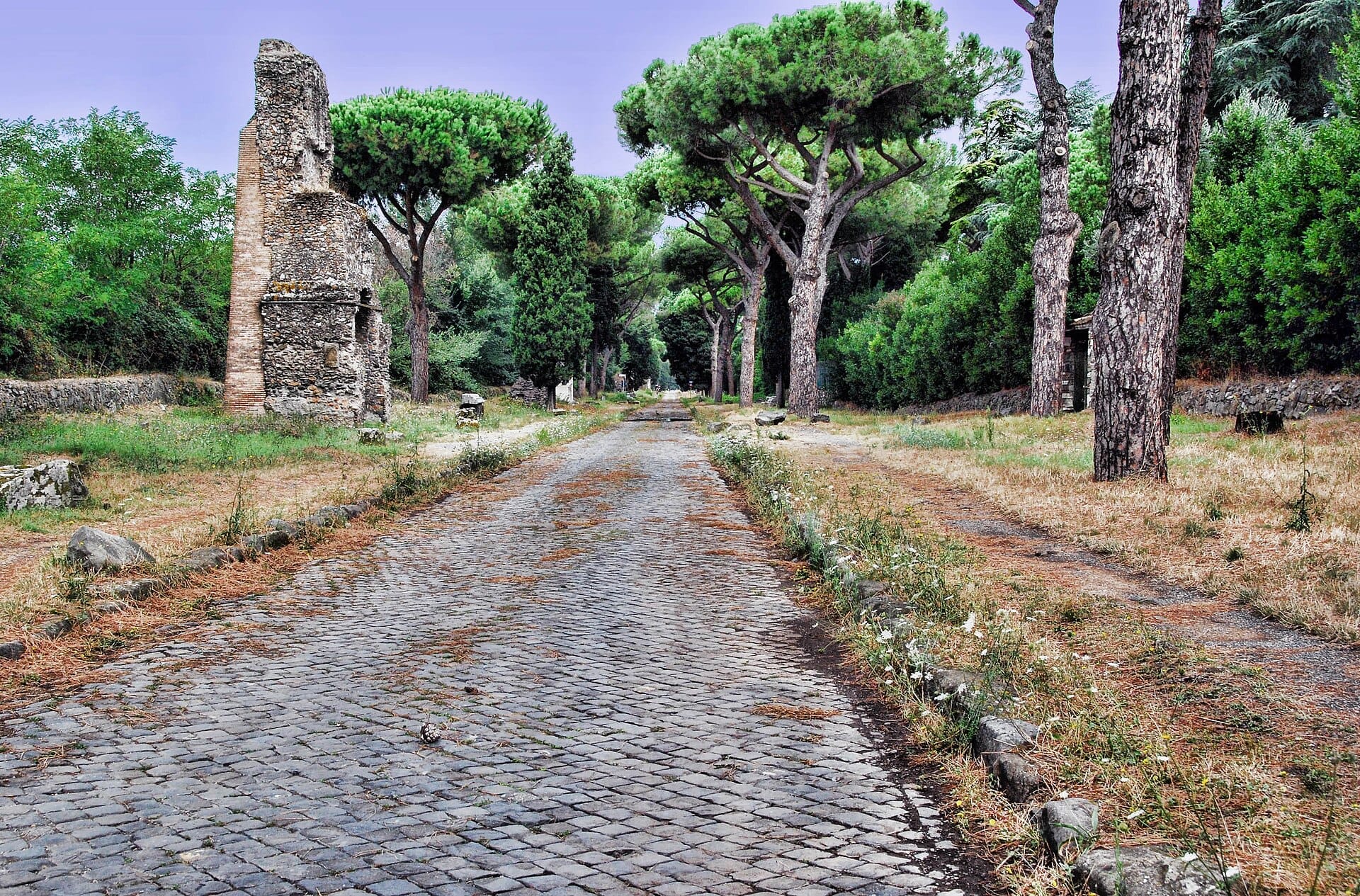
What the Appian Way Actually Is
The Via Appia Antica is not a ruin you look at from behind a fence. It is a road you walk on, the same basalt stones, the same width, occasionally the same ruts worn by cart wheels more than two thousand years ago. Commissioned in 312 BCE by the censor Appius Claudius Caecus, it was Rome's first major paved road, initially connecting the city to Capua, roughly 200 kilometres to the south. It was eventually extended over 500 kilometres further to Brundisium (modern Brindisi), making it the primary artery for military movement and trade across southern Italy.
Roman writers called it the Regina Viarum, the Queen of Roads. That title was not hyperbole. The road's construction was an engineering statement: straight where other roads meandered, wide enough for two carts to pass, built on a cambered bed of gravel and stone so rain would drain to the sides. The surface you see today, the large irregular polygonal basalt blocks called selce, is original. In places the stones have sunk and tilted over centuries, giving the road a rough, uneven character that makes walking it feel genuinely ancient rather than reconstructed.
Today the road is protected as part of the Appian Way Regional Park, a 3,500-hectare green corridor managed by the Comune di Roma. In 2024, the Via Appia was inscribed as a UNESCO World Heritage Site under the designation "Via Appia. Regina Viarum", recognising not just the Roman section but the full ancient route through multiple Italian regions. For context on visiting other significant ancient sites in the area, see our guide to Ancient Rome.
💡 Local tip
The road is open to vehicle traffic on weekdays. If you want the full experience, come on a Sunday or public holiday when the first section of Via Appia Antica is closed to cars and the road belongs entirely to walkers and cyclists.
How the Experience Changes by Time of Day
In the early morning, roughly between 7 and 9am, the Appian Way belongs to locals. Joggers move between the pine trees, dog walkers navigate the uneven stones carefully, and the air carries the smell of grass and damp earth. The light at this hour is low and raking, which means the texture of the road surface, and the worn faces of tomb fragments lining the verges, stand out in sharp relief. This is the best hour for photography of the road itself.
By mid-morning, tour groups begin arriving, particularly at the catacombs entrances. The Catacombs of San Callisto and the Catacombs of San Sebastiano, both on Via Appia Antica, draw significant visitor numbers from around 10am onward. If you plan to visit the catacombs, arriving before 10am is worth the effort. By midday in summer, the road can be uncomfortably hot. There is very little shade in the open stretches beyond the first two kilometres, and the dark basalt absorbs heat considerably.
Late afternoon, particularly from 4pm in spring and autumn, brings a softer quality to the light and noticeably thinner crowds. The countryside sections beyond the third kilometre feel genuinely quiet at this hour. The umbrella pines that line the road cast long shadows across the stones, and the distant dome of the Mausoleum of Cecilia Metella appears almost theatrical against the sky. This stretch, from roughly the 2nd to 5th mile markers, is where the road begins to feel less like a tourist attraction and more like an experience.
Tickets & tours
Live prices and dates from our booking partner. If you book, we may earn a commission at no extra cost to you.
Appian Way and Catacombs Golf Cart Shared Tour
From 95 €Instant confirmationFree cancellationAppian Way E-Bike tour with VR experience at Cecilia Metella Mausoleum
From 79 €Instant confirmationFree cancellationRome Appian Way Golf Cart Charter Ride with Driver
From 180 €Instant confirmationFree cancellationAppian Way and San Sebastian Catacombs English guided walking tour
From 79 €Instant confirmationFree cancellation
What You Will Actually See Along the Route
The first kilometre, from Porta San Sebastiano to the Catacombs of San Callisto, is the most densely visited and also the narrowest in terms of the road itself. The Porta San Sebastiano is among the best-preserved gates in the Aurelian Walls, and it houses the Museo delle Mura, a small free museum inside the gate towers with views along the original wall walk. Starting here gives you an immediate sense of the scale of ancient Rome's perimeter defences before you step onto the road.
The Circus of Maxentius appears around the second kilometre, a largely undervisited circus track that is one of the best-preserved in existence. Immediately beyond it stands the Mausoleum of Cecilia Metella, a circular tomb dating from the late 1st century BCE, its travertine drum still largely intact. Admission to the mausoleum is covered by the combined ticket that also includes the Baths of Caracalla and the Tomb of the Scipios, which makes it good value if you plan multiple stops.
Beyond the mausoleum, the road opens into the Campagna Romana, the open countryside that surrounds Rome. This section has scattered tomb ruins on both sides of the road, some reduced to brick cores stripped of their marble facing, others still holding their original stone courses. The landscape here is genuinely unusual for a European capital: fields, sheep in some seasons, and aqueduct arches visible in the middle distance. The Acquedotto Claudio crosses the horizon to the east, a reminder that the infrastructure of ancient Rome extended far beyond the road itself.
The Catacombs: What to Know Before You Go
Several catacombs open to the public line Via Appia Antica. The most visited are the Catacombs of San Callisto, which contain the burial galleries of multiple early popes and early Christian martyrs. They are operated by the Salesians and require a guided tour, which runs regularly and lasts about 30 minutes. Photography is not permitted inside.
The Catacombs of San Sebastiano are slightly smaller but historically significant as an early place of veneration for Saints Peter and Paul. The Catacombs of Domitilla, a short walk off the main road, are the largest catacomb network in Rome and include an intact underground basilica. Each catacomb charges its own entry fee, typically in the range of 8 to 10 euros per person, though prices should be verified before your visit as they are subject to change.
⚠️ What to skip
Most catacombs are closed on Sundays or have reduced hours on religious holidays. Check the specific catacomb's schedule before planning your visit around them. The road being car-free on Sunday does not mean the catacombs are open.
Getting There and Moving Around
There is no direct metro line to Via Appia Antica. The most straightforward public transport option is Bus 218, which runs from Piazza San Giovanni in Laterano (near the San Giovanni metro stop on Line A) along Via Appia Antica, stopping near the main catacomb entrances. Bus 660 serves the deeper sections of the road from the Colli Albani metro stop on Line A. Taxis and ride-hailing apps (Uber and Free Now both operate in Rome) are also practical for reaching the start of the road, particularly if you are staying in the centre.
Cycling is the most efficient and satisfying way to cover the full length of the park section. Several bike rental operators near the visitor centre at Via Appia Antica 42 (the Ex Cartiera Latina) offer standard and electric bikes. The surface is rough, so a bike with wider tyres or some front suspension is significantly more comfortable than a thin-tyred road bike. Expect to rent for roughly 3 to 5 hours to cover the main points of interest at a relaxed pace.
If you are planning a broader day in this part of Rome, the Appian Way pairs naturally with the Baths of Caracalla, which are located just inside the Aurelian Walls and a short taxi or bus ride from Porta San Sebastiano. For more on structuring a day across ancient sites, the Rome in 3 days guide covers logical itinerary groupings.
Practical Considerations and Honest Limitations
The cobblestone surface deserves honest mention. The basalt blocks are not smooth. They have heaved, sunk, and split over two millennia, and sections of the road are genuinely difficult to walk on for extended periods. Sturdy footwear with ankle support is not optional, it is the difference between an enjoyable walk and a painful one. Anyone with significant mobility limitations will find much of the road inaccessible, and wheelchair access is effectively ruled out on most stretches.
In summer, heat and sun exposure are real concerns on the open sections of the road. The umbrella pines provide intermittent shade, but stretches of several hundred metres can be completely exposed. Bring water, particularly if visiting between June and August. Conversely, after heavy rain the road surface becomes slippery, and low-lying areas of the park can retain standing water. The best months for the Appian Way, in terms of both temperature and light quality, are April, May, September, and October.
This is not an attraction for visitors expecting polished interpretation. There are limited information panels along the route, and many of the tomb structures are unlabelled. If historical context matters to you, consider joining a guided tour, or read about the road's history before arriving. For travellers who prefer structured museum experiences to open-air ruins, the Capitoline Museums offer significantly more interpretive depth. Those who find uneven ground difficult or prefer air-conditioned spaces should consider whether the Appian Way suits their visit.
Photography on the Appian Way
The road photographs best in early morning or late afternoon light, when low angles catch the texture of the basalt and cast long shadows between the tomb fragments. The stretch between the Mausoleum of Cecilia Metella and the fifth mile marker is the most photogenic, with intact sections of the ancient road surface, pine trees framing the view, and aqueduct arches visible on the horizon. On Sundays, this section is entirely free of parked cars, which makes composition considerably easier.
Wide-angle lenses work well for the road's perspective lines. A 24mm or 35mm equivalent lets you show both the road surface detail and the sky. Overcast days, which diffuse harsh contrast, are actually well-suited to shooting the grey-black basalt, which under direct summer sun can blow out in highlights or lose surface texture entirely.
Insider Tips
- The visitor centre at Ex Cartiera Latina (Via Appia Antica 42) has free maps of the park, clean toilets, and bike rental. It is worth stopping here before walking further, even briefly.
- If you visit on a Sunday and want to combine the car-free road with a catacomb visit, check the catacomb opening days in advance. Some are closed Sundays entirely, which means you could arrive to find the main paid attractions shut.
- The Circus of Maxentius, just past the second kilometre, is one of the least crowded major ancient sites in Rome. Most visitors walk past without stopping. The scale of the track is extraordinary and there are rarely more than a handful of people there at any given time.
- For the best light and fewest people, aim to be on the road by 7:30am on a weekday. The first hour before tour groups arrive is qualitatively different from the mid-morning experience.
- If you are cycling, electric bikes are worth the extra cost. The cobblestones require constant small adjustments and absorb energy quickly. After the first two kilometres, you will understand why the upgrade matters.
Who Is Appian Way For?
- Travellers who want to experience Roman history in open air rather than inside a museum or confined site
- Cyclists looking for a half-day route that combines history, countryside, and manageable distances
- Photographers seeking strong natural light, ancient textures, and uncrowded compositions
- Visitors who have already covered the main ancient sites and want to understand the broader Roman landscape
- Anyone travelling in spring or autumn who wants a full morning outdoors away from the tourist core
Nearby Attractions
Other things to see while in Ancient Rome:
- Baths of Caracalla
The Baths of Caracalla are among the best-preserved and most atmospheric ancient ruins in Rome. Inaugurated in 216 AD, this vast complex once welcomed up to 8,000 visitors a day. Today, the ruins reward anyone willing to look beyond the Colosseum.
- Castel Gandolfo
Perched on a volcanic crater rim 25 km southeast of Rome, the Apostolic Palace of Castel Gandolfo served as the papal summer residence for nearly four centuries. Since Pope Francis opened it to the public in 2016, visitors can tour the baroque interiors, formal gardens, and working farm that once fed the pontiff's household.
- Catacombs of San Callisto
Stretching beneath the Appian Way, the Catacombs of San Callisto served as the official cemetery of Rome's early Christian community from the second century AD. With 10 to 20 kilometers of galleries across four to five levels, the complex holds the Crypt of the Popes, the tomb of Saint Cecilia, and the remains of roughly 500,000 Christians. It is one of the most historically substantial underground sites in the ancient world.
- Circus Maximus
Once the largest entertainment venue in the ancient world, the Circus Maximus held 150,000–250,000 spectators watching chariot races on a track stretching 600 meters between the Palatine and Aventine Hills. Today the site is a free public park where ancient Roman history sits just beneath the surface, literally and figuratively.
Planning a trip? Discover personalized activities with the Nomado app.