Circus Maximus (Circo Massimo): Rome's Ancient Chariot Stadium
Once the largest entertainment venue in the ancient world, the Circus Maximus held 150,000–250,000 spectators watching chariot races on a track stretching 600 meters between the Palatine and Aventine Hills. Today the site is a free public park where ancient Roman history sits just beneath the surface, literally and figuratively.
Quick Facts
- Location
- Via del Circo Massimo, between Palatine and Aventine Hills, Rome
- Getting There
- Circo Massimo (Metro Line B), 2-minute walk
- Time Needed
- 30–60 minutes
- Cost
- Free entry, open 24/7
- Best for
- History lovers, early morning walkers, budget travelers
What Is the Circus Maximus?
The Circus Maximus (Circo Massimo in Italian) is the oldest and largest chariot-racing stadium in ancient Rome, and at its peak, one of the largest public gathering spaces in human history. Running roughly 600 meters in length and around 190–225 meters wide, the stadium once seated an estimated 150,000–250,000 spectators. To put that in context: the Colosseum, which draws millions of visitors each year, held roughly 50,000. The Circus Maximus was six times that size.
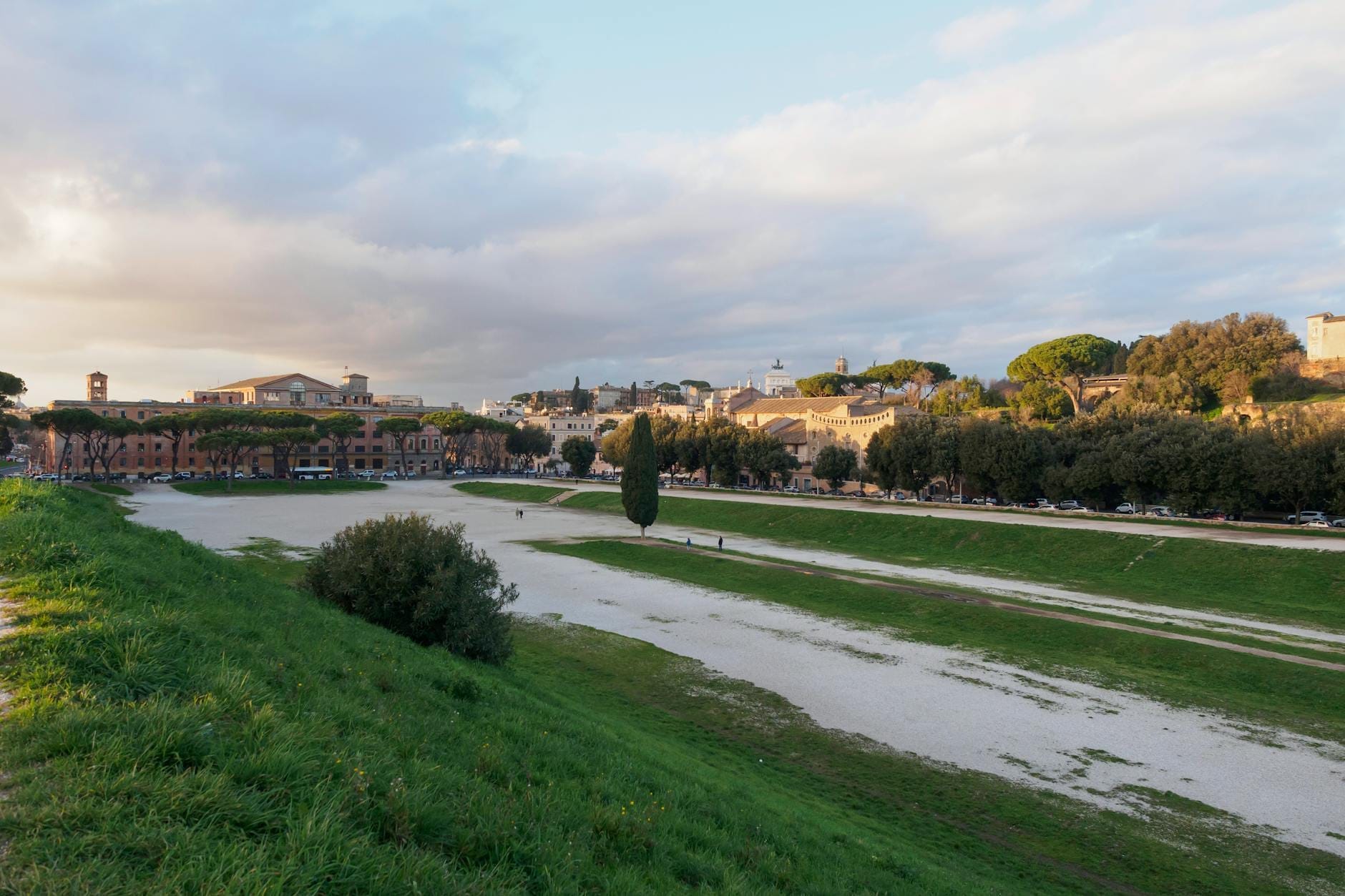
What greets visitors today is not a preserved ruin but a long, oval-shaped public park, flat and grass-covered, tracing the exact footprint of the ancient track. The original seating tiers, track surface, and monumental structures lie buried around six meters below ground. Two Egyptian obelisks once marked the central dividing barrier (the spina): one now stands in Piazza del Popolo, the other in Piazza di San Giovanni in Laterano. Their absence underlines how thoroughly the site was stripped over the centuries.
ℹ️ Good to know
The Circus Maximus is free to enter and open around the clock as a public archaeological park. No ticket, no reservation, no set hours. You can walk through at any time.
A History Worth Understanding Before You Arrive
The valley between the Palatine and Aventine Hills had been used for games and public spectacles long before Rome formalized the venue. The site, known in antiquity as the Vallis Murcia, hosted its earliest organized races during Rome's monarchic period. Over centuries, the structure was progressively enlarged, with major rebuilding under Julius Caesar and again under Emperor Trajan around 110 CE, which brought the venue to its greatest extent.
Chariot races here were not casual entertainment. They were deeply tied to Roman religious festivals, political displays, and civic identity. The four racing factions (Reds, Whites, Blues, and Greens) commanded intense public loyalty, comparable in social function to modern football clubs. Emperors attended races from the imperial box on the Palatine Hill directly above, watching the same track visible from the palace. The last recorded races at the Circus Maximus took place in the 6th century CE, long after the Western Roman Empire had collapsed.
The site's proximity to the Palatine Hill is one of its most evocative qualities. Standing in the park and looking upward at the terraced ruins above, it is easy to understand how emperors could oversee the spectacle from their private terraces while the city roared below.
Tickets & tours
Live prices and dates from our booking partner. If you book, we may earn a commission at no extra cost to you.
Interactive VR experience of ancient Rome's Circus Maximus
From 35 €Instant confirmationFree cancellationSt. Peter's Basilica, Vatican Museums, Sistine Chapel reserved entry
From 81 €Instant confirmationFree cancellationGuided tour of Galleria Borghese and of Villa Borghese gardens
From 69 €Instant confirmationFree cancellationVatican: Basilica, Dome and underground early bird tour
From 50 €Instant confirmationFree cancellation
What the Experience Actually Looks Like
Arriving from the Circo Massimo Metro station, you emerge directly beside the long southern flank of the park. The scale registers immediately: the green expanse stretches far ahead, curved at each end, framed by hills on both sides. There are no barriers, no entry gates, no ticket booths. Locals jog along the perimeter path most mornings, dogs off-leash in the open center, and the whole space operates as a neighborhood park first and historical site second.
At the eastern end of the park, near the Via dei Cerchi side, a small section of exposed archaeology is visible: a fragment of the original curved starting gates (carceres) and sections of ancient masonry have been partially excavated and are accessible on foot. This is the most visually informative corner of the site for anyone interested in understanding what once stood here. A low-level interpretive panel explains the basic layout, though signage throughout the park is sparse.
The sensory experience is quieter than you might expect given the historical weight. Birds move through the grass. Traffic hums from surrounding streets. On warm afternoons, the smell of cut grass mixes with the dry stone dust coming off the Palatine slopes above. In winter, when the grass is pale and the light is low, the park takes on a more melancholy quality that feels appropriate to a place where Roman crowds once gathered for centuries and then simply stopped.
Best Time to Visit
Early morning (7–9am) is the most rewarding time to visit. The park is used primarily by local joggers and dog walkers at this hour, the light rakes across the ground at a low angle revealing subtle contours in the earth, and the Palatine Hill to the north catches the sun in a way that makes the ancient skyline above genuinely striking. The absence of crowds at this hour also gives the site a quality of scale that midday visits lose when groups cluster around the excavated corners.
Midday in summer can feel punishing. The park has minimal shade and temperatures between June and August regularly reach 30°C or higher. If visiting in summer, come before 10am or after 5pm. Spring and autumn offer the most comfortable conditions, with temperatures between 12 and 20°C and longer golden hours. The site is fully open in all weather, though the grass paths can become muddy after heavy rain in the November to February window.
💡 Local tip
Combine a Circus Maximus visit with the Palatine Hill and Roman Forum on the same morning. Enter the Palatine/Forum complex from the Via Sacra side and you can look down over the Circus Maximus from the imperial palaces above, which reverses the perspective completely.
How to Get There and What to Bring
The Circo Massimo stop on Metro Line B deposits you directly at the park's southwestern edge, a two-minute walk from the main open area. Alternatively, the Colosseo stop (also Line B) is a 10 to 15-minute walk through the archaeological zone past the Arch of Constantine. This approach is worth considering if you want to build context by passing the Colosseum and Forum area on the way.
Several bus lines also serve the area. For a broader picture of how to move efficiently between Rome's archaeological sites, the getting around Rome guide covers the ATAC transit network in practical detail.
Bring water, especially in warmer months. There are no kiosks or vendors reliably stationed within the park itself, though bars and small shops operate on adjacent streets. Comfortable walking shoes are important: the terrain is grass and uneven earth, not pavement. For photography, a wide-angle lens helps capture the full length of the oval, and the view from the southeastern embankment looking northwest toward the Palatine makes for the most compositionally interesting frame.
Photography and Accessibility
The best single photograph from the Circus Maximus is taken from the raised grassy embankment on the southern perimeter, looking along the length of the oval toward the Palatine Hill in the background. Late afternoon light in spring and autumn turns the hill a warm amber and creates a visual connection between the park and the ruins above that captures something of the original spatial relationship.
Accessibility at this site is limited by its nature as an archaeological park. The main pathways around the perimeter are relatively flat, but the ground is uneven grass and compacted earth rather than paved surfaces. There are no formal wheelchair-accessible routes, ramps, or facilities within the park itself. Visitors with mobility requirements should factor this in, especially after wet weather when the ground becomes soft.
Setting Honest Expectations
The Circus Maximus rewards visitors who arrive knowing what to expect. If you are hoping to stand inside a preserved ancient stadium with columns, seating tiers, and visible Roman masonry, you will be disappointed. Virtually the entire structure lies underground. What survives above ground is the shape of the thing: the dimensions, the orientation, the relationship with the hills. That is not nothing, but it requires imagination to engage with.
For travelers short on time who are prioritizing Rome's most visually spectacular ancient sites, the Colosseum, Roman Forum, and Palatine Hill will offer more to look at per hour. The Circus Maximus works best as a complement to those sites, not a replacement. Its value is conceptual and atmospheric rather than visual.
If you are building an itinerary around ancient Rome, pairing this site with the Roman Forum and the Baths of Caracalla (a short walk south) makes for a coherent half-day in the archaeological zone. The Baths in particular offer surviving ancient walls standing to considerable height, which provides visual contrast to the Circus Maximus's flat openness.
⚠️ What to skip
The Circus Maximus hosts large public concerts and events several times a year. On event days, the park may be partially or fully closed to casual visitors, and crowds in the surrounding streets can be significant. Check local event listings before visiting if you want the site in its normal state.
Insider Tips
- Walk the full perimeter of the oval rather than just entering at the metro end. The northeastern corner, closest to the Palatine Hill, is where the original imperial box once stood above. Looking up from this point gives the clearest sense of how emperors watched races from above while remaining physically separate from the crowd.
- The raised grass embankment on the southern edge is not just a vantage point for photos: it follows the line of the original outer seating wall. Standing on it, you are approximating the elevation of ancient upper-tier spectators.
- Visit the Circus Maximus before entering the Palatine Hill complex rather than after. The view down onto the park from the imperial palaces on the Palatine makes far more sense once you have stood inside the oval yourself.
- The two Egyptian obelisks that once stood on the central spine of the track are still in Rome. One is at Piazza del Popolo and one is at Piazza di San Giovanni in Laterano. Seeing one of them in person adds unexpected depth to the Circus Maximus visit.
- The site is significantly less crowded than every other major ancient Rome attraction. If you need a few quiet minutes away from the tour-group density around the Colosseum, this park is a ten-minute walk away and feels like a different city.
Who Is Circus Maximus For?
- History enthusiasts who want to understand the full scale of ancient Roman public life beyond the Colosseum
- Budget travelers: the site is completely free with no booking required
- Early morning joggers and walkers who want a run route with serious historical atmosphere
- Photographers looking for wide-angle views of the Palatine Hill with foreground context
- Families with young children who need open space and freedom to move during a day of sightseeing
Nearby Attractions
Other things to see while in Ancient Rome:
- Appian Way
The Appian Way, or Via Appia Antica, is one of the ancient world's most consequential roads, stretching from Rome's Aurelian Walls into the open Campagna. Built in 312 BCE, it remains walkable today, lined with tombs, pine trees, and broken basalt stones that once carried Roman legions south. Free to enter and car-free on Sundays, it offers a rare escape from the city's tourist core into a landscape that has changed remarkably little in two millennia.
- Baths of Caracalla
The Baths of Caracalla are among the best-preserved and most atmospheric ancient ruins in Rome. Inaugurated in 216 AD, this vast complex once welcomed up to 8,000 visitors a day. Today, the ruins reward anyone willing to look beyond the Colosseum.
- Castel Gandolfo
Perched on a volcanic crater rim 25 km southeast of Rome, the Apostolic Palace of Castel Gandolfo served as the papal summer residence for nearly four centuries. Since Pope Francis opened it to the public in 2016, visitors can tour the baroque interiors, formal gardens, and working farm that once fed the pontiff's household.
- Catacombs of San Callisto
Stretching beneath the Appian Way, the Catacombs of San Callisto served as the official cemetery of Rome's early Christian community from the second century AD. With 10 to 20 kilometers of galleries across four to five levels, the complex holds the Crypt of the Popes, the tomb of Saint Cecilia, and the remains of roughly 500,000 Christians. It is one of the most historically substantial underground sites in the ancient world.
Planning a trip? Discover personalized activities with the Nomado app.