Capitoline Hill (Piazza del Campidoglio): Rome's Political and Architectural Heart
Capitoline Hill sits at the symbolic center of Rome, where Michelangelo's perfectly proportioned piazza crowns a site inhabited since the Bronze Age. Today it holds the world's oldest public museums, Rome's city hall, and some of the most striking views over the Roman Forum in the city.
Quick Facts
- Location
- Piazza del Campidoglio, Centro Storico, Rome
- Getting There
- Bus lines 40, 44, 63, 160 to Piazza Venezia; 5-min walk
- Time Needed
- 45 min for the piazza and views; 3–4 hrs if visiting Capitoline Museums
- Cost
- Piazza and viewpoints: free. Capitoline Museums: check official site for current pricing
- Best for
- History lovers, architecture enthusiasts, Roman Forum views
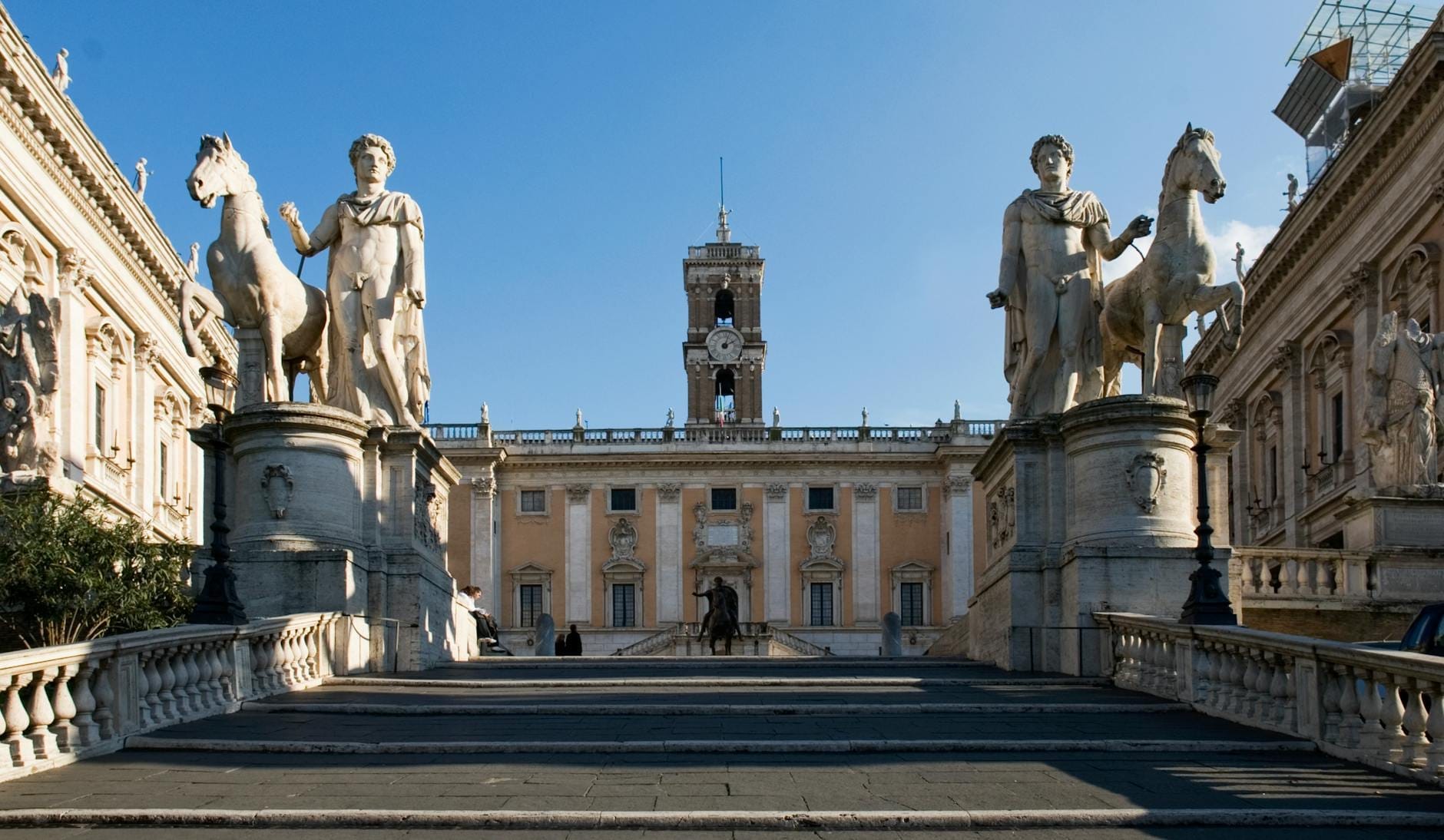
What Capitoline Hill Actually Is
Capitoline Hill, known in Italian as Piazza del Campidoglio, is the smallest of Rome's seven hills and, by any measure, the most historically loaded. Its summit has been continuously occupied since at least the 17th century BC, according to archaeological evidence from the Bronze Age. The ancient Romans considered it the spiritual and political apex of their world: the Temple of Jupiter Optimus Maximus stood here, a structure measuring roughly 53 by 63 meters and one of the largest sacred buildings in the Roman world.
Today the hill serves two very different functions simultaneously. It is Rome's working city hall, home to the Palazzo Senatorio and Rome's municipal administration. And it is one of the most architecturally significant public spaces in Italy, shaped by Michelangelo's 16th-century design into a composition that still draws architects from around the world to study it in person.
ℹ️ Good to know
The piazza itself, the Cordonata staircase, and the exterior views are entirely free to visit at any hour. You pay only to enter the Capitoline Museums inside Palazzo dei Conservatori and Palazzo Nuovo.
The Michelangelo Design: What to Look For
In 1536, Pope Paul III commissioned Michelangelo to redesign the hill's summit ahead of Holy Roman Emperor Charles V's visit to Rome. The result is a masterwork of Renaissance urban planning, though Michelangelo died in 1564 before it was completed. Workers followed his plans, and the piazza reached its current form over the following century.
The first thing you notice climbing the Cordonata, the wide ramped staircase designed specifically for horseback access, is that it draws the eye upward toward the twin palaces framing the space. These are Palazzo dei Conservatori on the right and Palazzo Nuovo on the left, their facades aligned at a slight angle rather than straight across. This is deliberate: the trapezoidal shape of the piazza corrects the optical distortion caused by the palaces' actual positions and creates an illusion of perfect symmetry. It is a trick of perception you can read about in any architecture textbook, but standing inside it is something else entirely.
At the center of the piazza stands an equestrian bronze statue of Marcus Aurelius, placed here in the 16th century. The statue you see is a high-quality replica; the original second-century AD bronze is preserved inside the Capitoline Museums' Palazzo dei Conservatori, protected from weather. The pavement's geometric oval pattern, also designed by Michelangelo, radiates outward from the statue's base in a twelve-pointed star that is most clearly visible from the upper landing of the Cordonata.
The Palazzo Senatorio at the far end remains Rome's city hall and is generally not open to visitors. Its bell tower houses the historic Patarina bell, which rings on Rome's official birthday, April 21st, and during mayoral elections. If you are researching the full civic and cultural context of this zone, the Piazza del Campidoglio detailed page covers the individual monuments in greater depth.
Tickets & tours
Live prices and dates from our booking partner. If you book, we may earn a commission at no extra cost to you.
Capitoline Museums Guided Tour with Multimedia Experience
From 80 €Instant confirmationFree cancellationCapitoline Museums experience with multimedia video
From 36 €Instant confirmationFree cancellationSt. Peter's Basilica, Vatican Museums, Sistine Chapel reserved entry
From 81 €Instant confirmationFree cancellationGuided tour of Galleria Borghese and of Villa Borghese gardens
From 69 €Instant confirmationFree cancellation
The Capitoline Museums: The World's Oldest Public Collection
The Capitoline Museums were founded in 1471 when Pope Sixtus IV donated a group of significant bronze sculptures to the Roman people. That makes them the oldest public museums in the world, predating the Louvre by more than three centuries. Today they occupy both Palazzo dei Conservatori and Palazzo Nuovo, connected by an underground corridor that passes beneath the piazza.
The collections span ancient Roman sculpture, Renaissance painting, and artifacts that trace Rome's history from its pre-Republican origins. Key works include the original Marcus Aurelius bronze, the Capitoline Wolf (a famous Etruscan or medieval bronze long associated with the founding myth of Rome), and the Dying Gaul, a Roman marble copy of a Hellenistic original that remains one of the most emotionally striking sculptures in any European museum.
Visitors planning a full museum day in Rome might pair this with the best museums in Rome guide to sequence their time efficiently. The Capitoline Museums are not quick — three to four hours is realistic if you engage seriously with the collection.
💡 Local tip
The rooftop terrace of Palazzo dei Conservatori offers an elevated view over the piazza and toward St. Peter's Basilica. It is included with museum admission and rarely crowded, even when the piazza below is packed.
Views Over the Roman Forum
The rear of the Palazzo Senatorio opens onto a terrace with one of Rome's most concentrated views: the entire Roman Forum stretched below, the Colosseum visible in the middle distance, and the Palatine Hill rising to the right. There is no admission fee for this viewpoint. You reach it by walking around the left side of the Palazzo Senatorio, through a passage that most visitors miss entirely.
Early morning, before 8:30 AM, this terrace is nearly empty. The light falls across the Forum from the east, catching the columns of the Temple of Saturn and the Arch of Septimius Severus in sharp relief. By midday, tour groups begin arriving and the space becomes crowded. Late afternoon, particularly in spring and autumn, the golden hour light on the ruins is extraordinary and the terrace fills again with photographers.
For a broader survey of Rome's finest panoramas, the best views in Rome guide covers additional vantage points across the city, from the Gianicolo to the Pincio terrace.
How the Hill Feels at Different Times of Day
Arriving at Capitoline Hill before 9 AM means sharing the Cordonata with local workers and the occasional early-rising tourist. The stone steps are cool underfoot, the air carries the scent of the cypress trees flanking the staircase, and the city noise from Piazza Venezia below is muffled enough that the hill feels genuinely separate from the chaos of the surrounding streets.
Between 10 AM and 2 PM, school groups and organized tours dominate the piazza. The space handles crowds reasonably well given its scale, but the Forum viewpoint becomes harder to enjoy. Midday in summer, the piazza's stone surfaces radiate heat and there is no shade of note. Bring water; there are no cafes immediately on the hill itself.
Evening visits, particularly between April and October, offer something different again. The hill is lit after dark, the equestrian statue of Marcus Aurelius glows under upward-pointing lights, and the Forum below is illuminated in a way that makes it look less like an excavation site and more like the civic center it once was. The piazza stays accessible after museum closing hours; only the museums themselves require daytime entry.
⚠️ What to skip
The Cordonata staircase surface is smooth travertine marble and becomes slippery when wet. Wear shoes with grip if visiting during or after rain.
Getting There and Practical Notes
Capitoline Hill sits directly above the southwestern end of Piazza Venezia, Rome's central traffic junction. Bus lines 40, 44, 63, and 160 all stop at Piazza Venezia, making it easily reachable from Termini station, the Vatican area, and the Campo de' Fiori. From the bus stop, you cross the piazza and the Cordonata entrance is immediately visible, marked by the statues of Castor and Pollux flanking the top of the ramp.
There is no metro station within comfortable walking distance. The nearest is Colosseo on Line B, about a 12-minute walk via the Roman Forum perimeter. Taxis can drop you at the base of Piazza Venezia; there is no vehicle access to the hill itself.
Accessibility is limited. The Cordonata ramp is wheelchair accessible, but several parts of the museum interior involve stairs with no lift alternatives. The Forum viewpoint at the rear of the Palazzo Senatorio is accessible by ramp. Contact the Capitoline Museums directly to confirm current accessibility provisions before planning a visit for those with mobility needs.
If you are walking a broader Centro Storico loop, Capitoline Hill connects naturally with the Roman Forum below and the Vittoriano monument directly across Piazza Venezia. The Centro Storico neighborhood page outlines a practical walking sequence linking these sites.
Who Should Temper Their Expectations
Visitors expecting a dramatic hill experience in the geographical sense will find this underwhelming. Capitoline Hill is the smallest and lowest of Rome's seven hills, and the approach via the Cordonata takes under two minutes. The piazza itself is smaller than many photographs suggest; the wide-angle compositions used in most travel images compress the surrounding buildings to make the space appear larger than it is.
If ancient Rome is your primary interest and you have limited time, the Roman Forum and Palatine Hill combined ticket gives you more archaeological depth for your effort. Capitoline Hill is at its most rewarding for visitors interested in the interplay between antiquity and Renaissance design, or for anyone who wants a free, accessible viewpoint over the Forum without buying an entry ticket to the archaeological site itself.
Insider Tips
- The Forum viewpoint at the rear of Palazzo Senatorio is free and reached by walking left around the building. Most visitors on the Cordonata never find it.
- The geometric pavement pattern Michelangelo designed is best seen from the top of the Cordonata, looking down, rather than from inside the piazza itself.
- The Patarina bell in the Palazzo Senatorio tower rings on April 21st, Rome's official birthday: if your visit falls near that date, the hill hosts civic ceremonies worth witnessing.
- Museum tickets can often be booked in advance online. Given that the Capitoline Museums hold the original Marcus Aurelius bronze and the Dying Gaul, the interior collection justifies the entry cost even if you have already seen the piazza.
- For evening visits, arrive around 30 minutes before sunset in spring and autumn. The westward light catches the Forum columns at a low angle and the hill is significantly less crowded than during peak daytime hours.
Who Is Capitoline Hill For?
- Architecture and urban design enthusiasts studying Michelangelo's Renaissance spatial planning
- History-focused travelers wanting the best free viewpoint over the Roman Forum
- Museum visitors prioritizing depth of ancient sculpture over volume of artifacts
- Photographers working early morning or golden hour light over the Forum
- Travelers building a Centro Storico walking day linking the Forum, Piazza Venezia, and the ancient core
Nearby Attractions
Other things to see while in Centro Storico:
- Ara Pacis
Commissioned in 13 BC to celebrate Augustus's campaigns in Gaul and Spain, the Ara Pacis Augustae is one of the best-preserved monuments of ancient Rome. Today it sits inside a striking modern pavilion on the Tiber's east bank, offering an unusually intimate encounter with imperial-era marble carving at near eye level.
- Campo de' Fiori
Campo de' Fiori is one of Rome's most recognizable piazzas, running a daily produce and flower market Monday through Saturday before reinventing itself as a lively social square after dark. Its paving stones have witnessed public executions, papal power, and centuries of commerce.
- Capitoline Museums
Perched atop Capitoline Hill overlooking the Roman Forum, the Musei Capitolini hold some of antiquity's greatest sculptures and paintings across three interconnected palaces. Founded in 1471, they predate the Louvre by more than three centuries and reward visitors with both iconic works and panoramic views that few Rome attractions can match.
- Fontana dei Quattro Fiumi
The Fontana dei Quattro Fiumi stands at the heart of Piazza Navona, a towering Baroque composition of four river gods, cascading water, and an ancient Egyptian obelisk. Commissioned by Pope Innocent X and completed by Gian Lorenzo Bernini in 1651, it remains one of the most theatrical public sculptures in Europe. Entry is free, and the piazza never closes.
Planning a trip? Discover personalized activities with the Nomado app.