Piazza del Campidoglio: Rome's Most Perfectly Designed Square
Commissioned by Pope Paul III and designed by Michelangelo in 1536, Piazza del Campidoglio crowns the Capitoline Hill with a geometric perfection that took over a century to complete. The square is free, open around the clock, and rewards visitors who linger well beyond a quick photo stop.
Quick Facts
- Location
- Piazza del Campidoglio, Capitoline Hill, Rome (Centro Storico)
- Getting There
- Multiple ATAC bus lines to Piazza Venezia; 5-minute walk up the Cordonata
- Time Needed
- 30–45 minutes for the square; add 2–3 hours for the Capitoline Museums
- Cost
- Free (square open 24/7); Capitoline Museums ticketed separately
- Best for
- Architecture enthusiasts, history lovers, panoramic views of the Roman Forum
What Is Piazza del Campidoglio?
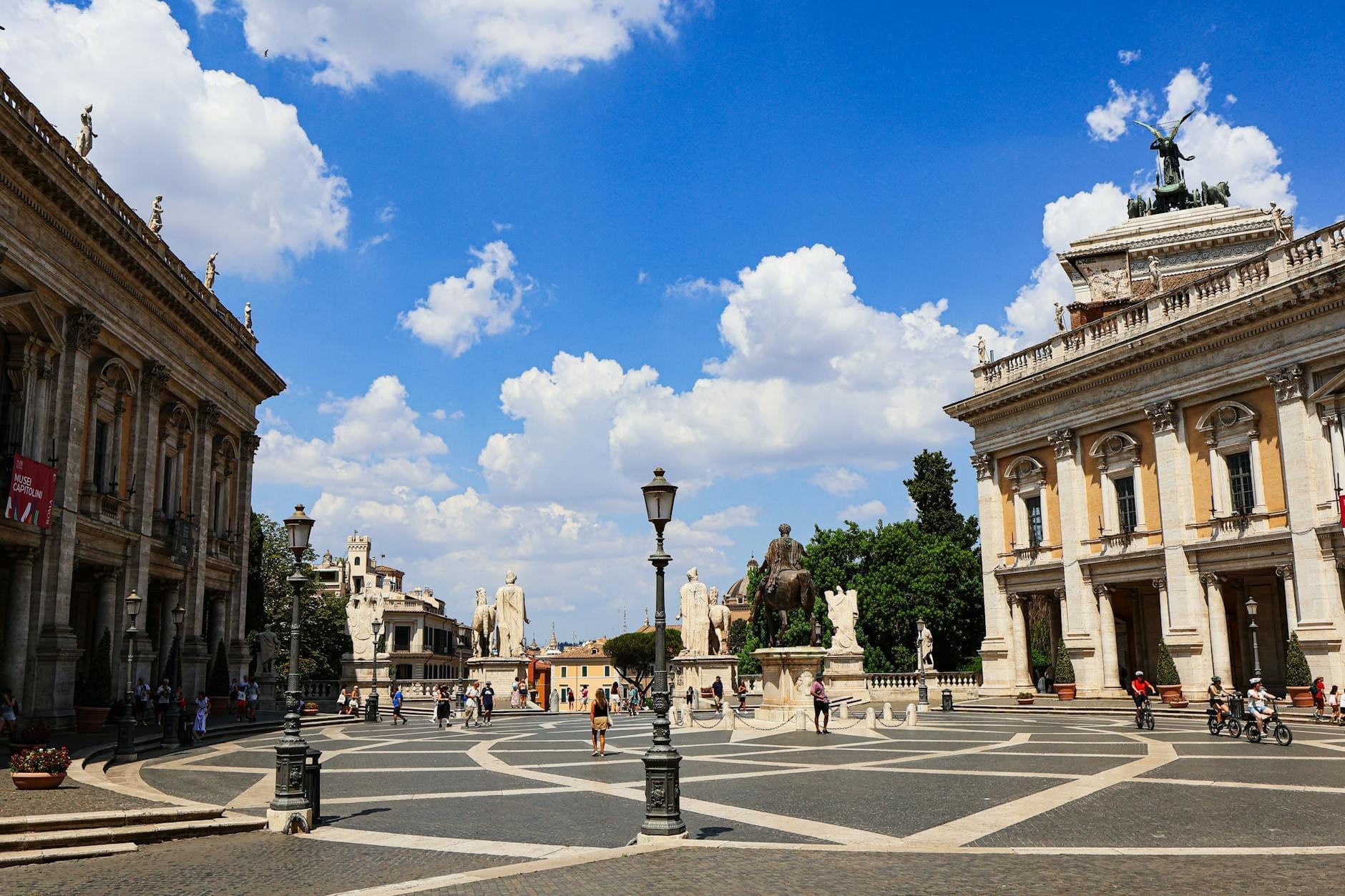
Piazza del Campidoglio sits atop the Capitoline Hill, the smallest but most historically loaded of Rome's seven hills. This was the religious and political heart of ancient Rome, home to the Temple of Jupiter Optimus Maximus. Today, the square is a Renaissance composition of extraordinary precision, designed by Michelangelo on papal commission and completed largely after his death in 1564.
The square anchors a neighborhood dense with world-class sites. The Roman Forum stretches out below its rear terrace. The Vittoriano monument looms just down the hill. And the Capitoline Museums, which flank the square on two sides, contain one of the great ancient art collections on earth.
💡 Local tip
Arrive before 8:30 AM or after 7:00 PM to have the square nearly to yourself. Midday, particularly in summer, it fills with large tour groups moving between the Vittoriano and the museums.
The Architecture: What Michelangelo Actually Designed
Pope Paul III commissioned the redesign of the Capitoline Hill in 1536, reportedly embarrassed by its dilapidated state ahead of Holy Roman Emperor Charles V's visit to Rome. Michelangelo's plan was radical for its time: instead of aligning the square toward the Vatican, he oriented it toward the city itself, toward the Roman people rather than the Church.
The defining feature is the oval pavement pattern, a twelve-pointed star radiating from the bronze equestrian statue of Marcus Aurelius at the center. What you see today is a replica installed in 1997; the original, dating to the 2nd century AD, is preserved inside the Capitoline Museums to protect it from pollution. The pavement geometry creates a subtle optical illusion: the oval appears convex when viewed from the top of the Cordonata staircase, giving the square a sense of rising to meet you.
Three palaces frame the space. Palazzo Senatorio, at the back, is the seat of Rome's municipal government and has been a site of civic power since the medieval period. Michelangelo redesigned its facade around 1546, adding the double staircase and the fountain below it. Palazzo dei Conservatori (right) and Palazzo Nuovo (left) face each other at precisely 80 degrees, not the 90 degrees you would expect, a deliberate choice to counteract perspective distortion when viewed from the entrance. Palazzo Nuovo was completed in 1603, over three decades after Michelangelo's death.
ℹ️ Good to know
The Cordonata, the wide ramped staircase leading up from Piazza d'Aracoeli, was designed wide enough for a horse to climb. It is flanked at the top by ancient statues of Castor and Pollux, the mythological twin patrons of Rome.
Tickets & tours
Live prices and dates from our booking partner. If you book, we may earn a commission at no extra cost to you.
Semi-private evening walking tour of Rome's piazzas and fountains
From 81 €Instant confirmationFree cancellationRome's underground and piazzas guided walking tour
From 95 €Instant confirmationFree cancellationReserved Entrance Ticket to Rome's Palazzo Altemps
From 30 €Instant confirmationFree cancellationReserved Entrance Ticket to Rome's Palazzo Braschi
From 32 €Instant confirmationFree cancellation
The Experience at Different Times of Day
Early morning is the best time to absorb the geometry. The low light from the east catches the travertine surfaces of the palace facades and casts long shadows across the pavement's radiating pattern. At this hour, the square belongs to a handful of photographers and the occasional city worker cutting through on their way to the municipal offices.
By mid-morning the organized groups arrive, often twenty or thirty people clustered around the Marcus Aurelius replica while a guide lectures in multiple languages. The physical space can handle the traffic, but the atmosphere shifts considerably. If your goal is contemplation or detailed architectural study, late afternoon is the better alternative: the western light turns the stonework golden, and the crowd thins as visitors move toward dinner.
At night, the square is floodlit and almost theatrical. The star-pattern pavement glows under artificial light, and the palaces take on a gravitas that can be harder to feel during daylight hours. The Forum ruins below are also illuminated, visible from the rear terrace of Palazzo Senatorio. Few visitors make the climb at night, which makes it the most genuinely quiet experience the square offers.
The View from the Rear Terrace
Walk around the right side of Palazzo Senatorio and you reach a small terrace overlooking the Roman Forum. It is not the highest vantage point in the city, but the angle is exceptional: you look directly down the length of the Forum toward the Arch of Titus and the Palatine Hill beyond. On clear days the outline of the Colosseum is visible to the right.
This terrace is often overlooked by visitors who stop at the front of the square and leave. It takes about two minutes to walk to, costs nothing, and provides a perspective on the Forum that is different from any available from street level. If you plan to explore the Forum itself afterward, this overview is a useful way to orient yourself before descending. The Palatine Hill and Forum are a short walk down the hill from here.
💡 Local tip
Photography tip: the terrace view toward the Forum is best in late afternoon when the light falls from the west across the ruins. Midday light is flat and harsh in summer.
Getting There and Practical Details
The square is free to enter and open at all hours. There are no tickets, no queues, and no bag checks. The Capitoline Museums, which occupy Palazzo dei Conservatori and Palazzo Nuovo, are separately ticketed and require advance booking in peak season.
The most convenient approach is from Piazza Venezia, a major bus hub served by numerous ATAC lines. From there, follow the signs toward the Vittoriano and look for the Cordonata staircase rising to the left of it. The ramp is gentle enough to be manageable with a stroller. Wheelchair access is available via the Cordonata itself. If you are combining the visit with the Roman Forum or Colosseum, those entrances are a 10-minute walk downhill from the rear of the Capitoline.
There are no cafes on the square itself. The Capitoline Museums have a rooftop bar and cafe that is open to museum ticket holders. For coffee before or after, the streets around Piazza Venezia have several standard Roman bars.
⚠️ What to skip
The streets around Piazza Venezia are among the most chaotic traffic intersections in Rome. Cross only at marked pedestrian crossings and do not assume vehicles will stop.
Historical Context: Why This Hill Matters
The Capitoline Hill carried enormous weight in antiquity. It was the site of Rome's most sacred temple, the Arx (the citadel), and the place where triumphs concluded when Roman generals processed up from the Forum after military victories. By the medieval period the hill had fallen into disrepair. When Michelangelo received his commission in the 1530s, he was not simply beautifying a square but reclaiming the symbolic center of Roman civic identity at a moment when the papacy was determined to project power after the traumatic Sack of Rome in 1527.
The choice to place an ancient pagan emperor, Marcus Aurelius, at the geometric heart of the square was deliberate and politically complex. The statue had survived antiquity largely because it was misidentified for centuries as Constantine, the first Christian emperor. Michelangelo's decision to center the entire composition on it signaled a Renaissance confidence in reclaiming classical heritage. For a deeper look at how ancient Rome layers beneath the modern city, the Ancient Rome neighborhood around the Forum provides essential context.
Who Should Skip This, and Who Should Not
If your sole interest is a quick selfie backdrop, the Spanish Steps or Trevi Fountain will serve you better in terms of crowd energy and Instagram familiarity. The Campidoglio rewards people who slow down: those who notice how the pavement pattern shifts as you walk across it, who stop to read the inscriptions on the bases of the flanking statues, who take the two extra minutes to reach the rear terrace.
Visitors primarily interested in art rather than architecture will get more value from combining this with a museum ticket. The Capitoline Museums hold not just the original Marcus Aurelius but also the Capitoline Wolf, Lupa Capitolina (though its dating is debated), an extensive collection of ancient portrait busts, and Caravaggio paintings in the Pinacoteca. The square alone, without the museums, is a 20 to 30 minute stop.
Insider Tips
- Visit after dark on a weeknight rather than a weekend. The floodlighting is identical both evenings, but weeknight crowds are a fraction of Saturday night tourists.
- The pavement oval is best appreciated from the top of the Cordonata, not from within the square itself. Pause at the entrance before walking down.
- The Capitoline Museums connect internally between Palazzo dei Conservatori and Palazzo Nuovo via an underground passage that passes beneath the square. Museum visitors can see the original Marcus Aurelius equestrian statue and compare it with the replica in the center of the piazza.
- Look up at the two Dioscuri statues (Castor and Pollux) flanking the entrance: these were found in the 16th century in the Ghetto area and date to the 1st or 2nd century AD, repaired and repositioned multiple times before landing here.
- If you are visiting the Roman Forum the same day, the Campidoglio rear terrace gives you a free elevated preview of the layout, helping you navigate the Forum more efficiently once you are inside.
Who Is Piazza del Campidoglio For?
- Architecture and design enthusiasts interested in Renaissance urban planning
- History travelers tracing the layers from ancient Rome through the papal period
- Photographers seeking Forum views from a high angle at golden hour
- Visitors planning a Capitoline Museums visit who want to understand the square's spatial design first
- Evening walkers looking for a quiet, illuminated space away from the most crowded nighttime sites
Nearby Attractions
Other things to see while in Centro Storico:
- Ara Pacis
Commissioned in 13 BC to celebrate Augustus's campaigns in Gaul and Spain, the Ara Pacis Augustae is one of the best-preserved monuments of ancient Rome. Today it sits inside a striking modern pavilion on the Tiber's east bank, offering an unusually intimate encounter with imperial-era marble carving at near eye level.
- Campo de' Fiori
Campo de' Fiori is one of Rome's most recognizable piazzas, running a daily produce and flower market Monday through Saturday before reinventing itself as a lively social square after dark. Its paving stones have witnessed public executions, papal power, and centuries of commerce.
- Capitoline Hill
Capitoline Hill sits at the symbolic center of Rome, where Michelangelo's perfectly proportioned piazza crowns a site inhabited since the Bronze Age. Today it holds the world's oldest public museums, Rome's city hall, and some of the most striking views over the Roman Forum in the city.
- Capitoline Museums
Perched atop Capitoline Hill overlooking the Roman Forum, the Musei Capitolini hold some of antiquity's greatest sculptures and paintings across three interconnected palaces. Founded in 1471, they predate the Louvre by more than three centuries and reward visitors with both iconic works and panoramic views that few Rome attractions can match.
Planning a trip? Discover personalized activities with the Nomado app.