Ara Pacis Augustae: Rome's Altar of Peace and What It Actually Shows You
Commissioned in 13 BC to celebrate Augustus's campaigns in Gaul and Spain, the Ara Pacis Augustae is one of the best-preserved monuments of ancient Rome. Today it sits inside a striking modern pavilion on the Tiber's east bank, offering an unusually intimate encounter with imperial-era marble carving at near eye level.
Quick Facts
- Location
- Lungotevere in Augusta, 00186 Roma – Campo Marzio district, Centro Storico
- Getting There
- Metro A: Flaminio (approx. 700 m walk); multiple buses along Lungotevere
- Time Needed
- 45–90 minutes for a thorough visit
- Cost
- Adults €15; ages 6–25 €10; under 6 free. Roma Pass accepted. Verify current prices before visiting.
- Best for
- Ancient history enthusiasts, sculpture lovers, travelers who want to slow down and look closely
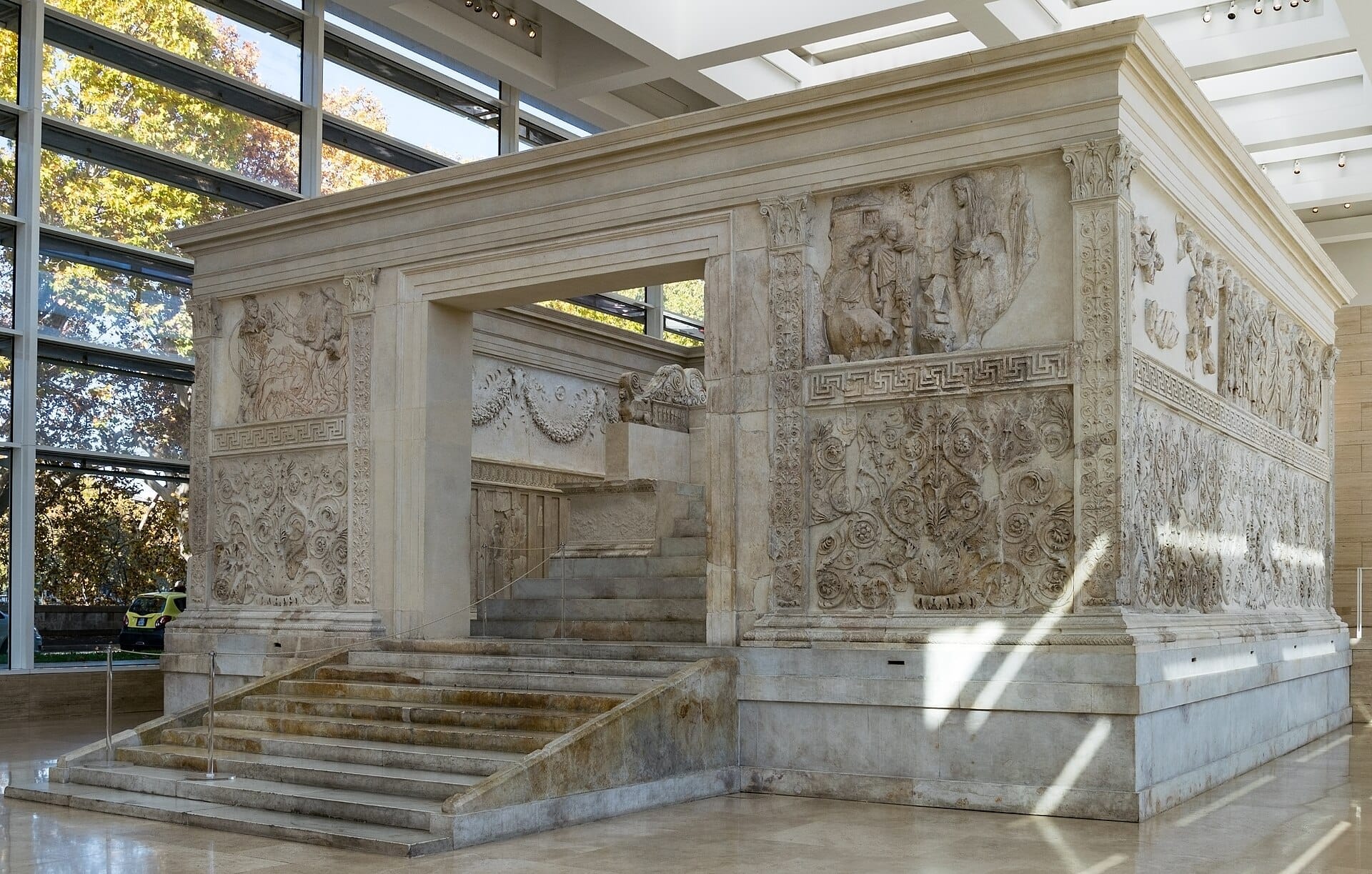
What the Ara Pacis Actually Is
The Ara Pacis Augustae is a marble altar enclosed within a nearly complete exterior screen, commissioned by the Roman Senate on July 4, 13 BC to mark the return of Augustus from his campaigns in Gaul and Hispania. It was consecrated on January 30, 9 BC. The altar celebrates the Pax Romana, the era of relative peace that Augustus imposed across the Mediterranean world after decades of civil war. In practical terms, it is one of the finest surviving examples of Roman relief sculpture anywhere on earth, and unlike the Colosseum or the Roman Forum, you can get close enough to read individual faces and fingers.
The altar originally stood in the Campus Martius, the flat plain north of Rome's ancient center. Over centuries it sank under roughly four meters of silt. Fragments were identified and excavated across multiple centuries, but the major recovery effort happened in 1937 and 1938 under Mussolini, who saw political value in aligning his regime with Augustan imagery. The reassembled monument was housed in a purpose-built structure near the Mausoleum of Augustus, and in 2006 that structure was replaced by the current glass-and-travertine pavilion designed by American architect Richard Meier.
ℹ️ Good to know
The Meier pavilion was controversial from the moment it opened: many Romans felt a modernist glass box clashed with the surrounding neoclassical and ancient fabric of the area. Whatever you think of the architecture, it does its primary job well, protecting the marble from the elements and flooding the interior with natural light.
Reading the Reliefs: What to Look For
The exterior screen is divided into four sides, each carrying different imagery. The long north and south flanks show a procession of actual historical figures: Augustus himself, the imperial family, priests, and senators moving in a solemn religious procession. Art historians have spent decades debating the identities of individual figures, but even a casual visitor can pick out telling details: a child tugging at an adult's toga, a priest whose face turns slightly away from the viewer, the subtle differentiation in how children and senators are carved to suggest depth and hierarchy.
The short east and west ends carry allegorical and mythological panels. The most discussed surviving panel on the east end depicts a seated female figure, almost certainly personifying either Peace or Italy, surrounded by abundant vegetation, two children, and animals. It is a compact image of prosperity, calm, and natural abundance, and the carving here is exceptional: fruit, cattle, water, and human figures are layered with a confidence that later relief carving struggled to match. The west end shows panels referencing Rome's founding mythology.
Below the figural friezes, a continuous band of acanthus scrollwork runs around the entire base. This is where many visitors stop paying attention, which is a mistake. The scrollwork is extraordinarily precise and inventive: look for small animals and insects worked into the foliage, barely visible unless you crouch slightly and examine it in the lateral light that streams through Meier's glass walls in the morning hours.
Tickets & tours
Live prices and dates from our booking partner. If you book, we may earn a commission at no extra cost to you.
Combined access to Castel Sant'Angelo and Ara Pacis Museum
From 49 €Instant confirmationFree cancellationTicket to Ara Pacis, Castel Sant'Angelo and Hop-on Hop-off Boat Tour
From 61 €Instant confirmationFree cancellationAra Pacis Museum Skip-the-Line Ticket
From 25 €Instant confirmationFree cancellationAra Pacis Ticket and Hop-On Hop-Off Boat Tour in Rome
From 41 €Instant confirmationFree cancellation
The Richard Meier Pavilion: Worth Judging on Its Own Terms
The pavilion that houses the Ara Pacis opened in 2006 and remains the only significant post-war building in the historic center of Rome, which explains the strong feelings it generates. Meier used white travertine, glass, and steel to create a structure that is deliberately transparent: the altar is visible from outside through the glass walls, and from inside you look out across the Tiber. The building frames the monument rather than hiding it.
From a practical standpoint, the pavilion is climate-controlled, accessible, and equipped with good interpretive materials in English and Italian. The quality of natural light inside changes significantly across the day. Morning visits, when low light enters from the east through the glass facade, are better for reading the acanthus scrollwork and the lower registers of the processional frieze. Afternoon light is flatter but makes the upper figural panels easier to photograph without harsh shadows.
💡 Local tip
Arrive when the museum opens to get the best light for photography and to walk the perimeter of the altar without other visitors in your frame. The processional friezes photograph cleanly from the rope line on the north and south sides.
Historical Context: Why Augustus Built This, and Why It Matters
Augustus was Rome's first emperor in practice if not in title, and his entire political project depended on convincing Rome that his rule represented stability after the trauma of civil war. The Ara Pacis was one of several monumental projects coordinated to communicate that message. It sits within a larger complex that included the Mausoleum of Augustus (still visible nearby, though closed for renovation for many years) and the Horologium Augusti, a vast sundial whose shadow supposedly fell on the altar on Augustus's birthday.
The choice of Parian marble, imported from the Aegean, was itself a statement. The level of craftsmanship on the processional friezes represented the finest Greek-trained sculptors working in Rome. The altar was not just a religious object: it was a political broadcast in stone, carefully engineered to associate Augustus's rule with divine favor, dynastic continuity, and the blessings of peace.
For a broader understanding of how Augustus reshaped Rome's public spaces, the Roman Forum and the Palatine Hill provide essential context. Augustus lived on the Palatine, and his house there is part of the same ideological landscape.
Planning Your Visit: Times, Crowds, and Logistics
The Ara Pacis Museum is in the northern part of the Centro Storico, close to the Tiber and within easy walking distance of Piazza del Popolo and the Spanish Steps. The nearest metro stop is Spagna on Line A, roughly a 400-meter walk. Several bus lines run along Lungotevere in Augusta. The area is flat and entirely walkable from the heart of the historic center.
Crowd patterns here differ from Rome's major sites. The Ara Pacis does not attract the same volume of visitors as the Colosseum or the Vatican Museums, which means it is genuinely possible to have sections of the altar to yourself on a weekday morning. Weekend afternoons are busiest, particularly when tour groups arrive. Because the space is enclosed and relatively compact, even moderate crowds can feel tight around the altar.
Opening hours and ticket prices are subject to change. Admission as of the latest available data is €14 for adults and €8.50 for ages 6 to 25, with free entry for children under 6. The Roma Pass covers admission. Always confirm current hours on the official Turismo Roma page before your visit, as municipal museums in Rome adjust schedules seasonally and for holidays.
⚠️ What to skip
The surrounding area on Lungotevere can be chaotic during peak traffic hours, with heavy vehicle noise audible inside the pavilion. This does not affect the experience of looking at the altar but is worth knowing if you are sensitive to ambient noise.
If you are building a half-day itinerary around this area, the Piazza del Popolo is a ten-minute walk north, and the Villa Borghese gardens are a short distance beyond that.
Who Will Get the Most Out of This Visit
Visitors who spend time with the interpretive materials and move slowly around the altar will leave with a genuinely memorable experience. The Ara Pacis rewards careful attention in a way that many larger monuments do not: the individual details of the carving, the political subtext of the imagery, and the sheer improbability of its survival make it compelling to anyone with an interest in ancient history or art.
Travelers who are less engaged with the specifics of Roman history may find the experience brief and slightly underwhelming. The altar is not large, the pavilion is spare, and if you walk through without reading the panels or engaging with the context, you can be done in fifteen minutes feeling like you missed something. This is an attraction that benefits from preparation: reading even a short summary of Augustan Rome before you arrive will transform what you see.
Families with older children who enjoy history will find it worthwhile. Younger children may find the Rome with kids guide useful for planning a broader itinerary that balances sites like this with more active experiences.
Accessibility is generally good. The modern pavilion is designed with ramps and level access in mind, and the altar itself is viewable from multiple angles without needing to climb. Visitors with mobility considerations should confirm the current accessibility provisions with the museum directly.
Insider Tips
- Stand at the southeast corner of the altar in the morning and look along the south processional frieze with the light coming from the east: this is the angle that best reveals the spatial depth of the carving, showing how Roman sculptors used shallow relief to imply a crowd of figures extending back into space.
- The acanthus scrollwork on the lower register is easy to overlook but arguably the most technically accomplished carving on the monument. Crouch slightly and look for birds and small creatures worked into the foliage, visible only in raking light.
- The Mausoleum of Augustus, located directly across the road, has been under restoration for years but is increasingly visible as work progresses. It provides immediate physical context for the Ara Pacis as part of a larger dynastic complex.
- If you have a Roma Pass, the Ara Pacis counts as one of your included admissions. For visitors doing multiple municipal museums in the same trip, it is worth factoring this into your pass strategy.
- The museum shop carries a well-curated selection of academic and popular books on Augustan Rome and Roman sculpture, including titles not easily found elsewhere in the city. Worth a browse even if you do not buy.
Who Is Ara Pacis For?
- Ancient history enthusiasts who want close access to first-rate Roman sculpture without large crowds
- Art historians and architecture students interested in both the altar and the Meier pavilion debate
- Slow travelers building a thoughtful itinerary around the northern Centro Storico
- Visitors with a Roma Pass who want to maximize their admission coverage
- Anyone who has seen the Roman Forum and wants to understand the Augustan political program in more depth
Nearby Attractions
Other things to see while in Centro Storico:
- Campo de' Fiori
Campo de' Fiori is one of Rome's most recognizable piazzas, running a daily produce and flower market Monday through Saturday before reinventing itself as a lively social square after dark. Its paving stones have witnessed public executions, papal power, and centuries of commerce.
- Capitoline Hill
Capitoline Hill sits at the symbolic center of Rome, where Michelangelo's perfectly proportioned piazza crowns a site inhabited since the Bronze Age. Today it holds the world's oldest public museums, Rome's city hall, and some of the most striking views over the Roman Forum in the city.
- Capitoline Museums
Perched atop Capitoline Hill overlooking the Roman Forum, the Musei Capitolini hold some of antiquity's greatest sculptures and paintings across three interconnected palaces. Founded in 1471, they predate the Louvre by more than three centuries and reward visitors with both iconic works and panoramic views that few Rome attractions can match.
- Fontana dei Quattro Fiumi
The Fontana dei Quattro Fiumi stands at the heart of Piazza Navona, a towering Baroque composition of four river gods, cascading water, and an ancient Egyptian obelisk. Commissioned by Pope Innocent X and completed by Gian Lorenzo Bernini in 1651, it remains one of the most theatrical public sculptures in Europe. Entry is free, and the piazza never closes.
Planning a trip? Discover personalized activities with the Nomado app.