Fontana dei Quattro Fiumi: Bernini's Masterpiece at Piazza Navona
The Fontana dei Quattro Fiumi stands at the heart of Piazza Navona, a towering Baroque composition of four river gods, cascading water, and an ancient Egyptian obelisk. Commissioned by Pope Innocent X and completed by Gian Lorenzo Bernini in 1651, it remains one of the most theatrical public sculptures in Europe. Entry is free, and the piazza never closes.
Quick Facts
- Location
- Piazza Navona, 00186 Rome (Centro Storico)
- Getting There
- Bus lines 40, 46, 62, 64, 70, 87, 492 to Corso Vittorio Emanuele II;
- Time Needed
- 20–45 minutes at the fountain; 1–2 hours for the full piazza
- Cost
- Free — open-air public fountain, no ticket required
- Best for
- Baroque architecture, history lovers, evening strolls, photography
What You're Looking At
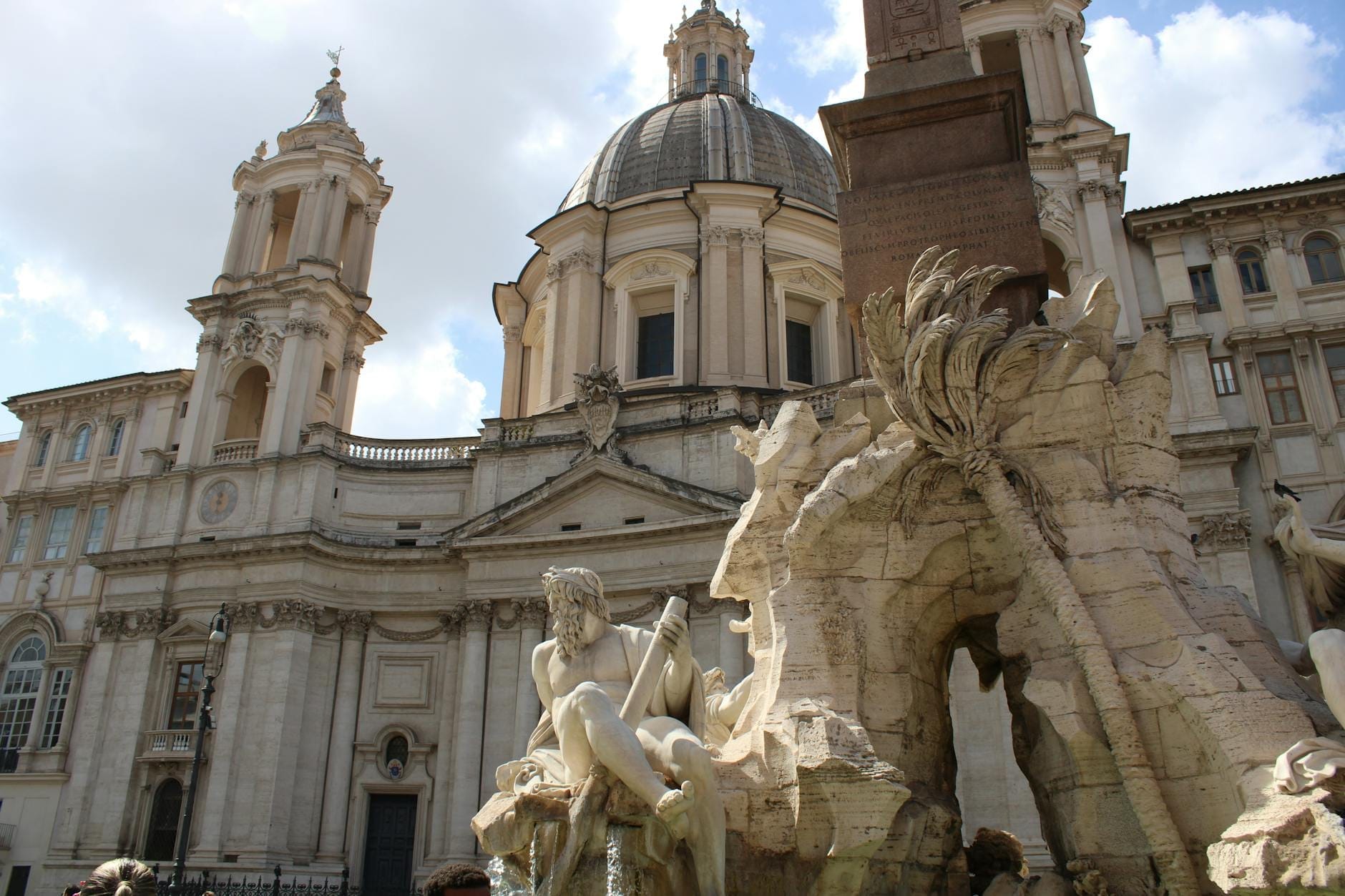
The Fontana dei Quattro Fiumi, completed in 1651, is not simply a fountain. It is a statement of papal power rendered in travertine, marble, and water. At its base, four colossal river gods recline around a hollowed rock formation: the Nile (with his face veiled, representing the then-unknown source of the river), the Danube, the Ganges, and the Rio della Plata. Above them rises a genuine ancient Egyptian obelisk, originally from the Circus of Maxentius on the Appian Way, topped with the Pamphilj family dove. The whole composition reaches roughly 26 metres from the pavement to the tip of the obelisk.
Bernini did not win this commission easily. Pope Innocent X initially favoured his rival Francesco Borromini, who was already at work on the adjacent church of Sant'Agnese in Agone. According to long-standing tradition, Bernini outmanoeuvred the pope's opposition by arranging for a silver model of his design to be placed where Innocent X would encounter it. Whether entirely true or not, the story reflects something real about Bernini's genius for spectacle and self-promotion, qualities that are written into every surface of the fountain itself.
ℹ️ Good to know
The fountain is free to view at any hour. Piazza Navona itself is a pedestrian-only square, so you can walk right up to the base and examine the sculpture from every angle without barriers.
The Piazza Context: Why the Setting Matters
Piazza Navona is built over the footprint of the ancient Stadium of Domitian, constructed around 85 AD. The elongated oval shape of the square directly traces the original track, and the Stadium of Domitian can actually be visited in the excavated ruins beneath the northern end of the piazza. Walking the perimeter of the square, you are essentially walking the circuit of a 30,000-seat Roman athletics stadium.
The fountain sits at the exact centre of this oval, which is not accidental. Innocent X used his commission to anchor Baroque Rome's most theatrical public space. The surrounding palaces, including Palazzo Pamphilj on the western flank, and the churches framing the ends of the square, were all orchestrated as a unified urban composition. When you stand at the fountain and look south, you are looking down a space that has functioned as a stage for public life, markets, and festivals for nearly four centuries.
Tickets & tours
Live prices and dates from our booking partner. If you book, we may earn a commission at no extra cost to you.
Fiumicino airport to Vatican City direct bus transfer
From 6 €Instant confirmationRoundtrip Transfer Ticket From Rome Fiumicino Airport To Vatican
From 7 €Instant confirmationFree cancellationBus transfer between Fiumicino airport and Rome city center
From 8 €Instant confirmationFree cancellationTransfer between Rome city center and Fiumicino Airport
From 7 €Instant confirmationFree cancellation
How the Fountain Changes Through the Day
Early morning, before 8am, is when the fountain shows itself most clearly. The café chairs are still stacked, the tour groups have not arrived, and the water catches the low eastern light in a way that makes the travertine glow pale gold. The sound of the water is actually audible at this hour, a steady, layered rush from multiple jets, which gets completely swallowed by crowd noise and street performers by mid-morning.
Midday between June and August is genuinely uncomfortable. The piazza faces south and offers almost no shade near the fountain. Temperatures regularly exceed 30°C, and the square fills with tour groups circling the fountain in waves. If a midday visit is unavoidable, the fountain itself provides no relief, but the narrow streets immediately east and west of the piazza are shaded and cooler within two minutes of walking.
Evening is the piazza's best mode. From around 7pm, the light softens, the temperature drops, and the fountain is illuminated from below, turning the white marble figures dramatic against the darkening sky. The square fills with Romans as well as visitors at this hour, which shifts the atmosphere considerably. Street musicians and portrait artists set up along the western colonnade. It becomes genuinely pleasant rather than merely historical.
💡 Local tip
For photography, arrive just after sunrise or return just after dark. At night, the uplighting on the fountain eliminates the flat midday shadows and reveals the depth and movement in Bernini's sculpted drapery and anatomy.
Reading the Four River Gods
Each of the four figures represents a major river from a different known continent, a deliberate symbol of papal authority extending across the known world. The Nile, facing toward Sant'Agnese in Agone, covers his face with a draped cloth. The popular (and appealing) story is that Bernini designed him to look away in horror from Borromini's church façade. In reality, the veil represents the then-unknown origin of the Nile, a geographical mystery that would not be solved until the nineteenth century. The story is a myth, but it has been repeated for so long that it has become part of the fountain's identity.
The Rio della Plata figure, representing the Americas, is shown with a raised arm that does appear to react to the church facade, and coins are scattered around his base, referencing New World wealth. The Danube, the largest of the four, faces the Palazzo Pamphilj. The Ganges holds a long oar. Each figure is accompanied by animals and flora associated with their respective regions: a horse, a lion, an armadillo, and a palm tree appear among the rocky base. These details reward close inspection and are easy to miss from a distance.
Getting There and Getting Around
Piazza Navona is car-free and sits in the heart of the Centro Storico. There is no metro stop directly adjacent: the nearest metro stations are Spagna or Barberini on Line A, both roughly a 20-minute walk away. More practical are the buses along Corso Vittorio Emanuele II, which runs one block south of the piazza. Lines 40, 46, 62, 64, 70, 87, and 492 all stop there. From Largo di Torre Argentina, a major bus hub about 8 minutes' walk to the southeast, you can reach the piazza on foot through the streets around Campo de' Fiori.
The Pantheon is roughly 5 minutes on foot to the east, which makes combining both in a single morning walk easy and logical. If you are planning a broader Centro Storico itinerary, the fountain fits naturally between the Pantheon and a detour north to the Palazzo Altemps, which houses part of the National Roman Museum collection.
⚠️ What to skip
There is no dedicated parking near Piazza Navona. If you are arriving by car, plan to park in a garage near Lungotevere and walk in. Driving directly to the piazza is not possible.
Who Should Temper Their Expectations
Visitors who find crowds genuinely difficult to navigate may want to plan carefully. At peak summer hours, Piazza Navona is one of the most densely visited spaces in central Rome. The fountain itself is not roped off or elevated, so in high season it can be completely surrounded by tour groups photographing from three metres away, which makes any contemplative viewing nearly impossible. If your interest is specifically in studying Bernini's sculptural technique, the morning or evening visits described above are not optional, they are necessary.
The fountain is also not an attraction that reveals itself through extended time spent. There is no interior to enter, no audio guide, no interpretive signage at the site itself. The experience is entirely visual and contextual. Visitors looking for deep dives into Baroque Rome may find more satisfaction pairing this with a church visit, such as nearby Santa Maria della Pace or the less-visited San Luigi dei Francesi, where Caravaggio's paintings are displayed.
Travelers working through Rome on a tight schedule will find this worth 20–30 minutes as part of a larger Centro Storico walk. For context on how to structure that, a three-day Rome itinerary can help prioritize how this fits among larger ticket items.
Insider Tips
- The fountain's obelisk was brought to Piazza Navona from the Circus of Maxentius on the Appian Way, not from Egypt. It is a Roman-era obelisk carved in the Egyptian style, which makes it historically distinct from the genuinely Egyptian obelisks elsewhere in Rome.
- The cafés along the western edge of Piazza Navona charge a significant premium for the view. For a coffee at normal Roman prices, walk one block in any direction. The quality of the espresso does not improve with the fountain backdrop.
- San Luigi dei Francesi, a 3-minute walk northeast of the piazza, contains three Caravaggio paintings in the Contarelli Chapel. It is free to enter and frequently overlooked by visitors who stop only at the fountain.
- The piazza floods on major feast days only as a tradition now discontinued, but historically the drainage channels in the square were closed in August and the piazza was deliberately flooded for summer cooling and carriage displays by the Roman nobility.
- If you circle the entire base of the fountain slowly, you will find the armadillo carved into the rock near the Rio della Plata figure, one of the earliest accurate representations of the animal in European monumental sculpture.
Who Is Fontana dei Quattro Fiumi For?
- Baroque art and architecture enthusiasts who want to see Bernini at his most theatrical
- First-time visitors to Rome building a classic Centro Storico walk
- Evening strollers looking for a landmark with atmosphere after dinner
- Photographers working the early morning golden hour or post-sunset uplighting
- Families with older children who can engage with the iconography of the four river gods
Nearby Attractions
Other things to see while in Centro Storico:
- Ara Pacis
Commissioned in 13 BC to celebrate Augustus's campaigns in Gaul and Spain, the Ara Pacis Augustae is one of the best-preserved monuments of ancient Rome. Today it sits inside a striking modern pavilion on the Tiber's east bank, offering an unusually intimate encounter with imperial-era marble carving at near eye level.
- Campo de' Fiori
Campo de' Fiori is one of Rome's most recognizable piazzas, running a daily produce and flower market Monday through Saturday before reinventing itself as a lively social square after dark. Its paving stones have witnessed public executions, papal power, and centuries of commerce.
- Capitoline Hill
Capitoline Hill sits at the symbolic center of Rome, where Michelangelo's perfectly proportioned piazza crowns a site inhabited since the Bronze Age. Today it holds the world's oldest public museums, Rome's city hall, and some of the most striking views over the Roman Forum in the city.
- Capitoline Museums
Perched atop Capitoline Hill overlooking the Roman Forum, the Musei Capitolini hold some of antiquity's greatest sculptures and paintings across three interconnected palaces. Founded in 1471, they predate the Louvre by more than three centuries and reward visitors with both iconic works and panoramic views that few Rome attractions can match.
Planning a trip? Discover personalized activities with the Nomado app.