Stadium of Domitian: The Ancient Stadium Hiding Under Piazza Navona
Beneath the cobblestones of Piazza Navona lies one of Rome's most unexpected archaeological sites. The Stadium of Domitian, built in 86 AD, is the only permanent masonry stadium ever constructed in ancient Rome, and it explains exactly why one of the world's most famous piazzas is shaped the way it is.
Quick Facts
- Location
- Via di Tor Sanguigna 3, beneath Piazza Navona, Centro Storico, Rome
- Getting There
- Bus to Senato stop (Piazza delle Cinque Lune); ~400m walk from Piazza Navona
- Time Needed
- 45–75 minutes (guided tour)
- Cost
- €10–€12 (audio guide included); guided tours from €38
- Best for
- History lovers, Roman archaeology, curious travelers seeking context behind Piazza Navona
- Official website
- stadiodomiziano.com/homepage-en
What Is the Stadium of Domitian?
The Stadio di Domiziano is a Roman archaeological site located 4.5 metres below the modern street level, directly beneath Piazza Navona. Emperor Domitian commissioned and inaugurated it in 86 AD as an athletics venue for the Certamen Capitolinus Iovi, a Greek-style games competition he introduced to Rome. It measured approximately 275 metres in length and 106 metres in width, holding a crowd of roughly 30,000 spectators. Critically, it was the first and only permanent masonry stadium built in ancient Rome, a distinction that sets it apart from the many wooden temporary structures of the era.
The shape of Piazza Navona is not coincidental. The piazza's elongated oval footprint traces the outline of the ancient stadium almost exactly. Over centuries, the surrounding tiers of seating became the foundations for medieval buildings, and the arena floor gradually rose to become the street-level square Romans and tourists know today. The Stadium of Domitian is, in the most literal sense, the skeleton of the piazza above it.
ℹ️ Good to know
Opening hours: Daily 10am–7pm (open every day of the year). Always verify current hours on the official site before visiting, as schedules can change seasonally.
The Experience: What You Actually See Underground
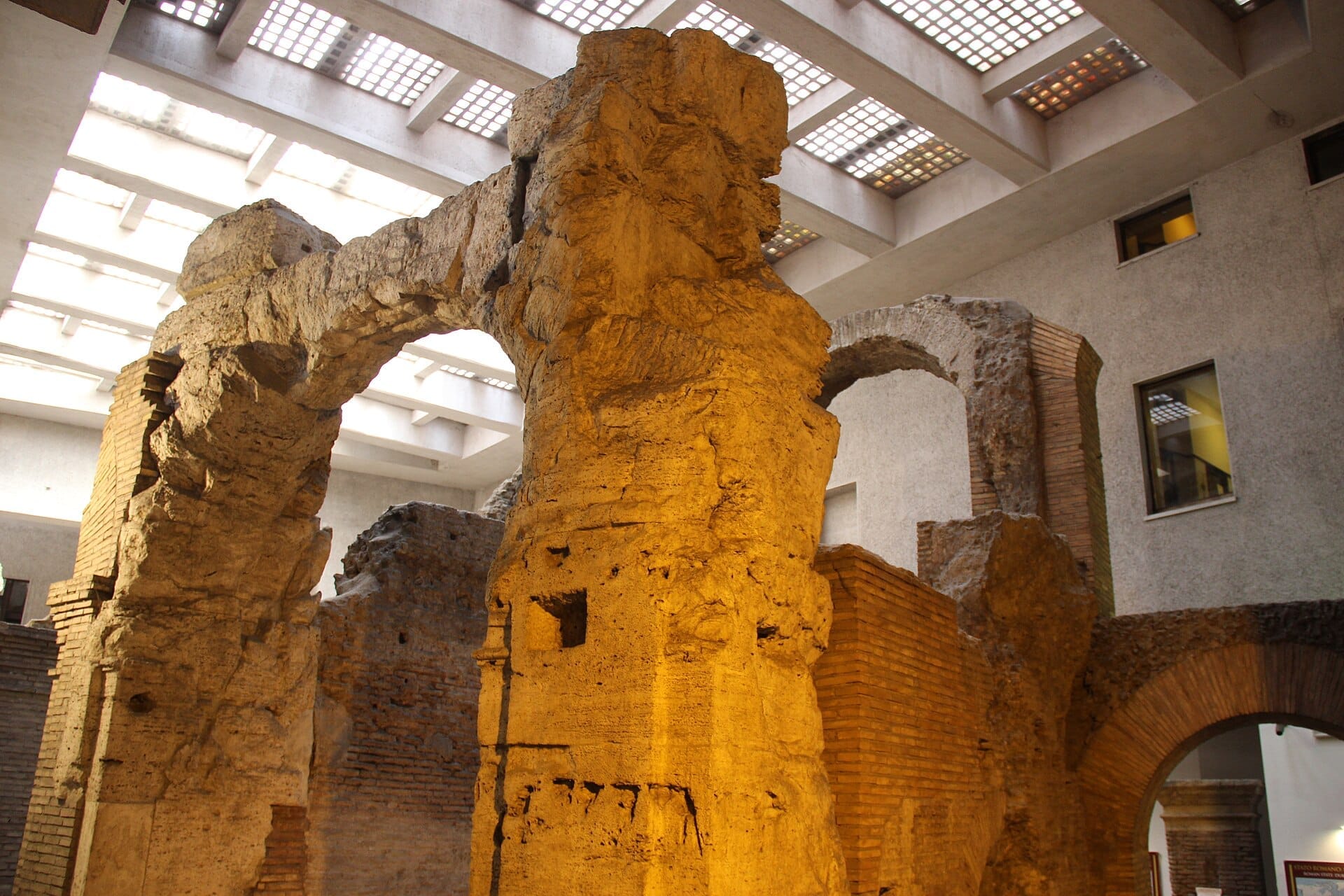
Entering through an unassuming doorway on Via di Tor Sanguigna, visitors descend into a genuinely atmospheric excavated space. The air cools noticeably as you go down, carrying that familiar mixture of damp stone and aged mortar that characterises Rome's subsurface. Once below, the scale of the original structure becomes evident in the exposed curved walls, arched passageways (known as vomitoria, used by crowds to exit rapidly), and stretches of original Roman brickwork that still show their herringbone opus reticulatum patterns.
The excavated section covers part of the northern curved end of the stadium, where the track would have rounded. Displays and reconstructions help visitors understand how the complete structure looked, including the tiered seating, the starting positions for races, and the ceremonial functions the space served. The audio guide, included in the base ticket price, provides detailed commentary that fills in the gaps between the physical remains.
Lighting is controlled and atmospheric, designed to highlight texture in the masonry rather than flood the space with harsh illumination. This works well for photography but means the site feels intimate rather than spectacular in scale. Visitors who expect a dramatic open arena on the scale of the Colosseum should recalibrate expectations: this is a narrow, corridor-like archaeological space, not a vast ruin. That said, the density of information and the quality of preserved masonry make it worth every minute for anyone seriously interested in Roman urban history.
💡 Local tip
Photography tip: The raking artificial lighting creates strong shadows on the Roman brickwork. A wide-angle lens or phone ultra-wide mode captures the curved passageways best. Tripods are generally not permitted in the narrow spaces.
Tickets & tours
Live prices and dates from our booking partner. If you book, we may earn a commission at no extra cost to you.
Historical Context: Domitian, Greek Games, and the Shape of a City
Domitian ruled from 81 to 96 AD, and his reign left a more significant physical mark on Rome than is commonly appreciated. Beyond the stadium, he reconstructed the Palatine Hill extensively and built the Domus Augustana. The stadium was part of his broader effort to introduce Greek cultural traditions to Rome, including nude athletics, which was a politically controversial move in Roman society at the time.
The Certamen Capitolinus Iovi games Domitian established featured competitions in music, oratory, and athletics, held every four years in imitation of the Greek quadrennial cycle. The stadium was purpose-built to host the athletic events, replacing the improvised temporary wooden structures Romans had previously used. Its construction in permanent masonry signalled an intention for these games to become a lasting Roman institution, though the games themselves faded after Domitian's assassination.
In late antiquity and the medieval period, the stadium's structure was gradually absorbed into the urban fabric. The curved northern end, the spina (central dividing spine), and the surrounding arcades all influenced how later buildings were arranged. By the Renaissance, Piazza Navona had fully formed over the site, and markets, festivals, and public life unfolded above what was, just metres below, one of the engineering achievements of the Roman world.
The relationship between ancient infrastructure and modern Roman street patterns is one of the city's defining characteristics. For a broader look at how Rome layers its history, the Basilica of San Clemente offers a comparable journey through multiple centuries of construction, descending through a medieval church, a 4th-century basilica, and a Mithraic temple in a single visit.
Timing Your Visit: Morning, Afternoon, or Avoiding August
Because the Stadium of Domitian is underground, time of day has essentially no effect on conditions inside. The temperature stays relatively constant, the lighting is entirely artificial, and crowd levels are the main variable. Mornings shortly after the 10am opening tend to be quieter, with tour groups arriving more frequently from late morning onward. Weekday visits are generally calmer than weekends throughout the year.
August is the important exception. The site remains open daily during August, which is when much of Rome's local population leaves the city and tourist density peaks. If your trip falls in August, book in advance and plan around the Saturday-Sunday schedule. For all other months, walk-in visits during the week are usually manageable without pre-booking, though busy periods around Easter and summer school holidays can fill tour slots.
⚠️ What to skip
Accessibility note: The site is not accessible to wheelchair users due to the descent and the narrow, uneven underground passages. Visitors with mobility limitations should check with the site directly before planning a visit.
Getting There and Combining With Piazza Navona
The entrance on Via di Tor Sanguigna is a short walk from Piazza Navona itself, roughly 400 metres from the piazza's northern end. Rome's bus network serves the area well, with stops at Piazza delle Cinque Lune (the Senato stop) placing visitors directly adjacent to both the piazza and the stadium entrance. The Centro Storico has no direct metro access, so buses or walking from metro stops such as Spagna or Barberini (both 20-25 minutes on foot) are the practical options.
The natural pairing is to visit the stadium first, then spend time on Piazza Navona itself. Standing above the piazza after seeing what lies below it changes how the space reads entirely. The Fountain of the Four Rivers at the piazza's centre, designed by Bernini in 1651, sits almost exactly where the ancient spina of the stadium once ran. That alignment is not accidental.
The Centro Storico rewards slow exploration. From Piazza Navona, the Pantheon is a ten-minute walk southeast, and the Campo de' Fiori is similarly close to the southwest. A well-planned half-day can take in all three without rushing.
Is the Stadium of Domitian Worth It?
The honest answer depends on what you are looking for. For travellers who find Roman archaeology intrinsically interesting, who want to understand why Piazza Navona looks the way it does, or who have already covered Rome's major sites and want something with genuine depth, the Stadium of Domitian is excellent value. The preserved masonry is impressive, the audio guide is informative, and the experience of being underground in a first-century Roman stadium is unlike anything above street level in the city.
For visitors on a short trip with limited time, this should probably come after the Colosseum, the Roman Forum, and the Palatine Hill. The site is a fragment of a larger structure, not a complete ruin, and some visitors find the underground corridor format less immediately arresting than open-air sites. Children may find it interesting but can also find the narrow, confined spaces and audio-guide format less engaging than outdoor archaeology.
Travellers interested in making the most of Rome's lesser-known archaeology should also consider the Domus Aurea, Nero's vast golden palace complex on the Oppian Hill, which offers a comparable underground experience with equally extraordinary historical weight. For guidance on structuring a broader Rome itinerary, a three-day Rome itinerary can help prioritise what to see when time is limited.
Insider Tips
- Book tickets directly through the official site at stadiodomiziano.com rather than third-party platforms to access the base €10–€12 admission price. Third-party guided tours start at significantly higher prices but include expert commentary beyond the audio guide.
- The site entrance on Via di Tor Sanguigna is easy to walk past. Look for the sign for 'Area Archeologica Stadio di Domiziano' on the building facade, not at street level on the pavement.
- Wear a light layer even in summer. The underground temperature stays consistently cooler than street level, which is welcome in July and August but can feel cold if you have been outside in heat for hours and then descend without a jacket.
- If you visit on a weekday morning, you may find yourself in a very small group or nearly alone with the audio guide, which makes the atmosphere considerably more immersive than a packed weekend tour slot.
- After visiting, walk the full perimeter of Piazza Navona and pay attention to the ground-floor facades of the buildings that ring the square. Several of them show medieval and Renaissance stonework built directly into or over the ancient stadium's outer arcade, a detail most visitors never notice.
Who Is Stadium of Domitian For?
- Roman history enthusiasts who want to understand the urban archaeology beneath Piazza Navona
- Repeat visitors to Rome who have already seen the major sites and want lesser-known depth
- Travellers visiting in summer who want a cool underground respite with genuine historical content
- Architecture and urban planning enthusiasts interested in how ancient structures shaped modern city layouts
- Solo travellers or couples who prefer intimate, unhurried archaeological experiences over large crowded sites
Nearby Attractions
Other things to see while in Centro Storico:
- Ara Pacis
Commissioned in 13 BC to celebrate Augustus's campaigns in Gaul and Spain, the Ara Pacis Augustae is one of the best-preserved monuments of ancient Rome. Today it sits inside a striking modern pavilion on the Tiber's east bank, offering an unusually intimate encounter with imperial-era marble carving at near eye level.
- Campo de' Fiori
Campo de' Fiori is one of Rome's most recognizable piazzas, running a daily produce and flower market Monday through Saturday before reinventing itself as a lively social square after dark. Its paving stones have witnessed public executions, papal power, and centuries of commerce.
- Capitoline Hill
Capitoline Hill sits at the symbolic center of Rome, where Michelangelo's perfectly proportioned piazza crowns a site inhabited since the Bronze Age. Today it holds the world's oldest public museums, Rome's city hall, and some of the most striking views over the Roman Forum in the city.
- Capitoline Museums
Perched atop Capitoline Hill overlooking the Roman Forum, the Musei Capitolini hold some of antiquity's greatest sculptures and paintings across three interconnected palaces. Founded in 1471, they predate the Louvre by more than three centuries and reward visitors with both iconic works and panoramic views that few Rome attractions can match.
Planning a trip? Discover personalized activities with the Nomado app.