Piazza del Popolo: Rome's Grand Northern Gateway
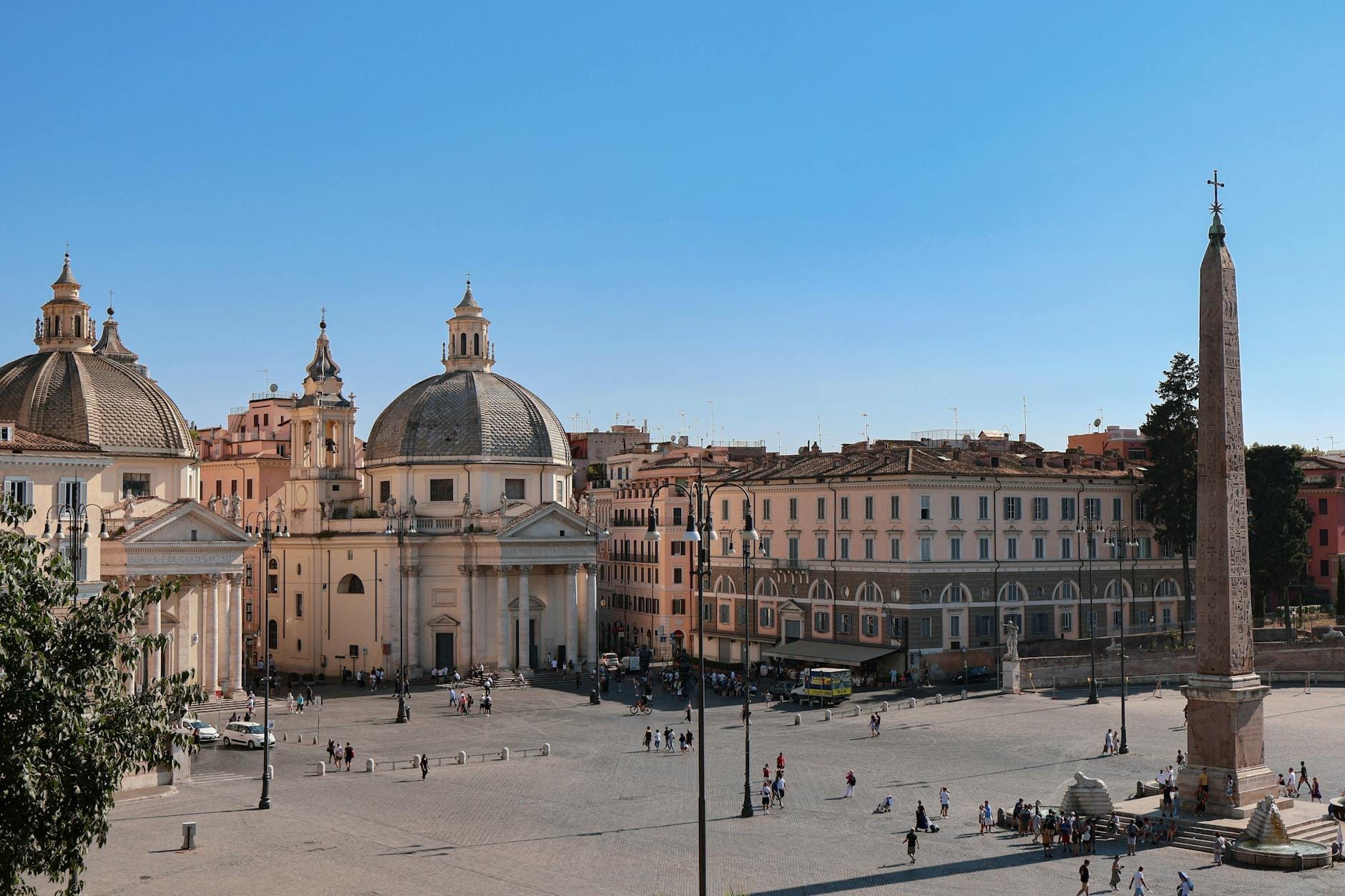
One of Rome's largest historic squares, Piazza del Popolo anchors the northern edge of the centro storico with a 3,200-year-old Egyptian obelisk, twin Baroque churches, and a sweeping oval layout redesigned in the early 19th century. Entry is free, it's open around the clock, and the surrounding terraces offer some of the best elevated views over the city.
Quick Facts
- Location
- Piazza del Popolo, 00187 Roma RM — northern edge of the Centro Storico
- Getting There
- Metro Line A, Flaminio station — exit directly onto the square
- Time Needed
- 30–60 minutes for the square itself; allow extra time if visiting the twin churches or climbing to the Pincio Terrace above
- Cost
- Free — open public space, no ticket required
- Best for
- Architecture lovers, photographers, early-morning walkers, and travelers arriving from the north
What Piazza del Popolo Actually Is
Piazza del Popolo is a large oval public square at the northern gateway of Rome's historic center, positioned where the ancient Via Flaminia enters the city through the old Aurelian Wall. The gate itself, originally called Porta Flaminia and built in the 3rd century AD under Emperor Aurelian, still stands at the northern end of the square and was later renamed Porta del Popolo. For centuries, arriving in Rome from the north meant passing through this gate, and the square was the first impression the city made on pilgrims, diplomats, and traders alike.
The layout you see today is largely the work of architect Giuseppe Valadier, who redesigned the square between 1811 and 1822 into the clean neoclassical oval it now forms. Before Valadier, the space was more irregular; his intervention introduced the symmetrical ramps, the flanking fountains, and the tiered terraces connecting the square to the Pincio hill above. It is one of the largest open spaces in the centro storico and feels genuinely airy in a city where most public spaces are hemmed in tightly by palaces and churches.
💡 Local tip
Metro Line A stops at Flaminio, which deposits you almost directly into the square from the south side. It is one of the most convenient major squares in Rome to reach by public transit.
The Flaminian Obelisk: 3,300 Years of History in One Stone
The centerpiece of the square is the Flaminian Obelisk, which stands approximately 23.9 meters tall including its base. The obelisk itself was carved in ancient Egypt around 1300 BC, during the reign of Ramesses II, and was later brought to Rome by Emperor Augustus to serve as the centerpiece of the Circus Maximus. It remained there for centuries until Pope Sixtus V ordered it moved to Piazza del Popolo in 1589, a project executed by architect Domenico Fontana. The four lions at its base, spouting water into shallow basins, were added in the 19th century as part of Valadier's redesign.
Standing directly beneath the obelisk and looking up gives a sense of the scale that photographs rarely convey. The hieroglyphs carved into its sides are still crisp in places, and the stone has a warm, slightly sandy texture in direct sunlight. This is genuinely one of the oldest objects in Rome, predating the city itself by several centuries.
Tickets & tours
Live prices and dates from our booking partner. If you book, we may earn a commission at no extra cost to you.
Semi-private evening walking tour of Rome's piazzas and fountains
From 81 €Instant confirmationFree cancellationRome's underground and piazzas guided walking tour
From 95 €Instant confirmationFree cancellationReserved Entrance Ticket to Rome's Palazzo Altemps
From 30 €Instant confirmationFree cancellationReserved Entrance Ticket to Rome's Palazzo Braschi
From 32 €Instant confirmationFree cancellation
The Twin Churches and the Trident
At the southern end of the square, two nearly identical Baroque churches face each other across a short gap: Santa Maria dei Miracoli (completed 1679) and Santa Maria in Montesanto (completed 1675), both designed with input from Carlo Rainaldi and later Gian Lorenzo Bernini and Carlo Fontana. They are not quite identical on close inspection — Santa Maria in Montesanto has an oval dome to accommodate its irregular plot, while Santa Maria dei Miracoli has a round dome — but from the square they read as a symmetrical pair framing the entrance to the city's historic core.
Between and beyond the two churches, three roads radiate southward into the city in a pattern Italians call the tridente, or trident. The central road is Via del Corso, Rome's main north-south artery. To the left runs Via del Babuino, leading toward the Spanish Steps; to the right, Via di Ripetta leads toward the river. This urban planning device, formalized in the 16th century, made Piazza del Popolo a deliberate orientation point for the city. Standing at the obelisk looking south down Via del Corso, you can see the axis extend for hundreds of meters with remarkable clarity.
If you want to explore what lies down those roads, the area around the Spanish Steps is a short walk along Via del Babuino, and the shopping street Via dei Condotti connects the two axes a few blocks south.
How the Square Changes by Time of Day
Early morning, roughly 7 to 9 AM, is when Piazza del Popolo is at its best. The light comes in low from the east and catches the obelisk at an angle, the fountains reflect orange and gold, and the square has a calm that feels almost private for somewhere this large. A handful of joggers cut through from the Villa Borghese gardens via the Pincio ramp, and locals walk small dogs around the perimeter. There is almost no tourist foot traffic at this hour.
By late morning, tour groups begin to arrive, typically disembarking from coaches parked along the northern edge near Porta del Popolo. The square remains spacious enough that it never feels genuinely overcrowded, but the mood shifts from contemplative to transactional. Gelato carts and souvenir stalls set up on the western side. Midday in summer brings intense heat; the square offers essentially no shade, and the stone radiates warmth. If you are visiting between June and August, avoid the 11 AM to 3 PM window unless you are heat-tolerant.
Late afternoon and early evening bring a softer light and a more local crowd, particularly on weekends. The terraces above the square on the Pincio side attract groups of young Romans who come to watch the sunset over the rooftops and domes to the west. The square is also fully lit at night, and the obelisk illuminated against a dark sky is a striking sight, though there is less pedestrian energy here after dark compared to squares like Campo de' Fiori or Piazza Navona.
⚠️ What to skip
The square is fully exposed and offers no shade structures. In summer, heat can be genuinely punishing between 11 AM and 3 PM. Bring water, wear sun protection, and consider visiting early morning or evening.
The Pincio Terrace: The View You Should Not Miss
Rising from the eastern side of the square, a long ramp and staircase climb to the Pincio Terrace, the raised garden platform that forms the southwestern edge of the Villa Borghese gardens. The terrace is technically part of the gardens rather than the square itself, but it is the natural continuation of any visit to Piazza del Popolo. From the main overlook at the top of the ramp, the view westward takes in the entire square below, the twin churches, the obelisk, and beyond them the dome of St. Peter's Basilica and dozens of smaller domes and bell towers stretching to the horizon.
This is one of the better free viewpoints in the city, particularly in the late afternoon when the light comes from behind you and falls on the square and roofline below. For a fuller rundown of elevated perspectives across the city, the guide to the best views in Rome covers this terrace alongside other vantage points. The Pincio Terrace itself is free to access and open during park hours.
Santa Maria del Popolo: The Church Worth Stepping Into
On the northern side of the square, tucked against the old city wall to the right of Porta del Popolo, stands Santa Maria del Popolo. This church is in a different category from the twin Baroque churches at the south end, both in age and in artistic importance. Founded in the 15th century and rebuilt over subsequent decades, it contains two paintings by Caravaggio in the Cerasi Chapel (the Conversion of Saint Paul and the Crucifixion of Saint Peter, both painted around 1600-1601), a chapel designed by Raphael, and funerary monuments by Andrea Sansovino. Admission to the church is free.
The Caravaggio paintings alone make this one of the more remarkable church interiors in Rome. The Cerasi Chapel is small and the paintings hang low on side walls, allowing unusually close inspection. This church tends to be less crowded than other Caravaggio sites in the city. For context on Rome's church architecture more broadly, the guide to the best churches in Rome places Santa Maria del Popolo within the wider landscape.
ℹ️ Good to know
Santa Maria del Popolo is on the north side of the square, to the right of the gate as you face it from inside the square. It is easy to walk past without noticing. Look for the Renaissance facade partially built into the old city wall.
Getting There and Getting Around
Metro Line A, Flaminio station, is the most direct option. The exit brings you out at the southern end of the square, between the twin churches, which is an excellent introduction to the space. The journey from Termini station takes roughly eight minutes. Bus routes also stop near the square along Via Flaminia to the north and Via del Corso to the south.
The square sits at the northern end of the centro storico and makes a logical starting point for a long walk south through the historic center. From here you can walk to the Pantheon in about 25 minutes on foot, or cut east to the Villa Borghese gardens. For a broader orientation to the neighborhood, the Centro Storico area guide covers the surrounding blocks in more detail.
Parking near the square is limited and the area is a ZTL (limited traffic zone), meaning most rental cars and non-resident vehicles cannot enter without a permit. Taxis can drop off near the square, but the metro is the cleaner option.
Photography Notes
The classic compositional shot is from the top of the Pincio ramp looking west over the square at golden hour. The obelisk, the twin domes, and the expanse of the piazza all sit within a single frame. For ground-level shots, the wide oval of the square works best with a wide-angle lens; the standard smartphone field of view will clip the corners at ground level. The lion fountains at the base of the obelisk photograph well in early morning when there are no people standing directly next to them. The Porta del Popolo gate at the north end has good architectural detail and is often overlooked by photographers who focus on the center of the square.
Insider Tips
- The twin churches at the south end of the square are not identical: Santa Maria in Montesanto has an oval dome (the plot was too narrow for a circular one), while Santa Maria dei Miracoli has a round dome. Standing directly between them makes the difference visible.
- Santa Maria del Popolo, tucked against the wall to the right of the northern gate, contains two original Caravaggio paintings in the Cerasi Chapel. Entry is free and the chapel is usually uncrowded. It takes about 15 minutes and is worth every one of them.
- The ramp up to the Pincio Terrace is on the eastern side of the square, next to the Egyptian-style fountain. The climb takes about five minutes on foot and delivers one of the best free views in Rome.
- If you are arriving from Fiumicino Airport by train and plan to start your Rome visit here, the FL1 regional train to Ostiense and then a metro connection to Flaminio is a reasonable option, though the Leonardo Express to Termini followed by Metro A is more straightforward.
- The square is used occasionally for public events and political gatherings, which can close off sections. If you are visiting on a weekend during spring or autumn, check local news briefly in case the space is partially restricted.
Who Is Piazza del Popolo For?
- Architecture and urban planning enthusiasts who want to understand how Rome's historic street grid was organized
- Photographers looking for wide, open compositions and elevated cityscape views from the Pincio Terrace
- Travelers who enjoy art church interiors: Santa Maria del Popolo offers Caravaggio, Raphael, and Sansovino in one free stop
- Early risers who want to experience a major Roman square before the crowds arrive
- First-time visitors using the square as a northern orientation point before walking south through the historic center
Nearby Attractions
Other things to see while in Centro Storico:
- Ara Pacis
Commissioned in 13 BC to celebrate Augustus's campaigns in Gaul and Spain, the Ara Pacis Augustae is one of the best-preserved monuments of ancient Rome. Today it sits inside a striking modern pavilion on the Tiber's east bank, offering an unusually intimate encounter with imperial-era marble carving at near eye level.
- Campo de' Fiori
Campo de' Fiori is one of Rome's most recognizable piazzas, running a daily produce and flower market Monday through Saturday before reinventing itself as a lively social square after dark. Its paving stones have witnessed public executions, papal power, and centuries of commerce.
- Capitoline Hill
Capitoline Hill sits at the symbolic center of Rome, where Michelangelo's perfectly proportioned piazza crowns a site inhabited since the Bronze Age. Today it holds the world's oldest public museums, Rome's city hall, and some of the most striking views over the Roman Forum in the city.
- Capitoline Museums
Perched atop Capitoline Hill overlooking the Roman Forum, the Musei Capitolini hold some of antiquity's greatest sculptures and paintings across three interconnected palaces. Founded in 1471, they predate the Louvre by more than three centuries and reward visitors with both iconic works and panoramic views that few Rome attractions can match.
Planning a trip? Discover personalized activities with the Nomado app.