Via dei Condotti: Rome's Grand Shopping Street with Deep Roots
Via dei Condotti is the spine of Rome's luxury quarter, stretching from Piazza di Spagna to Largo Carlo Goldoni. It is a free, pedestrian-friendly street lined with flagship boutiques, historic palaces, and one of Europe's oldest cafés. Whether you are window-shopping, photographing façades, or sipping espresso at Antico Caffè Greco, the street rewards visitors at almost any hour.
Quick Facts
- Location
- Via dei Condotti, Centro Storico, Rome — runs from Piazza di Spagna to Largo Carlo Goldoni
- Getting There
- Metro Line A, Spagna station (2-minute walk to the street's eastern end)
- Time Needed
- 30–90 minutes for the street itself; add time for Caffè Greco or window-shopping
- Cost
- Free (public street); boutiques and Caffè Greco charge their own prices
- Best for
- Architecture lovers, fashion-watchers, photographers, and anyone walking to or from the Spanish Steps
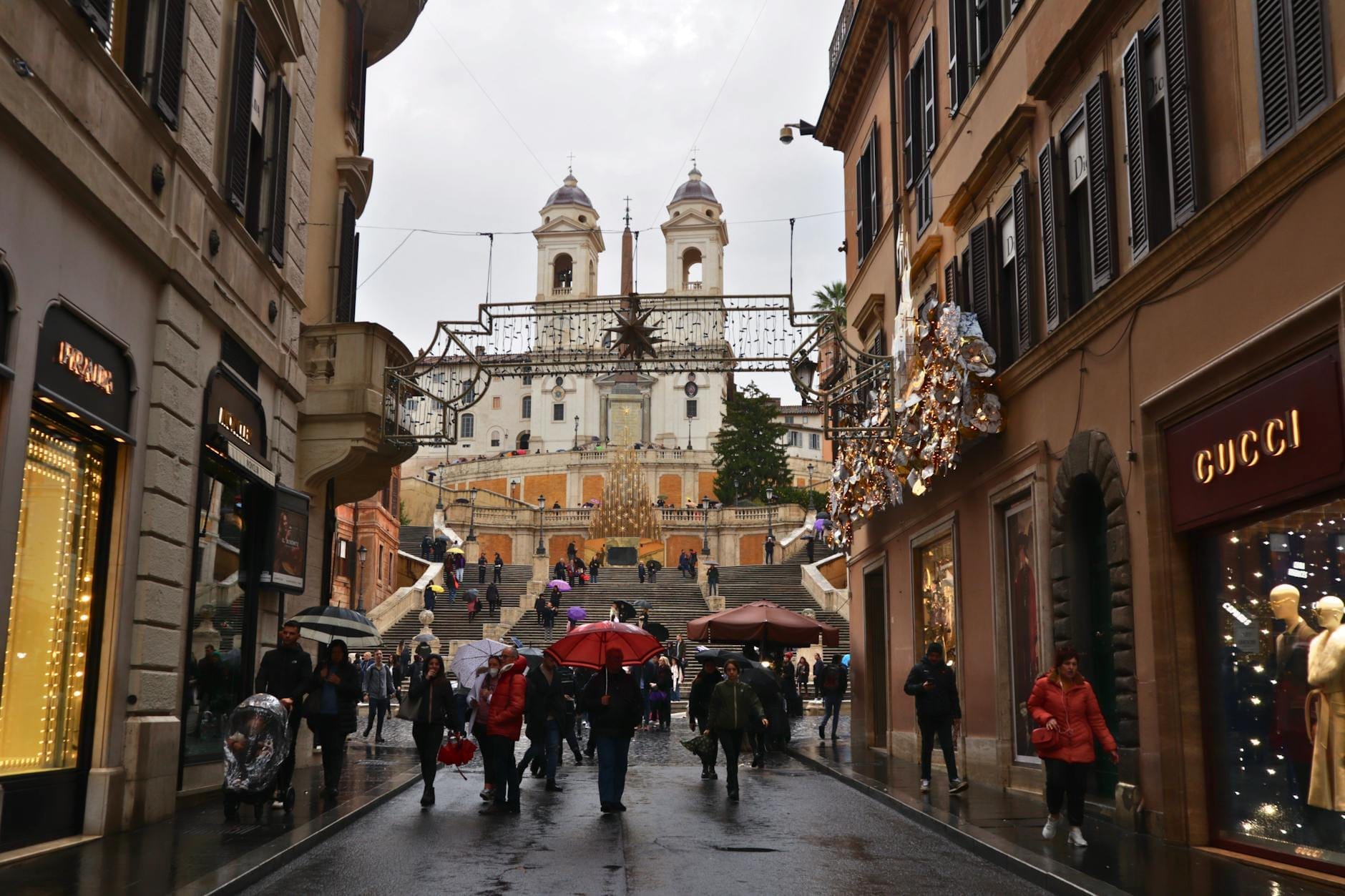
What Is Via dei Condotti?
Via dei Condotti is a short, straight street — roughly 300 metres long — that connects Piazza di Spagna at its eastern end to Largo Carlo Goldoni near Via del Corso to the west. It sits in the heart of Rome's Centro Storico shopping quarter, and for over a century it has been the address that luxury brands compete to occupy. Gucci, Prada, Louis Vuitton, Bulgari, Cartier, Valentino and Hermès all have flagship stores along the street or immediately adjacent to it.
Despite its upscale reputation, Via dei Condotti costs nothing to walk. The architecture, the window displays, the street life and the sight-line directly toward the Spanish Steps at the eastern end are all free. Treat it as an open-air showcase rather than a mandatory shopping destination, and it becomes one of the more satisfying short walks in the city.
💡 Local tip
For the classic postcard photograph — looking east along Via dei Condotti toward the Spanish Steps and the Trinità dei Monti church above — arrive in the early morning before the street fills with pedestrians. The light is also softer at that hour.
History: From Roman Aqueducts to Renaissance Streets
The street's name comes from 'condotti,' the Italian word for conduits or pipes. Beneath the paving stones run channels belonging to the Aqua Virgo, the ancient Roman aqueduct built in 19 BCE. That same water supply feeds the Trevi Fountain further east, making the hydrology beneath this street a thread connecting two of Rome's most visited spots.
The street in its current form was laid out in the 16th century as part of a broader urban renewal programme under Pope Paul III, formalising what had previously been a medieval route known as Via Trinitatis. The name referenced the church of Trinità dei Monti at the top of the hill, which is still visible from the street today. For more on the steps and church that anchor the view, see the full guide to the Spanish Steps and Trinità dei Monti.
By the 17th and 18th centuries, the area had become a gathering point for foreign visitors on the Grand Tour. English, French, and German travellers rented rooms in the streets around Piazza di Spagna, sketched the ruins, and socialised in the cafés. That cosmopolitan character has never entirely left the neighbourhood.
Tickets & tours
Live prices and dates from our booking partner. If you book, we may earn a commission at no extra cost to you.
Via Crucis Catholic Pilgrim Tour in Rome
From 95 €Instant confirmationFree cancellationLa Traviata: the Original Opera by Giuseppe Verdi
From 20 €Instant confirmationFree cancellationSt. Peter's Basilica, Vatican Museums, Sistine Chapel reserved entry
From 81 €Instant confirmationFree cancellationGuided tour of Galleria Borghese and of Villa Borghese gardens
From 69 €Instant confirmationFree cancellation
Antico Caffè Greco: The Street's Most Important Interior
At number 86 stands Antico Caffè Greco, which opened in 1760 and is considered one of the oldest continually operating cafés in Europe. The interior consists of a series of small, low-lit rooms with red velvet benches, dark wood panelling, and walls dense with portraits, mirrors, and memorabilia. The atmosphere is genuinely unlike any other café in Rome.
The guest book, metaphorically speaking, includes Goethe, Keats, Byron, Casanova, Liszt, and Stendhal. Whether or not those associations matter to you, the physical space is worth a look. Be aware: prices reflect the location and prestige. A standing espresso at the bar is considerably cheaper than table service in the back rooms, and the difference is significant.
ℹ️ Good to know
Antico Caffè Greco is a working café, not a museum. You are expected to order something. Standing at the bar for an espresso is the most economical and arguably the most Roman way to experience it.
The Street at Different Hours
Before 9:00 AM, Via dei Condotti belongs to delivery workers, café staff setting out chairs, and the occasional photographer. The stone paving is damp from overnight cleaning, the gates on boutiques are still rolled down, and you can walk the full length without stopping once. The sight-line to the Spanish Steps is clear in both directions.
By mid-morning, the street fills steadily. By noon it can feel congested, particularly in summer and around Easter or Christmas. The boutiques draw browsing visitors who slow the foot traffic even on a street that is only a few hundred metres long. Weekday mornings in spring or autumn are the most comfortable time to visit at a measured pace.
In the evening, the street takes on a different quality. Shops generally close between 7:00 and 8:00 PM, but the warm lighting in the window displays stays on after closing. On summer evenings, pedestrians spill out from Piazza di Spagna and the surrounding streets, and the lower half of Via dei Condotti becomes part of a slow evening passeggiata circuit. It is one of the better places in the city to watch how Romans and tourists occupy the same space.
If you are planning an evening visit, pair it with a walk along Piazza del Popolo to the north or loop down toward Piazza Navona for a longer evening route through the centro storico.
Architecture and Façades Worth Noticing
Most visitors focus on the shop windows, but the buildings themselves carry considerable architectural interest. Several palazzi along the street date to the 17th and 18th centuries, with rusticated ground floors, piano nobile windows framed by stone mouldings, and heavy carved portals. Many of these buildings were originally aristocratic residences that retail tenants have since occupied at street level.
The Palazzo Magistrale, seat of the Sovereign Military Order of Malta, sits adjacent to the street. It is not open for casual visits, but the exterior is notable. Looking west from the midpoint of the street, you can frame a view toward Via del Corso with the older urban fabric intact above the shop fronts, an easy detail to miss when your eye level is drawn to the brand logos.
💡 Local tip
Look up. The ground floors of Via dei Condotti are entirely given over to retail, but the upper floors retain their original window proportions, cornices, and ironwork balconies. The contrast between 17th-century masonry and contemporary brand signage is more interesting architecturally than it might sound.
Practical Information for Visitors
Via dei Condotti is a pedestrian zone, which means no vehicle traffic during shopping hours and comfortable walking at any time of day. The surface is uneven in places — smooth-soled footwear on the polished sampietrini (cobblestones) can be slippery after rain. Flat, closed-toe shoes are the practical choice.
Pickpocketing is a concern in this area, as it is throughout the Piazza di Spagna neighbourhood. The concentration of tourists with shopping bags and cameras makes it an active zone for opportunistic theft. Keep bags in front of you and avoid using your phone in the middle of a slow-moving crowd.
Getting here is straightforward. Metro Line A stops at Spagna station, which deposits you directly at the foot of the Spanish Steps and the eastern end of Via dei Condotti. The walk from Trevi Fountain takes about ten minutes on foot through the back streets of the centro storico. For transit planning across the city, the getting around Rome guide covers routes, fares, and tickets.
Luxury boutiques generally open between 10:00 AM and 7:00 or 8:00 PM, Monday through Saturday. Sunday hours vary considerably by brand, and some shops close entirely or open only in the afternoon. Antico Caffè Greco has its own opening hours, which are typically longer than the retail shops. Verify current hours directly with any specific shop you intend to visit, as seasonal adjustments are common.
Honest Assessment: Is It Worth Your Time?
Via dei Condotti is a short street. If you are not shopping, you can walk its full length in under five minutes. The case for including it in a Rome itinerary is not the length but the context: it frames one of Rome's most iconic views, it connects Piazza di Spagna to the Via del Corso shopping corridor, and Antico Caffè Greco is genuinely worth seeing.
Visitors who expect a lengthy or immersive experience may feel underwhelmed if the boutiques are not relevant to them. If luxury retail is not your interest, the adjacent streets offer more variety. The broader Centro Storico neighbourhood has enough density of interest that Via dei Condotti fits naturally into a longer walk rather than standing alone as a destination.
Travellers on a tight budget should know that while the street is free to walk, the area around Piazza di Spagna has some of the highest café and restaurant prices in Rome. Caffè Greco is worth one visit for the history, but eating or drinking in the immediate vicinity will cost more than almost anywhere else in the city. Plan accordingly.
Insider Tips
- The view east toward the Spanish Steps is best photographed from roughly the midpoint of the street, where the perspective compresses the distance and frames the Trinità dei Monti church cleanly above the staircase. Early morning or late afternoon light works best.
- At Antico Caffè Greco, order at the bar rather than sitting down in the back rooms if you want the espresso experience without the full table-service premium. The bar is toward the front entrance.
- The side streets immediately off Via dei Condotti, particularly Via Borgognona and Via della Croce, have a mix of mid-range boutiques, independent shops, and more affordable cafés. They are quieter and more navigable than the main street at peak hours.
- If you are visiting between November and January, the Christmas window displays along Via dei Condotti are among the most elaborate in Rome, with some boutiques commissioning bespoke installations. The street is worth a slow evening walk purely for this.
- Via del Corso, which meets Via dei Condotti at Largo Carlo Goldoni, offers high-street retail (Zara, H&M, Mango) if you want to continue shopping at significantly lower price points.
Who Is Via dei Condotti For?
- Architecture and urban history enthusiasts who want to read a street as a layered document from Roman aqueducts to 21st-century retail
- Photographers seeking the classic perspective shot toward the Spanish Steps and Trinità dei Monti
- Visitors who want to experience Antico Caffè Greco, one of Europe's genuinely old café interiors
- Fashion and luxury brand followers who want to see flagship store presentations in a historic setting
- Anyone connecting between Piazza di Spagna and the Via del Corso area on foot
Nearby Attractions
Other things to see while in Centro Storico:
- Ara Pacis
Commissioned in 13 BC to celebrate Augustus's campaigns in Gaul and Spain, the Ara Pacis Augustae is one of the best-preserved monuments of ancient Rome. Today it sits inside a striking modern pavilion on the Tiber's east bank, offering an unusually intimate encounter with imperial-era marble carving at near eye level.
- Campo de' Fiori
Campo de' Fiori is one of Rome's most recognizable piazzas, running a daily produce and flower market Monday through Saturday before reinventing itself as a lively social square after dark. Its paving stones have witnessed public executions, papal power, and centuries of commerce.
- Capitoline Hill
Capitoline Hill sits at the symbolic center of Rome, where Michelangelo's perfectly proportioned piazza crowns a site inhabited since the Bronze Age. Today it holds the world's oldest public museums, Rome's city hall, and some of the most striking views over the Roman Forum in the city.
- Capitoline Museums
Perched atop Capitoline Hill overlooking the Roman Forum, the Musei Capitolini hold some of antiquity's greatest sculptures and paintings across three interconnected palaces. Founded in 1471, they predate the Louvre by more than three centuries and reward visitors with both iconic works and panoramic views that few Rome attractions can match.
Planning a trip? Discover personalized activities with the Nomado app.