Spanish Steps (Scalinata di Trinità dei Monti): What to Expect Before You Go
The Spanish Steps are Rome's most famous staircase: 135 travertine steps connecting Piazza di Spagna to the church of Trinità dei Monti. Free to visit at any hour, the experience shifts dramatically between a quiet dawn and a packed summer afternoon. This guide tells you when to come, what you'll actually find, and whether it's worth your time.
Quick Facts
- Location
- Piazza di Spagna / Piazza Trinità dei Monti, Centro Storico, Rome
- Getting There
- Metro Line A – Spagna station (2-minute walk); buses 116, 117, 119
- Time Needed
- 20–45 minutes for the steps; 1–2 hours if exploring the surrounding area
- Cost
- Free, open 24/7
- Best for
- Architecture lovers, photographers, first-time visitors, spring travelers
What the Spanish Steps Actually Are
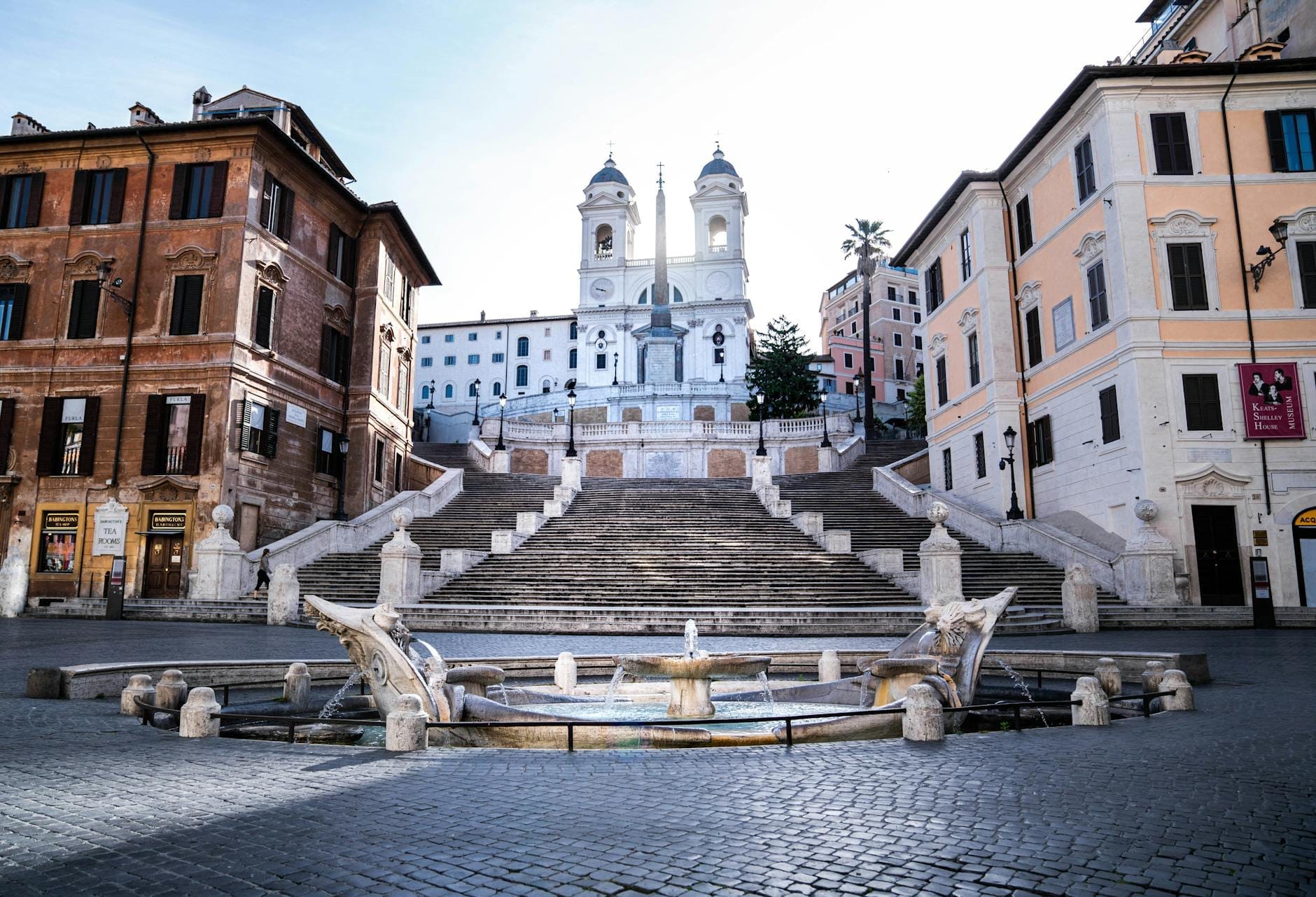
The Scalinata di Trinità dei Monti, universally known as the Spanish Steps, is a monumental baroque staircase of 135 travertine steps climbing roughly 29 meters (95 feet) from Piazza di Spagna at the base to the church of Trinità dei Monti at the summit. Built between 1723 and 1725 by architects Francesco de Sanctis and Alessandro Specchi, the staircase was funded by a French diplomat, Étienne Gueffier, as a way to connect the French church above with the Spanish Embassy below — hence a construction with two competing national identities baked into its very name. The steps cover approximately 3,000 square meters of cascading travertine limestone, organized in a series of terraces, balustrades, and landings that break the climb into a theatrical sequence rather than a single straight ascent.
The name 'Spanish' comes not from the builders or the funders but from the Spanish Embassy to the Holy See, which has been located in the adjoining Palazzo di Spagna since the 17th century. The square and steps have drawn poets, painters, and travelers since the 18th century, when the surrounding streets formed the heart of Rome's expatriate community. John Keats died in the house at the base of the steps in 1821; that building is now the Keats-Shelley Memorial House, still open to visitors.
ℹ️ Good to know
Sitting on the steps is prohibited under a 2019 municipal ordinance. Enforcement varies, but fines of up to €400 can be issued. The ban was introduced to protect the travertine surface, which was restored in a €1.5 million renovation completed in 2016 (note: major restoration occurred 2015-2016).
How the Experience Changes by Time of Day
Arriving before 8 a.m. is one of the more rewarding decisions you can make at this particular attraction. The steps are almost empty at that hour, the morning light falls at a low angle that picks out the texture of the travertine, and the sound of the Barcaccia fountain at the base carries clearly through the square without competing with tourist noise. The fountain, a half-sunken baroque boat sculpted by Pietro Bernini (father of the more famous Gian Lorenzo Bernini) in 1627, is worth pausing at properly, something difficult to do once crowds form.
By 10 a.m. on any day between April and October, the steps begin filling steadily. By noon in summer, the lower third is a solid mass of people, selfie sticks extended, gelato in hand. This is not inherently a problem if you have modest expectations: the steps are photogenic at any hour, and the energy of a full crowd has its own character. But if you want to read the architecture clearly, or feel any sense of the place as it was designed, midday in July is genuinely the wrong time.
Late afternoon, particularly after 5 p.m., brings a second window. Many tour groups have moved on, the shadows lengthen from the west, and the upper terrace near Trinità dei Monti catches warm golden light. Photographers targeting the classic downward view of the Barcaccia fountain framed by the steps and the surrounding rooftops should work this window carefully, positioning themselves slightly to one side of the central axis to avoid shooting directly into backlit crowds.
At night, the steps are lit in warm amber tones and the atmosphere is noticeably calmer. Romans and tourists alike drift through the area after dinner; street musicians sometimes set up in the square. The Barcaccia fountain, illuminated from below, is worth a second look after dark.
Tickets & tours
Live prices and dates from our booking partner. If you book, we may earn a commission at no extra cost to you.
Trevi Fountain, Navona, Pantheon and Spanish Steps walking tour
From 22 €Instant confirmationFree cancellationTuscan villages Spanish guided tour from Rome with Chianti tasting
From 235 €Instant confirmationSt. Peter's Basilica, Vatican Museums, Sistine Chapel reserved entry
From 81 €Instant confirmationFree cancellationGuided tour of Galleria Borghese and of Villa Borghese gardens
From 69 €Instant confirmationFree cancellation
The Spring Azalea Display
Every year in late April and early May, the steps are lined with large terracotta pots of blooming azaleas in shades of pink, red, and white. The display is organized by the Spanish Embassy and has been a tradition since the 1950s. For a few weeks, the staircase is genuinely spectacular in a way it isn't at other times of year: the flowers contrast with the grey-white travertine and the deep green of the church facade above, and the faint scent carries into the square on warm mornings.
If your Rome visit falls in this window, the Spanish Steps deserve more than a passing glance. Arrive early on a weekday and you may have nearly unobstructed views. Timing varies slightly by year depending on temperatures, but mid-April to early May is a reliable target. This coincides with some of the best overall travel conditions in Rome.
For a broader look at planning around seasonal conditions, the guide on the best time to visit Rome covers what each month offers across the city's main attractions.
The Surrounding Area: What's Worth Your Time
Piazza di Spagna itself is a long, irregular diamond of a square anchored by the Barcaccia fountain and framed by the kind of low-scale ochre and terracotta buildings that characterize central Rome. The square feeds directly into Via dei Condotti, Rome's most concentrated luxury shopping street, which runs west toward Via del Corso. Gucci, Prada, Bulgari, and similar brands line both sides of the street. If that's your interest, the proximity is hard to beat.
At the base of the steps, just to the right when ascending, is the Keats-Shelley Memorial House. The second-floor apartment where John Keats died of tuberculosis in February 1821 is preserved almost intact and contains an extensive archive of Romantic-era manuscripts, portraits, and personal effects. It's a genuinely affecting place, small enough to absorb in 45 minutes, and overlooked by most visitors who sweep past toward the steps themselves. Not far from the Spanish Steps, the Ara Pacis is another significant architectural and historical stop worth adding to a morning in this part of the city.
From the top of the steps, the church of Trinità dei Monti (originally built starting in 1502) is typically open during morning hours, though this can vary. The interior is relatively plain but contains two notable frescoes by Daniele da Volterra, including a Deposition that Michelangelo is said to have admired. Admission is free.
To the right of the church, the Villa Medici houses the French Academy in Rome (Académie de France à Rome) and hosts rotating exhibitions. The gardens are occasionally open for guided visits. Continuing further along the ridge leads to the Pincio terrace and the broad public park of Villa Borghese, both of which offer sweeping views over the city.
Getting There and Getting Around
The Spagna station on Metro Line A places you directly in Piazza di Spagna at street level; the exit deposits you roughly 50 meters from the base of the steps. This is one of the easiest major attraction approaches in Rome. The metro runs from approximately 5:30 a.m. to 11:30 p.m. on weekdays and until 1:30 a.m. on Fridays and Saturdays.
Buses 116, 117, and 119 serve the immediate area, though bus travel in central Rome is slower and less predictable than the metro. Walking from the Pantheon or Piazza Navona takes around 20–25 minutes through streets that are interesting in their own right.
⚠️ What to skip
The steps themselves are not wheelchair accessible. The 135-step climb has no elevator or ramp alternative on the main staircase. Visitors with limited mobility can approach Trinità dei Monti from the north via Viale Trinità dei Monti, which runs along the ridge from the Pincio area and reaches the top of the staircase without stairs.
The Spanish Steps sit on the eastern edge of the Centro Storico. Understanding the broader layout of this neighborhood helps you chain visits efficiently. The guide to Centro Storico covers the full range of what's walkable from here.
Photography: What Works and What Doesn't
The canonical photograph of the Spanish Steps is taken from roughly midway up, looking down toward the Barcaccia fountain with the long sweep of Via dei Condotti disappearing into the distance. This shot works best in morning light (east-facing), when the sun illuminates the steps from the side and adds depth to the travertine texture. Midday overhead light flattens everything and makes the stone look bleached rather than warm.
The upward view from the base of the fountain, framing the full width of the staircase against the church and its twin bell towers, benefits from late afternoon light coming from the west. A moderate wide-angle lens (24–35mm equivalent on full frame) captures the full width of the staircase. A telephoto compresses the tiers and creates a more abstract, layered image that works particularly well in the azalea season.
💡 Local tip
For drone photography, the Spanish Steps and Piazza di Spagna fall within a restricted flight zone. Aerial shots of the steps are not legally obtainable by private operators under standard Italian airspace rules for historic urban centers.
Honest Assessment: Is It Worth It?
The Spanish Steps are one of the most recognized images of Rome and, in their own way, they deliver. The baroque geometry is genuinely impressive at scale, the surrounding streets are handsome, and the view from the top across Rome's roofline is legitimately good. During the azalea season, the staircase is beautiful in a way that photographs don't fully convey.
That said, visitors who arrive expecting a contemplative historical experience in the middle of the day in summer are likely to be disappointed. The steps are crowded, the no-sitting rule is disorienting if you didn't know about it in advance, and the square can feel less like a heritage site and more like a transit hub for tour buses and designer shopping bags. These are manageable conditions, not deal-breakers, but worth calibrating expectations around.
Visitors who prioritize history over spectacle often find that nearby sites offer more for their time. The Pantheon is roughly 20 minutes on foot and represents a different caliber of architectural encounter. For sweeping city views with fewer crowds, the Pincio Terrace just above the steps rewards the extra walk.
Travelers who don't enjoy crowds, can't manage steep stairs, or are visiting Rome on a tight schedule may find the Spanish Steps a low-priority stop. The attraction is free and close to other sites, so it rarely requires a dedicated trip, but for some itineraries, spending 20 minutes here and moving on is the right call.
Insider Tips
- The Barcaccia fountain at the base runs on low pressure by design: the fountain was deliberately built as a half-sunken boat because the Roman water supply from the Acqua Vergine aqueduct didn't generate enough pressure to power a traditional vertical jet. Knowing this, the engineering solution looks less like an aesthetic quirk and more like a clever adaptation.
- The Keats-Shelley House at number 26 Piazza di Spagna, immediately to the right of the steps as you face them, charges a small admission fee and is almost always quiet. The preserved death room and the manuscript collection are moving if you have any interest in Romantic literature.
- If you visit during azalea season (late April to early May), arrive before 9 a.m. on a Tuesday or Wednesday for the best chance of near-empty steps with full flowers. Weekends during this period can be as crowded as peak summer.
- The top of the steps near the Trinità dei Monti church offers a view down Via dei Condotti that frames the Egyptian obelisk in Piazza del Popolo in the far distance on a clear day, aligning along the old axis of the Tridente road layout.
- Tap water in Rome is safe to drink and excellent in quality. The Barcaccia fountain, like most of Rome's public fountains, uses the same Acqua Vergine supply that has flowed continuously since Roman times. Bring a refillable bottle.
Who Is Spanish Steps For?
- First-time visitors to Rome completing the classic centro storico circuit
- Spring travelers who can time the azalea bloom in late April or early May
- Architecture and urban history enthusiasts interested in baroque city planning
- Photographers working early morning or late afternoon light
- Shoppers using Via dei Condotti and the surrounding luxury retail district
Nearby Attractions
Other things to see while in Centro Storico:
- Ara Pacis
Commissioned in 13 BC to celebrate Augustus's campaigns in Gaul and Spain, the Ara Pacis Augustae is one of the best-preserved monuments of ancient Rome. Today it sits inside a striking modern pavilion on the Tiber's east bank, offering an unusually intimate encounter with imperial-era marble carving at near eye level.
- Campo de' Fiori
Campo de' Fiori is one of Rome's most recognizable piazzas, running a daily produce and flower market Monday through Saturday before reinventing itself as a lively social square after dark. Its paving stones have witnessed public executions, papal power, and centuries of commerce.
- Capitoline Hill
Capitoline Hill sits at the symbolic center of Rome, where Michelangelo's perfectly proportioned piazza crowns a site inhabited since the Bronze Age. Today it holds the world's oldest public museums, Rome's city hall, and some of the most striking views over the Roman Forum in the city.
- Capitoline Museums
Perched atop Capitoline Hill overlooking the Roman Forum, the Musei Capitolini hold some of antiquity's greatest sculptures and paintings across three interconnected palaces. Founded in 1471, they predate the Louvre by more than three centuries and reward visitors with both iconic works and panoramic views that few Rome attractions can match.
Planning a trip? Discover personalized activities with the Nomado app.