Pincio Terrace: Rome's Best Free Panoramic View
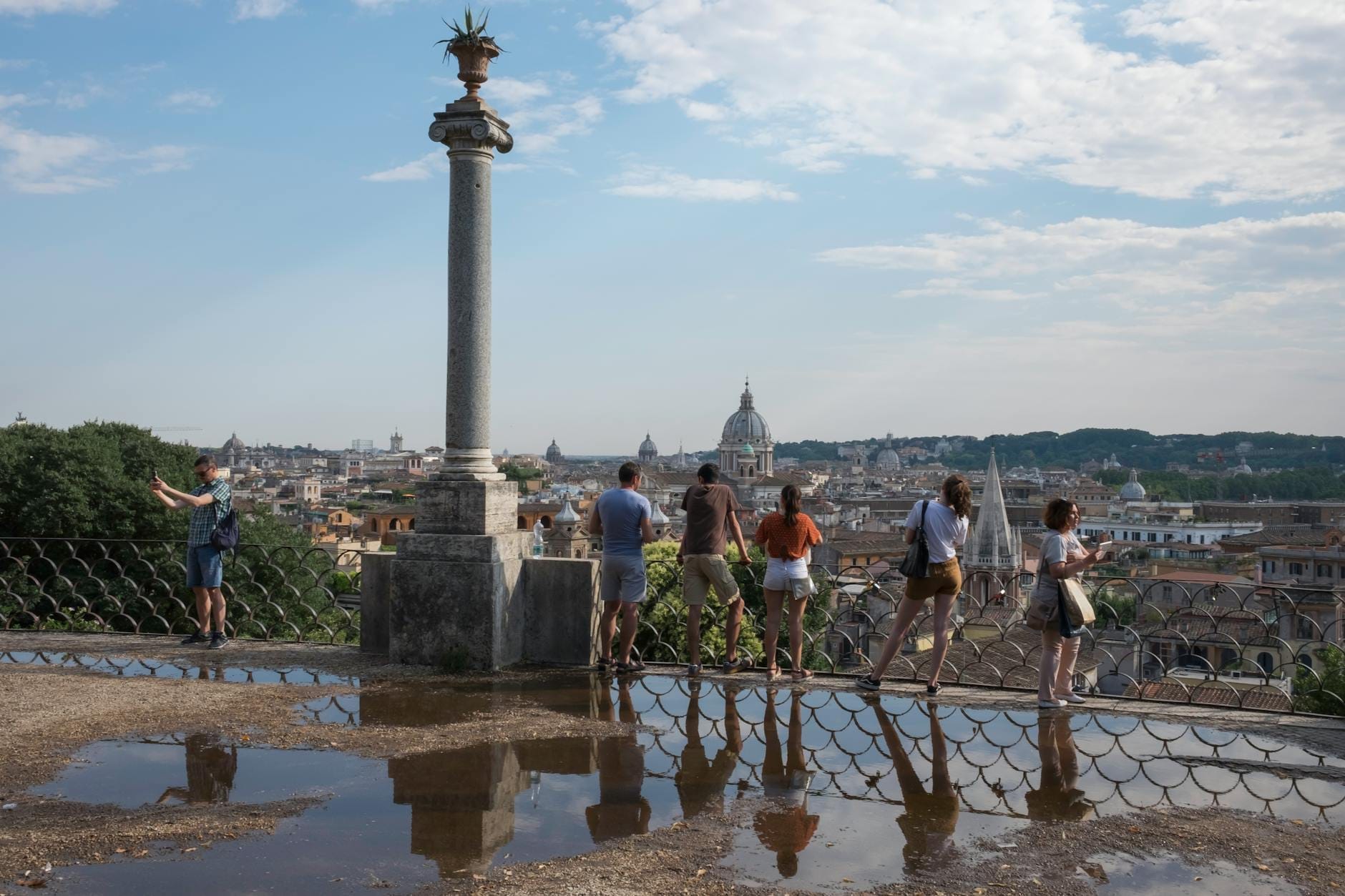
Perched above Piazza del Popolo on the edge of the Villa Borghese park, the Pincio Terrace is the city's most rewarding free viewpoint. The wide balcony faces west across Rome's rooftops, domes, and river bend, with the view shifting from sharp midday clarity to deep amber at sunset. It was Rome's first public garden, and the promenade that leads to it still carries that unhurried, old-city atmosphere.
Quick Facts
- Location
- Salita del Pincio, 00187 Rome (Villa Borghese area)
- Getting There
- Metro Line A – Flaminio; then walk up via Viale di Villa Medici or ramps from Piazza del Popolo (~10-15 min on foot)
- Time Needed
- 30–60 minutes for the terrace; 2+ hours if combining with the park promenade
- Cost
- Free, always open
- Best for
- Sunset views, couples, photographers, families with strollers, low-budget sightseeing
What the Pincio Terrace Actually Is
The Terrazza del Pincio, officially part of the Passeggiata del Pincio promenade, sits at roughly 60 metres above sea level on the edge of the Pincian Hill (Mons Pincius), overlooking the bowl of Piazza del Popolo and the rooftops stretching west toward the Tiber. The terrace itself is a wide, paved overlook with a central clock and fountain, flanked by umbrella pines and lined with stone busts of historical Italian figures. It does not feel like a tourist trap. It feels like a place where Romans actually come to breathe.
The hill takes its name from the ancient Gens Pinciana, a Roman family whose estate occupied this land in late antiquity. Before them, Lucullus, the general famous for his opulent banquets, cultivated the celebrated Horti Lucullani here in the 1st century BC. What you are standing on when you look out over the city is one of the most storied private gardens in ancient Rome, transformed over two thousand years into a public promenade.
💡 Local tip
Arrive 30–40 minutes before sunset for the best light on the domes and the Tiber bend. The western orientation means the view is essentially backlit during midday and transforms completely as the sun descends.
A Short History: From Imperial Gardens to Rome's First Public Park
The terrace and its promenade took their present form under Napoleon's administration. Beginning around 1810, the French landscape architect Louis-Martin Berthault drew up plans to remodel Pincian Hill as a public garden in the English romantic style. After Napoleon's fall, the project was continued by Giuseppe Valadier, the architect who also redesigned Piazza del Popolo below. The garden was substantially completed by around 1834, and it holds the distinction of being Rome's first public garden, at a time when most of the city's parks were private aristocratic estates.
A flyover bridge connecting the terrace directly to the Villa Borghese gardens was added in 1908, cementing the Pincio's role as the hinge between two of the city's most important green spaces. The busts lining the walkways, numbering in the hundreds, were installed across the 19th and early 20th centuries as a kind of open-air hall of fame for Italian historical figures, from Dante to Garibaldi.
For context on how this area fits into Rome's northern districts, the Villa Borghese area overview covers the broader park, surrounding streets, and what else is worth combining into a half-day visit.
Tickets & tours
Live prices and dates from our booking partner. If you book, we may earn a commission at no extra cost to you.
Castel Sant'Angelo guided tour with exclusive areas and terrace
From 49 €Instant confirmationFree cancellationGuided tour of Castel Sant'Angelo with local guide and terrace views
From 40 €Instant confirmationFree cancellationCastel Sant'Angelo terrace access and express tour
From 80 €Instant confirmationFree cancellationTrevi Fountain entrance with panoramic terrace visit
From 30 €Instant confirmationFree cancellation
The View: What You See and When It Looks Best
From the main terrace balustrade, the panorama sweeps across Piazza del Popolo directly below, then extends over a wide cross-section of Rome: the Pantheon's dome to the south, the dome of St. Peter's Basilica anchoring the western skyline, the Victor Emmanuel II monument (Vittoriano) catching light to the southeast, and on clear days, the Alban Hills in the far distance. The Tiber curves just far enough to be visible between the rooftops.
At midday, the light is harsh and flat, which makes this a poor time for photography but actually quite good for reading the topography clearly. The city's domes and towers are crisply delineated against a blue or white sky, and you can identify landmarks without the romantic blur of golden hour. In the two hours before sunset, the sky behind St. Peter's transitions through pale yellow to deep orange, and the dome becomes a dark silhouette against luminous colour. This is genuinely one of the best sunset positions in the city, and crowds reflect that.
If you want to compare Rome's viewpoints before deciding where to spend your evening hour, the guide to best views in Rome weighs the Pincio against other options like the Gianicolo and the Aventine.
Early morning is a different experience entirely. Between 7 and 9 am, the terrace is nearly deserted. Joggers pass through on their loop through Villa Borghese, the occasional dog walker pauses at the overlook, and the light comes from behind the hill, casting long shadows westward over the city. The air is cooler and carries the scent of stone pine resin, especially noticeable in summer. If you want the view without the crowds, this is the window.
How to Get There: The Routes Up the Hill
The most logical approach from central Rome is via Metro Line A to Flaminio, then up through Piazza del Popolo. From the piazza, take the ramps and switchback paths that climb directly to the terrace, a walk of roughly 10 to 15 minutes with a moderate gradient. The path is wide, paved, and well-maintained. Strollers can manage it, though it requires some effort on the steeper sections.
An alternative approach comes from the Spanish Steps side: from Piazzale Trinità dei Monti, walk north along Viale di Villa Medici through the grounds of Villa Medici toward the terrace. This route is flatter and passes through a quieter, more shaded section of the hill. It takes about 20 minutes on foot from the top of the Spanish Steps and offers a pleasant transition from the crowded southern end of the Pincio to the open overlook.
From within Villa Borghese, the 1908 flyover bridge provides direct access from the park, which makes it easy to combine a visit to the Galleria Borghese with an afternoon at the terrace. The walk from the gallery to the Pincio through the park takes approximately 20 minutes at a relaxed pace.
ℹ️ Good to know
There is no dedicated bus stop at the terrace itself. Bus routes serving Piazza del Popolo (including lines 119 and others) are the closest option if you prefer not to walk up from the metro. Confirm current routes on the ATAC website before your visit.
The Promenade and What Surrounds the Terrace
The overlook is the centerpiece, but the Passeggiata del Pincio extends well beyond it. The shaded avenue running northeast from the terrace is lined with those stone busts, and it draws a steady but unhurried flow of people throughout the day: elderly Romans on benches, families with children on rented pedal cars (a Pincio tradition), cyclists, and tourists moving more slowly than they do almost anywhere else in the city.
The small piazzale at the top of the ramps from Piazza del Popolo has a bar and café, useful for a coffee or water if you have climbed up from below and want something before heading into the park. It is not a destination in itself but serves its purpose reliably.
The Pincio connects naturally to the Villa Borghese gardens to the north and east, as well as to Villa Medici on the southern slope of the hill, which hosts temporary exhibitions and is worth checking if something is running during your visit.
Photography, Crowds, and Honest Limitations
For photography, a standard lens (around 35–50mm equivalent) works well for the panorama without distorting the skyline. A light telephoto helps isolate specific domes, particularly St. Peter's, which is far enough away to benefit from compression. The terrace balustrade is wide stone, useful for steadying a camera at dusk when light levels drop. Tripods are technically permitted in open public spaces, though the terrace gets congested at sunset and space is limited.
On the honest side: this is not a quiet, off-the-radar spot. On warm evenings and weekend afternoons, the terrace draws significant numbers of visitors, and the overlook area can feel crowded. The view is exceptional, but it is not secret. Families who have climbed from Piazza del Popolo, couples who have walked over from the park, and tour groups navigating the promenade all converge here in the late afternoon. If crowds are your primary concern, an early morning visit or a weekday midday visit is the more comfortable option.
⚠️ What to skip
The Pincio is not well-suited for anyone who has difficulty with gradients or steps. The ramps from Piazza del Popolo are the gentlest approach, but the hill involves real elevation gain from every entry point. Check the accessible Rome resources on Turismo Roma for wheelchair-specific route information.
If you are planning a broader day around this part of Rome, the guide to free things to do in Rome covers how to build an itinerary that keeps costs down while covering real ground.
Insider Tips
- The best unobstructed view of Piazza del Popolo below requires standing at the far left (south) end of the balustrade, not the center. The central position is what most people photograph, but the angled view from the left edge shows both churches of the piazza and the obelisk together.
- Pedal car rentals operate along the promenade and are a genuine local habit, especially on Sunday mornings. If you are visiting with young children, this is a more entertaining option than simply standing at the overlook.
- The avenue of busts is almost entirely ignored by visitors focused on the panorama. Walk it slowly and you will find a strange, compelling gallery of 19th-century Italian history in stone, largely to yourself at most hours.
- In summer, the pine trees along the promenade provide reliable shade that the terrace itself does not. If the heat is intense, spend more time on the shaded walkways and make your way to the overlook as the day cools.
- Combining the Pincio at sunset with dinner in Piazza del Popolo afterward is one of Rome's most straightforward and satisfying evening routines. The descent from the terrace brings you directly into the piazza, which has several restaurants on its perimeter.
Who Is Pincio Terrace For?
- Travelers who want a free, genuinely rewarding sunset view without booking anything in advance
- Photographers looking for a western-facing panorama of Rome's skyline and domes
- Families who want open space and a slow walk rather than another interior attraction
- Visitors combining a morning at Galleria Borghese with an afternoon in the park
- First-time visitors who want to orient themselves spatially within the city before diving into the historic center
Nearby Attractions
Other things to see while in Villa Borghese & Pincio:
- Galleria Borghese
Galleria Borghese holds one of the greatest private art collections ever assembled, featuring Bernini sculptures, Caravaggio paintings, and Raphael masterworks in a Baroque villa inside the Villa Borghese Gardens. Timed entry keeps crowds manageable, but advance booking is essential.
- MAXXI – National Museum of 21st Century Arts
MAXXI is Rome's premier contemporary art institution, housed in a 30,000 m² building designed by Zaha Hadid that won the Stirling Prize in 2010. Expect over 400 works spanning painting, installation, video art, and architecture — alongside a program of temporary exhibitions that keeps even return visitors engaged.
- Villa Borghese Gardens
Spanning 80 hectares on the Pincian Hill, Villa Borghese is Rome's third-largest public park and one of the few places in the city where entry costs nothing. Within its grounds you'll find the Galleria Borghese, a neoclassical temple, a boating lake, and some of the best elevated views in the city.
Planning a trip? Discover personalized activities with the Nomado app.