Galleria Borghese: Rome's Most Concentrated Art Experience
Galleria Borghese holds one of the greatest private art collections ever assembled, featuring Bernini sculptures, Caravaggio paintings, and Raphael masterworks in a Baroque villa inside the Villa Borghese Gardens. Timed entry keeps crowds manageable, but advance booking is essential.
Quick Facts
- Location
- Piazzale del Museo Borghese, 5, Villa Borghese Gardens, Rome
- Getting There
- Metro A to Spagna or Metro A to Flaminio, then 15–20 min walk uphill through the park
- Time Needed
- 2 hours (timed entry slots are exactly 2 hours; no extensions)
- Cost
- Admission fee applies; check the official website for current pricing. Advance booking mandatory.
- Best for
- Art lovers, Baroque enthusiasts, slow travelers, and anyone serious about Italian Renaissance and 17th-century sculpture
- Official website
- galleriaborghese.cultura.gov.it/en
What Makes Galleria Borghese Different from Every Other Museum in Rome
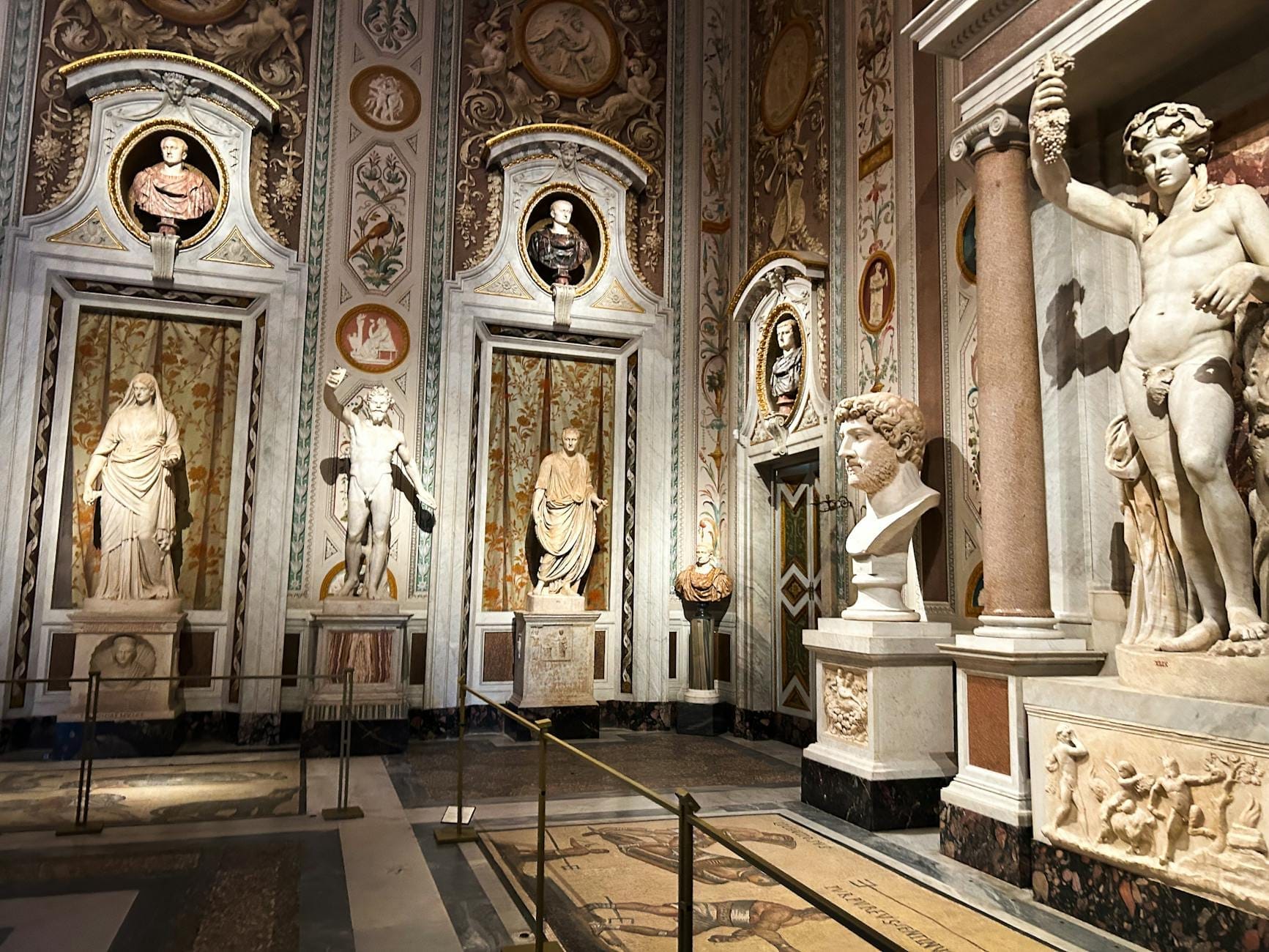
Most major museums overwhelm. Galleria Borghese does the opposite. The collection occupies a single Baroque villa, split across 20 rooms across two floors, and entry is capped at a small number of visitors per two-hour slot. The result is something rare in Rome: space to stand in front of a masterpiece without being jostled, time to look closely at the grain of marble, and quiet enough to think.
The gallery is housed in the Casino Nobile of Villa Borghese, designed by Flemish architect Jan van Santen (known in Italy as Giovanni Vasanzio) and Flaminio Ponzio, built between 1613 and 1616. It was never a residence. Cardinal Scipione Borghese, nephew of Pope Paul V and one of the most aggressive art collectors of the 17th century, commissioned it as a dedicated display space for his growing hoard of antiquities and contemporary commissions. The building was always a gallery, and it shows in how the rooms are proportioned and lit.
⚠️ What to skip
Timed entry slots fill weeks or months in advance, especially from April through October. Do not arrive without a pre-booked ticket expecting to get in. Check availability at the official website as early as possible after deciding to visit.
The Bernini Rooms: Sculpture That Seems to Breathe
The ground floor is where Galleria Borghese earns its reputation. Gian Lorenzo Bernini carved most of his defining early works specifically for Scipione Borghese, and they remain here, in the rooms they were made for. Standing in front of Apollo and Daphne (Room 3) for the first time produces a specific kind of disbelief. The marble captures Daphne mid-transformation into a laurel tree: fingers elongating into leaves, bark spreading up her legs, Apollo's expression shifting from pursuit to shock. The work was completed when Bernini was in his mid-twenties.
Room 4 holds The Rape of Proserpina (1621–22), where Pluto's fingers press visibly into the marble of Proserpina's thigh. The impression of soft flesh in hard stone is not a trick of light. You can walk a full circle around both sculptures, and it is worth doing slowly. The compositions shift as you move, revealing new details that are invisible from the front.
Room 2 contains David (1623–24), reportedly modeled from Bernini's own face. Unlike Michelangelo's contemplative David, this one is mid-action: jaw set, body twisted, the moment before the sling releases. The tension in the torso is almost uncomfortable to look at. These three sculptures alone would justify the visit.
Tickets & tours
Live prices and dates from our booking partner. If you book, we may earn a commission at no extra cost to you.
Guided tour of Galleria Borghese and of Villa Borghese gardens
From 69 €Instant confirmationFree cancellationGalleria Borghese Entrance Ticket with Optional Guided Tour
From 35 €Instant confirmationFree cancellationGalleria Borghese Museum entrance tickets with guided tour
From 75 €Instant confirmationGalleria Borghese Museum entrance tickets with guided tour
From 65 €Instant confirmation
Caravaggio and the Paintings Upstairs
The upper floor houses the paintings collection, and while it lives in the shadow of the sculptures for most visitors, it deserves equal attention. Scipione Borghese was one of Caravaggio's most important patrons and acquired six of his works, several of which are displayed here. Boy with a Basket of Fruit (1593–94), one of Caravaggio's earliest surviving works, shows the hyper-realistic attention to surface texture he would become known for: the leaves are wilting, the grapes are slightly overripe.
Madonna dei Palafrenieri (1605–06) is the most unsettling of the Caravaggios on display. The Virgin Mary is depicted as a tired, aging woman, not an idealized figure. It was commissioned for St. Peter's Basilica and rejected almost immediately. Scipione Borghese acquired it shortly after. Seeing these works in a small, human-scaled gallery rather than a cathedral gives them a different weight.
Raphael's Deposition (1507) occupies Room 9 and is considered one of the high points of his early career, painted when he was around 24 years old. The gallery also holds works by Correggio, Domenichino, and Titian. For the broader context of Rome's painting collections, the best museums in Rome guide is a useful companion when planning which spaces to prioritize across your trip.
The Villa Setting and Arriving Through the Park
The gallery sits on the Pincian Hill within the Villa Borghese Gardens, the third-largest park in Rome. The walk up from either the Spagna or Flaminio metro exits is genuinely pleasant in the morning, particularly in spring when the umbrella pines cast long shadows across the paths. Budget 20 minutes from either station; it is an uphill walk and the final stretch through the park itself takes longer than the map suggests.
The park around the gallery is worth time before or after your visit. The Villa Borghese Gardens contain a small lake, a children's cinema, viewpoints over the city, and enough shade to make a summer afternoon comfortable. The Pincio Terrace at the garden's western edge offers one of Rome's better panoramic views across the rooftops toward St. Peter's dome.
💡 Local tip
The museum has a bag check and does not allow large bags inside. Arrive 10–15 minutes before your slot to check bags and collect tickets. Latecomers are not always accommodated.
How the Experience Changes by Time of Day
Morning slots, particularly the earliest of the day, tend to feel calmer even within the capped visitor numbers. Natural light enters the villa at low angles in the morning, which has a noticeable effect on the Bernini marbles: the shadows within carved folds of fabric and hair become deeper and more defined. Afternoon slots are slightly more social, with groups arriving together, and the light flattens somewhat.
The two-hour slot passes faster than expected. Most visitors spend the majority of their time on the ground floor with the sculptures and feel time pressure arriving on the upper floor. Being intentional about the paintings before the clock runs down is worth planning for. A rough self-guided split: 70 minutes downstairs, 50 minutes upstairs.
The gallery is fully indoors and climate-controlled, which makes it one of Rome's better options on a very hot summer afternoon or a rainy day. The walk through the park is the only weather-exposed part of the visit, and it is short enough to manage with an umbrella.
Practical Details and What to Expect on Arrival
The gallery is managed by Italy's national cultural heritage authority and is located at Piazzale del Museo Borghese, 5. Tickets must be pre-booked through the official website. Opening hours, ticket prices, and available slot times change seasonally and are subject to closure for special events or maintenance. Always verify current availability on the official website before your trip.
Accessibility within the villa is limited by the building's age and protected status. The ground floor is accessible, but the upper floor involves staircases. The museum website provides the most current information on accessibility accommodations.
Photography without flash is permitted throughout the gallery, including with the Bernini sculptures. The marbles photograph well in natural light, though capturing the full three-dimensional impact of a piece like Apollo and Daphne in a single image is genuinely difficult. If you are planning a focused art itinerary, the Capitoline Museums offer a very different Roman collection and make a strong second-day pairing.
Who Should Think Twice Before Visiting
Galleria Borghese is a focused, specialized experience. Visitors expecting a comprehensive survey museum with ancient Roman artifacts, medieval rooms, and rotating blockbuster exhibitions will not find that here. The collection is narrow but extraordinarily deep in 17th-century Italian art. Travelers with young children should consider carefully: the two-hour enforced slot in a quiet, high-security environment with delicate sculptures is genuinely difficult with children under 8 or 9. It is manageable, but the experience is better suited to focused adult visits.
The mandatory advance booking is also a real barrier for spontaneous visitors or anyone with a flexible itinerary. If you cannot book weeks ahead, check the official website for last-minute cancellations. Alternatively, the skip-the-line booking guide for Rome covers strategies for securing tickets to major attractions under time pressure.
Insider Tips
- Book the first slot of the day. The gallery is quieter, the light is better on the marble, and you have the energy to look carefully rather than rushing through.
- Walk the full circle around Apollo and Daphne before looking at any other sculpture. The transformation from back to front is the intended experience, and most visitors miss it by staying at the main viewing angle.
- The audio guide available at the museum significantly improves the upper floor experience. The paintings require more context than the sculptures, which speak for themselves.
- After your slot, walk west through the park to the Pincio Terrace rather than retracing your route down to Spagna. The view over Rome from there is excellent and the path is flat.
- If slots near your travel dates are fully booked, check for cancellations on weekday mornings. Single-person slots open up more frequently than group bookings.
Who Is Galleria Borghese For?
- Art lovers with a specific interest in Baroque sculpture and 17th-century Italian painting
- Travelers who want a high-quality, manageable museum experience without spending a full day
- Photographers comfortable with indoor, natural-light conditions
- Anyone combining the visit with an afternoon in the Villa Borghese Gardens
- Slow travelers who prefer depth over breadth
Nearby Attractions
Other things to see while in Villa Borghese & Pincio:
- MAXXI – National Museum of 21st Century Arts
MAXXI is Rome's premier contemporary art institution, housed in a 30,000 m² building designed by Zaha Hadid that won the Stirling Prize in 2010. Expect over 400 works spanning painting, installation, video art, and architecture — alongside a program of temporary exhibitions that keeps even return visitors engaged.
- Pincio Terrace
Perched above Piazza del Popolo on the edge of the Villa Borghese park, the Pincio Terrace is the city's most rewarding free viewpoint. The wide balcony faces west across Rome's rooftops, domes, and river bend, with the view shifting from sharp midday clarity to deep amber at sunset. It was Rome's first public garden, and the promenade that leads to it still carries that unhurried, old-city atmosphere.
- Villa Borghese Gardens
Spanning 80 hectares on the Pincian Hill, Villa Borghese is Rome's third-largest public park and one of the few places in the city where entry costs nothing. Within its grounds you'll find the Galleria Borghese, a neoclassical temple, a boating lake, and some of the best elevated views in the city.
Planning a trip? Discover personalized activities with the Nomado app.