Villa Borghese Gardens: Rome's Grand Public Park, Explained
Spanning 80 hectares on the Pincian Hill, Villa Borghese is Rome's third-largest public park and one of the few places in the city where entry costs nothing. Within its grounds you'll find the Galleria Borghese, a neoclassical temple, a boating lake, and some of the best elevated views in the city.
Quick Facts
- Location
- Pincian Hill, Villa Borghese area, Rome
- Getting There
- Metro A – Spagna or Flaminio; tram 3 to Viale delle Belle Arti
- Time Needed
- 2–4 hours for the gardens; add 2 hours for Galleria Borghese
- Cost
- Gardens: Free. Galleria Borghese: separate paid ticket, advance booking required
- Best for
- Families, art lovers, afternoon walks, escaping the summer heat
What Villa Borghese Actually Is
The Villa Borghese Gardens occupy 80 hectares on the Pincian Hill in northern Rome, making them the city's third-largest public park. The grounds were originally developed from 1605 onward by Cardinal Scipione Borghese as an extension of a former vineyard, designed to display his extraordinary collection of sculpture and painting in an aristocratic garden setting. In the 19th century the layout was remodelled in the English naturalistic style, replacing the original rigid Italian geometry with meandering paths, informal tree groupings, and a small lake. In 1903 the gardens passed into public ownership and have been freely accessible ever since.
That history matters for how you experience the place today. This is not a manicured showcase garden demanding reverence. It is a working urban park where Roman families spread out picnic blankets on Sunday afternoons, students read between exams, joggers do loops around the lake, and tourists spill in from the Spanish Steps looking for shade. The formal neoclassical architecture, the occasional ancient-style temple, and the world-class gallery buried somewhere inside all coexist with dogs off-leash and rental bikes wobbling down gravel paths. That mix is exactly what makes it worth your time.
💡 Local tip
The gardens are free to enter at all times, sunrise to sunset, via multiple entrances. You do not need a ticket, a reservation, or a guided tour to walk the grounds. The Galleria Borghese inside the park is a completely separate attraction with timed entry, strict capacity limits, and tickets that sell out weeks in advance. Book that separately before your trip if it's a priority.
Getting In: Entrances and How to Arrive
There are four main entrances, and your choice matters depending on where you're coming from in the city. The Piazza del Popolo entrance on the northern edge is the most dramatic: you arrive via the piazza, which opens out to one of Rome's great civic spaces, and enter the park through a formal gateway with an immediate sense of the grounds spreading uphill before you. The Viale Trinità dei Monti entrance near the top of the Spanish Steps is the most commonly used by tourists and feeds directly into the upper park, close to the Pincio Terrace. The Via Vittorio Veneto entrance on the southeastern side drops you into the quieter, shadier lower sections. The Piazzale Belle Arti entrance on the western side is closest to the Galleria Nazionale d'Arte Moderna.
Metro Line A runs to both Spagna (Spanish Steps entrance) and Flaminio (Piazza del Popolo entrance), making access straightforward from most parts of the city. Tram 19 stops at Viale delle Belle Arti on the western edge. If you are combining Villa Borghese with Piazza del Popolo or the Spanish Steps, it makes sense to treat all three as a single half-day itinerary on foot.
⚠️ What to skip
The park is large enough that getting oriented without a map takes time. Download the Roma Capitale parks app or pick up a printed map at the park information points near the main entrances. The Galleria Borghese sits roughly in the center of the park, and first-time visitors regularly underestimate how long the walk from the Spanish Steps entrance takes.
Tickets & tours
Live prices and dates from our booking partner. If you book, we may earn a commission at no extra cost to you.
Guided tour of Galleria Borghese and of Villa Borghese gardens
From 69 €Instant confirmationFree cancellationBorghese Gallery and Gardens Guided Tour
From 69 €Instant confirmationFree cancellationGalleria Borghese Entrance Ticket with Optional Guided Tour
From 35 €Instant confirmationFree cancellationBorghese Gallery Skip-The-Line Tickets with Audio Guide
From 39 €Instant confirmationFree cancellation
The Park at Different Times of Day
Early morning, between 7 and 9am, Villa Borghese belongs almost entirely to locals. The gravel paths are quiet enough that you can hear birdsong clearly in the tree canopy overhead, which is dominated by holm oaks, stone pines, and umbrella pines whose silhouettes define the Roman skyline from a distance. The air smells of damp earth and pine resin, particularly after overnight rain. Joggers and dog walkers are the primary population at this hour, and the lake area near the Casino dell'Orologio has a stillness that is genuinely hard to find elsewhere in central Rome.
By mid-morning, especially on weekends, the dynamic shifts. Families with young children appear, rental bike and electric car concessions open for business, and the paths near the main entrances become noticeably busy. Midday in summer is the least comfortable time to visit: the open lawns offer little shelter and temperatures regularly reach 30°C or above between June and August. The tree-lined interior paths provide shade, but plan accordingly. Late afternoon, from around 4pm onward, is the most photogenic window: the light turns golden and rakes across the stone pines at a low angle, the crowds thin, and the park takes on a quality that photography cannot fully capture but that rewards simply sitting on a bench.
In spring, particularly April and May, the gardens are at their best for walking. Temperatures are mild (12 to 20°C), the lawns are green, and the ornamental plantings around the neoclassical structures are in good condition. Autumn, especially September and October, is similarly pleasant and sees fewer tourists than the peak summer months. Winter visits are underrated: the park is almost empty on weekday mornings, the low sun creates long shadows through the bare trees, and you see the architecture without crowds.
What to See Inside the Gardens
The most significant structure in the park is the Casino Borghese, the 17th-century villa that now houses the Galleria Borghese. The collection inside is concentrated and exceptional: Bernini's sculptures including Apollo and Daphne and The Rape of Proserpina, Caravaggio paintings including David with the Head of Goliath, and works by Raphael and Titian. Because the gallery operates with strictly timed entry and a visitor cap, the experience inside is unusually calm for a major art collection. Two-hour slots are the standard allocation. Book well in advance, especially for spring and summer visits.
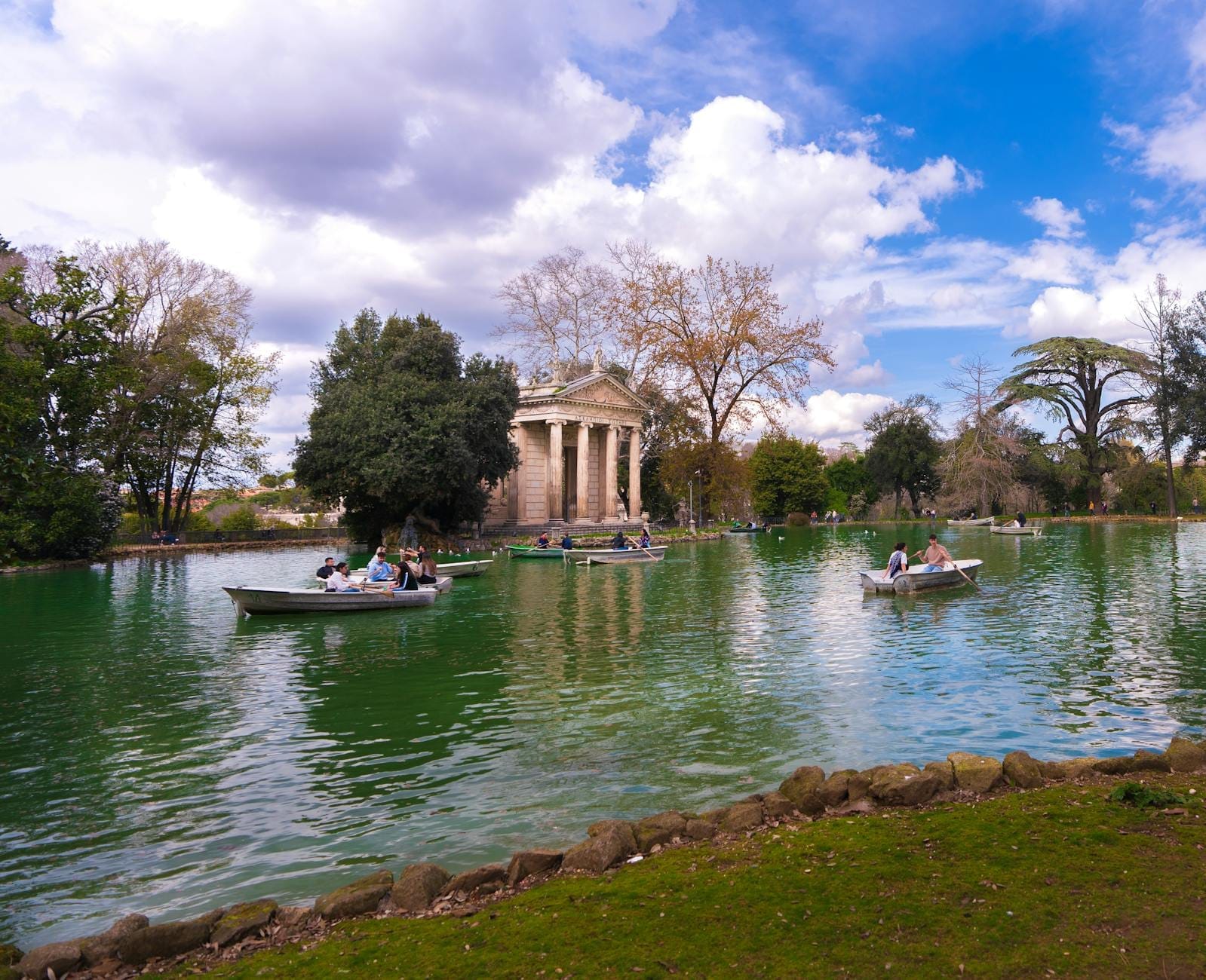
Beyond the gallery, the Temple of Diana is worth finding. Built in 1789, this small neoclassical structure sits near the artificial lake and is often overlooked by visitors who came only for the gallery. The lake itself is functional as much as decorative: rowing boats are available for hire and are popular with families. The Pincio Terrace on the southeastern edge of the park offers one of Rome's most famous panoramic views across the city toward St. Peter's dome, and is worth the short walk from any of the main entrances.
Historic secondary buildings scattered through the grounds include the Casino del Graziano, the Casino Giustiniani, and the Uccelliera, an old aviary structure that survives from the original 17th-century layout. None of these are typically open to visitors, but they give the park a sense of layered history that you absorb while walking between them. The Bioparco, Rome's zoo, occupies the northeastern corner of the park and is a separate paid attraction suited to families with young children.
ℹ️ Good to know
Bicycle and electric car rentals are available at several points within the park. Rental rates are posted at the concession stands and prices change seasonally. Renting a bike is a practical way to cover the full 80 hectares without exhausting yourself, particularly useful if you want to see the Galleria Borghese, the lake, and the Pincio Terrace in a single visit.
The Galleria Borghese: What You Need to Know Before Booking
The Galleria Borghese is consistently ranked among the finest small art museums in the world, and the ticket system reflects that demand. Entry is by timed two-hour slot with a strict cap on simultaneous visitors. Tickets must be booked in advance through the official reservation system; walk-up entry is rarely available except on off-peak winter weekdays, and even then it cannot be relied upon. The gallery is closed on Mondays.
One practical note that catches visitors off guard: the villa sits roughly 15 minutes on foot from the Spanish Steps entrance and around 10 minutes from the Flaminio entrance. Arriving late for your timed slot, even by a few minutes, can result in losing your booking. Give yourself more time than you think you need to walk from the park gates to the gallery entrance, especially if it is your first time navigating the grounds.
Photography, Accessibility, and Who Should Skip It
For photography, the most productive locations in the park are the Pincio Terrace at golden hour for city panoramas, the tree-lined avenue approaching the Casino Borghese for perspective shots with the stone pines overhead, and the lake area in early morning when the surface is still. The Temple of Diana works well in soft morning light before the midday sun flattens the shadows.
Accessibility across the main paths is reasonable: the principal routes are wide gravel or paved surfaces manageable by wheelchairs and pushchairs, though some secondary paths are uneven. The terrain is gently hilly in places, with the Pincio Terrace at a higher elevation than the lake and gallery areas. There are public toilets near the main entrance points and near the Bioparco.
Who should think twice before visiting: travelers on a tight one-day schedule who are not planning to enter the Galleria Borghese may find that the park, while pleasant, does not compete with the concentration of major monuments elsewhere in the city center. The gardens reward slow exploration, not a quick pass-through. If you have limited time in Rome and art galleries are not a priority, the park is better saved for a second visit or a longer stay.
If you are building a broader itinerary around this area of Rome, consider combining Villa Borghese with Piazza del Popolo and the Santa Maria del Popolo church on the same morning. All three are connected on foot and require no transit. See the Rome in 3 days itinerary for a structured approach to fitting this into a short trip.
Insider Tips
- The best approach to the Galleria Borghese on a hot day is to book the first entry slot (usually 9am) and combine it with an early morning walk through the park before crowds arrive. By the time you exit the gallery around 11am, the park fills up quickly.
- The rowing boats on the lake rent by the hour and are almost always available, even on busy weekends, because most visitors don't realize they exist. They're one of the few activities in central Rome that feels genuinely unhurried.
- If you enter from the Piazza del Popolo side and want to reach the Pincio Terrace viewpoint, follow the road uphill to the right after the formal entrance gate. Most visitors walk straight into the park and miss the terrace entirely.
- Bring water. The park has drinking fountains (nasoni) at several points, but finding them when you're thirsty takes time. Tap water in Rome is safe and drinking directly from the nasoni is normal practice.
- The park is significantly less crowded in November through February. Winter mornings after rain, when the air is clear and the stone pines are dripping, produce some of the most atmospheric conditions you'll find in any Roman park.
Who Is Villa Borghese Gardens For?
- Families with young children who need open space and low-cost activity options
- Art travelers with a pre-booked Galleria Borghese slot looking to extend the visit
- Visitors on second or third trips to Rome who have already covered the main ancient sites
- Anyone building a half-day itinerary connecting Piazza del Popolo and the Spanish Steps
- Travelers visiting in summer who need shaded, walkable respite from the exposed city center
Nearby Attractions
Other things to see while in Villa Borghese & Pincio:
- Galleria Borghese
Galleria Borghese holds one of the greatest private art collections ever assembled, featuring Bernini sculptures, Caravaggio paintings, and Raphael masterworks in a Baroque villa inside the Villa Borghese Gardens. Timed entry keeps crowds manageable, but advance booking is essential.
- MAXXI – National Museum of 21st Century Arts
MAXXI is Rome's premier contemporary art institution, housed in a 30,000 m² building designed by Zaha Hadid that won the Stirling Prize in 2010. Expect over 400 works spanning painting, installation, video art, and architecture — alongside a program of temporary exhibitions that keeps even return visitors engaged.
- Pincio Terrace
Perched above Piazza del Popolo on the edge of the Villa Borghese park, the Pincio Terrace is the city's most rewarding free viewpoint. The wide balcony faces west across Rome's rooftops, domes, and river bend, with the view shifting from sharp midday clarity to deep amber at sunset. It was Rome's first public garden, and the promenade that leads to it still carries that unhurried, old-city atmosphere.
Planning a trip? Discover personalized activities with the Nomado app.