Santa Maria del Popolo: Rome's Most Astonishing Free Church
Tucked against the ancient Porta del Popolo gate, the Basilica di Santa Maria del Popolo holds two Caravaggio masterpieces, a Raphael-designed chapel, and Augustinian frescoes that most visitors walk straight past on their way to the piazza. Entry is free, the interior is compact enough to absorb in an hour, and the art inside rivals anything behind a ticket barrier in this city.
Quick Facts
- Location
- Piazza del Popolo 12, 00187 Roma — north side of the piazza, directly beside the Porta del Popolo gate
- Getting There
- Metro Line A, Flaminio stop — the church is visible the moment you exit the station
- Time Needed
- 45 minutes to 1.5 hours depending on how closely you study the art
- Cost
- Free entry
- Best for
- Art lovers, art history students, travelers who want depth over spectacle
Why This Church Belongs on Your Itinerary
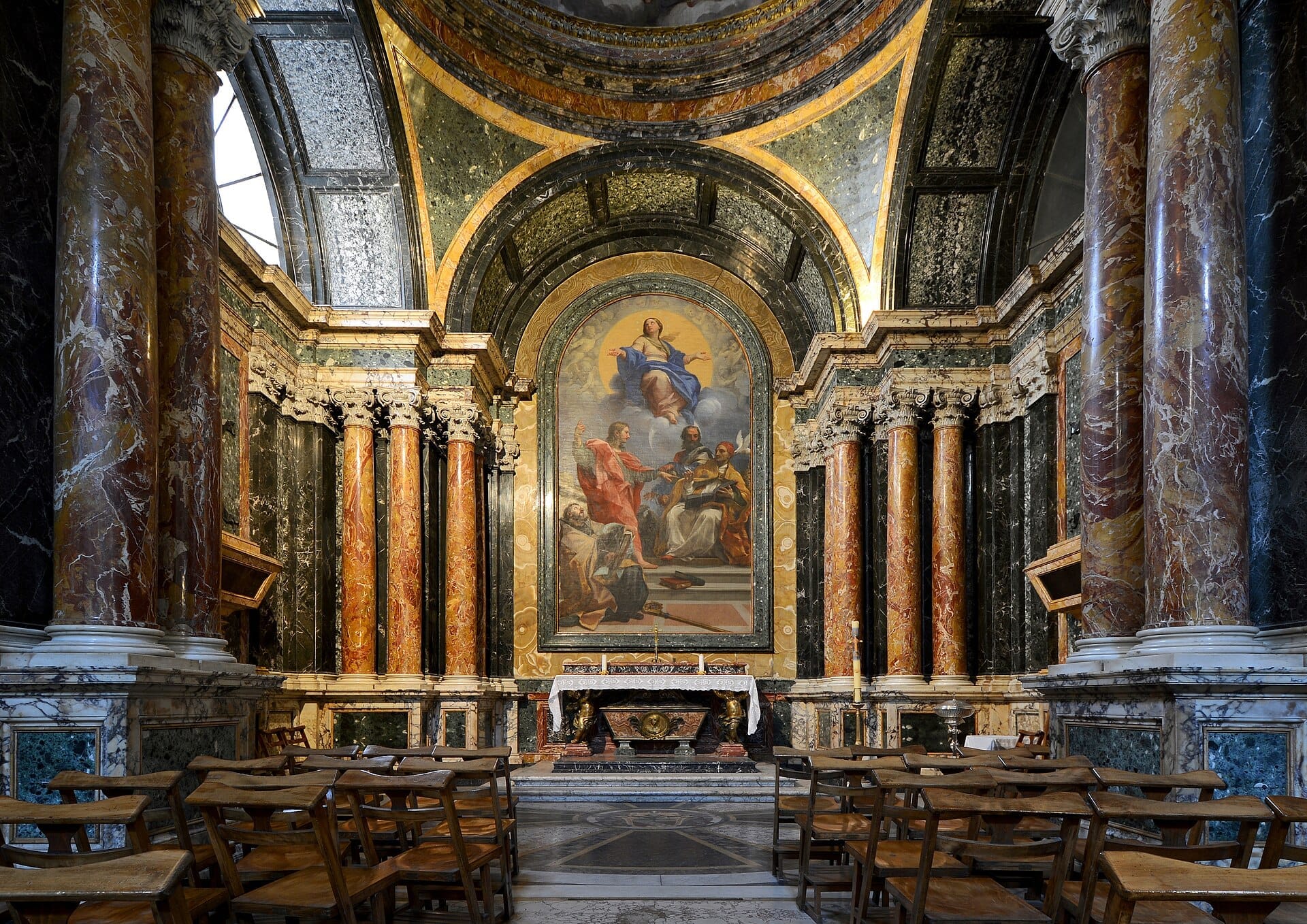
Most travelers arrive at Piazza del Popolo, photograph the twin baroque churches at the south end, and leave. That is a significant mistake. The Basilica di Santa Maria del Popolo, pressed against the left side of the ancient Porta del Popolo on the piazza's northern edge, contains two full-scale Caravaggio paintings, the Chigi Chapel designed by Raphael, and a cycle of frescoes by Pinturicchio — all at no charge and with no booking required.
The church is active — it holds regular masses and is a working Augustinian parish — so there will be moments when sections are temporarily off-limits to visitors. Plan accordingly, and bring a couple of euro coins if you want to illuminate the Cerasi Chapel, where the Caravaggios hang.
💡 Local tip
The Cerasi Chapel's lighting is coin-operated. Bring a 50-cent or 1-euro coin to activate the lights — without them, the Caravaggio paintings are extremely difficult to read in the dim interior.
Nine Centuries of History Compressed into One Façade
The site's origin traces to around 1099, when Pope Paschal II ordered a chapel built here to exorcise a walnut tree believed to harbor the ghost of Nero. The story is almost certainly legend, but it reflects the broader medieval anxiety about this northern gateway to Rome, which sat outside the Aurelian Walls and felt wild and spiritually exposed. A more substantial church was consecrated in 1235 under Pope Gregory IX.
The structure you enter today was built between 1472 and 1477 at the direction of Pope Sixtus IV — the same pope who commissioned the Sistine Chapel — making Santa Maria del Popolo one of the first major Renaissance churches in Rome. Sixtus entrusted it to the Augustinian friars, who have managed it ever since. The façade is plain by Roman baroque standards, which makes the interior's density of ornament all the more startling when the door swings open.
The church sits at the natural entry point of the Via Flaminia, the ancient consular road connecting Rome to the Adriatic coast. For centuries, pilgrims entering Rome from the north would pass through Porta del Popolo and pray here first. That context matters: the church's art program was deliberately assembled to awe and instruct new arrivals. Learn more about the surrounding area in our guide to Rome's historic center.
Tickets & tours
Live prices and dates from our booking partner. If you book, we may earn a commission at no extra cost to you.
Santa Maria Maggiore Dome entrance ticket with downloadable audioguide
From 26 €Instant confirmationFree cancellationBasilica of Santa Maria Maggiore audio tour and skip-the-line ticket
From 15 €Instant confirmationFree cancellationSanta Maria Maggiore Basilica audio guide and Underground entry ticket
From 30 €Instant confirmationFree cancellationSanta Maria Maggiore and panoramic dome entry ticket
From 22 €Instant confirmationFree cancellation
The Cerasi Chapel: Caravaggio at Close Range
The left transept holds the Cerasi Chapel, commissioned in 1600 by Tiberio Cerasi, treasurer-general to Pope Clement VIII. Cerasi originally hired Caravaggio to paint two large canvases for the side walls, and the resulting works — 'The Conversion of Saint Paul' and 'The Crucifixion of Saint Peter' — remain in place today, flanking an altarpiece by Annibale Carracci.
The Caravaggio paintings are disorienting in the best sense. 'The Conversion of Saint Paul' fills the canvas almost entirely with a horse's hindquarters, with Saul collapsed on the ground beneath it, arms raised toward a blinding light the viewer cannot see. Caravaggio strips the miracle of all its grandeur and locates it instead in a moment of private, physical shock. 'The Crucifixion of Saint Peter' is equally radical: four laborers strain to lift the cross, their effort shown with the unglamorous grit of a construction site. Stand close. The scale of each canvas — roughly 2.3 by 1.75 meters — makes the intimacy feel confrontational.
These are not the only Caravaggios on public view in Rome, but they are arguably the most accessible. No timed entry, no security queues, no glass between you and the paint surface. That alone justifies the detour.
The Chigi Chapel: Raphael's Architectural Vision
On the opposite side of the nave, the Chigi Chapel was designed by Raphael for the Sienese banker Agostino Chigi, one of the wealthiest men in Renaissance Europe. Raphael produced the architectural plan and the cartoon for the ceiling mosaic, which depicts God the Father surrounded by planetary deities — a rare fusion of Christian theology and classical cosmology that captures the intellectual mood of High Renaissance Rome perfectly.
The chapel was left unfinished at the deaths of both Raphael and Chigi in 1520. Gian Lorenzo Bernini completed it more than a century later, adding the figures of Daniel and Habakkuk in the niches — dramatic, torqued sculptures that clash productively with the serene Raphaelesque geometry around them. The pyramid-shaped marble tombs of Agostino and his brother Sigismondo occupy two of the corner piers. Notice how Bernini's Daniel looks across the chapel toward the angel tugging Habakkuk's hair: the two figures are in direct visual dialogue across the octagonal space.
Pinturicchio's Frescoes and the Della Rovere Chapel
Before either Caravaggio or Raphael arrived, the Augustinians commissioned Bernardino di Betto — known as Pinturicchio — to decorate the apse and several chapels in the 1480s and 1490s. His fresco cycle in the apse vault shows the coronation of the Virgin surrounded by sibyls and saints, rendered in the jewel-bright palette and narrative clarity that made him the preferred painter of the Borgia papal apartments.
The Della Rovere Chapel, near the entrance on the right, contains additional Pinturicchio frescoes alongside the tombs of two cardinals from the Della Rovere family — the same family that produced Pope Sixtus IV, who founded the church, and Pope Julius II, who commissioned Michelangelo's Sistine ceiling. The density of dynastic and artistic history in this one small chapel is remarkable.
ℹ️ Good to know
Santa Maria del Popolo is an active parish church. Visiting during or immediately before Sunday morning masses may limit access to some chapels. Weekday mornings between 9am and noon are generally the most visitor-friendly window.
Visiting in Practice: Times, Light, and Crowds
The church faces southeast, so morning light filters through the apse windows and catches the gilded vault mosaics at their best before noon. Afternoon visits are fine but the interior becomes quite dim once direct light leaves the nave, making the coin-operated lighting in the Cerasi and Chigi chapels essential rather than merely helpful.
Crowd levels are considerably lower here than at the Pantheon or the Trevi Fountain, but the church does attract art-focused tour groups, typically arriving between 10am and 1pm. If you visit at 8:30 or 9am on a weekday, you will often have the Cerasi Chapel entirely to yourself — a genuinely rare opportunity to stand alone with two Caravaggio masterpieces.
The Flaminio metro stop (Line A) deposits you at the southern edge of Piazza del Popolo, about a 3-minute walk across the square. If you are combining this visit with a walk up to the Pincio Terrace or the Villa Borghese gardens, the church is a natural first stop before the uphill climb.
Dress code rules apply: shoulders and knees must be covered. Scarves and sarongs work fine. Photography is permitted inside but flash is strictly forbidden and should be avoided out of respect regardless — the artworks are fragile and the atmosphere deserves it.
Honest Assessment: What the Church Is and Isn't
Santa Maria del Popolo is not a grand basilica in the scale of San Giovanni in Laterano or St. Peter's. The exterior is understated and easy to overlook. The interior, while rich, is compact, and if you arrive expecting the theatrical sweep of a major Roman church, you may find the scale modest. What it offers instead is density: more significant art per square meter than almost anywhere in Rome.
Travelers who are not particularly interested in painting or Renaissance architecture will find the visit shorter and less impactful. For them, the piazza itself — with its Egyptian obelisk and twin baroque churches — may provide more immediate satisfaction. Those who want structured context for Rome's church art scene can read our overview of the best churches in Rome.
The acoustic atmosphere inside is worth noting: the church is often close to silent on weekday mornings. After the noise of Via del Corso and the piazza, that quiet is itself something worth arriving for.
Insider Tips
- Bring at least two euro coins. The Cerasi Chapel light timer runs short, and you may want to activate it a second time after your eyes have adjusted and you want a longer look at the brushwork.
- Stand at the far left of the Cerasi Chapel to see how the Caravaggio paintings are angled slightly outward from the walls — Caravaggio apparently adjusted the orientation himself so the works could be read from the chapel entrance rather than only head-on.
- The Chigi Chapel floor contains a mosaic showing a skeleton rising from the earth with the inscription 'I was what you are; you will be what I am.' It is easy to miss because visitors tend to look up, not down.
- If the church is holding a mass when you arrive, wait outside or in the nave near the entrance. Masses rarely run longer than 40 minutes, and the atmosphere during and just after a service is calmer and less tour-group-heavy than midday.
- The two baroque churches facing each other at the south end of Piazza del Popolo — Santa Maria in Montesanto and Santa Maria dei Miracoli — look identical but are not. Comparing them is a brief and pleasant exercise in noticing what your eye assumes is symmetry but isn't.
Who Is Santa Maria del Popolo For?
- Art lovers and painters who want close, unmediated access to Caravaggio canvases without booking fees or crowds
- Architecture enthusiasts interested in how Renaissance and baroque design coexist and occasionally argue with each other in the same space
- Budget travelers: the artistic quality here is comparable to major paid museums, at zero cost
- Travelers combining a morning in the northern historic center with a walk up to Villa Borghese
- Anyone on a tight schedule who wants a single, concentrated cultural experience rather than a long queue
Nearby Attractions
Other things to see while in Centro Storico:
- Ara Pacis
Commissioned in 13 BC to celebrate Augustus's campaigns in Gaul and Spain, the Ara Pacis Augustae is one of the best-preserved monuments of ancient Rome. Today it sits inside a striking modern pavilion on the Tiber's east bank, offering an unusually intimate encounter with imperial-era marble carving at near eye level.
- Campo de' Fiori
Campo de' Fiori is one of Rome's most recognizable piazzas, running a daily produce and flower market Monday through Saturday before reinventing itself as a lively social square after dark. Its paving stones have witnessed public executions, papal power, and centuries of commerce.
- Capitoline Hill
Capitoline Hill sits at the symbolic center of Rome, where Michelangelo's perfectly proportioned piazza crowns a site inhabited since the Bronze Age. Today it holds the world's oldest public museums, Rome's city hall, and some of the most striking views over the Roman Forum in the city.
- Capitoline Museums
Perched atop Capitoline Hill overlooking the Roman Forum, the Musei Capitolini hold some of antiquity's greatest sculptures and paintings across three interconnected palaces. Founded in 1471, they predate the Louvre by more than three centuries and reward visitors with both iconic works and panoramic views that few Rome attractions can match.
Planning a trip? Discover personalized activities with the Nomado app.