Trevi Fountain (Fontana di Trevi): The Complete Visitor Guide
The Fontana di Trevi is Rome's largest Baroque fountain and one of the most recognized structures in the world. This guide covers what to expect when you arrive, how the experience changes by time of day, the new ticketed inner area, and the history behind this 18th-century masterpiece.
Quick Facts
- Location
- Piazza di Trevi, Trevi district, Centro Storico, Rome
- Getting There
- Metro Line A: Barberini station (approx. 500m walk)
- Time Needed
- 30–60 minutes
- Cost
- Free from main piazza; €2 for inner (lower) area access (introduced Feb 1, 2023)
- Best for
- First-time visitors, architecture lovers, evening strollers
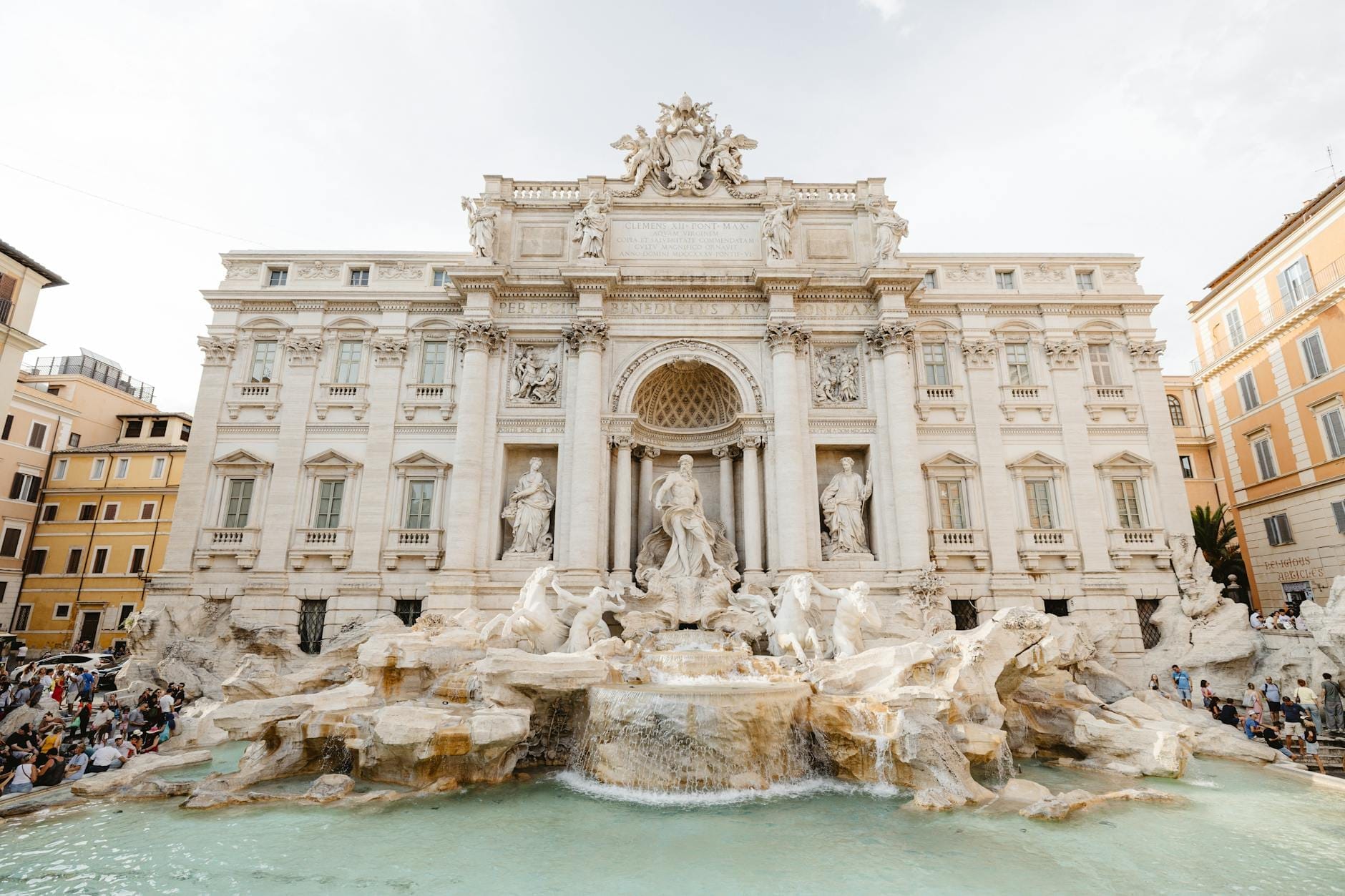
What Is the Trevi Fountain?
The Fontana di Trevi stands 26.3 meters tall and stretches 49.15 meters wide, making it the largest Baroque fountain in Rome and one of the largest in Europe. It occupies the entire rear facade of Palazzo Poli at the junction of three streets: Via de' Crocicchi, Via Poli, and Via delle Muratte. The name 'Trevi' likely derives from 'tre vie', meaning three roads, referring to this intersection in the historic Trevi district.
Construction began in 1732 under architect Nicola Salvi, working from a commission by Pope Clement XII. Salvi died before the project was finished, and Giuseppe Pannini completed the work. The fountain was inaugurated on May 22, 1762, by Pope Clement XIII. The result is a theatrical fusion of architecture and water: the palace facade becomes the backdrop for a full sculptural tableau, with the sea god Neptune at the center commanding two contrasting horse-and-triton groups, one calm, one agitated, representing the sea's shifting moods.
ℹ️ Good to know
Since February 1, 2023, a €2 fee (payable by contactless card or online) is required to access the inner (lower) area close to the fountain basin. Viewing from the main piazza level remains free. Hours: daily 9:00 AM to 10:00 PM for ticketed access; free unrestricted access after 9:00 PM.
The Water Behind the Stone: Aqua Virgo
What many visitors miss is that the Trevi Fountain is not just a decorative monument. It marks the terminal point of the Aqua Virgo, an ancient Roman aqueduct constructed in 19 BC under Marcus Agrippa. The aqueduct carried water from springs roughly 13 kilometers from of Rome into the city center, originally supplying the Baths of Agrippa in the Campus Martius. For over two thousand years, the same underground channel has fed this spot.
The Aqua Virgo was one of the few aqueducts that survived the collapse of Roman infrastructure in late antiquity, largely because it ran underground and was harder to sabotage. Pope Nicholas V commissioned a small fountain at the terminal point in the 15th century, and subsequent papal ambitions gradually escalated until Salvi's 18th-century design replaced everything before it with something on an entirely different scale.
If the history of Rome's ancient water infrastructure interests you, the Baths of Diocletian offer a deeper look at how the aqueduct system shaped the city's monumental architecture.
Tickets & tours
Live prices and dates from our booking partner. If you book, we may earn a commission at no extra cost to you.
Trevi Fountain skip-the-line tickets
From 3 €Instant confirmationRome by night tour with Colosseum and Trevi Fountain with a golf cart
From 100 €Instant confirmationFree cancellationRome piazzas and fountains sunset guided tour with aperitivo
From 79 €Instant confirmationFree cancellationTrevi Fountain and Piazza Navona underground guided walking tour
From 56 €Instant confirmationFree cancellation
How the Experience Changes by Time of Day
Arriving at the Trevi Fountain in the middle of a summer afternoon means navigating one of the densest crowd concentrations in Rome. The narrow piazza fills quickly, bodies pressed together, selfie sticks extended in every direction. It is not unpleasant if you expect it, but it is not a contemplative experience. The sound of the falling water is still audible, but the surrounding noise competes with it.
Early morning, particularly before 9:00 AM, produces a completely different atmosphere. The stone pavement catches low golden light, the fountain's travertine glows warmly, and the piazza holds only a handful of people. The sound of water cascading over the rocks and into the basin becomes the dominant sensory experience. The air in this part of the centro storico is cool and faintly damp in the morning, carrying a slight mineral quality from the fountain spray.
Evening visits, especially after 9:00 PM when ticketed access ends and entry returns to being free, offer a genuinely different visual experience. The fountain is illuminated, and the warm artificial light against the pale travertine creates contrast that photographs capture poorly but the eye absorbs well. Crowds thin noticeably after 10:00 PM. The surrounding narrow streets fill with people heading to or from dinner, and the piazza retains ambient energy without the daytime crush.
💡 Local tip
For the best photographs with minimal crowds, arrive no later than 7:30 AM. The fountain faces roughly northeast, so morning light falls on it at a useful angle in spring and summer. Bring a wide-angle lens or use your phone's panoramic mode: the fountain is wide and the piazza is small.
Navigating the Visit: Piazza Level vs. Inner Area
Until recently, the Trevi Fountain was completely free to approach from any direction. The new ticketing system, introduced to manage the chronic overcrowding and fund ongoing maintenance, divides the experience into two tiers. From the piazza level, you can see the entire fountain clearly without paying anything. The viewing angle from the upper rim of the basin is good enough to take in the full sculptural composition.
The inner area, accessed with the €2 ticket, brings you down to the lower terrace immediately in front of the basin. From here you are close enough to feel the fine mist on warm days and to study individual sculptural details: the sea horses' musculature, the coiling tritons, the relief panels flanking Neptune depicting the legend of Agrippa's soldier discovering the spring, and the young woman shown pointing toward the water source. The bas-relief work is dense and worth the closer view if you have any interest in Baroque sculpture.
Note that on the second Monday of each month, opening shifts to 2:00 PM to allow staff to collect coins from the basin. Rome's municipal government donates the collected coins, which reportedly amount to well over one million euros annually, to charitable causes. Arrive on those mornings and you will find the inner area closed until the revised opening time.
⚠️ What to skip
Sitting on the fountain edge, touching the sculpture, or entering the basin are prohibited and subject to fines. Eating and drinking at the fountain perimeter is also restricted. These rules are actively enforced by attendants during ticketed hours.
The Coin Tradition and Cultural Footprint
The practice of throwing a coin into the Trevi Fountain to ensure a return to Rome is widely attributed to the 1954 Italian film 'Tre Soldi nella Fontana' (Three Coins in the Fountain) and reinforced by the 1960 Fellini film 'La Dolce Vita', in which Anita Ekberg wades through the basin in an evening gown. The specific tradition of tossing one coin for a return visit, two for a new romance, and three for marriage is a later embellishment, but the coin-throwing itself predates the films and connects to older European customs around sacred springs and wishing wells.
The fountain's role in cinema and advertising has made it the single most imitated fountain design in the world. Scaled replicas exist on multiple continents. This cultural weight is part of what makes the real thing worth seeing: standing in front of the original, with its actual scale and the specific texture of its Tivoli travertine, the reproductions suddenly seem thin. The fountain is 49 meters wide. No photograph or replica quite prepares you for that.
The Trevi Fountain sits in the centro storico alongside other major set pieces. Piazza Navona is a 15-minute walk northwest and offers a useful comparison: Bernini's Fontana dei Quattro Fiumi there shows you what the previous generation of Baroque fountain-making looked like before Salvi raised the stakes.
Getting There and Practical Logistics
The most straightforward approach by public transit is Metro Line A to Barberini station, followed by a roughly 500-meter walk north through the Trevi district. The route is well signed and passes through pleasant streets. Buses also stop nearby: check current ATAC routes as service patterns change seasonally. Taxis can drop you at Piazza di Trevi, though the surrounding lanes are narrow and traffic restrictions apply at certain hours.
The Trevi Fountain is walkable from many central locations. From the Pantheon it is approximately 10 minutes on foot heading northeast. From the Spanish Steps it is around 15 minutes heading southeast. If you are combining multiple centro storico attractions in a day, the fountain fits naturally into a walking circuit.
For a full day itinerary that connects the fountain to Rome's other major highlights, the Rome in 3 Days guide builds a logical walking sequence that avoids unnecessary backtracking.
The piazza itself is small for the volume of visitors it receives. There are a few cafes and bars in the immediate vicinity, with prices reflecting the location premium. Restrooms are not available at the fountain itself; the nearest public facilities are typically inside nearby cafes that expect a purchase in exchange for access.
💡 Local tip
Wear comfortable shoes with grip. The cobblestones around Piazza di Trevi are uneven, and the area gets slippery after rain. Avoid carrying large bags or backpacks in peak hours: the crowd density makes pickpocketing a real risk in this part of the centro storico.
Insider Tips
- The second Monday of each month, when coin collection runs until 2:00 PM, is the quietest weekday morning to visit the piazza level. Many tourists see the closure sign and leave; the fountain from the upper rim is still fully visible and the crowd thins significantly.
- Stand to one side of the central axis when photographing. Most visitors cluster directly in front of Neptune's central niche. From a 30-degree angle to either side, the depth of the sculptural composition reads better and your frame includes less crowd.
- The bar directly on the corner of Via delle Muratte nearest the fountain has a first-floor window with a partial view of the fountain top. A coffee there costs more than elsewhere but gives you a rare eye-level view of the upper architectural cornice.
- If you are visiting in summer and want the mist effect visible in photos, come in the early afternoon when sunlight hits the spray directly. The rainbow effect in the mist is brief and weather-dependent but worth timing if you care about that shot.
- The fountain is underlit in the hours just after sunset, between approximately 8:30 and 9:30 PM. If you want illuminated nighttime shots, come after 9:30 PM when the lighting levels stabilize and the amber tone becomes consistent across the facade.
Who Is Trevi Fountain For?
- First-time visitors to Rome for whom the fountain is a genuine bucket-list moment
- Architecture and art history enthusiasts who want to study the Baroque sculptural program up close
- Photographers targeting either dawn light or evening illumination
- Travelers building a walking day through the centro storico who want to combine it with the Pantheon and Piazza Navona
- Evening strollers who want a landmark to anchor a nighttime walk through the historic center
Nearby Attractions
Other things to see while in Centro Storico:
- Ara Pacis
Commissioned in 13 BC to celebrate Augustus's campaigns in Gaul and Spain, the Ara Pacis Augustae is one of the best-preserved monuments of ancient Rome. Today it sits inside a striking modern pavilion on the Tiber's east bank, offering an unusually intimate encounter with imperial-era marble carving at near eye level.
- Campo de' Fiori
Campo de' Fiori is one of Rome's most recognizable piazzas, running a daily produce and flower market Monday through Saturday before reinventing itself as a lively social square after dark. Its paving stones have witnessed public executions, papal power, and centuries of commerce.
- Capitoline Hill
Capitoline Hill sits at the symbolic center of Rome, where Michelangelo's perfectly proportioned piazza crowns a site inhabited since the Bronze Age. Today it holds the world's oldest public museums, Rome's city hall, and some of the most striking views over the Roman Forum in the city.
- Capitoline Museums
Perched atop Capitoline Hill overlooking the Roman Forum, the Musei Capitolini hold some of antiquity's greatest sculptures and paintings across three interconnected palaces. Founded in 1471, they predate the Louvre by more than three centuries and reward visitors with both iconic works and panoramic views that few Rome attractions can match.
Planning a trip? Discover personalized activities with the Nomado app.