Baths of Diocletian: Rome's Largest Ancient Bath Complex
The Terme di Diocleziano once covered 13 hectares and welcomed up to 3,000 Romans daily. Today, part of the Museo Nazionale Romano, this monumental complex rewards visitors who come prepared, with vaulted halls, open-air courtyards, and inscriptions that bring Rome's imperial scale into focus.
Quick Facts
- Location
- Viale Enrico de Nicola 79, near Piazza della Repubblica, Monti
- Getting There
- Roma Termini (Lines A & B); 5-min walk from Piazza dei Cinquecento
- Time Needed
- 1.5 to 2.5 hours
- Cost
- Part of Museo Nazionale Romano; verify current ticket prices on the official site before visiting
- Best for
- Ancient history enthusiasts, architecture lovers, travelers who want a quieter alternative to the Colosseum
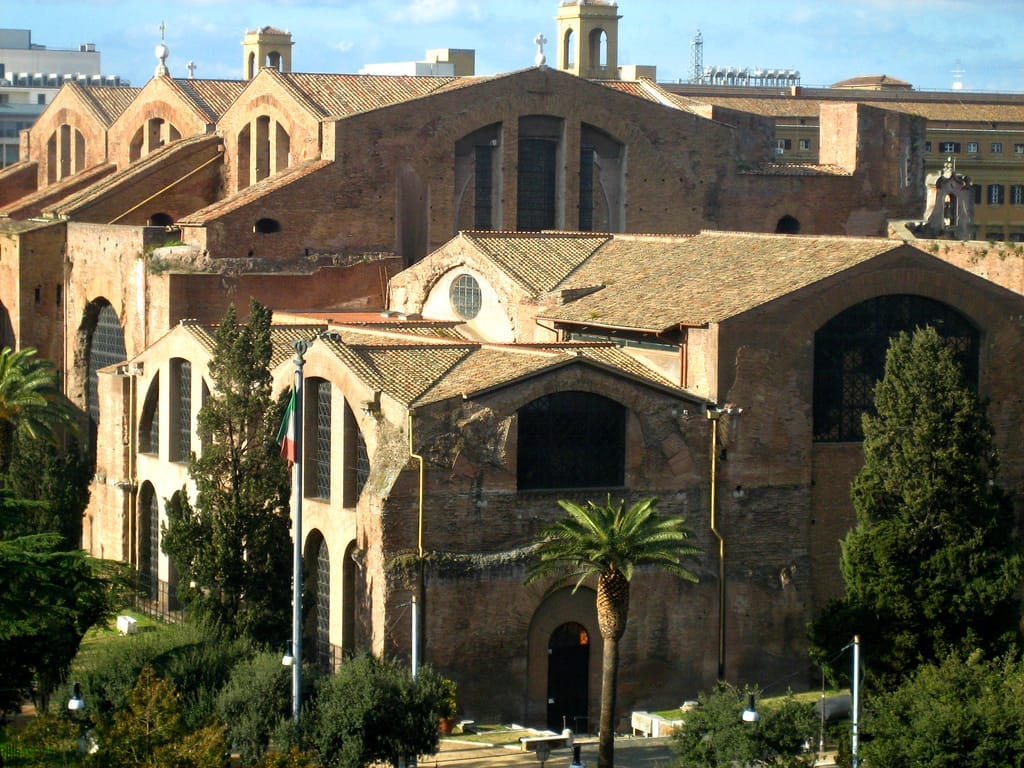
What the Baths of Diocletian Actually Are
The Terme di Diocleziano, completed around 306 AD, were the largest public bath complex ever built in ancient Rome. Commissioned by Emperor Maximian in honor of his co-emperor Diocletian, the complex stretched across 13 hectares, or roughly 120,000 square meters, and could serve up to 3,000 visitors at a time. To put that in perspective: this single structure was larger than many Roman towns.
The baths functioned for over two centuries, operating continuously until 537 AD when the Goths severed the aqueducts supplying Rome during the Gothic Wars. What stands today is an uneven but revealing portrait of that original structure, scattered across several buildings and a large open courtyard managed as part of the Museo Nazionale Romano.
Unlike the Colosseum or the Roman Forum, this site is rarely overcrowded. That relative quiet is both its main appeal and, for some visitors, its limitation. If you come expecting spectacle, you may feel underwhelmed. If you come with curiosity and a willingness to read the context, it rewards patience.
💡 Local tip
Arrive shortly after opening, ideally before 10:30am. The courtyard, which is the visual centerpiece, fills with tour groups by midday. Morning light through the ancient arches also makes for better photographs.
The Scale of Roman Engineering, Still Visible
Walking through the site, the first thing that strikes most visitors is sheer volume. The central hall, later converted by Michelangelo in the 1560s into the Basilica of Santa Maria degli Angeli e dei Martiri, preserves the original barrel-vaulted ceiling of the frigidarium (cold bath chamber). The ceiling rises around 30 meters, and the ancient columns of red granite, each monolithic and unfluted, were quarried from Egypt. These are not replicas. They have been standing for over 1,700 years.
Outside, the large cloister attributed to Michelangelo forms the courtyard of the museum. It is lined with Roman sarcophagi, inscriptions, ancient statuary, and architectural fragments arranged chronologically. Cypress trees shade the central lawn, and stone benches allow you to sit with the exhibits rather than rush past them. This is one of the few spaces in central Rome where you can quietly absorb Roman stone carving at close range without jostling.
A second, smaller cloister houses displays focused on epigraphy, Rome's official inscriptions. For most travelers this sounds dry, but the collection is surprisingly affecting: military dedications, funerary texts, bureaucratic records in stone. These are the administrative fingerprints of a civilization, and the museum presents them clearly.
Tickets & tours
Live prices and dates from our booking partner. If you book, we may earn a commission at no extra cost to you.
Candlelit dining experience in the ancient Baths of Agrippa
From 135 €Instant confirmationFree cancellationTicket to Ancient Baths of Caracalla with an audio guide
From 18 €Instant confirmationFree cancellationBaths of Caracalla ticket with round-trip transfer and audioguide app
From 0 €Instant confirmationFree cancellationSt. Peter's Basilica, Vatican Museums, Sistine Chapel reserved entry
From 81 €Instant confirmationFree cancellation
How the Site Changes Through the Day
Morning visits have the best conditions overall. The light in the courtyard is soft and directional, the crowds are thin, and staff are generally attentive. By early afternoon, the courtyard temperature rises quickly in summer, and the open-air sections become uncomfortable between June and August. If you are visiting during peak summer, plan for late morning arrival with a plan to move into the cooler interior galleries by 1pm.
Late afternoon brings a different quality of light into the cloister, with long shadows across the sarcophagi and the stone floor. It is aesthetically rewarding but operationally you will have less time before closing. Check current opening hours on the official Museo Nazionale Romano website before your visit, as hours vary seasonally.
⚠️ What to skip
The site is spread across multiple buildings and courtyards. Wear comfortable, flat-soled shoes. The stone pathways and uneven ancient flooring make heels or sandals without ankle support a poor choice.
The Michelangelo Connection
In 1561, Pope Pius IV commissioned Michelangelo, then in his mid-eighties, to convert part of the ancient baths into a Carthusian monastery church. The result was the Basilica of Santa Maria degli Angeli e dei Martiri, which incorporated the surviving frigidarium as its nave. Michelangelo kept the Roman bones of the structure intact, introducing Christian iconography without demolishing the ancient architecture.
The basilica was later modified significantly by Luigi Vanvitelli in 1749, who shifted the orientation and added the transept. What you see today is therefore a layered record: imperial Roman construction, late Renaissance reworking, and 18th-century alteration, all coexisting in a single interior. The church is accessed separately from the museum but stands on the same footprint. Entering it from Piazza della Repubblica, you step from a noisy Roman square into one of the largest and quietest church interiors in the city.
Practical Walkthrough: What to Prioritize
If your time is limited to 90 minutes, focus on three areas: the large Michelangelo cloister with its epigraphic and sculptural collections, the interior rooms displaying proto-historic finds and Roman Republic-era artifacts, and the surviving sections of the original bath walls visible from the courtyard perimeter. These three zones give you the full historical arc of the complex without museum fatigue.
The museum's epigraphic collection is one of the most important in Italy and is frequently overlooked by travelers focused on figurative sculpture. If you have any interest in how Roman society actually functioned, the inscriptions, from voting records to trade guild markers to military service logs, are more revealing than any marble portrait.
The Baths of Diocletian sit within easy walking distance of the National Roman Museum and the Quirinal Palace. Budget travelers should know that a combined Museo Nazionale Romano ticket covers multiple branches, which may offer better value. Verify current ticket combinations on the official site.
ℹ️ Good to know
The Museo Nazionale Romano operates across four sites in Rome: the Baths of Diocletian, Palazzo Massimo alle Terme, Palazzo Altemps, and Crypta Balbi. A combined ticket allows entry to all four and is generally valid for several days. Confirm current terms when purchasing.
Who This Attraction Suits and Who It Doesn't
The Baths of Diocletian are genuinely rewarding for travelers with an appetite for Roman history who have already processed the headline sites. If the Colosseum was your first day and the Forum your second, this is an ideal third stop: familiar enough to contextualize, different enough to add new dimensions.
Families with children under 10 may find the site less engaging than the Colosseum. There are no gladiators, no iconic skyline, and the inscriptions require reading. That said, the large open courtyard gives children room to move, and the oversized sarcophagi tend to hold attention briefly.
Travelers on a tight schedule who are trying to cover the Palatine Hill and the Forum in a single day should skip this site on that particular day and return if time allows. Trying to absorb too many Roman ruins in sequence leads to diminishing returns, not deeper understanding.
Architecture students, classicists, and anyone interested in Roman material culture will find this one of the most intellectually satisfying museum experiences in Rome. The site does not perform for the camera. It simply presents what survives.
Insider Tips
- The large cloister courtyard is shaded by mature cypress trees, but the open sections heat up fast. In summer, start your visit in the interior galleries and move to the courtyard in the last 30 minutes before closing.
- Buy the combined Museo Nazionale Romano ticket if you plan to visit Palazzo Massimo alle Terme, which is a 5-minute walk away and holds the finest Roman fresco and mosaic collections in the city. The two sites complement each other well.
- The Basilica of Santa Maria degli Angeli e dei Martiri on Piazza della Repubblica is free to enter and shares the same ancient footprint as the baths. Step inside even if you skip the paid museum, as the preserved frigidarium gives a visceral sense of the original scale.
- Photography is generally permitted in the outdoor areas. The low morning light across the epigraphic slabs in the smaller cloister produces particularly strong images if you have even basic interest in travel photography.
- The area around Roma Termini immediately adjacent to the entrance is loud, traffic-heavy, and not particularly welcoming. Walk one block south toward Piazza della Repubblica before entering, and the transition into the site feels more meaningful.
Who Is Baths of Diocletian For?
- Roman history enthusiasts who want depth beyond the headline ruins
- Architecture and engineering buffs interested in imperial-scale construction
- Repeat visitors to Rome looking for less-visited museum experiences
- Travelers combining multiple Museo Nazionale Romano sites on a single ticket
- Anyone who finds the Colosseum too crowded and wants a comparable historical weight in a quieter setting
Nearby Attractions
Other things to see while in Monti:
- National Roman Museum
The Museo Nazionale Romano is one of Rome's most important archaeological collections, spread across four distinct sites. Its crown jewel, Palazzo Massimo alle Terme, holds Roman sculptures, imperial frescoes, and coin collections that rival anything in the city. This guide tells you exactly what to expect, where to focus your time, and how to get the most from each visit.
- Quirinal Palace
Perched on Rome's highest hill and spanning 110,500 square meters, the Quirinal Palace has served popes, kings, and presidents across five centuries. Today it opens its doors to visitors, offering access to state rooms, sweeping art collections, and one of the finest views in the city.
- San Clemente Basilica
San Clemente Basilica in Rome's Monti district is three buildings stacked on top of each other across 2,000 years of history. The 12th-century upper church is free to enter; the underground excavations reveal a 4th-century basilica, a Roman house, and an ancient Mithraic temple for €10. Few sites in Rome compress so much time into a single visit.
- San Giovanni in Laterano
The Archbasilica of Saint John Lateran holds a title that St. Peter's Basilica does not: it is the cathedral church of Rome and the Pope's official seat as Bishop of Rome. Founded by Emperor Constantine in the early 4th century, it predates the Vatican by over a thousand years and remains one of the most historically significant Christian sites on earth.
Planning a trip? Discover personalized activities with the Nomado app.