Quirinal Palace: Inside Rome's Most Powerful Address
Perched on Rome's highest hill and spanning 110,500 square meters, the Quirinal Palace has served popes, kings, and presidents across five centuries. Today it opens its doors to visitors, offering access to state rooms, sweeping art collections, and one of the finest views in the city.
Quick Facts
- Location
- Piazza del Quirinale, Quirinal Hill, Rome
- Getting There
- Bus lines 40, 64, 70, 170 stop near Piazza del Quirinale; closest metro is Repubblica (Line A), approx. 10-min walk
- Time Needed
- 1.5 to 3 hours depending on tour scope
- Cost
- Verify current admission via official website; access may be limited when state functions are in session
- Best for
- History enthusiasts, architecture lovers, and visitors curious about modern Italian democracy
- Official website
- palazzo.quirinale.it/palazzo_en.html
What Is the Quirinal Palace?
The Palazzo del Quirinale, known in English as the Quirinal Palace, is the official residence of the President of the Italian Republic and the largest working presidential palace in Rome. It sits at the summit of the Quirinal Hill, the tallest of Rome's celebrated Seven Hills, giving it a commanding presence over the city's rooftops and domes. Covering 110,500 square meters, it ranks as the sixth largest palace in the world, roughly 20 times the footprint of the White House.
What makes the Quirinal unusual among Rome's great buildings is its continuous relevance. This is not a museum frozen in amber or a ruin you reconstruct in your imagination. It has been an active seat of power since 1573, cycling through papal authority, royal residence, and now republican governance. That layering of political history gives every gilded ceiling and frescoed corridor a weight that purely decorative palaces rarely match.
⚠️ What to skip
Access to the palace is restricted or suspended on days when official state functions, presidential receptions, or diplomatic events are scheduled. Always check the official website at palazzo.quirinale.it before planning your visit, as dates and opening conditions change regularly.
Five Centuries of Shifting Power
Construction began in 1573 under Pope Gregory XIII, who wanted a summer retreat away from the Tiber lowlands, where summer heat and disease made the Vatican increasingly uncomfortable. In 1587, Pope Sixtus V acquired the land outright and commissioned a major expansion. Over the following century, the palace grew steadily, with successive popes leaving their architectural mark. The final significant phase of this papal-era construction was completed around 1700 under architect Ferdinando Fuga, whose work also included the palace's distinctive Coffee House in the gardens.
The architects involved read like a catalogue of Roman Baroque greatness: Domenico Fontana shaped the early palace structure, Carlo Maderno extended the main body, and Gian Lorenzo Bernini contributed the iconic loggia facing the piazza. The result is less a single coherent vision than a conversation between masters across generations, which is partly why the interiors feel so richly varied.
After Italian unification and the end of papal temporal power in 1870, the palace became the royal residence of the House of Savoy. When Italy voted to abolish the monarchy in the 1946 referendum, the Quirinal transitioned once again, this time to the Italian Republic. It has served as the official seat of every Italian president since.
Tickets & tours
Live prices and dates from our booking partner. If you book, we may earn a commission at no extra cost to you.
St. Peter's Basilica, Vatican Museums, Sistine Chapel reserved entry
From 81 €Instant confirmationFree cancellationGuided tour of Galleria Borghese and of Villa Borghese gardens
From 69 €Instant confirmationFree cancellationVatican: Basilica, Dome and underground early bird tour
From 50 €Instant confirmationFree cancellationPasta-making class, tasting and prosecco with local chef in Rome
From 79 €Instant confirmationFree cancellation
The Piazza and the Approach
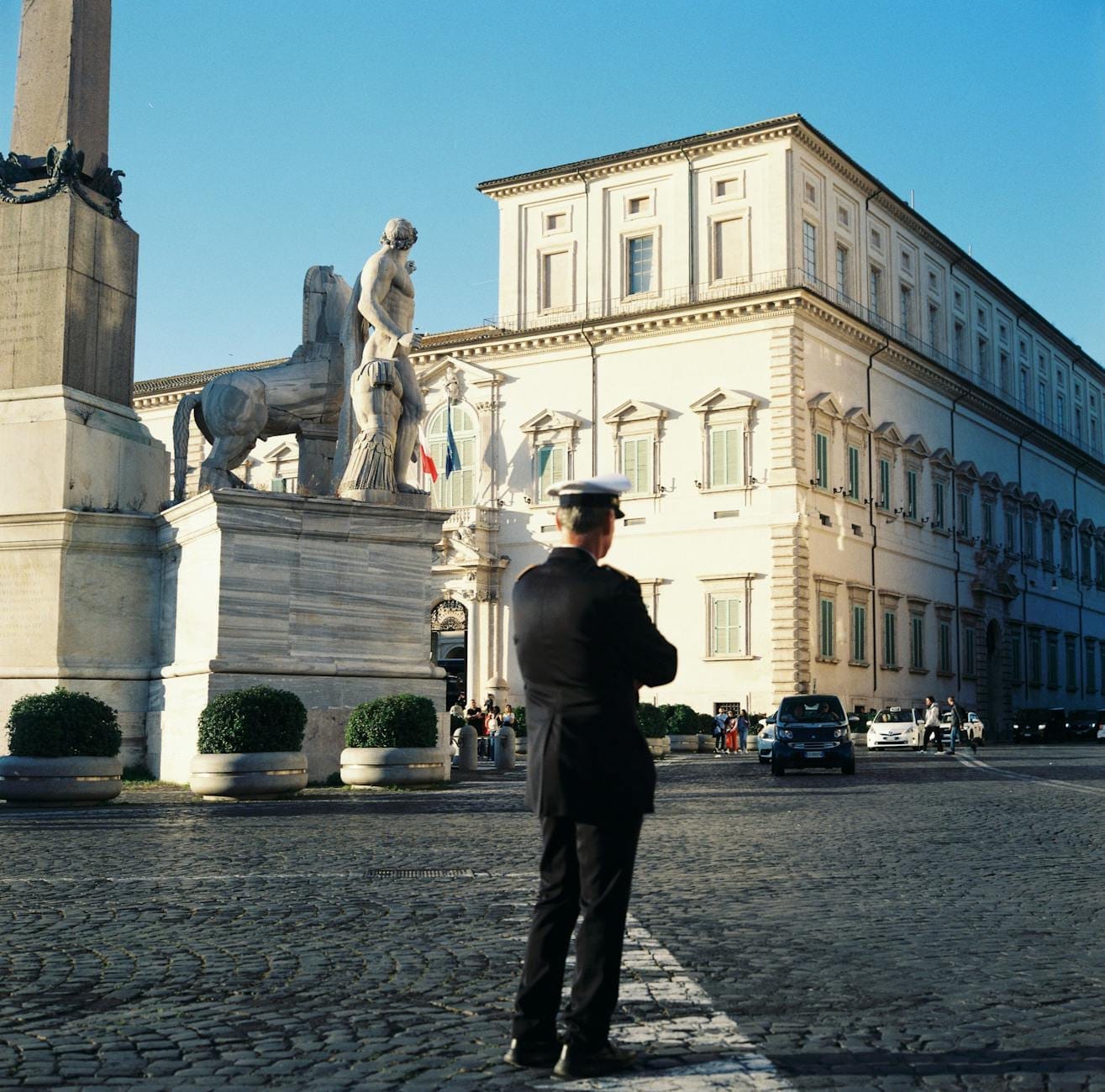
Even visitors who never enter the palace encounter something worth pausing at. Piazza del Quirinale is one of Rome's most theatrical open spaces, anchored at its center by an ancient obelisk flanked by colossal marble statues of Castor and Pollux with their horses. These sculptures were excavated from the nearby Baths of Constantine and installed here in the late 18th century. In the morning, when the light falls flat and golden across the travertine paving, the square feels almost cinematic.
The terrace along the eastern edge of the piazza offers one of the most underrated panoramic views in the city. Looking west and southwest, you can trace the Capitoline Hill, the dome of the Pantheon, and on clear days, the dome of St. Peter's rising above the city fabric. For a broader look at how Rome layers its hills and monuments, Rome's best viewpoints include several spots that pair well with a morning at the Quirinal.
The Changing of the Guard ceremony takes place at the palace entrance and is worth timing your arrival around. The uniformed Corazzieri, Italy's presidential guard regiment, are among the tallest soldiers in the Italian military, a requirement for service in this ceremonial role. The ritual itself is brief but visually precise, and it costs nothing to watch from the piazza.
Inside the Palace: Rooms and Collections
Visitor access to the interior is structured and guided, which means you move through a curated sequence of state rooms rather than exploring freely. The architecture shifts dramatically as you pass from one hall to the next. The Mascarino Staircase, named after architect Ottaviano Mascarino who designed it in the late 16th century, sets the tone early: wide, ceremonial, faced in stone, and designed to make an arriving dignitary feel the full weight of the institution.
The Great Hall of the Cuirassiers is the largest interior space open to visitors, a long formal hall used for state receptions. Its proportions are genuinely staggering, and the ceiling frescoes demand time you may not expect to spend looking upward. The Pauline Chapel, built to mirror the scale and function of the Sistine Chapel in the Vatican, contains frescoes by Guido Reni and holds significant importance in papal and later royal ceremony.
The palace collections span paintings, sculpture, tapestries, antique clocks, historical carriages, porcelain, and Murano glass chandeliers of extraordinary scale. For visitors building a broader understanding of Rome's artistic heritage, the best museums in Rome offer useful context for the decorative traditions on display here.
💡 Local tip
Arrive at the palace entrance slightly ahead of your scheduled entry time. Security screening is thorough, and latecomers may miss the start of the guided tour. Photography policies vary by room, so ask at the entrance rather than assuming.
The Gardens
The palace gardens are among the least-visited parts of the complex and arguably the most peaceful. Laid out originally in the 17th century, they were later softened with Romantic landscaping elements in the late 18th century, mixing formal Italian geometry with more naturalistic planting. Ferdinando Fuga's Coffee House, a small pavilion used by popes and later royals as a retreat within the retreat, sits within the garden grounds and is included in some visitor itineraries.
On warm afternoons, the scent of clipped box hedge and citrus mixes with cooler air from the hilltop elevation. The gardens feel genuinely removed from Rome's street-level chaos, which is unusual for a location so central. Garden access may be included with palace entry or offered separately depending on the season and current programming, so verify before arriving.
Getting There and Practical Logistics
The Quirinal Hill sits between Termini station and the historic center, making it accessible on foot from several directions. From Termini, the walk takes roughly 15 minutes through streets that pass the National Roman Museum near Piazza della Repubblica. Bus lines 40, 64, 70, and 170 connect the hill to the centro storico. There is no metro stop directly at the palace, but Line A's Repubblica stop puts you within a manageable walking distance.
The Monti neighborhood begins just below the Quirinal Hill's southern slope, making it a natural pairing for a half-day itinerary. Monti offers some of Rome's better independent cafés and lunch spots, which makes timing your palace visit for the morning and descending for lunch a practical and pleasant structure.
Wear comfortable shoes with grip. The piazza itself is flat, but the streets approaching from below involve uneven cobblestones and inclines. Modest dress is expected inside the palace, meaning covered shoulders and no shorts. Security requires bags to be screened, and large backpacks may need to be checked.
ℹ️ Good to know
Opening days and hours are subject to change based on official state functions. The palace may close on short notice for presidential or government events. Booking in advance through the official website is strongly recommended, and it provides the most current schedule.
Honest Assessment: Is It Worth Your Time?
The Quirinal Palace is not the most approachable attraction in Rome. Access is controlled, schedules shift, and the palace's significance is easier to appreciate with some background knowledge about Italian history. Visitors who arrive expecting a freeform exploration will find the guided, restricted format frustrating.
But for visitors who care about the arc of Italian political history, Baroque architecture, or the question of how a building changes meaning as power changes hands, the Quirinal is genuinely rewarding. It complements rather than competes with the more ancient sites nearby. A morning here followed by time at the Roman Forum or the Capitoline Museums gives a coherent picture of Rome from republic through empire through church authority through modern republic.
Those with only two or three days in Rome and a focus on ancient history or religious art will likely find more return elsewhere. The palace rewards patience and prior reading more than most Roman attractions.
Insider Tips
- The panoramic terrace on the eastern side of Piazza del Quirinale is freely accessible at any time, even when the palace itself is closed. It is one of the better elevated views of central Rome and costs nothing.
- The Changing of the Guard ceremony at the palace entrance is brief and precise. Arrive a few minutes early to secure a clear sightline from the piazza rather than trying to view through other visitors.
- If the palace is closed on your preferred date due to a state function, note that the exterior of the building and the piazza itself remain accessible. The statues of Castor and Pollux and the obelisk are worth the walk regardless.
- Visit on a weekday morning for the lightest crowds. Weekend afternoon visits can bring significantly more foot traffic to both the piazza and the palace entry points.
- The Monti neighborhood directly below the hill has several good espresso bars that open early. Fuel up before your tour rather than after, as there are no significant café options immediately adjacent to the palace entrance.
Who Is Quirinal Palace For?
- Travelers interested in Italian political history and the transition from monarchy to republic
- Architecture enthusiasts drawn to Baroque state rooms designed by Bernini, Maderno, and Fontana
- Visitors who want a major Roman site that sees fewer crowds than the Colosseum or Vatican
- Photographers looking for panoramic city views from one of Rome's highest accessible points
- Slow travelers with extra days in Rome who have already covered the primary ancient and religious sites
Nearby Attractions
Other things to see while in Monti:
- Baths of Diocletian
The Terme di Diocleziano once covered 13 hectares and welcomed up to 3,000 Romans daily. Today, part of the Museo Nazionale Romano, this monumental complex rewards visitors who come prepared, with vaulted halls, open-air courtyards, and inscriptions that bring Rome's imperial scale into focus.
- National Roman Museum
The Museo Nazionale Romano is one of Rome's most important archaeological collections, spread across four distinct sites. Its crown jewel, Palazzo Massimo alle Terme, holds Roman sculptures, imperial frescoes, and coin collections that rival anything in the city. This guide tells you exactly what to expect, where to focus your time, and how to get the most from each visit.
- San Clemente Basilica
San Clemente Basilica in Rome's Monti district is three buildings stacked on top of each other across 2,000 years of history. The 12th-century upper church is free to enter; the underground excavations reveal a 4th-century basilica, a Roman house, and an ancient Mithraic temple for €10. Few sites in Rome compress so much time into a single visit.
- San Giovanni in Laterano
The Archbasilica of Saint John Lateran holds a title that St. Peter's Basilica does not: it is the cathedral church of Rome and the Pope's official seat as Bishop of Rome. Founded by Emperor Constantine in the early 4th century, it predates the Vatican by over a thousand years and remains one of the most historically significant Christian sites on earth.
Planning a trip? Discover personalized activities with the Nomado app.