Vittoriano (Altar of the Fatherland): Rome's Most Polarizing Monument
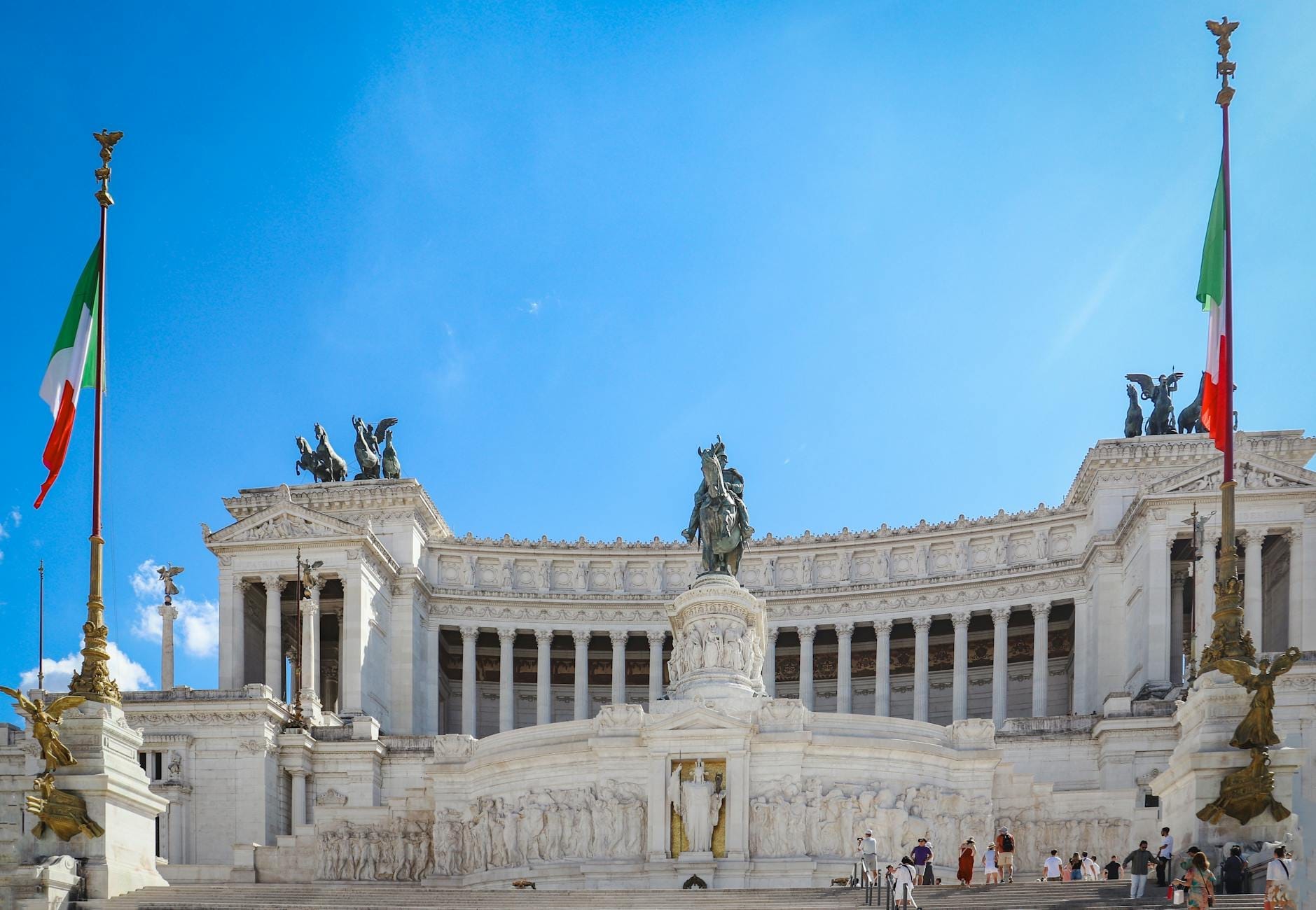
The Vittoriano, officially the Monumento Nazionale a Vittorio Emanuele II, dominates Piazza Venezia with blinding white marble and colossal bronze statuary. Love it or find it excessive, its free-access terraces offer some of the most commanding views of the Roman Forum and the ancient city anywhere in Rome.
Quick Facts
- Location
- Piazza Venezia, Centro Storico, Rome
- Getting There
- Metro Line B – Cavour (approx. 700m on foot); Metro Line B – Colosseo (approx. 1 km on foot); Bus lines 40, 64, 85 stop at Piazza Venezia
- Time Needed
- 45 minutes (free access) to 2 hours (full museums + terrace)
- Cost
- Free entry to monument; Panoramic Terrace €12; Full Museums + Terrace €20; enhanced ticket with multimedia video available
- Best for
- Views of Ancient Rome, Italian Risorgimento history, photography
- Official website
- vive.cultura.gov.it/en/vittoriano
What Is the Vittoriano?
The Vittoriano, formally known as the Monumento Nazionale a Vittorio Emanuele II, stands at the northern edge of Piazza Venezia as the most visually dominant structure in central Rome. Built from brilliant white Botticino marble quarried in Brescia, it measures 135 meters wide and rises 81 meters high including its bronze quadrigas, making it roughly as tall as an eight-story building. Romans have a long tradition of giving it unflattering nicknames: "la torta nuziale" (the wedding cake) and "la macchina da scrivere" (the typewriter) are the two most common, both said with a mixture of exasperation and affection.
Construction began in 1885, the monument was inaugurated in 1911, and the full complex was only completed in 1935. It was conceived as a statement of national identity following Italian unification, honoring King Victor Emmanuel II, the first king of a unified Italy. At its heart sits the Altare della Patria, the Altar of the Fatherland, which houses the Tomb of the Unknown Soldier, established in 1921 and permanently guarded by two soldiers of the Italian army. The flame beside the tomb burns continuously. For Italians, particularly veterans and their families, this is not a tourist attraction but a site of genuine national mourning and pride.
💡 Local tip
Entry to the monument's lower levels, the colonnaded portico, and the Altare della Patria is completely free. Only the panoramic elevator to the very top terrace and the museum circuit require a ticket (€12-€20).
The Architecture: Overwhelming by Design
The Vittoriano is the work of architect Giuseppe Sacconi, who won the design competition in 1882. Sacconi drew on ancient Roman temple forms, particularly the stepped podium and colonnaded portico structure, but scaled everything to a degree that makes the surrounding medieval and Renaissance fabric of the city feel compressed by comparison. The Corinthian columns of the upper colonnade are 15 meters tall. The equestrian statue of Victor Emmanuel II at the center weighs 50 tons, and it was engineered so that twelve people could stand inside the horse's belly during construction.
The Botticino marble was chosen for its whiteness, meant to evoke the gleaming temples of ancient Rome. This choice has always been controversial. Rome's other ancient monuments have mellowed to warm travertine gold over millennia; the Vittoriano, even after more than a century, still looks startlingly white, almost clinical, against the ochre and sienna tones of the surrounding city. This is part of why it never quite blended in, and probably never will. If you want to understand the full architectural sweep of the Centro Storico, this building is an essential reference point.
Tickets & tours
Live prices and dates from our booking partner. If you book, we may earn a commission at no extra cost to you.
St. Peter's Basilica, Vatican Museums, Sistine Chapel reserved entry
From 81 €Instant confirmationFree cancellationGuided tour of Galleria Borghese and of Villa Borghese gardens
From 69 €Instant confirmationFree cancellationVatican: Basilica, Dome and underground early bird tour
From 50 €Instant confirmationFree cancellationPasta-making class, tasting and prosecco with local chef in Rome
From 79 €Instant confirmationFree cancellation
What You See at Ground Level (Free Access)
Arriving from Piazza Venezia, the scale hits you immediately. The broad ceremonial staircase leads up through fountains representing the Adriatic and Tyrrhenian seas toward the central altar. The Tomb of the Unknown Soldier sits directly beneath a gilded mosaic ceiling at the altar level. Two sentinels stand motionless in full dress uniform, changed every hour with a formal ceremony that draws a small crowd of onlookers. The silence around the tomb is noticeably different from the noise of the surrounding plaza, and most visitors instinctively lower their voices.
At this level, free of charge, you can walk the full width of the monument's lower terrace and get your first good look outward toward the Capitoline Hill and the start of the Roman Forum. It is already a better vantage point than the street. On the south-facing side, the terrace looks directly toward the Capitoline Museums and the Tabularium. The Capitoline Museums are a short walk from here and pair well with a visit.
ℹ️ Good to know
The changing of the guard at the Tomb of the Unknown Soldier happens hourly. Arrive a few minutes early if you want to watch without people blocking your view.
The Panoramic Terrace: Worth the Ticket?
The panoramic terrace at the very top of the Vittoriano is reached either by climbing 243 steps or by taking the elevator housed inside the monument's flanking towers. The paid ticket (€12-€20) covers both the elevator and access to the Museum of the Risorgimento and the Museum of Palazzo Venezia. The view from the top terrace is genuinely exceptional and arguably the best 360-degree panorama in central Rome, particularly for seeing the ancient city's layout.
Looking south, the view takes in the Roman Forum, the Palatine Hill, the Colosseum, and on clear days the Alban Hills beyond. Looking north, you see the curve of the Tiber, the dome of the Pantheon, and the hills of Parioli. The terrace is narrow, exposed to wind, and can be crowded during peak hours, particularly between 10am and 2pm. Morning visits just after opening give you calmer conditions and better light on the ancient monuments to the south. For context on the broader cityscape, this page on the best views in Rome compares this terrace to alternatives like the Gianicolo and the Pincio.
Photography note: the southern view is best in morning light. In afternoon, the Forum sits partially in shadow and the Colosseum is backlit. The northern view over the city center is better in late afternoon when the sun is lower and colors warm. Bring a wide-angle lens if you have one; the terrace railing limits close-cropped shots.
⚠️ What to skip
The terrace is fully exposed. In summer, temperatures at the top can be 3-5°C higher than at street level with no shade. Bring water and sun protection. In winter, wind makes it feel significantly colder than the ground.
The Museums: More Than an Afterthought
The Museum of the Risorgimento, spread across the monument's internal corridors, covers the history of Italian unification from the late 18th century through 1921. The collection includes weapons, uniforms, flags, proclamations, and portraits of figures central to the Risorgimento movement: Garibaldi, Cavour, and Mazzini among them. The museum is rarely crowded and offers a quiet, air-conditioned alternative to the heat outside.
For visitors with a serious interest in Italian political and military history, the museums add genuine depth to the visit. For those primarily here for the views, they may feel like extra walking. The enhanced ticket option, which adds a 25-minute multimedia video about Ancient Rome, is aimed at general visitors and works well as a brief orientation to the city's layers of history. Labels in the museum are in Italian and English.
Practical Walkthrough: How to Visit
The Vittoriano sits at Piazza Venezia, one of Rome's busiest traffic intersections. Reaching it on foot from the Colosseo metro station takes about 15 minutes along Via dei Fori Imperiali, a walk with Trajan's Column and the markets of Trajan visible along the way. Bus lines 40, 64, and 85 stop directly at Piazza Venezia, connecting the area to Termini station and the Vatican.
The main entrance is from Piazza Venezia, via the broad central staircase. Security screening is in place at the lower entrance, similar to airport-style bag checks. The process is usually quick outside of peak hours. Queues for the elevator to the panoramic terrace can be 15-30 minutes long on summer weekends. Buying tickets in advance online through the official VIVE portal reduces wait time. Booking ahead in Rome is consistently worthwhile for ticketed attractions during high season (April to October).
There are no specific published accessibility details for visitors with mobility limitations on the monument's official sources. The stepped entrance to the monument would present significant challenges for wheelchair users; contact the official VIVE office directly before visiting if mobility is a concern.
After the Vittoriano, the natural continuation is east toward the Roman Forum and Palatine Hill, or south toward the Circus Maximus. The surrounding Piazza Venezia has cafes and bars, though prices are elevated given the location. For a proper meal, walk ten minutes toward the Jewish Ghetto or Testaccio for better value.
Honest Assessment: Should You Go?
The Vittoriano is not a subtle or intimate attraction. It is vast, formally arranged, and deliberately overwhelming. Visitors expecting the warmth of Trastevere's medieval streets or the layered history of the Pantheon may find it cold. Those who find monumental nationalist architecture uncomfortable will not enjoy it. The monument was built by demolishing a significant portion of the medieval Capitoline neighborhood, a fact that still rankles some architectural historians.
That said, the free lower terraces and the panoramic views from the top are among the most useful things Rome offers. The view of the Roman Forum from here is more comprehensive than the view from inside the Forum itself. For first-time visitors trying to understand the city's geography, thirty minutes at the Vittoriano does more spatial work than almost anything else. It earns its place on any sensible Rome itinerary, even if you leave with mixed feelings about the building itself.
Insider Tips
- The free lower terrace on the south side (no ticket required) already gives you a strong view over the Capitoline Hill. If the terrace ticket feels expensive, this level alone is worth the stop.
- Arrive at opening time on weekdays for the shortest elevator queues and the best morning light on the Forum below. Midday on summer weekends can mean 30-minute waits.
- The internal staircases connecting museum levels are narrow and can feel disorienting. Pick up the free floor plan from the information desk at entry to avoid backtracking.
- Piazza Venezia below is one of the loudest intersections in Rome. If you want quiet photographs of the monument's facade, come before 8am when traffic is light and tour groups have not yet arrived.
- The monument looks dramatically different at night when floodlit. The white marble takes on a golden cast under artificial light, and the equestrian statue stands out clearly against the dark sky. A brief evening visit from the piazza costs nothing and reads very differently from the daytime experience.
Who Is Vittoriano (Altar of the Fatherland) For?
- First-time visitors to Rome who want a spatial overview of the ancient city's layout
- History enthusiasts interested in Italian unification and the Risorgimento period
- Photographers seeking a 360-degree panoramic terrace with views of the Forum and Colosseum
- Travelers on a budget who want a strong vantage point for free at the lower terrace level
- Anyone curious about how 19th-century Italy constructed its national identity in stone
Nearby Attractions
Other things to see while in Centro Storico:
- Ara Pacis
Commissioned in 13 BC to celebrate Augustus's campaigns in Gaul and Spain, the Ara Pacis Augustae is one of the best-preserved monuments of ancient Rome. Today it sits inside a striking modern pavilion on the Tiber's east bank, offering an unusually intimate encounter with imperial-era marble carving at near eye level.
- Campo de' Fiori
Campo de' Fiori is one of Rome's most recognizable piazzas, running a daily produce and flower market Monday through Saturday before reinventing itself as a lively social square after dark. Its paving stones have witnessed public executions, papal power, and centuries of commerce.
- Capitoline Hill
Capitoline Hill sits at the symbolic center of Rome, where Michelangelo's perfectly proportioned piazza crowns a site inhabited since the Bronze Age. Today it holds the world's oldest public museums, Rome's city hall, and some of the most striking views over the Roman Forum in the city.
- Capitoline Museums
Perched atop Capitoline Hill overlooking the Roman Forum, the Musei Capitolini hold some of antiquity's greatest sculptures and paintings across three interconnected palaces. Founded in 1471, they predate the Louvre by more than three centuries and reward visitors with both iconic works and panoramic views that few Rome attractions can match.
Planning a trip? Discover personalized activities with the Nomado app.