Trajan's Column (Colonna di Traiano): Rome's Greatest Stone Narrative
Erected in 113 AD to commemorate Emperor Trajan's conquest of Dacia, Trajan's Column is a 30-metre marble monument whose continuous spiral frieze depicts over 2,500 carved figures. It stands free to view at any hour, making it one of ancient Rome's most accessible and underrated landmarks.
Quick Facts
- Location
- Via dei Fori Imperiali, 00187 Roma — Fori Imperiali district, ancient Rome
- Getting There
- Metro Line B, Colosseo stop (10-min walk); also walkable from Piazza Venezia (5 min)
- Time Needed
- 20–40 minutes for the column; add 1–1.5 hours if visiting Trajan's Market
- Cost
- Free (exterior, 24 hours). Adjacent Trajan's Market & Imperial Forums Museum: €18 full ticket
- Best for
- History enthusiasts, architecture lovers, early-morning walkers, Roman Empire context-seekers
- Official website
- mercatiditraiano.it/en
What Trajan's Column Actually Is
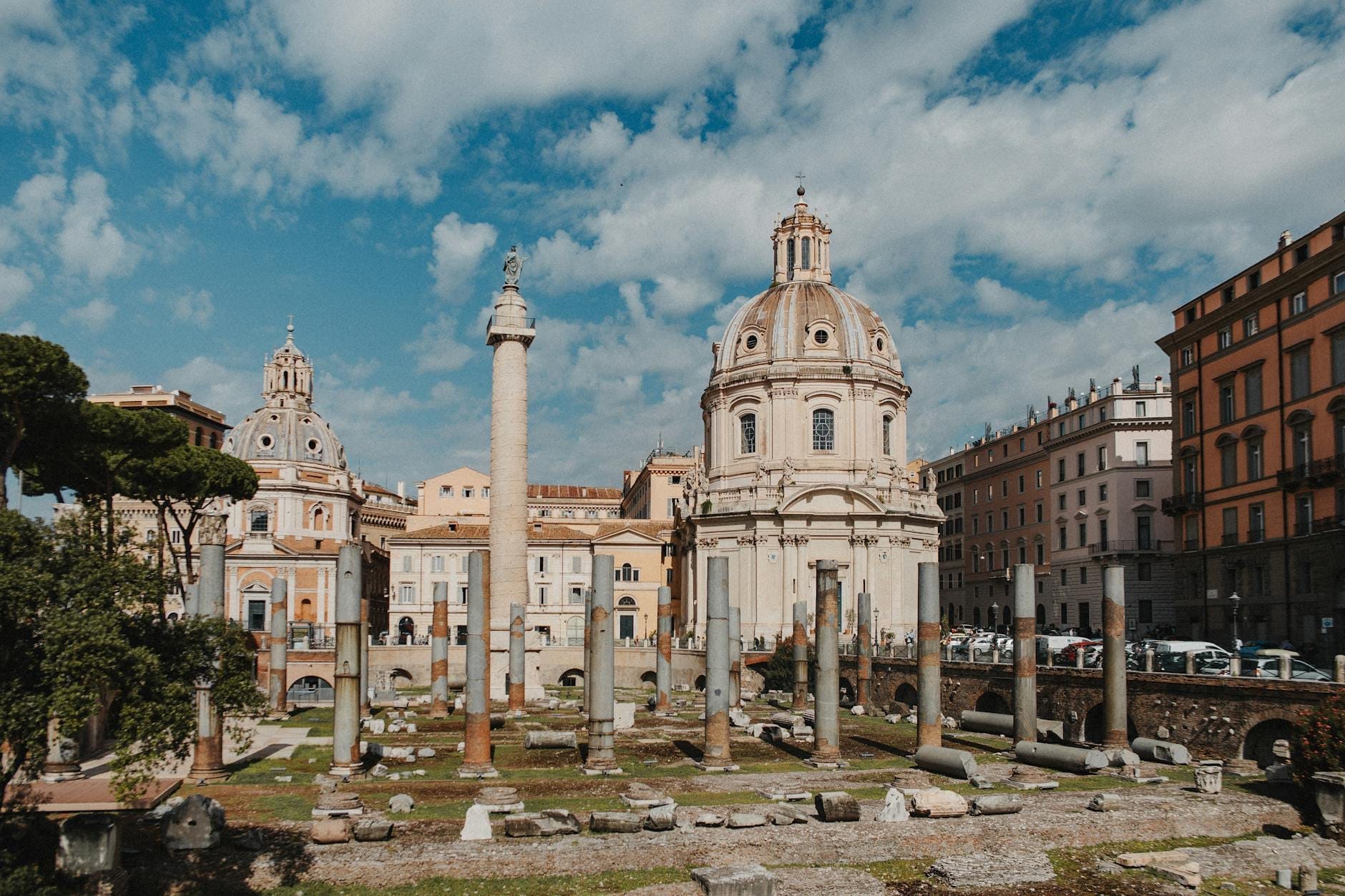
Trajan's Column, known in Italian as Colonna di Traiano, is a Roman triumphal column completed in 113 AD under the reign of Emperor Trajan. Standing 30 metres tall (38 metres including its pedestal), it was erected to commemorate Rome's two military campaigns against the Dacians, a people occupying what is now Romania. The column is carved from a series of Luna marble drums stacked vertically, and its most extraordinary feature is the helical frieze that winds around the shaft in 23 spiralling bands from base to top, depicting roughly 2,500 individual human figures across more than 155 scenes.
This is not decoration. It is the most complete surviving narrative of a Roman military campaign in visual form. Soldiers build camps, cross the Danube on pontoon bridges, negotiate with tribal leaders, and engage in pitched battle. Trajan himself appears over 50 times throughout the sequence. The frieze reads like a continuous scroll, intended to be understood by Romans standing far below, though whether anyone could actually read the upper bands with the naked eye remains a subject of scholarly debate.
ℹ️ Good to know
The column is free to view from the exterior at any hour of the day or night. No ticket, no queue. This makes it one of the few ancient Roman monuments where you can linger as long as you like without time pressure.
The Frieze Up Close: What You're Looking At
From ground level, the lowest three or four bands of the frieze are legible without magnification, and these reward careful attention. You can trace the preparation for war: legionaries are shown constructing fortifications, loading supplies onto boats, and marching in formation. The carving has real depth for stone relief work, with figures layered in registers to suggest distance. Faces carry expression. Officers gesture. The human scale of ancient warfare is more present here than in any museum exhibit.
The upper registers are harder to read without binoculars or a telephoto lens, which is worth knowing before you arrive. Carry binoculars if the detail matters to you. Photography is straightforward from the viewing area, but capturing the upper sections requires a long zoom and patience with the light angle. Early morning in summer, when low sun rakes across the marble from the east, produces the best surface relief contrast for photography.
At the summit stands a bronze statue of St. Peter, placed there in 1587 by Pope Sixtus V. The original gilded bronze statue of Trajan has been lost. The substitution tells its own story about how Rome absorbed and repurposed its ancient past across centuries.
Tickets & tours
Live prices and dates from our booking partner. If you book, we may earn a commission at no extra cost to you.
Entrance tickets to Trajan's Markets and the Fori Imperiali Museum
From 32 €Instant confirmationFree cancellationSt. Peter's Basilica, Vatican Museums, Sistine Chapel reserved entry
From 81 €Instant confirmationFree cancellationGuided tour of Galleria Borghese and of Villa Borghese gardens
From 69 €Instant confirmationFree cancellationVatican: Basilica, Dome and underground early bird tour
From 50 €Instant confirmationFree cancellation
The Setting: Fori Imperiali and the Broader Context
Trajan's Column does not stand alone. It rises from the ruins of Trajan's Forum, the last and largest of Rome's imperial fora, built around the same time as the column. The forum was an enormous complex that included a vast basilica, two libraries (one Latin, one Greek, flanking the column), a Greek and Latin library court, and the adjacent markets. Most of the forum's superstructure is gone, but the column and the remarkably preserved Roman Forum nearby give you a strong sense of how this area once functioned as the civic and ceremonial heart of the ancient city.
The column was also designed as a tomb. Trajan's ashes, along with those of his wife Pompeia Plotina, were reportedly placed in a chamber within the base. This makes it one of the few monuments within the ancient city limits used for burial, which Roman law generally prohibited.
The entire stretch of Via dei Fori Imperiali, the road that Mussolini cut through the ancient forums in 1932, gives you a remarkable open-air survey of imperial Roman architecture. The Capitoline Hill rises to the northwest, and the Colosseum is visible to the southeast. Standing at the column's base, you are at the geographical and historical core of the Roman Empire.
When to Visit and How the Experience Changes
Because the exterior is accessible around the clock, timing your visit makes a significant difference to what you experience. Early morning, before 8am, the area is quiet enough that you will often have the monument nearly to yourself. The light at that hour is soft, the street sweepers are still working the nearby roads, and the marble reads clearly against the pale sky. This is genuinely the best time to come if you want uninterrupted contemplation.
Midday in summer is a different proposition. The sun is directly overhead, which flattens the relief carvings and makes them harder to read visually. The surrounding pedestrian zone fills with tour groups moving between the Colosseum and Piazza Venezia. The column itself is roped off at a distance, so there is no jostling directly at the base, but the ambient noise and crowding reduce the sense of connection with the monument. If you are visiting in July or August, midday is the time to skip.
Evening visits offer a third experience. The column is lit at night, and the carved surface glows against the dark sky in a way that daylight does not replicate. The surrounding area quiets down considerably after 9pm, particularly on weekdays. This is one of the more atmospheric ways to encounter ancient Rome without paying for anything.
💡 Local tip
Visiting in June through August? Come before 8am or after 8pm to avoid the heat and the worst of the tourist foot traffic. The monument is free and open all hours, so there is no reason to suffer the midday crush.
Combining Trajan's Column with Trajan's Market
Directly adjacent to the column, carved into the Quirinal Hill, is Trajan's Market, officially the Mercati di Traiano, now housing the Museo dei Fori Imperiali. This is one of the better-preserved Roman commercial complexes in existence, a multi-storey structure of brick and concrete built in the early 2nd century AD. The museum inside it uses the original spaces to explain the imperial forums through models, friezes, and architectural fragments.
The ticket for Trajan's Market and the Imperial Forums Museum costs €18. Opening hours are daily 9:30am to 7:30pm, with the ticket office closing at 6:30pm. The museum is closed on January 1, May 1, and December 25, and closes at 2pm on December 24 and 31. Children under 6 enter free, as do disabled visitors with one companion, with valid ID. Rome residents get discounted entry.
The market is genuinely worth adding to your visit. The hemicycle of the market's upper levels gives you an elevated view back down toward the column that is not available from street level, and the museum provides the contextual framework that the column's exterior alone cannot supply. Plan roughly 1 to 1.5 hours for the combined site.
⚠️ What to skip
Trajan's Market can be uneven and requires climbing stairs. Wheelchair access is available via specific routes — contact the museum directly or check mercatiditraiano.it for current accessibility details before your visit.
Getting There and What to Bring
Metro Line B stops at Colosseo, from which Trajan's Column is a 10-minute walk northwest along Via dei Fori Imperiali. From Piazza Venezia, the column is a 5-minute walk southeast along the same road. Several bus lines also stop at Piazza Venezia. For broader context on moving around the city, see this guide to getting around Rome.
The immediate area is fully pedestrianized, so there is no parking at the column itself. Taxis and rideshare drop-offs are easiest on Via dei Fori Imperiali or Piazza Venezia. The walk from the Colosseum covers some of the most significant archaeology in the world along a wide, flat pavement, making it a natural connector for anyone doing a loop of the ancient city.
Wear comfortable shoes. The pavement around the ruins is uneven in places, and if you combine this with the Roman Forum or Palatine Hill, you will be on your feet for several hours. Water is essential in summer. There are nasone drinking fountains (Rome's traditional cast-iron spigots) in the area, so you can refill rather than buy plastic bottles. Sun protection matters between May and September: there is almost no shade at the column itself.
Honest Assessment: Is It Worth the Detour?
Trajan's Column is not the kind of monument that produces an immediate emotional impact for every visitor. You cannot go inside. The frieze is easier to understand through high-resolution photographs in a museum than by squinting upward from street level. If you are already planning to visit the Roman Forum and the Palatine Hill, the column is directly on the most logical route and requires no extra time commitment. In that context, it is an essential stop.
If you are coming solely to see the column, the experience is better suited to those who already have some background in Roman history or who plan to pair it with Trajan's Market. The monument rewards preparation. Read something about the Dacian Wars beforehand, or at least look up a high-resolution image of the full frieze. You will look at the stone very differently.
Travelers with very limited time in Rome who are prioritising experiences over context may find the column a relatively passive stop compared to, say, the Capitoline Museums, which house a cast of the entire frieze and original Roman sculpture in a climate-controlled setting. But for those who respond to the scale and permanence of things that have stood in the same spot for nearly 1,900 years, the column has a gravity that no museum reproduction can replicate.
Insider Tips
- Bring binoculars or a long-zoom camera lens. The upper registers of the frieze are invisible to the naked eye from ground level, but with even modest magnification, scenes of battle, diplomacy, and military logistics come into sharp focus.
- The roof terrace of Trajan's Market is one of the better elevated views of the column and the surrounding forums. You get the spatial relationship of the entire complex in one frame, which is impossible from street level.
- The column's shadow moves across the forum area in a way that affects photography significantly. The eastern face is best lit in the morning; the western face in the late afternoon. Plan your circuit accordingly if photography is a priority.
- Phone +39-060608 is Rome's cultural heritage information line, staffed in multiple languages. It can provide current access details, reduced-price schemes, and accessibility information for the adjacent museum.
- If you are visiting multiple imperial-era sites, check whether a combined ticket or cultural pass covers Trajan's Market during your visit period. Pricing and inclusions change, so verify at mercatiditraiano.it before committing.
Who Is Trajan's Column For?
- Roman history enthusiasts who want to trace the story of a specific military campaign in its original monumental form
- Architecture and relief-carving scholars, or anyone interested in how the Romans depicted narrative in stone
- Early-morning walkers combining a quiet circuit of the imperial forums before the crowds arrive
- Photographers working the ancient forum corridor, particularly those interested in dawn and dusk light on marble
- Budget travelers: the exterior is entirely free, making this one of the most significant ancient monuments you can visit without spending anything
Nearby Attractions
Other things to see while in Ancient Rome:
- Appian Way
The Appian Way, or Via Appia Antica, is one of the ancient world's most consequential roads, stretching from Rome's Aurelian Walls into the open Campagna. Built in 312 BCE, it remains walkable today, lined with tombs, pine trees, and broken basalt stones that once carried Roman legions south. Free to enter and car-free on Sundays, it offers a rare escape from the city's tourist core into a landscape that has changed remarkably little in two millennia.
- Baths of Caracalla
The Baths of Caracalla are among the best-preserved and most atmospheric ancient ruins in Rome. Inaugurated in 216 AD, this vast complex once welcomed up to 8,000 visitors a day. Today, the ruins reward anyone willing to look beyond the Colosseum.
- Castel Gandolfo
Perched on a volcanic crater rim 25 km southeast of Rome, the Apostolic Palace of Castel Gandolfo served as the papal summer residence for nearly four centuries. Since Pope Francis opened it to the public in 2016, visitors can tour the baroque interiors, formal gardens, and working farm that once fed the pontiff's household.
- Catacombs of San Callisto
Stretching beneath the Appian Way, the Catacombs of San Callisto served as the official cemetery of Rome's early Christian community from the second century AD. With 10 to 20 kilometers of galleries across four to five levels, the complex holds the Crypt of the Popes, the tomb of Saint Cecilia, and the remains of roughly 500,000 Christians. It is one of the most historically substantial underground sites in the ancient world.
Planning a trip? Discover personalized activities with the Nomado app.