Palazzo Farnese: Inside Rome's Most Powerful Renaissance Palace
Commissioned by a Farnese cardinal who became pope, this 16th-century colossus took three of Rome's greatest architects to complete. Today it serves as the French Embassy, but guided tours open its frescoed halls and newly accessible basements to the public on select days.
Quick Facts
- Location
- Piazza Farnese 67, Centro Storico, Rome
- Getting There
- Walk from Campo de' Fiori (5 min) or Piazza Navona (12 min); buses to Largo Argentina
- Time Needed
- 45–60 minutes (guided tour only)
- Cost
- €15 adults (palace tour); €20 palace + basements; free for children under 6
- Best for
- Renaissance art lovers, architecture enthusiasts, history focused travelers
- Official website
- visite-palazzofarnese.it
What Palazzo Farnese Actually Is
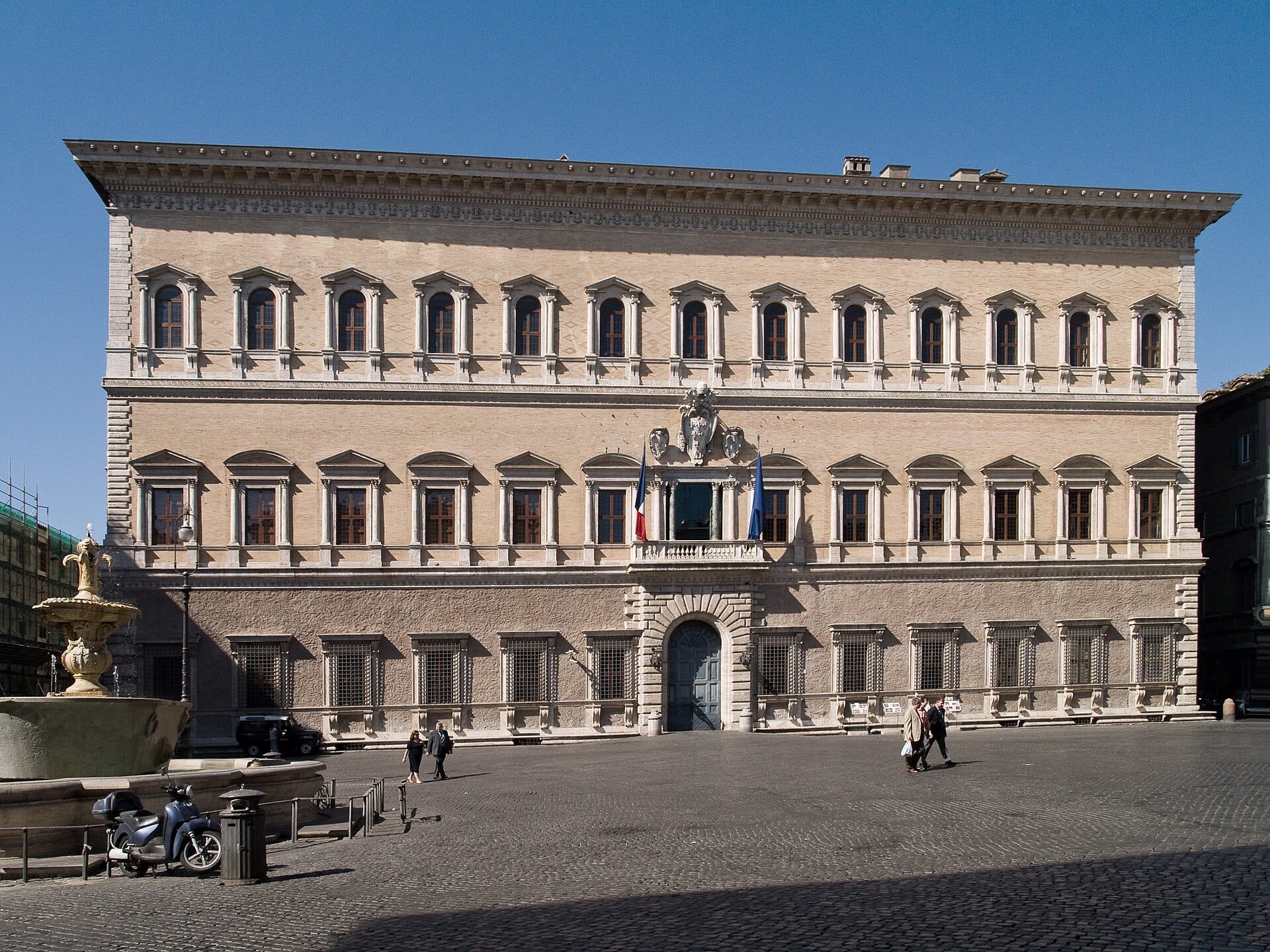
Palazzo Farnese is widely considered the greatest Renaissance palace in Rome, and the competition for that title is fierce. Sitting on Piazza Farnese just a short walk from the market square of Campo de' Fiori, it is an enormous travertine block that dominates the piazza in a way few buildings in the city manage. The scale feels deliberate, almost aggressive: this was not a home, it was a declaration.
Construction began around 1513 to 1517 under Cardinal Alessandro Farnese, who would become Pope Paul III in 1534. The project outlived everyone involved. Antonio da Sangallo the Younger designed the core structure, Michelangelo took over in 1546 and added the famous upper cornice and the central window on the facade, and Giacomo della Porta and Vignola brought it to completion in 1589. The succession of architects is not just trivia: you can read the different design sensibilities in the building itself, if you know where to look.
Since 1874, Palazzo Farnese has served as the French Embassy to Italy and also houses the École française de Rome. The Italian government leases it to France for the symbolic sum of one euro per year, in exchange for France leasing the Villa Medici to Italy on the same terms. This arrangement means the building is not a public museum. Access is strictly by guided tour, booked in advance.
Booking a Tour: What You Need to Know Before You Go
⚠️ What to skip
Tours must be booked up to 5 days in advance through the official booking site at visite-palazzofarnese.it. The palace is not open for walk-in visitors, and no amount of confident knocking will change that. English-language tours run on Wednesdays at 3pm and 5pm.
Tours run on Mondays, Wednesdays, and Fridays, though availability and scheduling can shift. English tours are typically offered on Wednesdays. The standard palace tour runs 45 to 60 minutes and costs €15 for adults. Children six and under enter free. If you want to see the basements, which have been open to visitors since May 2024, that ticket costs €20. A combined tour that includes access to the École française de Rome costs €22. Prices are quoted in euros and were verified from 2026 sources, but confirm on the official site before booking.
Group sizes are small and security is tight. Guards at the entrance conduct thorough checks, and entry can be refused at their discretion. Bring ID and arrive a few minutes early. The atmosphere inside is that of a working diplomatic building, not a tourist attraction, which is exactly what makes it interesting.
Tickets & tours
Live prices and dates from our booking partner. If you book, we may earn a commission at no extra cost to you.
Palazzo Venezia reserved entrance with the Museum of the Risorgimento
From 33 €Instant confirmationFree cancellationReserved Entrance Ticket to Rome's Palazzo Altemps
From 30 €Instant confirmationFree cancellationReserved Entrance Ticket to Rome's Palazzo Braschi
From 32 €Instant confirmationFree cancellationPalazzo Barberini Galleria Nazionale d'Arte Antica Skip-the-Line Entry
From 25 €Instant confirmationFree cancellation
The Architecture: Three Masters, One Building
Standing in Piazza Farnese and looking at the facade, the first thing you notice is the texture. The entire exterior is clad in travertine limestone, and in morning light the stone takes on a warm cream color that shifts to almost orange at dusk. The three-story facade is symmetrical and calm, with evenly spaced windows framed by alternating triangular and curved pediments on the lower floors. Then your eye reaches the top cornice, and the scale shifts. Michelangelo's cornice projects dramatically outward, far beyond what Sangallo had planned, giving the roofline a visual weight that anchors the whole composition.
The central window on the upper floor is also Michelangelo's contribution. It is slightly larger than the others and sits within a more elaborate surround, drawing the eye to the center of the facade in a way that feels inevitable. Michelangelo was reportedly in his seventies when he took over the project, and his interventions are small in number but impossible to ignore.
The courtyard inside is one of the finest in Rome. Sangallo designed the lower two levels as a classical arcade; Michelangelo added the third story with a different rhythm and heavier detailing. The result is a courtyard that feels like it is in quiet argument with itself, which is, arguably, what makes it so compelling. Compare it to the courtyard of Palazzo Doria Pamphilj and you get a sense of how differently Roman noble families expressed their ambitions in stone.
Inside the Palace: Frescoes, Halls, and the Famous Gallery
The interior highlight is the Galleria dei Carracci on the upper floor, decorated between 1597 and 1608 by Annibale Carracci and his brother Agostino, with assistance from their workshop. The ceiling fresco cycle depicts the Loves of the Gods, drawn from Ovid's Metamorphoses, and is considered one of the foundational works of Baroque ceiling painting. Michelangelo's Sistine Chapel ceiling and Raphael's frescoes in the Vatican were the obvious reference points, and Carracci engaged with both directly.
The illusionistic technique Carracci used, playing with painted architectural frames, figures that appear to sit on ledges, and views that seem to open into sky, created a visual grammar that painters across Europe would imitate for over a century. Standing in the gallery, you understand why it had that influence. The ceiling is dense but never chaotic, and the figures have a physical confidence that was genuinely new at the time.
💡 Local tip
Bring a small pair of pocket binoculars if you have them. The ceiling details in the Galleria dei Carracci reward close inspection, and craning your neck for 30 minutes is uncomfortable. A folding neck pillow, the kind sold for air travel, is a surprisingly useful tool in heavily frescoed rooms.
Since May 2024, the basements have been added to the tour options. These lower levels contain archaeological remains from earlier structures on the site, including sections from ancient Roman buildings, and give physical depth to what was already a layered history. The basement tour is an add-on worth taking if you have any interest in how Rome builds on top of itself, layer by layer.
The Piazza Outside: Worth the Visit on Its Own
Even if you do not get inside, Piazza Farnese is one of the better piazzas in the Centro Storico. It is quieter and more residential in feel than the nearby Piazza Navona, and the two granite basins at its center, converted into fountains using bathtubs taken from the Baths of Caracalla, have an unusual solidity that most Roman fountains lack. The scale of the palace facade across the piazza gives the space a grandeur that is rare in Rome, where many famous buildings are hemmed in by narrow streets.
In the evening, when the piazza is mostly clear of tourists and local residents sit at the tables of the bar on the corner, the floodlit facade takes on a theatrical quality. This is one of Rome's more underappreciated evening spots. The surrounding streets, including Via Giulia running parallel to the Tiber, are worth exploring on foot and have their own character: antique shops, small churches, and the occasional glimpse of a courtyard through a half-open gate.
Practical Walkthrough and Getting There
Palazzo Farnese sits at Piazza Farnese 67 in Rome's historic center. The most natural approach on foot is from Campo de' Fiori, which is about a five-minute walk through a narrow connecting street. From Piazza Navona the walk takes around 12 minutes. The nearest bus stops are at Largo Argentina, served by multiple lines, from which you can walk west through the ghetto neighborhood in about ten minutes.
There is no metro stop nearby. This part of Rome is best navigated on foot, which suits the area well: the streets between the palace, Campo de' Fiori, and the river are some of the more pleasant walking in the city. If you are coming from the Vatican or Prati, bus lines crossing the Tiber near Castel Sant'Angelo will get you close.
Dress for a formal environment. Because this is a functioning embassy, casual beachwear or athletic clothes are not appropriate and may result in refused entry. Comfortable shoes are fine; the tour involves stairs and some standing in place while the guide speaks.
ℹ️ Good to know
Photography policies inside the palace may be restricted depending on which areas are open and the specific tour date. Confirm when booking. The exterior and piazza have no restrictions.
Who Should Skip This
If you are traveling with children under ten, the structured guided tour format in a working diplomatic building is genuinely difficult to manage. The tour moves at an adult pace and involves standing in rooms where noise and movement are constrained. Children under six enter free, but that does not mean they will enjoy it.
If you are on a tight schedule and can only book a Wednesday afternoon slot, weigh the time investment carefully. The tour is 45 to 60 minutes, but with travel, security checks, and waiting, you should budget at least two hours for the whole experience. For travelers who are not specifically interested in Renaissance architecture or Baroque painting, the Palazzo is genuinely niche. Rome has many other palaces and museums with easier access and broader appeal.
Visitors focused on ancient Rome rather than Renaissance history will find more to explore at the Roman Forum or the Palatine Hill on the same day, and may want to save Palazzo Farnese for a return trip.
Insider Tips
- Book your tour slot as early as the 5-day window allows. Wednesday English tours fill quickly, especially between April and October.
- The palace and basements combined ticket at €20 is worth the extra €5 if the archaeological layers interest you at all. The basement access is relatively new and adds meaningful depth to the visit.
- After the tour, walk north along Via Giulia toward the river. This street, commissioned by Pope Julius II as Rome's first planned straight road, is one of the most atmospheric in the city and has almost no tourist crowds.
- The two fountains in Piazza Farnese are Roman bathtubs from the Baths of Caracalla. Knowing that makes you look at them differently. They were repurposed from the Baths of Caracalla as fountains in the piazza, commissioned by the Farnese family.
- If you cannot get a tour booking in time, the courtyard arcade is sometimes visible from the entrance gate. Arriving early in the morning when the building opens for official business occasionally allows a glimpse inside, though this is at the discretion of security staff and should not be counted on.
Who Is Palazzo Farnese For?
- Travelers with a specific interest in Renaissance and Baroque architecture
- Art history enthusiasts who want to see the Carracci ceiling fresco cycle in person
- Visitors to Rome on a longer stay who have covered the main ancient sites
- Photographers focused on architectural interiors and classical facades
- Anyone who appreciates the strangeness of a 500-year-old palace that also processes visa applications
Nearby Attractions
Other things to see while in Centro Storico:
- Ara Pacis
Commissioned in 13 BC to celebrate Augustus's campaigns in Gaul and Spain, the Ara Pacis Augustae is one of the best-preserved monuments of ancient Rome. Today it sits inside a striking modern pavilion on the Tiber's east bank, offering an unusually intimate encounter with imperial-era marble carving at near eye level.
- Campo de' Fiori
Campo de' Fiori is one of Rome's most recognizable piazzas, running a daily produce and flower market Monday through Saturday before reinventing itself as a lively social square after dark. Its paving stones have witnessed public executions, papal power, and centuries of commerce.
- Capitoline Hill
Capitoline Hill sits at the symbolic center of Rome, where Michelangelo's perfectly proportioned piazza crowns a site inhabited since the Bronze Age. Today it holds the world's oldest public museums, Rome's city hall, and some of the most striking views over the Roman Forum in the city.
- Capitoline Museums
Perched atop Capitoline Hill overlooking the Roman Forum, the Musei Capitolini hold some of antiquity's greatest sculptures and paintings across three interconnected palaces. Founded in 1471, they predate the Louvre by more than three centuries and reward visitors with both iconic works and panoramic views that few Rome attractions can match.
Planning a trip? Discover personalized activities with the Nomado app.